Compare Ratio Relationships
I can compare ratios by finding unit rates or using equivalent ratios.
How to Use This Deck
Click Present or press F11 for fullscreen. Use arrow keys to advance.
Blue boxes show exactly what to say, ask, and how long to spend.
Text boxes, polls, and drag-sort save automatically in the browser.
Press N or click 📝 in the toolbar for pacing tips and answers.
Launch the full HTML activity for independent practice.
File → Print or the print button for handout copies.
🎯 Content Objective / Objetivo de contenido
I can compare ratios by finding unit rates or using equivalent ratios.
Today's Flow
Total pacing: ~45 min · Progress bar at top tracks your place
LAUNCH
⏱ ~10 min
⏱️ 3 MIN · THINK-PAIR-SHARE
Reginald used 3 red and 3 blue cans; Anwar used 2 red and 3 blue. Why is 'who used more blue cans' a different question from 'whose paint is more blue'?
Check for Understanding #1
Teacher: If >30% thumbs down, re-teach with a fresh example before moving on.
Purple Paint Mixture
Two friends used the paint shown to create shades of purple paint. Whose mixture contains the most blue paint?
Concept Launch
💡 How do we compare two ratios?
To compare ratios fairly, make one amount the same in both, or find the unit rate (the amount for just 1). Then you can see which ratio is bigger.
Comparing Ratio Relationships. 1. Convert each ratio to a unit rate (e.g. price per item or miles per gallon). 2. Alternatively, scale both ratios to a common term (like a common denominator). 3. Compare the resulting unit rates to identify the better buy or faster rate
Check for Understanding #2
Teacher: If >30% thumbs down, re-teach with a fresh example before moving on.
Now it's your turn
VOCABULARY
⏱ ~8 min
| Term / Término | Meaning / Significado | Example / Ejemplo | Visual |
|---|---|---|---|
| Compare Ratios Comparar razones |
Decide which ratio is greater, less, or equal by using equivalent ratios or unit rates. Decidir cuál razón es mayor, menor o igual usando razones equivalentes o tasas unitarias. |
Compare 6:2 and 8:4 using unit rates: 3 > 2. | |
| Unit rate Tasa unitaria |
A rate for just 1 of something, like cost for 1 item. Una tasa para solo 1 de algo, como el precio de 1 artículo. |
$3 per 1 pound → unit rate is $3/lb | |
| Equivalent ratio Razón equivalente |
Two ratios that mean the same thing. Dos razones que significan lo mismo. |
4:6 and 2:3 are equivalent (both simplify to 2:3) | |
| Compare Comparar |
To look at ratios and see which is bigger, smaller, or equal. Mirar razones para ver cuál es mayor, menor o igual. |
3:4 vs. 2:5 — which has more of the first ingredient per unit? | |
| Simplify Simplificar |
To write a ratio with smaller numbers that still compares the same way. 6:8 and 3:4 are the same ratio. Escribir una razón con números más pequeños que compara igual. 6:8 y 3:4 son la misma razón. |
8:12 → divide both by 4 → 2:3 | |
| Common denominator Denominador común |
A bottom number that two fractions can share so you can compare them. Un número de abajo que dos fracciones pueden compartir para compararlas. |
To compare 3/5 and 4/7, use LCD 35: 21/35 vs 20/35 |
Vocabulary — True or False?
Which statements correctly use Equivalent ratio?
Fix the False One
Which Word Fits?
Make the ___ match, or find each ___ ___, before deciding which ratio is greater.
Use It In a Sentence
Check for Understanding #3
Teacher: If >30% thumbs down, re-teach with a fresh example before moving on.
Turn & Talk — Launch
Reginald used 3 red and 3 blue cans; Anwar used 2 red and 3 blue. Why is 'who used more blue cans' a different question from 'whose paint is more blue'?
👂 Listen For
Students recognize that both friends used the same number of blue cans (3), so counting blue cans cannot settle it: how blue the paint is depends on blue compared with red — Reginald's 3 blue : 3 red versus Anwar's 3 blue : 2 red (3 of 6 cans versus 3 of 5) — so Anwar's purple is bluer.
Extend: Some students say both purples are equally blue because both friends used 3 blue cans. Why is that reasoning not enough? Justify using the red cans.
EXPLORE & PRACTICE
⏱ ~18 min
Visual Modeling Workspace
Use the drawing tray below to annotate the visual model. Teacher: say "Click to reveal" on key steps.
Explore Activity
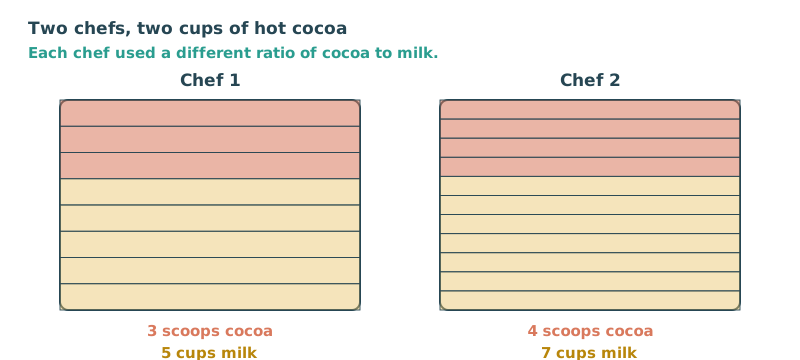
Build equivalent ratios for each chef's recipe so you can compare them fairly. Chef Reyes: 3 tbsp cocoa per 5 oz milk. Chef Tran: 4 tbsp cocoa per 7 oz milk.
✍️ Explore Discourse
The two recipes use different amounts, so you cannot compare them directly. How did building equivalent ratios let you compare them fairly?
Whiteboard Moment
Show your work clearly. Be ready to explain your thinking to a partner.
Turn & Talk — Explore
You scaled both recipes to 35 oz of milk: Chef Reyes became 21:35 and Chef Tran became 20:35. How does scaling to a common denominator let you compare the recipes fairly?
👂 Listen For
Students explain that equal milk (35 oz) makes the comparison fair, so 21 tbsp > 20 tbsp means Chef Reyes is more chocolatey.
Extend: Find the unit rate (cocoa per 1 oz) for each chef and show it gives the same winner as the 35 oz scaling. Why must both methods agree?
Practice Check A
Store A sells 3 mangoes for $6. Store B sells 5 mangoes for $9. Which store offers a better price per mango?
✍️ Show Your Work
Explain why your answer is correct using today's vocabulary.
Practice Check B
Chef A uses 2 cups of cheese for every 8 crackers. Chef B uses 3 cups of cheese for every 9 crackers. Who uses more cheese per cracker?
✍️ Show Your Work
Explain why your answer is correct using today's vocabulary.
Equivalent Ratio Sort
Complete the interactive activity using today's strategy.
✍️ Justify Your Thinking
Match each scenario to the correct answer: Which ratio is greater?
A classmate turned in the work below. One step has a mistake. Read every step, find it, name it, and fix it.
Choose ONE option to show what you know — then do it in the workspace below.
Use evidence from today's lesson to complete each frame.
Today's key idea is: "Comparing Ratio Relationships. 1. Convert each ratio to a unit rate (e.g. price per item or miles per gallon). 2. Alternatively, scale both ratios to a common term (like a common denominator). 3. Compare the resulting unit rates to identify the better buy or faster rate" — and it works because ___.
Because Compare Ratios means ___, but a tricky part is ___, so I have to ___.
A common mistake with Compare Ratios is ___. It happens because ___, and the fix is ___.
I can prove my answer is correct by ___, using Unit rate to check my work.
✍️ TWR · WRITE 3 SENTENCES · 7 MIN
Comparing Ratio Relationships. 1. Convert each ratio to a unit rate (e.g. price per item or miles per gallon). 2. Alternatively, scale both ratios to a common term (like a common denominator). 3. Compare the resulting unit rates to identify the better buy or faster rate because ___
Comparing Ratio Relationships. 1. Convert each ratio to a unit rate (e.g. price per item or miles per gallon). 2. Alternatively, scale both ratios to a common term (like a common denominator). 3. Compare the resulting unit rates to identify the better buy or faster rate but ___
Comparing Ratio Relationships. 1. Convert each ratio to a unit rate (e.g. price per item or miles per gallon). 2. Alternatively, scale both ratios to a common term (like a common denominator). 3. Compare the resulting unit rates to identify the better buy or faster rate so ___
🌱 TWR · GROW THE KERNEL · 6 MIN
Answer these to add detail
Sentence starters (tap to use)
Student Workspace
Build equivalent ratios for each chef's recipe so you can compare them fairly. Chef Reyes: 3 tbsp cocoa per 5 oz milk. Chef Tran: 4 tbsp cocoa per 7 oz milk.
| Ounces of Milk | Chef Reyes — Cocoa (tbsp) | Chef Tran — Cocoa (tbsp) |
|---|---|---|
| 5 | 3 | — |
| 7 | — | 4 |
| 35 | ||
| Per 1 oz |
✏️ Sketch Your Strategy
Differentiation Paths
Step-by-step with a worked model and sentence frames.
Chef A uses 2 cups of cheese for every 8 crackers. Chef B uses 3 cups of cheese for every 9 crackers. Who uses more cheese per cracker?
Core practice aligned to the standard.
Extension with error analysis or multi-step reasoning.
Partner Activity
Work with your partner on the practice problems at your differentiation path level. Explain each step using math vocabulary.
Check for Understanding #4
Teacher: If >30% thumbs down, re-teach with a fresh example before moving on.
Real-World Connection
🌍 Math in the Wild
Two pizza shops are running deals. Mario's Pizza sells 2 large pizzas for $18. Sal's Pizza sells 3 large pizzas for $25. A school needs to buy pizza for a class party and wants to get the best deal per pizza.
✍️ Connection Reasoning
Mario's costs ___ per pizza and Sal's costs about ___ per pizza, so the better deal is ___.
Mario's costs ___ per pizza and Sal's costs about ___ per pizza, so the better deal is ___.
Turn & Talk — Connect
Two pizza shops have deals: Mario's sells 2 large pizzas for $18, and Sal's sells 3 for $25. How would you compare these to find the best price per pizza?
👂 Listen For
Students compute $9.00/pizza for Mario's and about $8.33/pizza for Sal's, then choose Sal's because the lower unit rate is the better deal.
Extend: If you only need 2 pizzas, does the better unit rate always mean the better total price? Explain when buying the deal with the lower unit rate might not save money.
Summarize: Compare Ratio Relationships
Comparing Ratio Relationships. 1. Convert each ratio to a unit rate (e.g. price per item or miles per gallon). 2. Alternatively, scale both ratios to a common term (like a common denominator). 3. Compare the resulting unit rates to identify the better buy or faster rate
In your own words:
CLOSURE & REFLECT
⏱ ~8 min
Today I learned that ___ because ___.
One thing I am still not sure about is ___.
A bakery sells 4 muffins for $10 and another bakery sells 6 muffins for $14. Which bakery has the lower price per muffin?
Bonus Exit Check
Which ratio is greater: 3:4 or 5:8?
✍️ Show Your Work
Explain why your answer is correct using today's vocabulary.
Reflection & Self-Assessment
Continue Learning
Launch the Full Interactive Activity
Students continue practice in the HTML lesson engine with auto-check, hints, and differentiation.
Family Connection
Share tonight's family homework and discuss one vocabulary word at home.
Open Family Homework ↗Teacher Notes
⏱️ Pacing Guide
- Launch & vocab: 12 min
- I Do / We Do / You Do: 15 min
- Explore & practice: 15 min
- Connect & closure: 8 min
Total: ~45 min
🎯 Listen For · Common Errors
• Students recognize that both friends used the same number of blue cans (3), so counting blue cans cannot settle it: how blue the paint is depends on blue compared with red — Reginald's 3 blue : 3 red versus Anwar's 3 blue : 2 red (3 of 6 cans versus 3 of 5) — so Anwar's purple is bluer.
• Students explain that equal milk (35 oz) makes the comparison fair, so 21 tbsp > 20 tbsp means Chef Reyes is more chocolatey.
• Students compute $9.00/pizza for Mario's and about $8.33/pizza for Sal's, then choose Sal's because the lower unit rate is the better deal.
• Listen for students naming a specific strategy tied to 6.AT.3 — not just "I multiplied." They should connect steps to the key idea.
Common mistake: A common mistake in Compare Ratios is thinking the ratio with the bigger raw number automatically wins — like assuming Chef Tran's 8 tablespoons of cocoa must be more chocolatey than Chef Reyes's 6 tablespoons, without checking that the milk amounts (14 oz vs. 10 oz) are different. Never compare the raw numbers alone — always scale both ratios to the same amount or find each unit rate first.
Answer Key (Teacher Appendix)
Hide this slide during presentation or move to the end of your copy.
✓ Practice 1: Store B — Store A: $6÷3 = $2.00 per mango. Store B: $9÷5 = $1.80 per mango. Store B has the better (lower) price per mango.
✓ Practice 2: Chef B — Chef A: 2÷8 = 0.25 cups per cracker. Chef B: 3÷9 ≈ 0.33 cups per cracker. Chef B uses more cheese per cracker.
✓ Practice 3: 3:4 — Convert to the same denominator: 3:4 = 6:8. Since 6:8 > 5:8, the ratio 3:4 is greater.
✓ Practice 4: Recipe B — Recipe A: 2÷6 ≈ 0.33 lemons per cup. Recipe B: 3÷7 ≈ 0.43 lemons per cup. Since 0.43 > 0.33, Recipe B is more lemony.
✓ Exit ticket: The second bakery — First bakery: $10÷4 = $2.50 per muffin. Second bakery: $14÷6 ≈ $2.33 per muffin. The second bakery has the lower price.