Touch and changeToca y cambia
Move, type, tap, or drag in the model. Watch what changes.Mueve, escribe, toca o arrastra en el modelo. Observa qué cambia.
Unit 3 · Ratios and Rates Unidad 3 · Razones y tasas
Solve Problems with Unit RatesResolver problemas con tasas unitarias
6.AT.2 ▾This lesson builds proficiency in Grade 6 mathematical standard 6.AT.2.Esta lección desarrolla destrezas en el estándar matemático de 6.º grado 6.AT.2.
Optional, ungraded practice. Choose ONE plan below. Work with someone or on your own; no adult signature is needed. Práctica opcional, sin calificación. Elige UN plan abajo. Trabaja con alguien o a solas; no necesitas la firma de un adulto.
Choose one plan, not all three. Each plan tells you what to do and when to stop. Switching keeps your answers.Elige un plan, no los tres. Cada plan indica qué hacer y cuándo terminar. Al cambiar, conservas tus respuestas.
Learn & practice selected: 4 focused stops and all 6 core problems, about 20 minutes. Ruta de aprendizaje: 4 paradas y los 6 problemas, unos 20 minutos.
The Photobooth is a camera you can open any time — photograph the notebook page, the scratchpad or the whiteboard, add a frame and stickers, then download or print it. It is optional, and the photo stays on this device. La cabina de fotos es una cámara que pueden abrir cuando quieran: fotografíen la página del cuaderno, el borrador o la pizarra, agreguen un marco y calcomanías, y descárguenla o imprímanla. Es opcional, y la foto se queda en este dispositivo.
💡 Draw fraction bars, tape diagrams, equations, or line up decimals together!💡 ¡Dibujen barras de fracciones, modelos o alineen decimales juntos!
Tonight we solve real-world rate problems by finding the unit rate — the cost or amount for just 1 — and then using it.
Esta noche resolvemos problemas reales de tasas encontrando la tasa unitaria — el costo o la cantidad para solo 1 — y luego usándola.
For the grown-up helping tonightPara el adulto que ayuda hoy
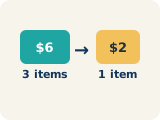
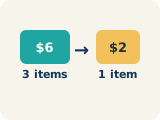
$6 ÷ 3 = $2 per snack / por merienda
Real example: Team 1 knows that 3 pounds of chicken cost $18.
Ejemplo real: el equipo 1 sabe que 3 libras de pollo cuestan $18.
A rate compares two amounts with different units, like dollars and pounds.
Una tasa compara dos cantidades con unidades diferentes, como dólares y libras.
Step 1 (Make it a Fraction): Write rate as a fraction with Cost on TOP ($18) and Pounds on BOTTOM (3): $18 / 3 pounds.
Paso 1 (Escribir como Fracción): Escribe la tasa como fracción con Costo ARRIBA ($18) y Libras ABAJO (3): $18 / 3 libras.
Step 2 (Divide Both by Bottom): Divide both parts by the bottom number: (18 ÷ 3) / (3 ÷ 3) = $6 / 1 pound.
Paso 2 (Dividir Ambos entre el de Abajo): Divide ambas partes entre el número de abajo: (18 ÷ 3) / (3 ÷ 3) = $6 / 1 libra.
The unit rate is in fraction form over 1 ($6/1 pound = $6 per pound).
La tasa unitaria está en forma de fracción sobre 1 ($6/1 libra = $6 por libra).
Step 3 (Use the Rate): Now multiply the unit rate ($6) by any amount.
Paso 3 (Usar la Tasa): Ahora multiplica la tasa unitaria ($6) por cualquier cantidad.
For 5 pounds: 6 × 5 = $30. For 8 pounds: 6 × 8 = $48.
Para 5 libras: 6 × 5 = $30. Para 8 libras: 6 × 8 = $48.
Listen for "tasa unitaria" (unit rate) — the rate written as a fraction over 1.
Escucha "tasa unitaria" — la tasa escrita como fracción sobre 1.
Top on top, bottom on bottom: Put Cost/Total on TOP and Units on BOTTOM. Divide both parts by the bottom number.
Arriba va arriba, abajo va abajo: Pon Costo/Total ARRIBA y Unidades ABAJO. Divide ambas partes entre el número de abajo.
Fraction over 1: The unit rate is in fraction form over 1 ($6/1 pound = $6 per pound). Then multiply to find the new total.
Fracción sobre 1: La tasa unitaria está en forma de fracción sobre 1 ($6/1 libra = $6 por libra). Luego multiplica para hallar el nuevo total.
Change the two amounts. Divide to find the amount for one item.Cambia las dos cantidades. Divide para hallar la cantidad por un objeto.
🌐 Esta herramienta interactiva por ahora solo está en inglés. Para qué sirve: Divide un par de cantidades para obtener la tasa 'por 1' y ver por qué la tasa unitaria permite comparar dos ofertas. Usen los pasos en español de esta tarjeta para guiarse.
Move, type, tap, or drag in the model. Watch what changes.Mueve, escribe, toca o arrastra en el modelo. Observa qué cambia.
Record one equation, value, or relationship you can see.Escribe una ecuación, un valor o una relación que puedas ver.
I notice ___ changes when ___ changes. This shows ___.Noto que ___ cambia cuando ___ cambia. Esto muestra ___.
Ask: "Where do you see the numbers from tonight's math in this model?"Pregunta: "¿Dónde ves los números de la tarea de hoy en este modelo?"
Choose a snack or imagine 3 identical snacks for $6. Elige una merienda o imagina 3 meriendas iguales por $6.
Using a familiar rule before identifying what this question asks. Usar una regla conocida sin identificar qué pide esta pregunta.
Tap a word on the left, then tap its matching definition on the right! ¡Toca una palabra a la izquierda y su significado a la derecha!
Tap any card to flip and explore its definition and example. Toca cualquier tarjeta para voltearla y explorar su definición y ejemplo.
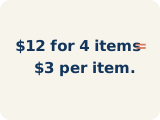
Resolución de problemas con tasas unitarias
Resolución de problemas con tasas unitarias
Find an amount per 1 unit and use it to compare choices or solve a problem.
ES Hallar una cantidad por 1 unidad y usarla para comparar opciones o resolver un problema.
Tasa unitaria
Tasa unitaria
A rate for just 1 of something, like cost for 1 item.
ES Una tasa para solo 1 de algo, como el precio de 1 artículo.
Mejor compra
Mejor compra
The choice that costs less for each item.
ES La opción que cuesta menos por cada artículo.
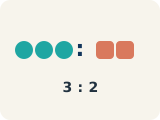
Comparación
Comparación
Looking at two or more amounts to see how they are related.
ES Mirar dos o más cantidades para ver cómo se relacionan.
Por unidad
Por unidad
For each single item.
ES Por cada artículo.
Tasa
Tasa
A ratio comparing two amounts with different units, like miles per hour.
ES Una razón que compara dos cantidades con unidades distintas, como millas por hora.
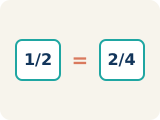
Proporción
Proporción
A math sentence saying two ratios are equal. It helps find a missing number.
ES Una oración matemática que dice que dos razones son iguales. Ayuda a hallar un número que falta.
Student: explain. Partner: ask “How do you know?” Then switch. Working solo? Say or write your explanation; bring a question to a trusted adult at school.Estudiante: explica. Acompañante: pregunta «¿Cómo lo sabes?» Luego cambien. ¿Trabajas a solas? Di o escribe tu explicación; lleva una pregunta a un adulto de confianza en la escuela.
A car drives 100 miles in 2 hours. Find the unit rate, then find how far it goes in 4 hours.
Un carro recorre 100 millas en 2 horas. Encuentren la tasa unitaria, luego cuánto recorre en 4 horas.
Work side by side. You ask questions; your student does the thinking. Trabajen juntos. Tú haces preguntas; tu estudiante piensa.
Find the miles for 1 hour by dividing.
Encuentren las millas para 1 hora dividiendo.
Now find how far in 4 hours by multiplying.
Ahora encuentren cuánto en 4 horas multiplicando.
Check together: does the answer make sense for 4 hours?
Revisen juntos: ¿la respuesta tiene sentido para 4 horas?
Do these together. Start at ★ and climb to ★★★ when ready. Háganlos juntos. Empiecen en ★ y suban a ★★★ cuando estén listos.
A pump fills 20 liters in 4 minutes. At the same rate, how many liters does it fill in 7 minutes?Una bomba llena 20 litros en 4 minutos. A la misma tasa, ¿cuántos litros llena en 7 minutos?
C. 35 LC. 35 L
A printer prints 42 pages in 6 minutes. How many pages does it print in 15 minutes at the same rate?Una impresora imprime 42 páginas en 6 minutos. ¿Cuántas páginas imprime en 15 minutos al mismo ritmo?
C. 105 pages
A machine dispenses 24 tokens in 3 minutes. At this rate, how many tokens does it dispense in 10 minutes?Una máquina despacha 24 fichas en 3 minutos. A ese ritmo, ¿cuántas fichas despacha en 10 minutos?
C. 80 tokens
What is Printer A's unit rate?¿Cuál es la tasa unitaria de la impresora A?
C. 30 tickets per minuteC. 30 boletos por minuto
Shop A sells 6 bags of chips for $9.00. Shop B sells 10 bags for $14.00. You need 30 bags. Which shop is the better buy, and what will 30 bags cost there?La Tienda A vende 6 bolsas de papitas por $9.00. La Tienda B vende 10 bolsas por $14.00. Necesitas 30 bolsas. ¿Qué tienda es la mejor compra y cuánto costarán 30 bolsas allí?
B. Shop B, $42.00B. Tienda B, $42.00
Point and name → finish the sentence → explain in your own words.Señala y nombra → completa la oración → explica con tus propias palabras.
For every ___, there are ___. The units tell me ___.Por cada ___, hay ___. Las unidades me indican ___.
Check: I answered the question, showed my thinking, labeled units, and explained why.Reviso: respondí la pregunta, mostré mi razonamiento, indiqué las unidades y expliqué por qué.
"Can you show me how you see that in your work or a quick sketch?" "¿Puedes mostrarme cómo ves eso en tu trabajo o en un dibujo rápido?"
Follow-up: Point to where each number from the problem shows up. Seguimiento: Señala dónde aparece cada número del problema.
Try the recommended mission. Student: explain; partner: ask one question, then switch. Paper drawings work for every object. Prueba la misión recomendada. Estudiante: explica; acompañante: haz una pregunta, luego cambien. Puedes dibujar los objetos en papel.
One mission is enough. You can also work solo and explain in writing.Una misión es suficiente. También puedes trabajar a solas y explicar por escrito.
Draw a recipe using 2 cups of juice and 3 cups of water. Make a table for one, two, and three batches. Explain why the taste stays the same.
Dibuja una receta con 2 tazas de jugo y 3 de agua. Haz una tabla para una, dos y tres tandas. Explica por qué el sabor se mantiene.
Show a labeled drawing, table, or equation. Your partner asks one question; working alone, write your explanation.
Muestra un dibujo con etiquetas, una tabla o una ecuación. Tu acompañante hace una pregunta; a solas, escribe tu explicación.
⏱️ About 8 minutes for the 6 problems below. The extra practice at the bottom is optional. ⏱️ Unos 8 minutos para los 6 problemas de abajo. La práctica extra al final es opcional.
A few problems to practice together. Each one has a step-by-step guide, a picture to draw on, and a space to show your work. Use Check This Problem for instant feedback — no need to finish everything at once. Unos problemas para practicar juntos. Cada uno tiene una guía paso a paso, un dibujo para trabajar y un espacio para mostrar el trabajo. Usen Revisar esta pregunta para retroalimentación al instante — no tienen que terminar todo de una vez.
Easier problems to practice the idea. Do these first together. Problemas más fáciles para practicar la idea. Hagan estos primero juntos.
Say the question in your own words. Circle what you know and underline what you need to find.
Explica la pregunta con tus propias palabras. Encierra lo que sabes y subraya lo que debes hallar.
Divide each deal's price by its number of ounces to get a cost per ounce.
Divide el precio de cada oferta entre su número de onzas para obtener el costo por onza.
Start here: Different package sizes can only be compared once both are priced per ounce.
Empieza aquí: Los envases de distinto tamaño solo se pueden comparar cuando ambos tienen precio por onza.
The snack bar compares two popcorn deals: 12 oz for $3.00 or 20 oz for $4.00. Which is the better buy?El puesto de bocadillos compara dos ofertas de palomitas: 12 oz por $3.00 o 20 oz por $4.00. ¿Cuál es la mejor compra?
👪 Read the question together, then let your student pick an answer before you discuss why.👪 Lean la pregunta juntos; dejen que su estudiante elija antes de hablar del porqué.
Answer key for families — compare, then talk about why.Clave de respuestas para la familia — comparen y hablen del porqué.
Not tried yet? Close this and give it one try first. A wrong first try still helps.¿Todavía no lo intentaron? Ciérrenla y hagan un intento primero. Un primer intento equivocado también ayuda.
Why:Por qué: 12 oz: $3.00 ÷ 12 = $0.25 per oz. 20 oz: $4.00 ÷ 20 = $0.20 per oz. $0.20 < $0.25, so 20 oz for $4.00 is the better buy.12 oz: $3.00 ÷ 12 = $0.25 por oz. 20 oz: $4.00 ÷ 20 = $0.20 por oz. $0.20 < $0.25, así que 20 oz por $4.00 es la mejor compra.
Say the question in your own words. Circle what you know and underline what you need to find.
Explica la pregunta con tus propias palabras. Encierra lo que sabes y subraya lo que debes hallar.
Divide each deal's total cost by its number of tickets.
Divide el costo total de cada oferta entre su número de boletos.
Start here: The cheaper deal is the one with the lower price for a single ticket.
Empieza aquí: La oferta más barata es la que tiene el precio más bajo por un solo boleto.
The ticket counter sells redemption tickets two ways: 8 tickets for $2.00 or 15 tickets for $3.00. Which costs less per ticket?El mostrador de boletos vende boletos de premio de dos maneras: 8 boletos por $2.00 o 15 boletos por $3.00. ¿Cuál cuesta menos por boleto?
Answer key for families — compare, then talk about why.Clave de respuestas para la familia — comparen y hablen del porqué.
Not tried yet? Close this and give it one try first. A wrong first try still helps.¿Todavía no lo intentaron? Ciérrenla y hagan un intento primero. Un primer intento equivocado también ayuda.
Why:Por qué: 8 for $2.00: $2.00 ÷ 8 = $0.25 each. 15 for $3.00: $3.00 ÷ 15 = $0.20 each. $0.20 < $0.25, so 15 for $3.00 is cheaper per ticket.8 por $2.00: $2.00 ÷ 8 = $0.25 cada uno. 15 por $3.00: $3.00 ÷ 15 = $0.20 cada uno. $0.20 < $0.25, así que 15 por $3.00 es más barato por boleto.
Say the question in your own words. Circle what you know and underline what you need to find.
Explica la pregunta con tus propias palabras. Encierra lo que sabes y subraya lo que debes hallar.
Compare only the two cards for the same prize, and send the one with the smaller price per item to Better Buy.
Compara solo las dos tarjetas del mismo premio y manda a Mejor compra la que tenga el menor precio por artículo.
Start here: Each card shows a total price for a bundle, but a better buy is decided by what a single item costs.
Empieza aquí: Cada tarjeta muestra un precio total por un paquete, pero la mejor compra se decide por lo que cuesta un solo artículo.
For each prize item, find the unit rate of both deals and sort each card into Better Buy or Worse Buy.Para cada premio, encuentra la tasa unitaria de las dos ofertas y clasifica cada tarjeta en Mejor compra o Peor compra.
👪 On a phone, use Move to. On a computer, drag cards or tap a card then tap a column.👪 En el teléfono usen Mover a. En la computadora arrastren o toquen tarjeta y columna.
💡 Each card shows a total price for a bundle, but a better buy is decided by what a single item costs.Cada tarjeta muestra un precio total por un paquete, pero la mejor compra se decide por lo que cuesta un solo artículo.
💡 Compare only the two cards for the same prize, and send the one with the smaller price per item to Better Buy.Compara solo las dos tarjetas del mismo premio y manda a Mejor compra la que tenga el menor precio por artículo.
💡 Start with the snack packs: $5.00 ÷ 4 = $1.25 each, so work out $9.00 ÷ 6 before you place either card.Empieza con los paquetes de botanas: $5.00 ÷ 4 = $1.25 cada uno, así que calcula $9.00 ÷ 6 antes de colocar cualquiera de las dos tarjetas.
Answer key for families — compare, then talk about why.Clave de respuestas para la familia — comparen y hablen del porqué.
Not tried yet? Close this and give it one try first. A wrong first try still helps.¿Todavía no lo intentaron? Ciérrenla y hagan un intento primero. Un primer intento equivocado también ayuda.
Why:Por qué: Within each prize, the better buy is the deal with the lower cost per item: $1.25 beats $1.50 for snack packs, $0.35 beats $0.40 for stickers, and $0.08 beats $0.09 for tokens. The winning deal is not always the bigger bundle — the 4-pack of snacks beats the 6-pack.Dentro de cada premio, la mejor compra es la oferta con el menor costo por artículo: $1.25 gana sobre $1.50 en los paquetes de botanas, $0.35 gana sobre $0.40 en las calcomanías y $0.08 gana sobre $0.09 en las fichas. La oferta ganadora no siempre es el paquete más grande: el paquete de 4 botanas le gana al de 6.
Try these once the warm-up feels easy. It's okay to use the steps and pictures. Intenten estos cuando el calentamiento sea fácil. Está bien usar los pasos y los dibujos.
Say the question in your own words. Circle what you know and underline what you need to find.
Explica la pregunta con tus propias palabras. Encierra lo que sabes y subraya lo que debes hallar.
Cost per token = dollars ÷ tokens for each company. Then multiply the cheaper rate by 1,000.
Costo por ficha = dólares ÷ fichas en cada compañía. Luego multiplica la tasa más barata por 1,000.
Start here: Three jobs here: find each company's cost per token, pick the cheaper one, then price out 1,000 tokens.
Empieza aquí: Aquí hay tres tareas: hallar el costo por ficha de cada compañía, elegir la más barata y calcular el precio de 1,000 fichas.
Two arcade supply companies offer token deals. Company X: 300 tokens for $36. Company Y: 500 tokens for $55. The arcade needs 1,000 tokens. Find the unit rate for each company, determine which is cheaper per token, and calculate the total cost of buying 1,000 tokens from the better deal.Dos compañías de suministros para arcades ofrecen paquetes de fichas. Compañía X: 300 fichas por $36. Compañía Y: 500 fichas por $55. El arcade necesita 1,000 fichas. Encuentra la tasa unitaria de cada compañía, determina cuál es más barata por ficha y calcula el costo total de comprar 1,000 fichas en la mejor oferta.
👪 A complete sentence with math vocabulary is the goal — not a perfect paragraph.👪 Una oración completa con vocabulario matemático es la meta — no un párrafo perfecto.
Answer key for families — compare, then talk about why.Clave de respuestas para la familia — comparen y hablen del porqué.
Not tried yet? Close this and give it one try first. A wrong first try still helps.¿Todavía no lo intentaron? Ciérrenla y hagan un intento primero. Un primer intento equivocado también ayuda.
Why:Por qué: Company X charges $36 ÷ 300 = $0.12 per token and Company Y charges $55 ÷ 500 = $0.11 per token, so Y is cheaper for each token even though its package costs more. At $0.11 per token, 1,000 tokens cost 1,000 × $0.11 = $110.La Compañía X cobra $36 ÷ 300 = $0.12 por ficha y la Compañía Y cobra $55 ÷ 500 = $0.11 por ficha, así que Y es más barata por cada ficha aunque su paquete cueste más. A $0.11 por ficha, 1,000 fichas cuestan 1,000 × $0.11 = $110.
Say the question in your own words. Circle what you know and underline what you need to find.
Explica la pregunta con tus propias palabras. Encierra lo que sabes y subraya lo que debes hallar.
Turn each drone into a decimal rate (miles ÷ minutes), then the bigger decimal is the faster drone.
Convierte cada dron en una tasa decimal (millas ÷ minutos) y luego el decimal mayor es el dron más rápido.
Start here: The table wants miles per MINUTE, so miles get divided by minutes for each drone.
Empieza aquí: La tabla quiere millas por MINUTO, así que las millas se dividen entre los minutos en cada dron.
Two delivery drones fly at different rates. Drone A travels 9 miles in 12 minutes. Drone B travels 7 miles in 10 minutes. Complete the table and determine which drone delivers faster.Dos drones de entrega vuelan a tasas diferentes. El dron A recorre 9 millas en 12 minutos. El dron B recorre 7 millas en 10 minutos. Completa la tabla y determina cuál dron entrega más rápido.
👪 Encourage your student to show work on paper if a box feels tricky.👪 Animen a mostrar el trabajo en papel si una casilla se siente difícil.
| DroneDron | DistanceDistancia | TimeTiempo | Miles per MinuteMillas por minuto | Faster?¿Más rápida? |
|---|---|---|---|---|
| Drone ADron A | 9 miles9 millas | 12 min |
|
|
| Drone BDron B | 7 miles7 millas | 10 min |
|
|
Answer key for families — compare, then talk about why.Clave de respuestas para la familia — comparen y hablen del porqué.
Not tried yet? Close this and give it one try first. A wrong first try still helps.¿Todavía no lo intentaron? Ciérrenla y hagan un intento primero. Un primer intento equivocado también ayuda.
Why:Por qué: Miles per minute comes from dividing distance by time: 9 ÷ 12 = 0.75 for Drone A and 7 ÷ 10 = 0.70 for Drone B. Drone A covers more ground in each minute, so it is the faster drone even though Drone B finishes its shorter trip in less total time.Las millas por minuto salen de dividir la distancia entre el tiempo: 9 ÷ 12 = 0.75 para el Dron A y 7 ÷ 10 = 0.70 para el Dron B. El Dron A recorre más terreno en cada minuto, así que es el más rápido aunque el Dron B termine su viaje más corto en menos tiempo total.
Say the question in your own words. Circle what you know and underline what you need to find.
Explica la pregunta con tus propias palabras. Encierra lo que sabes y subraya lo que debes hallar.
Find all four unit rates, then compare Store A vs Store B within each item (batteries vs batteries, candy vs candy).
Halla las cuatro tasas unitarias y luego compara la Tienda A con la Tienda B dentro de cada artículo (pilas con pilas, dulces con dulces).
Start here: Every row is the same move: price ÷ quantity = cost of ONE battery or one piece of candy.
Empieza aquí: Cada fila es el mismo movimiento: precio ÷ cantidad = costo de UNA pila o un dulce.
Find the unit rate for each deal and identify the better buy.Encuentra la tasa unitaria de cada oferta e identifica cuál conviene más.
| OptionOpción | DealOferta | Unit RateTasa unitaria |
|---|---|---|
| Store A BatteriesPilas de la tienda A | 8 for $6.008 por $6.00 |
|
| Store B BatteriesPilas de la tienda B | 12 for $8.4012 por $8.40 |
|
| Store A CandyDulces de la tienda A | 15 for $6.7515 por $6.75 |
|
| Store B CandyDulces de la tienda B | 20 for $8.0020 por $8.00 |
|
Answer key for families — compare, then talk about why.Clave de respuestas para la familia — comparen y hablen del porqué.
Not tried yet? Close this and give it one try first. A wrong first try still helps.¿Todavía no lo intentaron? Ciérrenla y hagan un intento primero. Un primer intento equivocado también ayuda.
Why:Por qué: Dividing each price by its quantity gives the cost of one item: $6.00 ÷ 8 = $0.75 and $8.40 ÷ 12 = $0.70 for batteries, $6.75 ÷ 15 = $0.45 and $8.00 ÷ 20 = $0.40 for candy. Store B wins both comparisons even though both of its deals carry the higher total price.Dividir cada precio entre su cantidad da el costo de un artículo: $6.00 ÷ 8 = $0.75 y $8.40 ÷ 12 = $0.70 para las baterías, y $6.75 ÷ 15 = $0.45 y $8.00 ÷ 20 = $0.40 para los dulces. La Tienda B gana las dos comparaciones aunque sus dos ofertas tienen el precio total más alto.
Optional. Only if your student wants more — these are bonus problems. Opcional. Solo si tu estudiante quiere más — son problemas adicionales.
Say the question in your own words. Circle what you know and underline what you need to find.
Explica la pregunta con tus propias palabras. Encierra lo que sabes y subraya lo que debes hallar.
Find each pack's price for ONE ball (cost ÷ number of balls), then compare the two unit prices.
Halla el precio de UNA pelota en cada paquete (costo ÷ número de pelotas) y luego compara los dos precios unitarios.
Start here: You can't compare $4.50 and $8.00 straight across — the packs hold different numbers of balls.
Empieza aquí: No puedes comparar $4.50 y $8.00 directamente: los paquetes traen cantidades distintas de pelotas.
Which is the better buy: 6 bouncy balls for $4.50 or 10 bouncy balls for $8.00?¿Cuál es la mejor compra: 6 pelotas saltarinas por $4.50 o 10 pelotas saltarinas por $8.00?
Answer key for families — compare, then talk about why.Clave de respuestas para la familia — comparen y hablen del porqué.
Not tried yet? Close this and give it one try first. A wrong first try still helps.¿Todavía no lo intentaron? Ciérrenla y hagan un intento primero. Un primer intento equivocado también ayuda.
Why:Por qué: $4.50 ÷ 6 = $0.75 each. $8.00 ÷ 10 = $0.80 each. $0.75 < $0.80, so 6 for $4.50 is the better buy.$4.50 ÷ 6 = $0.75 cada una. $8.00 ÷ 10 = $0.80 cada una. $0.75 < $0.80, así que 6 por $4.50 es la mejor compra.
Say the question in your own words. Circle what you know and underline what you need to find.
Explica la pregunta con tus propias palabras. Encierra lo que sabes y subraya lo que debes hallar.
For each pack, divide the total price by the number of erasers to get the cost of one.
Para cada paquete, divide el precio total entre el número de borradores para obtener el costo de uno.
Start here: Pack A's finished row shows the move: 12 for $3.60 became $3.60 ÷ 12 = $0.30 each.
Empieza aquí: La fila terminada del Paquete A muestra el movimiento: 12 por $3.60 se volvió $3.60 ÷ 12 = $0.30 cada uno.
Find the unit rate for each deal to determine which is cheaper.Encuentra la tasa unitaria de cada oferta para determinar cuál es más barata.
| ItemArtículo | DealOferta | Unit RateTasa unitaria |
|---|---|---|
| Erasers Pack APaquete de borradores A | 12 for $3.6012 por $3.60 | $0.30 each$0.30 cada uno |
| Erasers Pack BPaquete de borradores B | 8 for $2.808 por $2.80 |
|
| Erasers Pack CPaquete de borradores C | 20 for $5.0020 por $5.00 |
|
Answer key for families — compare, then talk about why.Clave de respuestas para la familia — comparen y hablen del porqué.
Not tried yet? Close this and give it one try first. A wrong first try still helps.¿Todavía no lo intentaron? Ciérrenla y hagan un intento primero. Un primer intento equivocado también ayuda.
Why:Por qué: A unit rate turns each deal into the price of one eraser, so packs of different sizes can be compared fairly: $2.80 ÷ 8 = $0.35 each and $5.00 ÷ 20 = $0.25 each. Pack C costs the most in total but the least per eraser, so it is the cheapest deal.Una tasa unitaria convierte cada oferta en el precio de un borrador, así que paquetes de distinto tamaño se pueden comparar de forma justa: $2.80 ÷ 8 = $0.35 cada uno y $5.00 ÷ 20 = $0.25 cada uno. El paquete C cuesta más en total pero menos por borrador, así que es la oferta más barata.
Say the question in your own words. Circle what you know and underline what you need to find.
Explica la pregunta con tus propias palabras. Encierra lo que sabes y subraya lo que debes hallar.
For each deal, divide the total price by how many items it includes, then look for the card showing that amount.
Para cada oferta, divide el precio total entre la cantidad de artículos que incluye y luego busca la tarjeta que muestre esa cantidad.
Start here: A unit price tells you what one single item costs, which puts every deal on the same footing.
Empieza aquí: Un precio unitario te dice cuánto cuesta un solo artículo, lo que pone todas las ofertas en igualdad de condiciones.
Match each prize deal to its unit price (price ÷ quantity).Une cada oferta de premios con su precio unitario (precio ÷ cantidad).
👪 Say each term out loud, then talk through which match makes sense before choosing.👪 Digan cada término en voz alta y hablen de cuál pareja tiene sentido antes de elegir.
Answer key for families — compare, then talk about why.Clave de respuestas para la familia — comparen y hablen del porqué.
Not tried yet? Close this and give it one try first. A wrong first try still helps.¿Todavía no lo intentaron? Ciérrenla y hagan un intento primero. Un primer intento equivocado también ayuda.
Why:Por qué: Each match is price ÷ quantity: $4.50 ÷ 5 = $0.90, $6.00 ÷ 8 = $0.75, $2.40 ÷ 3 = $0.80, and $3.50 ÷ 10 = $0.35. The deal with the largest total, the $6.00 bouncy balls, is not the priciest per item, which is exactly why unit prices are what you compare.Cada pareja es precio ÷ cantidad: $4.50 ÷ 5 = $0.90, $6.00 ÷ 8 = $0.75, $2.40 ÷ 3 = $0.80 y $3.50 ÷ 10 = $0.35. La oferta con el total más grande, las pelotas de $6.00, no es la más cara por artículo, y por eso se comparan los precios unitarios.
Say the question in your own words. Circle what you know and underline what you need to find.
Explica la pregunta con tus propias palabras. Encierra lo que sabes y subraya lo que debes hallar.
Divide the distance by the time: miles ÷ hours.
Divide la distancia entre el tiempo: millas ÷ horas.
Start here: 'Miles per hour' tells you the distance covered in exactly 1 hour.
Empieza aquí: 'Millas por hora' indica la distancia recorrida en exactamente 1 hora.
The delivery van brings arcade supplies 150 miles in 3 hours. What is the unit rate in miles per hour?La camioneta de reparto lleva suministros para el salón de juegos 150 millas en 3 horas. ¿Cuál es la tasa por unidad en millas por hora?
Answer key for families — compare, then talk about why.Clave de respuestas para la familia — comparen y hablen del porqué.
Not tried yet? Close this and give it one try first. A wrong first try still helps.¿Todavía no lo intentaron? Ciérrenla y hagan un intento primero. Un primer intento equivocado también ayuda.
Why:Por qué: 150 ÷ 3 = 50 miles per hour.150 ÷ 3 = 50 millas por hora.
Say the question in your own words. Circle what you know and underline what you need to find.
Explica la pregunta con tus propias palabras. Encierra lo que sabes y subraya lo que debes hallar.
Divide cost by quantity for each store, then pick the smaller per-notebook price.
Divide el costo entre la cantidad en cada tienda y luego elige el precio menor por cuaderno.
Start here: Each store sells a different number of notebooks, so compare the price of ONE notebook at each store.
Empieza aquí: Cada tienda vende un número distinto de cuadernos, así que compara el precio de UN cuaderno en cada tienda.
Store A sells 5 notebooks for $8. Store B sells 3 notebooks for $5.25. Which has the lower price per notebook?La tienda A vende 5 cuadernos por $8. La tienda B vende 3 cuadernos por $5.25. ¿Cuál tiene el precio más bajo por cuaderno?
Answer key for families — compare, then talk about why.Clave de respuestas para la familia — comparen y hablen del porqué.
Not tried yet? Close this and give it one try first. A wrong first try still helps.¿Todavía no lo intentaron? Ciérrenla y hagan un intento primero. Un primer intento equivocado también ayuda.
Why:Por qué: Store A: $8 ÷ 5 = $1.60. Store B: $5.25 ÷ 3 = $1.75. $1.60 < $1.75, so Store A is cheaper per notebook.Tienda A: $8 ÷ 5 = $1.60. Tienda B: $5.25 ÷ 3 = $1.75. $1.60 < $1.75, así que la tienda A es más barata por cuaderno.
Say the question in your own words. Circle what you know and underline what you need to find.
Explica la pregunta con tus propias palabras. Encierra lo que sabes y subraya lo que debes hallar.
Fastest = the most miles in one hour, so order the three mph values from biggest to smallest.
Más rápido = más millas en una hora, así que ordena los tres valores de mph de mayor a menor.
Start here: Find each walker's unit rate first: miles ÷ hours gives miles per hour. Then sort by those speeds.
Empieza aquí: Cada tarjeta ya muestra la velocidad del caminante en mph: esa es la tasa unitaria con la que clasificas.
Three friends each walked different distances in different times. Sort them from fastest to slowest.Tres amigos caminaron distancias diferentes en tiempos diferentes. Ordénalos del más rápido al más lento.
💡 Find each walker's unit rate first: miles ÷ hours gives miles per hour. Then sort by those speeds.Cada tarjeta ya muestra la velocidad del caminante en mph: esa es la tasa unitaria con la que clasificas.
💡 Fastest = the most miles in one hour, so order the three mph values from biggest to smallest.Más rápido = más millas en una hora, así que ordena los tres valores de mph de mayor a menor.
💡 Compare 3 mph, 2.5 mph, and 2 mph. The biggest number takes the Fastest spot; place the rest in order.Compara 3 mph, 2.5 mph y 2 mph. El número mayor se lleva el puesto de Más Rápido; coloca los demás en orden.
Answer key for families — compare, then talk about why.Clave de respuestas para la familia — comparen y hablen del porqué.
Not tried yet? Close this and give it one try first. A wrong first try still helps.¿Todavía no lo intentaron? Ciérrenla y hagan un intento primero. Un primer intento equivocado también ayuda.
Why:Por qué: Speed is a unit rate — the miles covered in one hour — so it ranks the walkers no matter how long each one walked. Aiden's 6 ÷ 2 = 3 mph is fastest, Bella's 10 ÷ 4 = 2.5 mph is in the middle, and Carlos's 4 ÷ 2 = 2 mph is slowest, so Bella's longest total distance does not make her the fastest.La velocidad es una tasa unitaria —las millas recorridas en una hora—, así que ordena a los caminantes sin importar cuánto tiempo caminó cada uno. Los 6 ÷ 2 = 3 mph de Aiden son los más rápidos, los 10 ÷ 4 = 2.5 mph de Bella quedan en medio y los 4 ÷ 2 = 2 mph de Carlos son los más lentos, así que la mayor distancia total de Bella no la hace la más rápida.
Say the question in your own words. Circle what you know and underline what you need to find.
Explica la pregunta con tus propias palabras. Encierra lo que sabes y subraya lo que debes hallar.
Divide the ounces by the minutes so the time becomes 1 minute.
Divide las onzas entre los minutos para que el tiempo se vuelva 1 minuto.
Start here: The unit rate here is ounces per ONE minute — 15 ounces spread across 5 minutes.
Empieza aquí: La tasa unitaria aquí son onzas por UN minuto: 15 onzas repartidas en 5 minutos.
A faucet drips 15 ounces of water in 5 minutes. What is the unit rate?Una llave gotea 15 onzas de agua en 5 minutos. ¿Cuál es la tasa por unidad?
Answer key for families — compare, then talk about why.Clave de respuestas para la familia — comparen y hablen del porqué.
Not tried yet? Close this and give it one try first. A wrong first try still helps.¿Todavía no lo intentaron? Ciérrenla y hagan un intento primero. Un primer intento equivocado también ayuda.
Why:Por qué: 15 ÷ 5 = 3 ounces per minute.15 ÷ 5 = 3 onzas por minuto.
Say the question in your own words. Circle what you know and underline what you need to find.
Explica la pregunta con tus propias palabras. Encierra lo que sabes y subraya lo que debes hallar.
Divide widgets by hours for the unit rate, then multiply that rate by 12.
Divide los artículos entre las horas para la tasa unitaria y luego multiplica esa tasa por 12.
Start here: Two steps: find widgets per ONE hour first, then scale up to the 12-hour shift.
Empieza aquí: Dos pasos: halla primero los artículos por UNA hora y luego escálalo al turno de 12 horas.
A factory produces 360 widgets in 8 hours. At the same rate, how many widgets are produced in a 12-hour shift?Una fábrica produce 360 piezas en 8 horas. Al mismo ritmo, ¿cuántas piezas se producen en un turno de 12 horas?
Answer key for families — compare, then talk about why.Clave de respuestas para la familia — comparen y hablen del porqué.
Not tried yet? Close this and give it one try first. A wrong first try still helps.¿Todavía no lo intentaron? Ciérrenla y hagan un intento primero. Un primer intento equivocado también ayuda.
Why:Por qué: Unit rate: 360 ÷ 8 = 45 widgets per hour. In 12 hours: 45 × 12 = 540 widgets.Tasa por unidad: 360 ÷ 8 = 45 piezas por hora. En 12 horas: 45 × 12 = 540 piezas.
Pick a game and play as a team. Nothing here is timed, and every game can be replayed as many times as you like. Escojan un juego y jueguen en equipo. Nada aquí tiene cronómetro, y pueden repetir cada juego cuantas veces quieran.
Choose ONE game. Quick Quiz practices this lesson; the other games review related skills. Play together or solo, without a timer. Elige UN juego. Reto rápido practica esta lección; los demás repasan temas relacionados. Juega acompañado o a solas, sin cronómetro.
Flip two cards to find each problem's twin answer. Fewer flips = sharper memory! Volteen dos tarjetas para encontrar la pareja de cada problema. ¡Menos vueltas = mejor memoria!
Matches: 0 / 4 · Flips: 0 Parejas: 0 / 4 · Vueltas: 0
🎉 All twins found! Can you beat your flip count on a rematch?¡Encontraron todas las parejas! ¿Pueden lograrlo con menos vueltas en la revancha?
Take turns — student answers one, then a family member answers the next. Watch for the trick statements! Por turnos: el estudiante responde una y luego un familiar responde la siguiente. ¡Cuidado con las trampas!
Tap a card, then tap the bin it belongs in. Talk it through before you tap! Toquen una tarjeta y luego el cesto al que pertenece. ¡Conversen antes de tocar!
Everyone votes and says WHY. Then tap to see what the math says — sometimes it is a tie! Todos votan y dicen POR QUÉ. Luego toquen para ver qué dicen las matemáticas: ¡a veces es empate!
🔎 What the math saysLo que dicen las matemáticas
Reinforce tonight's topic with a quick family game. You ask; your student decides! Refuercen el tema de hoy con un juego rápido en familia. ¡Ustedes preguntan; su estudiante decide!
🎮 Play together! Use the same multiplier on BOTH parts of the ratio. 🎮 ¡Jueguen juntos! Usen el mismo multiplicador en AMBAS partes de la razón.
The bigger review game for tonight's lesson — sort, match and choose. A wrong answer gives a hint and lets your student try again. No timer. El juego de repaso más grande para la lección de hoy — clasificar, emparejar y elegir. Si se equivocan, reciben una pista y lo intentan otra vez. Sin cronómetro.
Explain one answer aloud or on paper: “I got ___ because ___. I checked by ___.” Include your strategy and units. Then you are done.Explica una respuesta en voz alta o en papel: “Obtuve ___ porque ___. Comprobé usando ___.” Incluye tu estrategia y las unidades. Después termina.
Name one strategy that helped, or one question to ask next time. You can stop here; no adult signature is needed.
Di una estrategia que te ayudó o una pregunta para la próxima vez. Puedes terminar aquí; no necesitas la firma de un adulto.
Answers save automatically on this device. Tap Check This Problem anytime. Las respuestas se guardan solas en este dispositivo. Toquen Revisar esta pregunta cuando quieran.
These extras are not required. Photos, recordings and reflections stay on this device. To send anything to Mr. Neft, use ClassDojo.Estos extras no son obligatorios. Las fotos, grabaciones y reflexiones quedan en este dispositivo. Para enviar algo al Sr. Neft, usa ClassDojo.
Saved on:Guardado el:
🔥 1-Night StreakRacha de 1 noche
Question draft (not sent):Borrador de pregunta (no enviado):
Family reflection:Reflexión familiar:
Student Work Photo:Foto del trabajo:
Student Voice Memo:Nota de voz del estudiante:
A personal record of practice for . Saved on this device; not submitted to the teacher.
Practice partner (optional)
Date
Use this as a photobooth for the work itself: point the camera at tonight's notebook page, the scratchpad or the whiteboard and take the picture — or pose holding it up. Choose a frame, add stickers, then download it, print it, or add it to your optional reflection. The photo is never uploaded; it stays on this device. Úsenla como cabina de fotos del trabajo: apunten la cámara a la página del cuaderno, al borrador o a la pizarra y tomen la foto, o posen sosteniéndola. Elijan un marco, agreguen calcomanías y luego descárguenla, imprímanla o agréguenla a la reflexión opcional. La foto nunca se sube a internet; se queda en este dispositivo.
Camera Ready!¡Cámara lista!
Tap “Start Camera” to photograph tonight’s work, or use “Upload Work” below. The photo stays on this device.Toca “Iniciar Cámara” para fotografiar el trabajo de hoy, o usa “Subir Foto”. La foto se queda en este dispositivo.
Holding your open notebook or paper up next to your smile makes the best shot! You can also snap a photo of just your written work. ¡Sostener el cuaderno abierto junto a su sonrisa crea la mejor foto! También pueden tomar la foto solo de su trabajo escrito.
A unit rate compares an amount with one unit of another quantity. Keep units visible.
Una tasa unitaria compara una cantidad con una unidad de otra. Mantén visibles las unidades.
Choose a snack or imagine 3 identical snacks for $6.
Elige una merienda o imagina 3 meriendas iguales por $6.
Find dollars per snack: $6 ÷ 3 = $2. Reverse the units: 3 ÷ 6 = 0.5 snack per dollar.
Halla dólares por merienda: $6 ÷ 3 = $2. Invierte las unidades: 3 ÷ 6 = 0.5 merienda por dólar.
Use a rule before checking what this question asks.
Usa una regla sin revisar qué pide esta pregunta.
These links go to specific videos and lessons about tonight's topic — not general math pages. Estos enlaces van a videos y lecciones específicas sobre el tema de hoy — no páginas generales.