Estimate the Percent of a Number
I can estimate the percent of a number using benchmark percents, rounding, and compatible numbers.
How to Use This Deck
Click Present or press F11 for fullscreen. Use arrow keys to advance.
Blue boxes show exactly what to say, ask, and how long to spend.
Text boxes, polls, and drag-sort save automatically in the browser.
Press N or click 📝 in the toolbar for pacing tips and answers.
Launch the full HTML activity for independent practice.
File → Print or the print button for handout copies.
🎯 Content Objective / Objetivo de contenido
I can estimate the percent of a number using benchmark percents, rounding, and compatible numbers.
Today's Flow
Total pacing: ~45 min · Progress bar at top tracks your place
LAUNCH
⏱ ~10 min
⏱️ 3 MIN · THINK-PAIR-SHARE
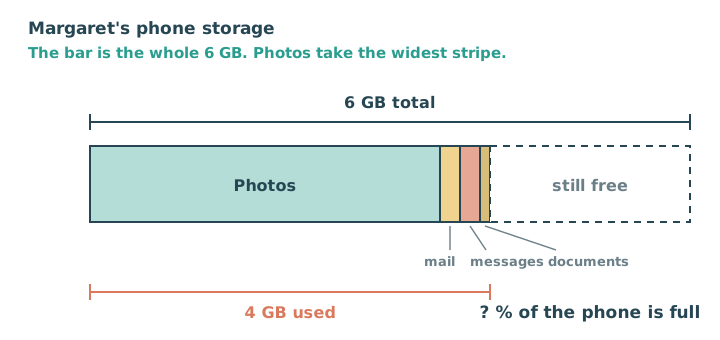
Margaret's phone has 6 GB total and 4 GB used. On the double number line, 4 GB lands between the 50% mark (3 GB) and the 75% mark (4.5 GB), closer to 4.5. Why does that make 'about 70%' a reasonable estimate instead of an exact one?
Check for Understanding #1
Teacher: If >30% thumbs down, re-teach with a fresh example before moving on.
Unit 4 · Lesson 3
Margaret checked the cloud storage on her phone: 6 GB total, 4 GB used. Approximately what percent of her storage is used — and of the used storage, approximately what percent are photos?
Concept Launch
💡 Approximately — the problem is asking for an estimate
The word approximately tells you an exact answer is not required. Benchmarks, rounding and compatible numbers get you close, fast.
Estimating Percents of Numbers. 1. Use benchmark percents: 10% (move decimal left 1), 1% (move left 2), 50% (half), 25% (quarter). 2. Combine benchmarks (e.g. 15% = 10% + 5%; 75% = 50% + 25%). 3. Round numbers to compatible values for quick mental estimates
Check for Understanding #2
Teacher: If >30% thumbs down, re-teach with a fresh example before moving on.
Now you try
VOCABULARY
⏱ ~8 min
| Term / Término | Meaning / Significado | Example / Ejemplo | Visual |
|---|---|---|---|
| estimate estimación |
A reasoned answer that is close enough to be useful, found without exact computation. Una respuesta razonada, lo bastante cercana para ser útil, sin cálculo exacto. |
8.6% of 216 is about 10% of 220, which is 22. | 8.6% of 216 ≈ 10% of 200 = 20 pounds of metal. |
| benchmark percent porcentaje de referencia |
A friendly percent — 1%, 10%, 25%, 50%, 75%, 100% — used as a landmark for estimating. Un porcentaje amigable — 1%, 10%, 25%, 50%, 75%, 100% — que sirve de punto de referencia. |
4 GB of 6 GB sits between the 50% and 75% marks. | 1% · 10% · 25% · 50% · 75% · 100% — the landmarks you can find mentally. |
| compatible numbers números compatibles |
Numbers close to the originals that are easy to compute with mentally. Números cercanos a los originales con los que es fácil calcular mentalmente. |
For 8.6% of 216, use 10% and 200. | 8.6% of 216 → 10% of 220: both nudged to numbers that divide nicely. |
| double number line recta numérica doble |
Two parallel number lines that pair amounts with their percents at the same positions. Dos rectas paralelas que emparejan cantidades con sus porcentajes en las mismas posiciones. |
GB on top, percent on the bottom: 1.5 GB lines up with 25%. | 0 · 25% · 50% · 75% · 100% above; 0 · 1.5 · 3 · 4.5 · 6 GB below. |
| the whole el todo |
The quantity that counts as 100% in a problem — and it can change between questions. La cantidad que representa el 100% en un problema, y puede cambiar entre preguntas. |
First the whole is 6 GB; for the photos question the whole becomes the 4 GB used. | “Of the USED storage” makes 4 GB the whole — not the 6 GB total. |
| Decompose Descomponer |
Break a percent into friendly pieces that are easy to find. Separar un porcentaje en partes fáciles de calcular. |
15% = 10% + 5% |
Which Word Fits?
A reasoned answer close enough to be useful is an ___.
Use It In a Sentence
Check for Understanding #3
Teacher: If >30% thumbs down, re-teach with a fresh example before moving on.
Turn & Talk — Launch
Margaret's phone has 6 GB total and 4 GB used. On the double number line, 4 GB lands between the 50% mark (3 GB) and the 75% mark (4.5 GB), closer to 4.5. Why does that make 'about 70%' a reasonable estimate instead of an exact one?
👂 Listen For
A strong answer names both landmark percents (50% and 75%) and explains why 4 GB sits closer to one than the other. A weak answer just says 'it's close to 70%' without placing it between benchmarks.
Extend: The Green-Team recycled 216 pounds of material, and 8.6% was metal. Justify why rounding to '10% of 220' gives a reasonable estimate, even though neither number is exact.
EXPLORE & PRACTICE
⏱ ~18 min
Visual Modeling Workspace
Use the drawing tray below to annotate the visual model. Teacher: say "Click to reveal" on key steps.
Explore Activity
Sort all six, then tell a partner one estimate where you would use BOTH moves at once.
✍️ Explore Discourse
You sorted a move into 'Benchmark percent' and your partner into 'Compatible numbers.' Which number did each strategy change — the percent or the whole — and why does changing that one keep the estimate close?
Whiteboard Moment
Show your work clearly. Be ready to explain your thinking to a partner.
Turn & Talk — Explore
You sorted moves like 'treating 24% as 25%' and 'changing 216 pounds to 200 pounds' into benchmark percent versus compatible numbers. What's the difference between those two strategies?
👂 Listen For
Listen for students naming WHICH part of the problem each strategy changes — the percent or the quantity — not just labeling the cards by feel.
Extend: Estimating 8.6% of 216 often uses BOTH strategies at once: 10% of 220. Explain how using both together makes the mental math easier than using just one.
Practice Check A
The Green-Team recycled 216 pounds; 8.6% was metal. Using compatible numbers 10% and 200, the estimate is:
✍️ Show Your Work
Explain why your answer is correct using today's vocabulary.
Practice Check B
Photos use 3.5 GB of the 4 GB of used storage. About what percent of the USED storage is photos?
✍️ Show Your Work
Explain why your answer is correct using today's vocabulary.
Equivalent Ratio Sort
Complete the interactive activity using today's strategy.
✍️ Justify Your Thinking
Sort each percent problem by the benchmark that estimates it best.
A classmate turned in the work below. One step has a mistake. Read every step, find it, name it, and fix it.
No worked steps provided for this lesson.
Choose ONE option to show what you know — then do it in the workspace below.
Use evidence from today's lesson to complete each frame.
Today's key idea is: "Estimating Percents of Numbers. 1. Use benchmark percents: 10% (move decimal left 1), 1% (move left 2), 50% (half), 25% (quarter). 2. Combine benchmarks (e.g. 15% = 10% + 5%; 75% = 50% + 25%). 3. Round numbers to compatible values for quick mental estimates" — and it works because ___.
Because estimate means ___, but a tricky part is ___, so I have to ___.
I can justify my method by showing ___, which proves my answer makes sense.
I can prove my answer is correct by ___, using benchmark percent to check my work.
✍️ TWR · WRITE 3 SENTENCES · 7 MIN
Estimating Percents of Numbers. 1. Use benchmark percents: 10% (move decimal left 1), 1% (move left 2), 50% (half), 25% (quarter). 2. Combine benchmarks (e.g. 15% = 10% + 5%; 75% = 50% + 25%). 3. Round numbers to compatible values for quick mental estimates because ___
Estimating Percents of Numbers. 1. Use benchmark percents: 10% (move decimal left 1), 1% (move left 2), 50% (half), 25% (quarter). 2. Combine benchmarks (e.g. 15% = 10% + 5%; 75% = 50% + 25%). 3. Round numbers to compatible values for quick mental estimates but ___
Estimating Percents of Numbers. 1. Use benchmark percents: 10% (move decimal left 1), 1% (move left 2), 50% (half), 25% (quarter). 2. Combine benchmarks (e.g. 15% = 10% + 5%; 75% = 50% + 25%). 3. Round numbers to compatible values for quick mental estimates so ___
🌱 TWR · GROW THE KERNEL · 6 MIN
Answer these to add detail
Sentence starters (tap to use)
Student Workspace
Sort all six, then tell a partner one estimate where you would use BOTH moves at once.
| Column A | Column B |
|---|---|
✏️ Sketch Your Strategy
Differentiation Paths
Step-by-step with a worked model and sentence frames.
Margaret's phone has 6 GB of storage and 4 GB is used. About what percent is used?
The Green-Team recycled 216 pounds; 8.6% was metal. Using compatible numbers 10% and 200, the estimate is:
Two students estimate 8.6% of 216. Ana uses 10% of 220 = 22. Ben uses 10% of 200 = 20. Whose estimate is closer to the exact answer, 18.576?
Partner Activity
Work with your partner on the practice problems at your differentiation path level. Explain each step using math vocabulary.
Check for Understanding #4
Teacher: If >30% thumbs down, re-teach with a fresh example before moving on.
Real-World Connection
🌍 Math in the Wild
Margaret's storage: 6 GB total, 4 GB used, and 3.5 GB of the used space is photos. The rest of the used space is mail, messages, and documents.
✍️ Connection Reasoning
Of the USED storage, approximately what percent are photos — and why does the whole change from 6 GB to 4 GB for this question?
The whole for this question is ___ . Photos are about ___ % of the used storage, since 3.5 GB sits between the ___ % benchmark and the ___ % benchmark on the number line.
Turn & Talk — Connect
Photos take up 3.5 GB of the 4 GB of USED storage. Why does the whole change from 6 GB to 4 GB for this question, and why would using 6 GB give the wrong percent?
👂 Listen For
A strong answer explains that the whole is defined by the question's wording ('of the used storage'), not by habit, and can place 3.5 GB between the 75% and 100% marks of a 4 GB whole to get about 87%. A weak answer keeps using 6 GB out of habit.
Extend: If instead the question asked 'what percent of the TOTAL storage are photos,' would the answer still be about 87%? Explain what would change.
Summarize: Estimate the Percent of a Number
Estimating Percents of Numbers. 1. Use benchmark percents: 10% (move decimal left 1), 1% (move left 2), 50% (half), 25% (quarter). 2. Combine benchmarks (e.g. 15% = 10% + 5%; 75% = 50% + 25%). 3. Round numbers to compatible values for quick mental estimates
In your own words:
CLOSURE & REFLECT
⏱ ~8 min
Today I learned that ___ because ___.
One thing I am still not sure about is ___.
Estimate 19% of 412 using benchmarks or compatible numbers.
Bonus Exit Check
Margaret has a 6 GB phone with 4 GB used. Question A asks what percent of the total 6 GB is used. Question B asks what percent of the used 4 GB is photos. Why is the whole different in the two questions?
✍️ Show Your Work
Explain why your answer is correct using today's vocabulary.
Reflection & Self-Assessment
Continue Learning
Launch the Full Interactive Activity
Students continue practice in the HTML lesson engine with auto-check, hints, and differentiation.
Family Connection
Share tonight's family homework and discuss one vocabulary word at home.
Open Family Homework ↗Teacher Notes
⏱️ Pacing Guide
- Launch & vocab: 12 min
- I Do / We Do / You Do: 15 min
- Explore & practice: 15 min
- Connect & closure: 8 min
Total: ~45 min
🎯 Listen For · Common Errors
• A strong answer names both landmark percents (50% and 75%) and explains why 4 GB sits closer to one than the other. A weak answer just says 'it's close to 70%' without placing it between benchmarks.
• Listen for students naming WHICH part of the problem each strategy changes — the percent or the quantity — not just labeling the cards by feel.
• A strong answer explains that the whole is defined by the question's wording ('of the used storage'), not by habit, and can place 3.5 GB between the 75% and 100% marks of a 4 GB whole to get about 87%. A weak answer keeps using 6 GB out of habit.
• Listen for students explaining the DIRECTION their rounding pushed the estimate (higher or lower than exact), not just stating a final number.
Common mistake: Keeping the same whole for every question — when the problem says 'of the used storage,' the whole changes from 6 GB to 4 GB, and estimates anchored to the old whole are wrong before any arithmetic happens.
Answer Key (Teacher Appendix)
Hide this slide during presentation or move to the end of your copy.
✓ Practice 1: 20 pounds — 10% of 200 = 0.1 × 200 = 20 pounds of metal.
✓ Practice 2: About 87% — The whole is 4 GB here. 75% of 4 is 3 GB and 100% is 4 GB; 3.5 sits midway — about 87%.
✓ Practice 3: The second question asks about the used storage, so 4 GB becomes 100% — Each percent question defines its own whole. 'Of the used storage' makes the 4 GB the new 100%.
✓ Practice 4: About 20 — 24% is about 25%, and 81 is about 80. One quarter of 80 is 20.
✓ Exit ticket: About 80 — 19% is about 20%, and 412 is about 400. 20% of 400 is 0.2 × 400 = 80.