Determine the Volume of Rectangular Prisms
I can find the volume of a rectangular prism with whole-number edges using length × width × height.
How to Use This Deck
Click Present or press F11 for fullscreen. Use arrow keys to advance.
Blue boxes show exactly what to say, ask, and how long to spend.
Text boxes, polls, and drag-sort save automatically in the browser.
Press N or click 📝 in the toolbar for pacing tips and answers.
Launch the full HTML activity for independent practice.
File → Print or the print button for handout copies.
🎯 Content Objective / Objetivo de contenido
I can find the volume of a rectangular prism with whole-number edges using length × width × height.
Today's Flow
Total pacing: ~45 min · Progress bar at top tracks your place
LAUNCH
⏱ ~10 min
⏱️ 3 MIN · THINK-PAIR-SHARE
Your time capsule container is a rectangular prism. To find how much it can hold, why do you need three measurements (length, width, and height) instead of just one or two?
Check for Understanding #1
Teacher: If >30% thumbs down, re-teach with a fresh example before moving on.
Time Capsule Project
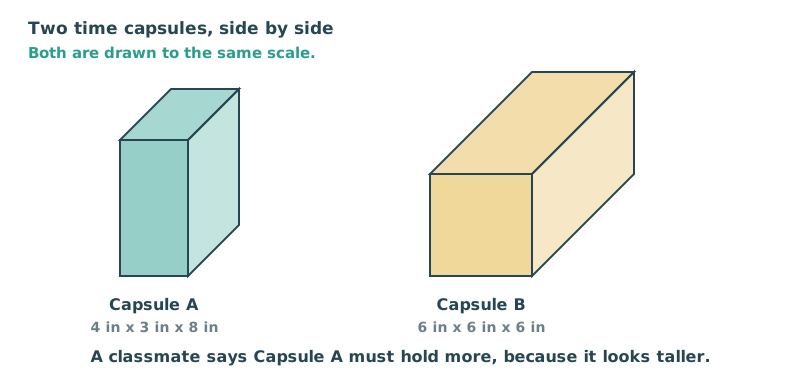
Your team is building time capsule containers to store class memories. Each container is a rectangular prism, and you need to figure out how much each one can hold. That means calculating the volume using whole number dimensions!
Concept Launch
💡 How do we find the volume of a box?
Volume is how much space is inside a 3D shape. For a rectangular prism (a box), volume = length × width × height, measured in cubic units.
Volume of Rectangular Prisms (Whole Numbers). Formula: V = Length × Width × Height = Base Area × Height (V = l · w · h = B · h). 1. Identify the length, width, and height of the box. 2. Multiply base area (l × w) by height (h). 3. Label answer in cubic units (e.g. in³, cm³, ft³)
Check for Understanding #2
Teacher: If >30% thumbs down, re-teach with a fresh example before moving on.
Now it's your turn
VOCABULARY
⏱ ~8 min
| Term / Término | Meaning / Significado | Example / Ejemplo | Visual |
|---|---|---|---|
| Volume with Whole-Number Edges Volumen con aristas de números enteros |
The number of unit cubes inside a rectangular prism. Formula: V = l × w × h. La cantidad de cubos unitarios dentro de un prisma rectangular. Fórmula: V = l × w × h. |
V = l × w × h; 3 × 4 × 5 = 60 cubic units. | |
| Volume Volumen |
How much space is inside a solid shape. Cuánto espacio hay dentro de una figura sólida. |
A box 3 × 2 × 4 holds 24 unit cubes, so V = 24 cubic units | |
| Rectangular prism Prisma rectangular |
A solid box shape with six flat rectangle sides. Una figura sólida en forma de caja con seis lados rectangulares. |
A cereal box or shoe box — it has length, width, and height | |
| Cubic units Unidades cúbicas |
The units used to measure space inside, like cubic inches. Las unidades para medir el espacio interior, como pulgadas cúbicas. |
A tiny cube that is 1 in × 1 in × 1 in = 1 in³ (one cubic inch) | |
| Length, width, height Largo, ancho, altura |
How long, how wide, and how tall a box is. Qué tan largo, ancho y alto es una caja. |
V = l × w × h: for a box 5 × 3 × 2, volume = 30 cubic units | |
| Net Plantilla (desarrollo plano) |
A flat shape that folds up into a solid. Una figura plana que se dobla y forma un sólido. |
A cross-shaped pattern of 6 rectangles folds into a rectangular box |
Which Word Fits?
The number of unit cubes inside a prism, found with V = l × w × h, is the ___.
Use It In a Sentence
Check for Understanding #3
Teacher: If >30% thumbs down, re-teach with a fresh example before moving on.
Turn & Talk — Launch
Your time capsule container is a rectangular prism. To find how much it can hold, why do you need three measurements (length, width, and height) instead of just one or two?
👂 Listen For
Students explain that volume is three-dimensional, so all three edges (length, width, height) are needed; two measurements only give area of one face.
Extend: Could two time capsules have the same volume but different shapes? Justify with an example.
EXPLORE & PRACTICE
⏱ ~18 min
Visual Modeling Workspace
Use the drawing tray below to annotate the visual model. Teacher: say "Click to reveal" on key steps.
Explore Activity
Calculate the volume of each time capsule container. Use V = l × w × h.
✍️ Explore Discourse
Container C holds the most (96 in³) and Container B holds the least (50 in³). What do you notice about the dimensions that make one volume larger than another?
Whiteboard Moment
Show your work clearly. Be ready to explain your thinking to a partner.
Turn & Talk — Explore
Container C is 8 × 3 × 4 and Container B is 5 × 5 × 2. How did you count or multiply the unit cubes to find each volume, and which holds more?
👂 Listen For
Students compute Container C = 8 × 3 × 4 = 96 in³ and Container B = 5 × 5 × 2 = 50 in³, and conclude C holds more by connecting volume to multiplying all three edges.
Extend: Container B (50 in³) has a larger length and width than Container D (10 × 2 × 3 = 60 in³), yet D holds more. Explain how that is possible.
Practice Check A
Two storage bins: Bin A is 8 × 6 × 5 inches. Bin B is 9 × 4 × 7 inches. Which holds more and by how much?
✍️ Show Your Work
Explain why your answer is correct using today's vocabulary.
Practice Check B
A rectangular prism has length 8 cm, width 5 cm, and height 4 cm. What is its volume?
✍️ Show Your Work
Explain why your answer is correct using today's vocabulary.
Area Grid Shading
Click cells to shade area. Count shaded squares.
✍️ Justify Your Thinking
Sort each label into the correct box.
A classmate turned in the work below. One step has a mistake. Read every step, find it, name it, and fix it.
Choose ONE option to show what you know — then do it in the workspace below.
Use evidence from today's lesson to complete each frame.
Today's key idea is: "Volume of Rectangular Prisms (Whole Numbers). Formula: V = Length × Width × Height = Base Area × Height (V = l · w · h = B · h). 1. Identify the length, width, and height of the box. 2. Multiply base area (l × w) by height (h). 3. Label answer in cubic units (e.g. in³, cm³, ft³)" — and it works because ___.
Because Volume with Whole-Number Edges means ___, but a tricky part is ___, so I have to ___.
A common mistake with Volume with Whole-Number Edges is ___. It happens because ___, and the fix is ___.
I can prove my answer is correct by ___, using Volume to check my work.
✍️ TWR · WRITE 3 SENTENCES · 7 MIN
Volume of Rectangular Prisms (Whole Numbers). Formula: V = Length × Width × Height = Base Area × Height (V = l · w · h = B · h). 1. Identify the length, width, and height of the box. 2. Multiply base area (l × w) by height (h). 3. Label answer in cubic units (e.g. in³, cm³, ft³) because ___
Volume of Rectangular Prisms (Whole Numbers). Formula: V = Length × Width × Height = Base Area × Height (V = l · w · h = B · h). 1. Identify the length, width, and height of the box. 2. Multiply base area (l × w) by height (h). 3. Label answer in cubic units (e.g. in³, cm³, ft³) but ___
Volume of Rectangular Prisms (Whole Numbers). Formula: V = Length × Width × Height = Base Area × Height (V = l · w · h = B · h). 1. Identify the length, width, and height of the box. 2. Multiply base area (l × w) by height (h). 3. Label answer in cubic units (e.g. in³, cm³, ft³) so ___
🌱 TWR · GROW THE KERNEL · 6 MIN
Answer these to add detail
Sentence starters (tap to use)
Student Workspace
Calculate the volume of each time capsule container. Use V = l × w × h.
| Container | Length (in) | Width (in) | Height (in) | Volume (in³) |
|---|---|---|---|---|
| Container A | 6 | 4 | 3 | |
| Container B | 5 | 5 | 2 | |
| Container C | 8 | 3 | 4 | |
| Container D | 10 | 2 | 3 |
✏️ Sketch Your Strategy
Differentiation Paths
Step-by-step with a worked model and sentence frames.
What is the volume of a rectangular prism with l = 7 in, w = 3 in, h = 4 in?
Core practice aligned to the standard.
Extension with error analysis or multi-step reasoning.
Partner Activity
Work with your partner on the practice problems at your differentiation path level. Explain each step using math vocabulary.
Check for Understanding #4
Teacher: If >30% thumbs down, re-teach with a fresh example before moving on.
Real-World Connection
🌍 Math in the Wild
A moving company uses rectangular boxes. A large box is 24 inches long, 18 inches wide, and 18 inches tall. A medium box is 18 inches long, 14 inches wide, and 12 inches tall.
✍️ Connection Reasoning
How many more cubic inches does the large box hold than the medium box?
The large box volume is ___ in³ because V = ___ × ___ × ___. The medium box volume is ___ in³. The large box holds ___ more cubic inches.
Turn & Talk — Connect
A moving company's large box is 24 × 18 × 18 in and its medium box is 18 × 14 × 12 in. Talk through how you would find how many more cubic inches the large box holds.
👂 Listen For
Students compute large = 7776 in³, medium = 3024 in³, then subtract to get 4752 in³ more, and reason that you must find each volume before comparing.
Extend: Why can't you just compare one dimension (like length) to decide which box holds more? Use the two boxes to justify.
Summarize: Determine the Volume of Rectangular Prisms
Volume of Rectangular Prisms (Whole Numbers). Formula: V = Length × Width × Height = Base Area × Height (V = l · w · h = B · h). 1. Identify the length, width, and height of the box. 2. Multiply base area (l × w) by height (h). 3. Label answer in cubic units (e.g. in³, cm³, ft³)
In your own words:
CLOSURE & REFLECT
⏱ ~8 min
Today I learned that ___ because ___.
One thing I am still not sure about is ___.
A rectangular prism has l = 11 in, w = 5 in, h = 4 in. What is the volume?
Bonus Exit Check
A box has a volume of 72 in³. Its base is 6 in by 4 in. What is its height?
✍️ Show Your Work
Explain why your answer is correct using today's vocabulary.
Reflection & Self-Assessment
Continue Learning
Launch the Full Interactive Activity
Students continue practice in the HTML lesson engine with auto-check, hints, and differentiation.
Family Connection
Share tonight's family homework and discuss one vocabulary word at home.
Open Family Homework ↗Teacher Notes
⏱️ Pacing Guide
- Launch & vocab: 12 min
- I Do / We Do / You Do: 15 min
- Explore & practice: 15 min
- Connect & closure: 8 min
Total: ~45 min
🎯 Listen For · Common Errors
• Students explain that volume is three-dimensional, so all three edges (length, width, height) are needed; two measurements only give area of one face.
• Students compute Container C = 8 × 3 × 4 = 96 in³ and Container B = 5 × 5 × 2 = 50 in³, and conclude C holds more by connecting volume to multiplying all three edges.
• Students compute large = 7776 in³, medium = 3024 in³, then subtract to get 4752 in³ more, and reason that you must find each volume before comparing.
• Students change in² to in³ and explain that volume fills 3D space (three edges multiplied), while square units describe flat area of one face.
Common mistake: A common mistake in Volume with Whole Number Edges is multiplying only two of the three edges and stopping there — for example, seeing a box that is 6 in long, 4 in wide, and 3 in tall, multiplying just 6 × 4 = 24, and calling that the volume, when 24 is only the area of the bottom face (in square inches), not the volume of the whole box. The height must also be multiplied in: V = 6 × 4 × 3 = 72 cubic inches. A second common mistake is adding the three edges instead of multiplying them (6 + 4 + 3 = 13 instead of 6 × 4 × 3 = 72 cubic inches). Volume always MULTIPLIES all three edges, and the answer is always labeled in cubic units (in³), never square units (in²) or plain units (in).
Answer Key (Teacher Appendix)
Hide this slide during presentation or move to the end of your copy.
✓ Practice 1: Bin B by 12 in³ — Bin A: 8 × 6 × 5 = 240 in³. Bin B: 9 × 4 × 7 = 252 in³. Bin B holds 12 in³ more.
✓ Practice 2: 160 cm³ — V = l × w × h = 8 × 5 × 4 = 160 cm³.
✓ Practice 3: 3 in — Height = V ÷ (l × w) = 72 ÷ (6 × 4) = 72 ÷ 24 = 3 in.
✓ Practice 4: 84 in³ — V = l × w × h = 7 × 3 × 4 = 84 cubic inches.
✓ Exit ticket: 220 in³ — V = 11 × 5 × 4 = 220 cubic inches. Remember: volume uses cubic units (in³).