Touch and changeToca y cambia
Move, type, tap, or drag in the model. Watch what changes.Mueve, escribe, toca o arrastra en el modelo. Observa qué cambia.
Unit 5 · Solve Area, Surface Area, and Volume Problems Unidad 5 · Resolver problemas de área, área total y volumen
Area of Regular PolygonsÁrea de polígonos regulares
6.GR.1 ▾This lesson builds proficiency in Grade 6 mathematical standard 6.GR.1.Esta lección desarrolla destrezas en el estándar matemático de 6.º grado 6.GR.1.
Optional, ungraded practice. Choose ONE plan below. Work with someone or on your own; no adult signature is needed. Práctica opcional, sin calificación. Elige UN plan abajo. Trabaja con alguien o a solas; no necesitas la firma de un adulto.
Choose one plan, not all three. Each plan tells you what to do and when to stop. Switching keeps your answers.Elige un plan, no los tres. Cada plan indica qué hacer y cuándo terminar. Al cambiar, conservas tus respuestas.
Learn & practice selected: 4 focused stops and all 6 core problems, about 20 minutes. Ruta de aprendizaje: 4 paradas y los 6 problemas, unos 20 minutos.
The Photobooth is a camera you can open any time — photograph the notebook page, the scratchpad or the whiteboard, add a frame and stickers, then download or print it. It is optional, and the photo stays on this device. La cabina de fotos es una cámara que pueden abrir cuando quieran: fotografíen la página del cuaderno, el borrador o la pizarra, agreguen un marco y calcomanías, y descárguenla o imprímanla. Es opcional, y la foto se queda en este dispositivo.
💡 Draw fraction bars, tape diagrams, equations, or line up decimals together!💡 ¡Dibujen barras de fracciones, modelos o alineen decimales juntos!
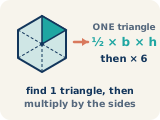
Tonight we find the area of a regular polygon, like a hexagon (6 sides). We break it into equal triangles, find one triangle's area, then add them all up.
Esta noche hallamos el área de un polígono regular, como un hexágono (6 lados). Lo separamos en triángulos iguales, hallamos el área de un triángulo y luego los sumamos todos.
For the grown-up helping tonightPara el adulto que ayuda hoy
A = ½Pa = ½ × 24 × 3 = 36
Real example: a hexagon (6 sides) skylight.
Ejemplo real: un tragaluz hexagonal (6 lados).
Each side is 6 feet, and each triangle from the center has a height of 5.2 feet. We want the total area. The height is rounded to the nearest tenth, so we estimate the area.
Cada lado es 6 pies, y cada triángulo desde el centro tiene una altura de 5.2 pies. Queremos el área total. La altura está redondeada a la décima más cercana, así que estimamos el área.
Find one triangle: area = ½ × base × height = ½ × 6 × 5.2.
Halla un triángulo: área = ½ × base × altura = ½ × 6 × 5.2.
Multiply 6 × 5.2 = 31.2, then take half: ½ × 31.2 = 15.6 square feet for one triangle.
Multiplica 6 × 5.2 = 31.2, luego toma la mitad: ½ × 31.2 = 15.6 pies cuadrados para un triángulo.
A hexagon has 6 triangles, so multiply: 6 × 15.6 = 93.6.
Un hexágono tiene 6 triángulos, así que multiplica: 6 × 15.6 = 93.6.
The total area is 93.6 square feet.
El área total es 93.6 pies cuadrados.
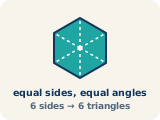
Listen for "polígono regular" (regular polygon) — a shape where all sides and all angles are equal, like a stop sign.
Escucha la palabra "polígono regular" — una figura donde todos los lados y ángulos son iguales, como una señal de alto.
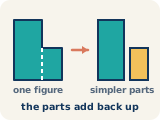
Listen for "descomponer" (decompose) — it means to break the shape into smaller, simpler shapes.
Escucha la palabra "descomponer" — significa separar la figura en figuras más pequeñas y simples.
Remind them to multiply by the number of sides at the end, not just stop at one triangle.
Recuérdenles multiplicar por el número de lados al final, no solo detenerse en un triángulo.
Change the shape or its measurements. Find the area in square units.Cambia la figura o sus medidas. Halla el área en unidades cuadradas.
🌐 Esta herramienta interactiva por ahora solo está en inglés. Para qué sirve: Mueve un control y observa cómo una figura se reorganiza en una forma cuya área ya conoces: de ahí sale cada fórmula de área. Usen los pasos en español de esta tarjeta para guiarse.
Move, type, tap, or drag in the model. Watch what changes.Mueve, escribe, toca o arrastra en el modelo. Observa qué cambia.
Record one equation, value, or relationship you can see.Escribe una ecuación, un valor o una relación que puedas ver.
I notice ___ changes when ___ changes. This shows ___.Noto que ___ cambia cuando ___ cambia. Esto muestra ___.
Ask: "Where do you see the numbers from tonight's math in this model?"Pregunta: "¿Dónde ves los números de la tarea de hoy en este modelo?"
Draw a square of side 6. Connect its center to all four vertices. Dibuja un cuadrado de lado 6. Une su centro con los cuatro vértices.
Using a familiar rule before identifying what this question asks. Usar una regla conocida sin identificar qué pide esta pregunta.
Tap a word on the left, then tap its matching definition on the right! ¡Toca una palabra a la izquierda y su significado a la derecha!
Tap any card to flip and explore its definition and example. Toca cualquier tarjeta para voltearla y explorar su definición y ejemplo.
Área de polígonos regulares
Área de polígonos regulares
The space a regular polygon covers. Split it from the center into identical triangles, find one triangle's area, then multiply by how many there are.
ES El espacio que cubre un polígono regular. Divídelo desde el centro en triángulos idénticos, halla el área de uno y multiplícala por cuántos hay.
Polígono regular
Polígono regular
A closed flat shape made of straight sides, where every side is the same length and every angle is the same size.
ES Una figura plana cerrada de lados rectos, donde todos los lados miden lo mismo y todos los ángulos son iguales.
Descomponer
Descomponer
To break a shape into smaller, simpler shapes.
ES Separar una figura en figuras más pequeñas y simples.
Triángulo
Triángulo
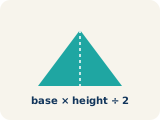
A shape with three sides.
ES Una figura de tres lados.
Compuesto
Compuesto
Made by putting two or more simple shapes together.
ES Formada al juntar dos o más figuras simples.
Fórmula
Fórmula
A math rule written with symbols.
ES Una regla matemática escrita con símbolos.
Student: explain. Partner: ask “How do you know?” Then switch. Working solo? Say or write your explanation; bring a question to a trusted adult at school.Estudiante: explica. Acompañante: pregunta «¿Cómo lo sabes?» Luego cambien. ¿Trabajas a solas? Di o escribe tu explicación; lleva una pregunta a un adulto de confianza en la escuela.
Imagine a pentagon (5 sides) tile. Each of its 5 triangles has a base of 4 cm and a height of 3 cm. The height is rounded to the nearest centimeter; use it to estimate the area.
Imaginen una baldosa de pentágono (5 lados). Cada uno de sus 5 triángulos tiene una base de 4 cm y una altura de 3 cm. La altura está redondeada al centímetro más cercano; úsenla para estimar el área.
Work side by side. You ask questions; your student does the thinking. Trabajen juntos. Tú haces preguntas; tu estudiante piensa.
First find one triangle: ½ × 4 × 3. What is 4 × 3?
Primero hallen un triángulo: ½ × 4 × 3. ¿Cuánto es 4 × 3?
How many triangles does a pentagon split into?
¿En cuántos triángulos se divide un pentágono?
Now multiply one triangle's area by the number of triangles. What is the total area?
Ahora multipliquen el área de un triángulo por el número de triángulos. ¿Cuál es el área total?
Do these together. Start at ★ and climb to ★★★ when ready. Háganlos juntos. Empiecen en ★ y suban a ★★★ cuando estén listos.
A regular octagon craft splits from its center into 8 congruent triangles. Each triangle has an area of 9 cm². What is the total area?Una manualidad con forma de octágono regular se divide desde el centro en 8 triángulos congruentes. Cada triángulo tiene un área de 9 cm². ¿Cuál es el área total?
D. 72 cm²D. 72 cm²
A regular hexagon tile splits from its center into 6 triangles. One triangle has a base of 10 cm and a height of about 8.7 cm. What is the area of that one triangle?Una baldosa con forma de hexágono regular se divide desde el centro en 6 triángulos. Un triángulo tiene base de 10 cm y altura de aproximadamente 8.7 cm. ¿Cuál es el área de ese triángulo?
B. 43.5 cm²B. 43.5 cm²
What is the area of one center triangle?¿Cuál es el área de un triángulo central?
C. 15 sq ftC. 15 pies cuadrados
What is the total floor area of the octagon?¿Cuál es el área total del piso del octágono?
C. 120 sq ftC. 120 pies cuadrados
A regular pentagon garden has sides of 6 ft. Each center triangle has a height of about 4.1 ft. Find the approximate total area, and explain why you use 5 triangles.Un jardín con forma de pentágono regular tiene lados de 6 pies. Cada triángulo central tiene una altura de aproximadamente 4.1 pies. Halla el área total aproximada y explica por qué usas 5 triángulos.
One triangle: ½ × 6 × 4.1 = 12.3 ft². A pentagon has 5 sides, so lines from the center to each corner make 5 congruent triangles: 5 × 12.3 = 61.5 ft² (about 61.5 ft², since 4.1 is rounded).Un triángulo: ½ × 6 × 4.1 = 12.3 pies². Un pentágono tiene 5 lados, así que las líneas del centro a cada esquina forman 5 triángulos congruentes: 5 × 12.3 = 61.5 pies² (aproximadamente, porque 4.1 está redondeado).
Point and name → finish the sentence → explain in your own words.Señala y nombra → completa la oración → explica con tus propias palabras.
I used ___ units because I measured ___.Usé unidades ___ porque medí ___.
Check: I answered the question, showed my thinking, labeled units, and explained why.Reviso: respondí la pregunta, mostré mi razonamiento, indiqué las unidades y expliqué por qué.
"Can you show me how you see that in your work or a quick sketch?" "¿Puedes mostrarme cómo ves eso en tu trabajo o en un dibujo rápido?"
Follow-up: Point to where each number from the problem shows up. Seguimiento: Señala dónde aparece cada número del problema.
Try the recommended mission. Student: explain; partner: ask one question, then switch. Paper drawings work for every object. Prueba la misión recomendada. Estudiante: explica; acompañante: haz una pregunta, luego cambien. Puedes dibujar los objetos en papel.
One mission is enough. You can also work solo and explain in writing.Una misión es suficiente. También puedes trabajar a solas y explicar por escrito.
Design a paper decoration: sketch a regular hexagon made from six equal triangles, each with base 4 cm and height 3.46 cm. Label the measurements and calculate its area. Explain each part of your calculation.
Diseña una decoración de papel: dibuja un hexágono regular formado por seis triángulos iguales, cada uno con base 4 cm y altura 3.46 cm. Indica las medidas y calcula el área. Explica cada parte del cálculo.
Show a labeled drawing, table, or equation. Your partner asks one question; working alone, write your explanation.
Muestra un dibujo con etiquetas, una tabla o una ecuación. Tu acompañante hace una pregunta; a solas, escribe tu explicación.
⏱️ About 8 minutes for the 6 problems below. The extra practice at the bottom is optional. ⏱️ Unos 8 minutos para los 6 problemas de abajo. La práctica extra al final es opcional.
A few problems to practice together. Each one has a step-by-step guide, a picture to draw on, and a space to show your work. Use Check This Problem for instant feedback — no need to finish everything at once. Unos problemas para practicar juntos. Cada uno tiene una guía paso a paso, un dibujo para trabajar y un espacio para mostrar el trabajo. Usen Revisar esta pregunta para retroalimentación al instante — no tienen que terminar todo de una vez.
Easier problems to practice the idea. Do these first together. Problemas más fáciles para practicar la idea. Hagan estos primero juntos.
Say the question in your own words. Circle what you know and underline what you need to find.
Explica la pregunta con tus propias palabras. Encierra lo que sabes y subraya lo que debes hallar.
That means the number of triangles always equals the number of sides. Name the sides for each polygon first.
Eso significa que el número de triángulos siempre es igual al número de lados. Nombra los lados de cada polígono primero.
Start here: Picture it: one spoke from the center to each corner. Each triangle sits on one side.
Empieza aquí: Imagínalo: un radio desde el centro hasta cada esquina. Cada triángulo se apoya en un lado.
Each regular polygon below is cut into congruent triangles by drawing a line from the center to every corner. Sort by how many triangles it makes.Cada polígono regular de abajo se corta en triángulos congruentes trazando una línea desde el centro hasta cada esquina. Clasifica según cuántos triángulos forma.
👪 On a phone, use Move to. On a computer, drag cards or tap a card then tap a column.👪 En el teléfono usen Mover a. En la computadora arrastren o toquen tarjeta y columna.
💡 Picture it: one spoke from the center to each corner. Each triangle sits on one side.Imagínalo: un radio desde el centro hasta cada esquina. Cada triángulo se apoya en un lado.
💡 That means the number of triangles always equals the number of sides. Name the sides for each polygon first.Eso significa que el número de triángulos siempre es igual al número de lados. Nombra los lados de cada polígono primero.
💡 A hexagon has 6 sides, so 6 triangles. Is 6 more than 5? Place it, then do the octagon, triangle, square, and pentagon.Un hexágono tiene 6 lados, así que 6 triángulos. ¿Es 6 más que 5? Colócalo y sigue con el octágono, el triángulo, el cuadrado y el pentágono.
Answer key for families — compare, then talk about why.Clave de respuestas para la familia — comparen y hablen del porqué.
Not tried yet? Close this and give it one try first. A wrong first try still helps.¿Todavía no lo intentaron? Ciérrenla y hagan un intento primero. Un primer intento equivocado también ayuda.
Why:Por qué: A regular polygon splits into one triangle per side, so the triangle count is just the number of sides. The hexagon (6 sides) and the octagon (8 sides) are the only ones above 5; the equilateral triangle (3), the square (4), and the pentagon (exactly 5) all belong in the '5 or fewer' group.Un polígono regular se divide en un triángulo por cada lado, así que la cantidad de triángulos es simplemente el número de lados. El hexágono (6 lados) y el octágono (8 lados) son los únicos por encima de 5; el triángulo equilátero (3), el cuadrado (4) y el pentágono (exactamente 5) van en el grupo de '5 o menos'.
Say the question in your own words. Circle what you know and underline what you need to find.
Explica la pregunta con tus propias palabras. Encierra lo que sabes y subraya lo que debes hallar.
Multiply base × height first, then take half of it. Compare the result to 12 sq ft.
Multiplica base × altura primero y luego saca la mitad. Compara el resultado con 12 pies cuadrados.
Start here: Each card gives you a base and a height — that is everything you need for ½ × base × height.
Empieza aquí: Cada tarjeta te da una base y una altura: eso es todo lo que necesitas para ½ × base × altura.
Each tile decomposes into congruent triangles from its center. Work out the area of ONE triangle, then sort the tile. Use the given heights; nonsquare heights are rounded, so their areas are estimates.Cada mosaico se descompone en triángulos congruentes desde su centro. Calcula el área de UN triángulo y luego clasifica el mosaico. Usa las alturas dadas; las de figuras que no son cuadrados están redondeadas, así que sus áreas son estimaciones.
💡 Each card gives you a base and a height — that is everything you need for ½ × base × height.Cada tarjeta te da una base y una altura: eso es todo lo que necesitas para ½ × base × altura.
💡 Multiply base × height first, then take half of it. Compare the result to 12 sq ft.Multiplica base × altura primero y luego saca la mitad. Compara el resultado con 12 pies cuadrados.
💡 Start with the square: ½ × 4 × 2 = 4 sq ft. Is 4 at most 12?Empieza con el cuadrado: ½ × 4 × 2 = 4 pies². ¿Es 4 menor o igual que 12?
Answer key for families — compare, then talk about why.Clave de respuestas para la familia — comparen y hablen del porqué.
Not tried yet? Close this and give it one try first. A wrong first try still helps.¿Todavía no lo intentaron? Ciérrenla y hagan un intento primero. Un primer intento equivocado también ayuda.
Why:Por qué: Using the given heights, the central-triangle areas are ½ × 4 × 2 = 4 sq ft for the square, about ½ × 4 × 3.5 = 7 sq ft for the hexagon, about ½ × 6 × 7.2 = 21.6 sq ft for the octagon, and about ½ × 8 × 5.5 = 22 sq ft for the pentagon. The first two are at most 12; the last two are over 12.Con las alturas dadas, las áreas de los triángulos centrales son ½ × 4 × 2 = 4 pies² para el cuadrado, aproximadamente ½ × 4 × 3.5 = 7 pies² para el hexágono, aproximadamente ½ × 6 × 7.2 = 21.6 pies² para el octágono y aproximadamente ½ × 8 × 5.5 = 22 pies² para el pentágono. Las dos primeras no superan 12; las otras dos son mayores que 12.
Say the question in your own words. Circle what you know and underline what you need to find.
Explica la pregunta con tus propias palabras. Encierra lo que sabes y subraya lo que debes hallar.
One triangle uses A = ½ × b × h — don't multiply by 6 yet; that step is for the whole hexagon.
Un triángulo usa A = ½ × b × h; todavía no multipliques por 6, ese paso es para el hexágono completo.
Start here: Focus on just ONE of the 6 triangles: its base is 6 ft and its height is 5.2 ft.
Empieza aquí: Concéntrate en solo UNO de los 6 triángulos: su base es de 6 pies y su altura de 5.2 pies.
A regular hexagon is divided into 6 equal triangles from the center. Each triangle has a base of 6 ft and a height of 5.2 ft. What is the area of one triangle? Use the given heights; nonsquare heights are rounded, so their areas are estimates.Un hexágono regular se divide en 6 triángulos iguales desde el centro. Cada triángulo tiene una base de 6 ft y una altura de 5.2 ft. ¿Cuál es el área de un triángulo? Usa las alturas dadas; las de figuras que no son cuadrados están redondeadas, así que sus áreas son estimaciones.
👪 Read the question together, then let your student pick an answer before you discuss why.👪 Lean la pregunta juntos; dejen que su estudiante elija antes de hablar del porqué.
Answer key for families — compare, then talk about why.Clave de respuestas para la familia — comparen y hablen del porqué.
Not tried yet? Close this and give it one try first. A wrong first try still helps.¿Todavía no lo intentaron? Ciérrenla y hagan un intento primero. Un primer intento equivocado también ayuda.
Why:Por qué: A = ½ × b × h = ½ × 6 × 5.2 = 15.6 square feet.A = ½ × b × h = ½ × 6 × 5.2 = 15.6 pies cuadrados.
Try these once the warm-up feels easy. It's okay to use the steps and pictures. Intenten estos cuando el calentamiento sea fácil. Está bien usar los pasos y los dibujos.
Say the question in your own words. Circle what you know and underline what you need to find.
Explica la pregunta con tus propias palabras. Encierra lo que sabes y subraya lo que debes hallar.
A hexagon has 6 central triangles; a pentagon has 5.
Un hexágono tiene 6 triángulos centrales; un pentágono tiene 5.
Start here: Each central triangle has the same AREA, but the triangles need not have the same shape.
Empieza aquí: Cada triángulo central tiene la misma ÁREA, pero los triángulos no tienen que tener la misma forma.
A regular hexagon and a regular pentagon are each divided into congruent central triangles. In both polygons, each central triangle has area 15 sq ft. Which polygon has greater total area? Explain why the triangle count matters. The two polygons have different side lengths.Un hexágono regular y un pentágono regular se dividen en triángulos centrales congruentes. En ambos polígonos, cada triángulo central tiene área 15 pies². ¿Cuál polígono tiene mayor área total? Explica por qué importa la cantidad de triángulos. Los dos polígonos tienen lados de diferentes longitudes.
👪 A complete sentence with math vocabulary is the goal — not a perfect paragraph.👪 Una oración completa con vocabulario matemático es la meta — no un párrafo perfecto.
Answer key for families — compare, then talk about why.Clave de respuestas para la familia — comparen y hablen del porqué.
Not tried yet? Close this and give it one try first. A wrong first try still helps.¿Todavía no lo intentaron? Ciérrenla y hagan un intento primero. Un primer intento equivocado también ayuda.
Why:Por qué: The hexagon has area 6 × 15 = 90 sq ft. The pentagon has area 5 × 15 = 75 sq ft. The hexagon has 15 sq ft more because it has one additional triangle of that area. Equal triangle areas do not require equal bases and heights.El hexágono tiene área 6 × 15 = 90 pies². El pentágono tiene área 5 × 15 = 75 pies². El hexágono tiene 15 pies² más porque tiene un triángulo adicional de esa área. Tener áreas iguales no exige bases y alturas iguales.
Say the question in your own words. Circle what you know and underline what you need to find.
Explica la pregunta con tus propias palabras. Encierra lo que sabes y subraya lo que debes hallar.
Step 1: ½ × base × height. Step 2: multiply that by the triangle count. Then compare to 90.
Paso 1: ½ × base × altura. Paso 2: multiplica eso por el número de triángulos. Luego compara con 90.
Start here: Do not sort by how many sides the polygon has — more sides does not guarantee more area.
Empieza aquí: No clasifiques por cuántos lados tiene el polígono: más lados no garantiza más área.
Find the TOTAL area of each regular polygon, then sort it against the 90 sq ft cutoff. Use the given heights; nonsquare heights are rounded, so their areas are estimates.Halla el área TOTAL de cada polígono regular y luego clasifícalo según el límite de 90 pies cuadrados. Usa las alturas dadas; las de figuras que no son cuadrados están redondeadas, así que sus áreas son estimaciones.
💡 Do not sort by how many sides the polygon has — more sides does not guarantee more area.No clasifiques por cuántos lados tiene el polígono: más lados no garantiza más área.
💡 Step 1: ½ × base × height. Step 2: multiply that by the triangle count. Then compare to 90.Paso 1: ½ × base × altura. Paso 2: multiplica eso por el número de triángulos. Luego compara con 90.
💡 Pentagon: ½ × 8 × 5.5 = 22 sq ft for one triangle, and 5 × 22 = 110 sq ft total. Is 110 at least 90? Place it, then work the rest.Pentágono: ½ × 8 × 5.5 = 22 pies cuadrados por triángulo, y 5 × 22 = 110 en total. ¿Es 110 al menos 90? Colócalo y sigue.
Answer key for families — compare, then talk about why.Clave de respuestas para la familia — comparen y hablen del porqué.
Not tried yet? Close this and give it one try first. A wrong first try still helps.¿Todavía no lo intentaron? Ciérrenla y hagan un intento primero. Un primer intento equivocado también ayuda.
Why:Por qué: Each card needs both steps. Pentagon: 5 × (½ × 8 × 5.5) = 110 sq ft. Hexagon: 6 × (½ × 6 × 5.2) = 93.6 sq ft. Both reach 90. Octagon: 8 × (½ × 4 × 4.8) = 76.8 sq ft. Square: 4 × (½ × 5 × 2.5) = 25 sq ft. Both fall short — and notice the octagon has the MOST sides but not the most area, because its triangles are smaller.Cada tarjeta necesita los dos pasos. Pentágono: 5 × (½ × 8 × 5.5) = 110 pies cuadrados. Hexágono: 6 × (½ × 6 × 5.2) = 93.6. Ambos llegan a 90. Octágono: 8 × (½ × 4 × 4.8) = 76.8. Cuadrado: 4 × (½ × 5 × 2.5) = 25. Ambos quedan por debajo, y fíjate que el octágono tiene MÁS lados pero no más área, porque sus triángulos son más pequeños.
Say the question in your own words. Circle what you know and underline what you need to find.
Explica la pregunta con tus propias palabras. Encierra lo que sabes y subraya lo que debes hallar.
Count the sides to know how many triangles there are, then multiply by the area of a single triangle.
Cuenta los lados para saber cuántos triángulos hay y luego multiplica por el área de un solo triángulo.
Start here: A regular polygon splits from its center into one triangle for each side, and all of those triangles are congruent.
Empieza aquí: Un polígono regular se divide desde su centro en un triángulo por cada lado, y todos esos triángulos son congruentes.
A regular hexagonal floor tile splits from its center into 6 congruent triangles, each with an area of 12 cm². What is the total area of the tile?Una baldosa hexagonal regular se divide desde su centro en 6 triángulos congruentes, cada uno con un área de 12 cm². ¿Cuál es el área total de la baldosa?
Answer key for families — compare, then talk about why.Clave de respuestas para la familia — comparen y hablen del porqué.
Not tried yet? Close this and give it one try first. A wrong first try still helps.¿Todavía no lo intentaron? Ciérrenla y hagan un intento primero. Un primer intento equivocado también ayuda.
Why:Por qué: A hexagon has 6 sides, so it splits into 6 equal triangles. Total = 6 × 12 = 72 cm².Un hexágono tiene 6 lados, así que se divide en 6 triángulos iguales. Total = 6 × 12 = 72 cm².
Optional. Only if your student wants more — these are bonus problems. Opcional. Solo si tu estudiante quiere más — son problemas adicionales.
Say the question in your own words. Circle what you know and underline what you need to find.
Explica la pregunta con tus propias palabras. Encierra lo que sabes y subraya lo que debes hallar.
Find the area of one triangle with ½ × base × height, then multiply by the number of triangles.
Halla el área de un triángulo con ½ × base × altura y luego multiplica por el número de triángulos.
Start here: Every regular polygon breaks into congruent triangles, one for each side.
Empieza aquí: Todo polígono regular se descompone en triángulos congruentes, uno por cada lado.
A regular pentagonal tile splits into 5 congruent triangles. Each triangle has a base of 4 in and a height of about 2.8 in. What is the total area of the tile? Use the given heights; nonsquare heights are rounded, so their areas are estimates.Una baldosa pentagonal regular se divide en 5 triángulos congruentes. Cada triángulo tiene una base de 4 in y una altura aproximada de 2.8 in. ¿Cuál es el área total de la baldosa? Usa las alturas dadas; las de figuras que no son cuadrados están redondeadas, así que sus áreas son estimaciones.
Answer key for families — compare, then talk about why.Clave de respuestas para la familia — comparen y hablen del porqué.
Not tried yet? Close this and give it one try first. A wrong first try still helps.¿Todavía no lo intentaron? Ciérrenla y hagan un intento primero. Un primer intento equivocado también ayuda.
Why:Por qué: One triangle = ½ × 4 × 2.8 = 5.6 in². A pentagon has 5 triangles, so total = 5 × 5.6 = 28 in².Un triángulo = ½ × 4 × 2.8 = 5.6 in². Un pentágono tiene 5 triángulos, así que el total = 5 × 5.6 = 28 in².
Say the question in your own words. Circle what you know and underline what you need to find.
Explica la pregunta con tus propias palabras. Encierra lo que sabes y subraya lo que debes hallar.
Find the area of one triangle first with ½ × base × height, then multiply by the number of triangles.
Primero halla el área de un triángulo con ½ × base × altura y luego multiplica por el número de triángulos.
Start here: An octagon has 8 sides, so it splits from the center into 8 congruent triangles.
Empieza aquí: Un octágono tiene 8 lados, así que se divide desde el centro en 8 triángulos congruentes.
An octagon tile splits into equal triangles, each with base 6 ft and height ≈ 7.2 ft. How many triangles, and what is the total area? Use the given heights; nonsquare heights are rounded, so their areas are estimates.Una baldosa octagonal se divide en triángulos iguales, cada uno con base 6 ft y altura ≈ 7.2 ft. ¿Cuántos triángulos hay y cuál es el área total? Usa las alturas dadas; las de figuras que no son cuadrados están redondeadas, así que sus áreas son estimaciones.
Answer key for families — compare, then talk about why.Clave de respuestas para la familia — comparen y hablen del porqué.
Not tried yet? Close this and give it one try first. A wrong first try still helps.¿Todavía no lo intentaron? Ciérrenla y hagan un intento primero. Un primer intento equivocado también ayuda.
Why:Por qué: An octagon has 8 sides, so it splits into 8 triangles. One triangle = ½ × 6 × 7.2 = 21.6 sq ft. Total = 8 × 21.6 = 172.8 sq ft.Un octágono tiene 8 lados, así que se divide en 8 triángulos. Un triángulo = ½ × 6 × 7.2 = 21.6 pies cuadrados. Total = 8 × 21.6 = 172.8 pies cuadrados.
Say the question in your own words. Circle what you know and underline what you need to find.
Explica la pregunta con tus propias palabras. Encierra lo que sabes y subraya lo que debes hallar.
Use ½ × 4 × 3.5 for one triangle, then multiply that result by 6 for the hexagon.
Usa ½ × 4 × 3.5 para un triángulo y luego multiplica ese resultado por 6 para el hexágono.
Start here: Two stages hide here: first one triangle (base 4 cm, height 3.5 cm), then all 6 of them.
Empieza aquí: Aquí se esconden dos etapas: primero un triángulo (base 4 cm, altura 3.5 cm) y luego los 6 juntos.
A regular hexagon is split into 6 triangles, each with base 4 cm and height 3.5 cm. What is the total area? Use the given heights; nonsquare heights are rounded, so their areas are estimates.Un hexágono regular se divide en 6 triángulos, cada uno con base 4 cm y altura 3.5 cm. ¿Cuál es el área total? Usa las alturas dadas; las de figuras que no son cuadrados están redondeadas, así que sus áreas son estimaciones.
Answer key for families — compare, then talk about why.Clave de respuestas para la familia — comparen y hablen del porqué.
Not tried yet? Close this and give it one try first. A wrong first try still helps.¿Todavía no lo intentaron? Ciérrenla y hagan un intento primero. Un primer intento equivocado también ayuda.
Why:Por qué: Each triangle: ½ × 4 × 3.5 = 7 sq cm. Total: 6 × 7 = 42 sq cm.Cada triángulo: ½ × 4 × 3.5 = 7 cm cuadrados. Total: 6 × 7 = 42 cm cuadrados.
Say the question in your own words. Circle what you know and underline what you need to find.
Explica la pregunta con tus propias palabras. Encierra lo que sabes y subraya lo que debes hallar.
A regular hexagon splits into 6 identical triangles, so the total is 6 copies of one triangle's area.
Un hexágono regular se divide en 6 triángulos idénticos, así que el total son 6 copias del área de un triángulo.
Start here: Find one central triangle’s area: ½ × 6 × 5.2 = 15.6 sq ft using the rounded height.
Empieza aquí: Halla el área de un triángulo central: ½ × 6 × 5.2 = 15.6 pies² con la altura redondeada.
A regular hexagonal skylight has 6 central triangles, each with base 6 ft and rounded height 5.2 ft. Using those measurements, what is the approximate total area?Un tragaluz hexagonal regular tiene 6 triángulos centrales, cada uno con base 6 pies y altura redondeada de 5.2 pies. Con esas medidas, ¿cuál es el área total aproximada?
Answer key for families — compare, then talk about why.Clave de respuestas para la familia — comparen y hablen del porqué.
Not tried yet? Close this and give it one try first. A wrong first try still helps.¿Todavía no lo intentaron? Ciérrenla y hagan un intento primero. Un primer intento equivocado también ayuda.
Why:Por qué: Total area = 6 triangles × 15.6 sq ft = 93.6 square feet.Área total = 6 triángulos × 15.6 pies cuadrados = 93.6 pies cuadrados.
Say the question in your own words. Circle what you know and underline what you need to find.
Explica la pregunta con tus propias palabras. Encierra lo que sabes y subraya lo que debes hallar.
Column 5 uses ½ × base × height. Column 6 multiplies that answer by the Number of Triangles.
La columna 5 usa ½ × base × altura. La columna 6 multiplica esa respuesta por el Número de Triángulos.
Start here: Each row has two blanks: the area of ONE triangle first, then the total for the whole polygon.
Empieza aquí: Cada fila tiene dos espacios: primero el área de UN triángulo y luego el total del polígono completo.
Complete the table: find one central triangle’s area and the polygon’s total area. Use the given rounded heights for estimates; the square dimensions are exact.Completa la tabla: halla el área de un triángulo central y el área total del polígono. Usa las alturas redondeadas dadas para estimar; las medidas del cuadrado son exactas.
👪 Encourage your student to show work on paper if a box feels tricky.👪 Animen a mostrar el trabajo en papel si una casilla se siente difícil.
| PolygonPolígono | Number of TrianglesCantidad de triángulos | Triangle BaseBase del triángulo | Triangle HeightAltura del triángulo | Area of One TriangleÁrea de un triángulo | Total AreaÁrea total |
|---|---|---|---|---|---|
| HexagonHexágono | 6 | 6 ft6 pies | 5.2 ft5.2 pies |
|
|
| PentagonPentágono | 5 | 8 ft8 pies | 5.5 ft5.5 pies |
|
|
| SquareCuadrado | 4 | 5 ft5 pies | 2.5 ft2.5 pies |
|
|
| OctagonOctágono | 8 | 4 ft4 pies | 4.8 ft4.8 pies |
|
|
Answer key for families — compare, then talk about why.Clave de respuestas para la familia — comparen y hablen del porqué.
Not tried yet? Close this and give it one try first. A wrong first try still helps.¿Todavía no lo intentaron? Ciérrenla y hagan un intento primero. Un primer intento equivocado también ayuda.
Why:Por qué: Each row is two moves: one triangle's area with ½ × base × height, then that answer times the number of triangles. The hexagon gives ½ × 6 × 5.2 = 15.6 and 6 × 15.6 = 93.6 sq ft, the pentagon 22 and 110 sq ft, the square 6.25 and 25 sq ft, and the octagon 9.6 and 76.8 sq ft.Cada fila tiene dos movimientos: el área de un triángulo con ½ × base × altura, y luego ese resultado por el número de triángulos. El hexágono da ½ × 6 × 5.2 = 15.6 y 6 × 15.6 = 93.6 pies cuadrados; el pentágono, 22 y 110; el cuadrado, 6.25 y 25; y el octágono, 9.6 y 76.8 pies cuadrados.
Say the question in your own words. Circle what you know and underline what you need to find.
Explica la pregunta con tus propias palabras. Encierra lo que sabes y subraya lo que debes hallar.
Work in two steps: evaluate the ½ × b × h part, then multiply by the number of triangles named.
Trabaja en dos pasos: evalúa la parte ½ × b × h y luego multiplica por el número de triángulos indicado.
Start here: Each polygon card shows its triangle count and one triangle's ½ × b × h setup — the match is the TOTAL area.
Empieza aquí: Cada tarjeta de polígono muestra su número de triángulos y el planteamiento ½ × b × h de un triángulo; la pareja es el área TOTAL.
Match each polygon to its total area. Use the given heights; nonsquare heights are rounded, so their areas are estimates.Une cada polígono con su área total. Usa las alturas dadas; las de figuras que no son cuadrados están redondeadas, así que sus áreas son estimaciones.
👪 Say each term out loud, then talk through which match makes sense before choosing.👪 Digan cada término en voz alta y hablen de cuál pareja tiene sentido antes de elegir.
Answer key for families — compare, then talk about why.Clave de respuestas para la familia — comparen y hablen del porqué.
Not tried yet? Close this and give it one try first. A wrong first try still helps.¿Todavía no lo intentaron? Ciérrenla y hagan un intento primero. Un primer intento equivocado también ayuda.
Why:Por qué: Multiply one triangle’s area by the triangle count. Using the displayed rounded heights: hexagon ≈ 6 × 15.6 = 93.6 sq ft, pentagon ≈ 5 × 22 = 110 sq ft, octagon ≈ 8 × 9.6 = 76.8 sq ft, decagon ≈ 10 × 6.9 = 69 sq ft, and equilateral triangle ≈ 3 × 2.4 = 7.2 sq ft. The square is exact: 4 × 6.25 = 25 sq ft.Multiplica el área de un triángulo por su cantidad. Con las alturas redondeadas mostradas: hexágono ≈ 6 × 15.6 = 93.6 pies², pentágono ≈ 5 × 22 = 110 pies², octágono ≈ 8 × 9.6 = 76.8 pies², decágono ≈ 10 × 6.9 = 69 pies² y triángulo equilátero ≈ 3 × 2.4 = 7.2 pies². El cuadrado es exacto: 4 × 6.25 = 25 pies².
Say the question in your own words. Circle what you know and underline what you need to find.
Explica la pregunta con tus propias palabras. Encierra lo que sabes y subraya lo que debes hallar.
Work in two steps: evaluate the ½ × base × height part first, then multiply that result by the triangle count on the card.
Trabaja en dos pasos: primero resuelve la parte ½ × base × altura y luego multiplica ese resultado por la cantidad de triángulos de la tarjeta.
Start here: Each card shows the setup for ONE triangle plus how many triangles the tile has; the match is the area of the WHOLE tile.
Empieza aquí: Cada tarjeta muestra el planteamiento de UN triángulo y cuántos triángulos tiene la baldosa; la pareja es el área de la baldosa COMPLETA.
Match each polygon tile to its total area. Use the given heights; nonsquare heights are rounded, so their areas are estimates.Une cada mosaico poligonal con su área total. Usa las alturas dadas; las de figuras que no son cuadrados están redondeadas, así que sus áreas son estimaciones.
Answer key for families — compare, then talk about why.Clave de respuestas para la familia — comparen y hablen del porqué.
Not tried yet? Close this and give it one try first. A wrong first try still helps.¿Todavía no lo intentaron? Ciérrenla y hagan un intento primero. Un primer intento equivocado también ayuda.
Why:Por qué: Square: 4 × (½ × 9 × 4.5) = 81 sq ft. Using rounded heights, the octagon is about 8 × (½ × 3 × 3.6) = 43.2 sq ft and the hexagon about 6 × (½ × 5 × 4.3) = 64.5 sq ft. The whole equilateral triangle is about ½ × 6 × 5.2 = 15.6 sq ft; do not multiply it by 3.Cuadrado: 4 × (½ × 9 × 4.5) = 81 pies². Con alturas redondeadas, el octágono mide aproximadamente 8 × (½ × 3 × 3.6) = 43.2 pies² y el hexágono aproximadamente 6 × (½ × 5 × 4.3) = 64.5 pies². El triángulo equilátero completo mide aproximadamente ½ × 6 × 5.2 = 15.6 pies²; no lo multipliques por 3.
Say the question in your own words. Circle what you know and underline what you need to find.
Explica la pregunta con tus propias palabras. Encierra lo que sabes y subraya lo que debes hallar.
Drawing from the center to each corner makes exactly one triangle per side of the polygon.
Trazar desde el centro hasta cada vértice forma exactamente un triángulo por cada lado del polígono.
Start here: 'Penta' is a clue about how many sides a pentagon has.
Empieza aquí: 'Penta' es una pista sobre cuántos lados tiene un pentágono.
How many triangles can you make from the center of a regular pentagon?¿Cuántos triángulos puedes formar desde el centro de un pentágono regular?
Answer key for families — compare, then talk about why.Clave de respuestas para la familia — comparen y hablen del porqué.
Not tried yet? Close this and give it one try first. A wrong first try still helps.¿Todavía no lo intentaron? Ciérrenla y hagan un intento primero. Un primer intento equivocado también ayuda.
Why:Por qué: A regular pentagon has 5 sides, so drawing lines from the center to each vertex creates 5 equal triangles.Un pentágono regular tiene 5 lados, así que trazar líneas desde el centro hasta cada vértice crea 5 triángulos iguales.
Pick a game and play as a team. Nothing here is timed, and every game can be replayed as many times as you like. Escojan un juego y jueguen en equipo. Nada aquí tiene cronómetro, y pueden repetir cada juego cuantas veces quieran.
Choose ONE game. Quick Quiz practices this lesson; the other games review related skills. Play together or solo, without a timer. Elige UN juego. Reto rápido practica esta lección; los demás repasan temas relacionados. Juega acompañado o a solas, sin cronómetro.
Flip two cards to find each problem's twin answer. Fewer flips = sharper memory! Volteen dos tarjetas para encontrar la pareja de cada problema. ¡Menos vueltas = mejor memoria!
Matches: 0 / 4 · Flips: 0 Parejas: 0 / 4 · Vueltas: 0
🎉 All twins found! Can you beat your flip count on a rematch?¡Encontraron todas las parejas! ¿Pueden lograrlo con menos vueltas en la revancha?
Take turns — student answers one, then a family member answers the next. Watch for the trick statements! Por turnos: el estudiante responde una y luego un familiar responde la siguiente. ¡Cuidado con las trampas!
Tap a card, then tap the bin it belongs in. Talk it through before you tap! Toquen una tarjeta y luego el cesto al que pertenece. ¡Conversen antes de tocar!
Everyone votes and says WHY. Then tap to see what the math says — sometimes it is a tie! Todos votan y dicen POR QUÉ. Luego toquen para ver qué dicen las matemáticas: ¡a veces es empate!
🔎 What the math saysLo que dicen las matemáticas
Reinforce tonight's topic with a quick family game. You ask; your student decides! Refuercen el tema de hoy con un juego rápido en familia. ¡Ustedes preguntan; su estudiante decide!
🎮 Play together! Area = base × height (watch units!). 🎮 ¡Jueguen juntos! Área = base × altura (¡cuidado con las unidades!).
The bigger review game for tonight's lesson — sort, match and choose. A wrong answer gives a hint and lets your student try again. No timer. El juego de repaso más grande para la lección de hoy — clasificar, emparejar y elegir. Si se equivocan, reciben una pista y lo intentan otra vez. Sin cronómetro.
Explain one answer aloud or on paper: “I got ___ because ___. I checked by ___.” Include your strategy and units. Then you are done.Explica una respuesta en voz alta o en papel: “Obtuve ___ porque ___. Comprobé usando ___.” Incluye tu estrategia y las unidades. Después termina.
Name one strategy that helped, or one question to ask next time. You can stop here; no adult signature is needed.
Di una estrategia que te ayudó o una pregunta para la próxima vez. Puedes terminar aquí; no necesitas la firma de un adulto.
Answers save automatically on this device. Tap Check This Problem anytime. Las respuestas se guardan solas en este dispositivo. Toquen Revisar esta pregunta cuando quieran.
These extras are not required. Photos, recordings and reflections stay on this device. To send anything to Mr. Neft, use ClassDojo.Estos extras no son obligatorios. Las fotos, grabaciones y reflexiones quedan en este dispositivo. Para enviar algo al Sr. Neft, usa ClassDojo.
Saved on:Guardado el:
🔥 1-Night StreakRacha de 1 noche
Question draft (not sent):Borrador de pregunta (no enviado):
Family reflection:Reflexión familiar:
Student Work Photo:Foto del trabajo:
Student Voice Memo:Nota de voz del estudiante:
A personal record of practice for . Saved on this device; not submitted to the teacher.
Practice partner (optional)
Date
Use this as a photobooth for the work itself: point the camera at tonight's notebook page, the scratchpad or the whiteboard and take the picture — or pose holding it up. Choose a frame, add stickers, then download it, print it, or add it to your optional reflection. The photo is never uploaded; it stays on this device. Úsenla como cabina de fotos del trabajo: apunten la cámara a la página del cuaderno, al borrador o a la pizarra y tomen la foto, o posen sosteniéndola. Elijan un marco, agreguen calcomanías y luego descárguenla, imprímanla o agréguenla a la reflexión opcional. La foto nunca se sube a internet; se queda en este dispositivo.
Camera Ready!¡Cámara lista!
Tap “Start Camera” to photograph tonight’s work, or use “Upload Work” below. The photo stays on this device.Toca “Iniciar Cámara” para fotografiar el trabajo de hoy, o usa “Subir Foto”. La foto se queda en este dispositivo.
Holding your open notebook or paper up next to your smile makes the best shot! You can also snap a photo of just your written work. ¡Sostener el cuaderno abierto junto a su sonrisa crea la mejor foto! También pueden tomar la foto solo de su trabajo escrito.
The apothem is perpendicular from the center to a side; consistent dimensions matter.
La apotema va del centro a un lado de forma perpendicular; las medidas deben ser coherentes.
Draw a square of side 6. Connect its center to all four vertices.
Dibuja un cuadrado de lado 6. Une su centro con los cuatro vértices.
Each central triangle has base 6 and perpendicular height 3 (the apothem). Find one area: 9.
Cada triángulo central tiene base 6 y altura perpendicular 3 (apotema). Halla un área: 9.
Use a rule before checking what this question asks.
Usa una regla sin revisar qué pide esta pregunta.
These links go to specific videos and lessons about tonight's topic — not general math pages. Estos enlaces van a videos y lecciones específicas sobre el tema de hoy — no páginas generales.