Learn It
What is prime factorization?
Prime factorization means writing a number as a product of prime numbers only. A prime number can be divided only by 1 and itself, like 2, 3, 5, and 7.
Picture itSee what the math looks like before you read about it
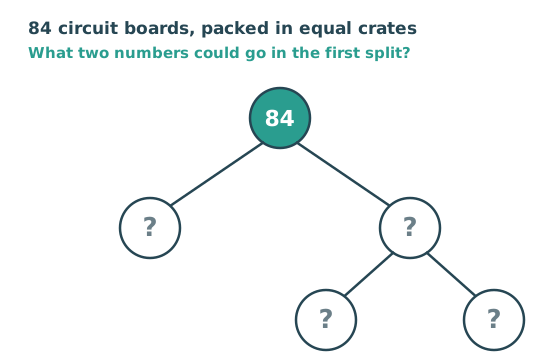
Watch me solve itI do — read one step at a time
- I want the of 60. I start by splitting it:60 = 6 × 10
The factor tree so far - 6 is not , so I break it: 6 = 2 × 3. Both 2 and 3 are prime, so I stop those branches.6 = 2 × 3
The factor tree so far - 10 is not , so I break it: 10 = 2 × 5. Both 2 and 5 are prime, so I stop.10 = 2 × 5
The factor tree so far - Now every is :60 = 2 × 2 × 3 × 5
- Using , I write it as 2² × 3 × 5. I check: 2 × 2 × 3 × 5 = 60. Correct.2 × 2 × 3 × 5 = 60
Watch out — mistakes students make here
- 20 still breaks down — a prime factorization stops only at primes.
- 4 and 10 aren't prime — keep splitting until every factor is prime.
- 8 isn't prime — break it down further into primes.
Try it with meWe do — you answer first, then check
Same steps, new numbers.
- Let's 12 together. What is one way to split 12 into two factors?
Check this step
(You might say 3 × 4.) - Is 3 ?
Check this step
Yes, so we keep it. Is 4 ? No — what is 4 split apart? (4 = 2 × 2.) - So put the together: 12 = 2 × 2 × 3. Every factor is prime, so we are done.12 = 2 × 2 × 3
On your ownYou do — solve this one by yourself
Before you start, remember:
- Remember: keep splitting until every branch is a .
Solve: Two students found different for 60. Student A started with 2 × 30. Student B started with 6 × 10. Which statement is true?
My answer
Stuck? Open one hint at a time.
Hint 1
Notice the question isn't asking which START is right — it asks what happens when both finished trees are compared.
Hint 2
Finish BOTH trees yourself: keep splitting every branch down to primes, then compare the two final lists of prime factors.
Hint 3
Student A: 60 = 2 × 30, then 30 = 2 × 15, then 15 = 3 × 5. Now finish Student B's tree from 6 × 10 and compare the prime lists.
Check my answer
The Fundamental Theorem of Arithmetic says every composite number has exactly one prime factorization. No matter how you start the factor tree, you always end with 2 × 2 × 3 × 5.
Turn & TalkSay it out loud with a partner
Mission Control needs to break the 60 supply crates into prime parts. Is 60 a or a , and how can you tell before you even start the ?
Try starting with:
- 60 is a ___ number because it has ___.60 es un número ___ porque tiene ___.
- I can tell before factoring because ___.Puedo saberlo antes de factorizar porque ___.