Touch and changeToca y cambia
Move, type, tap, or drag in the model. Watch what changes.Mueve, escribe, toca o arrastra en el modelo. Observa qué cambia.
Unit 6 · Numerical and Algebraic Expressions Unidad 6 · Expresiones numéricas y algebraicas
Write and Evaluate Algebraic ExpressionsEscribir y evaluar expresiones algebraicas
6.AT.6a ▾This lesson builds proficiency in Grade 6 mathematical standard 6.AT.6a.Esta lección desarrolla destrezas en el estándar matemático de 6.º grado 6.AT.6a.
Optional, ungraded practice. Choose ONE plan below. Work with someone or on your own; no adult signature is needed. Práctica opcional, sin calificación. Elige UN plan abajo. Trabaja con alguien o a solas; no necesitas la firma de un adulto.
Choose one plan, not all three. Each plan tells you what to do and when to stop. Switching keeps your answers.Elige un plan, no los tres. Cada plan indica qué hacer y cuándo terminar. Al cambiar, conservas tus respuestas.
Learn & practice selected: 4 focused stops and all 6 core problems, about 20 minutes. Ruta de aprendizaje: 4 paradas y los 6 problemas, unos 20 minutos.
The Photobooth is a camera you can open any time — photograph the notebook page, the scratchpad or the whiteboard, add a frame and stickers, then download or print it. It is optional, and the photo stays on this device. La cabina de fotos es una cámara que pueden abrir cuando quieran: fotografíen la página del cuaderno, el borrador o la pizarra, agreguen un marco y calcomanías, y descárguenla o imprímanla. Es opcional, y la foto se queda en este dispositivo.
💡 Draw fraction bars, tape diagrams, equations, or line up decimals together!💡 ¡Dibujen barras de fracciones, modelos o alineen decimales juntos!
Tonight we turn words into an algebraic expression, then evaluate it for a given number of students.
Esta noche convertimos palabras en una expresión algebraica y luego la evaluamos para un número dado de estudiantes.
For the grown-up helping tonightPara el adulto que ayuda hoy
Real example: a concert charges $12 for each ticket, plus a flat $50 venue fee.
Ejemplo real: un concierto cobra $12 por cada boleto, más una tarifa fija de $50 por el lugar.
Let t be the number of tickets. We want an expression for the total revenue.
Sea t el número de boletos. Queremos una expresión para los ingresos totales.
"$12 for each ticket" means 12 times t.
"$12 por cada boleto" significa 12 por t.
We write that as 12t (a number next to a letter means multiply).
Lo escribimos como 12t (un número junto a una letra significa multiplicar).
The $50 fee is added one time, no matter how many tickets sell.
La tarifa de $50 se suma una sola vez, sin importar cuántos boletos se vendan.
So we add 50.
Entonces sumamos 50.
Put the two parts together: total revenue = 12t + 50.
Junta las dos partes: ingresos totales = 12t + 50.
The 12 is the coefficient, t is the variable, and 50 is the constant.
El 12 es el coeficiente, t es la variable, y 50 es la constante.
Listen for "variable" — it means a letter that stands for an unknown number.
Escucha la palabra "variable" — significa una letra que representa un número desconocido.
Listen for "coeficiente" — it is the number in front of the letter, like the 12 in 12t.
Escucha la palabra "coeficiente" — es el número que va frente a la letra, como el 12 en 12t.
Watch the order with "less than." "5 less than t" is t − 5, not 5 − t.
Cuida el orden con "menos que". "5 menos que t" es t − 5, no 5 − t.
A one-time fee is added once and never multiplied by the variable: 4.25s + 23.50, not (4.25 + 23.50)s.
Un cargo único se suma una sola vez y nunca se multiplica por la variable: 4.25s + 23.50, no (4.25 + 23.50)s.
Change the numbers. Explain what the picture shows.Cambia los números. Explica qué muestra el dibujo.
🌐 Esta herramienta interactiva por ahora solo está en inglés. Para qué sirve: Introduce un valor en ax + b y observa cómo las palabras, la expresión y el resultado cambian juntos. Usen los pasos en español de esta tarjeta para guiarse.
Move, type, tap, or drag in the model. Watch what changes.Mueve, escribe, toca o arrastra en el modelo. Observa qué cambia.
Record one equation, value, or relationship you can see.Escribe una ecuación, un valor o una relación que puedas ver.
I notice ___ changes when ___ changes. This shows ___.Noto que ___ cambia cuando ___ cambia. Esto muestra ___.
Ask: "Where do you see the numbers from tonight's math in this model?"Pregunta: "¿Dónde ves los números de la tarea de hoy en este modelo?"
Game developers write algebraic expressions like '50x + 100' to calculate player score or coin rewards for completing x quests plus a 100-coin daily login bonus! Los desarrolladores escriben expresiones como '50x + 100' para calcular monedas o puntajes al completar x misiones más un bono diario de 100 monedas.
Combining unlike terms (like adding 3x + 5 to get 8x). Combinar términos no semejantes (como sumar 3x + 5 y obtener 8x).
Tap a word on the left, then tap its matching definition on the right! ¡Toca una palabra a la izquierda y su significado a la derecha!
Tap any card to flip and explore its definition and example. Toca cualquier tarjeta para voltearla y explorar su definición y ejemplo.
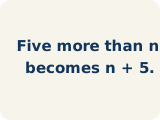
Escribir expresiones algebraicas
Escribir expresiones algebraicas
Translate words or a situation into numbers, variables, and operation symbols.
ES Traducir palabras o una situación a números, variables y símbolos de operaciones.
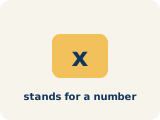
Variable
Variable
A letter that stands for a number that is unknown or can change.
ES Una letra que representa un número desconocido o que puede cambiar.
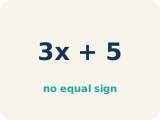
Expresión algebraica
Expresión algebraica
A math phrase that has at least one letter.
ES Una frase matemática que tiene al menos una letra.
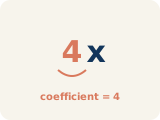
Coeficiente
Coeficiente
The number in front of a letter, like the 3 in 3x.
ES El número frente a una letra, como el 3 en 3x.
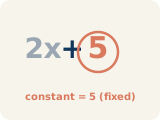
Constante
Constante
A fixed number in an expression or equation that does not change.
ES Un número fijo en una expresión o ecuación que no cambia.
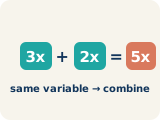
Términos semejantes
Términos semejantes
Terms with the same letter raised to the same power, like 2x and 5x.
ES Términos con la misma letra elevada a la misma potencia, como 2x y 5x.
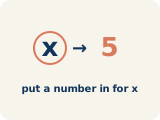
Sustituir
Sustituir
To replace a variable with a given number before working out the value.
ES Reemplazar una variable por un número dado antes de calcular el valor.
Evaluar
Evaluar
To find what an expression is worth once every variable has a number, following the order of operations.
ES Hallar cuánto vale una expresión una vez que cada variable tiene un número, siguiendo el orden de las operaciones.
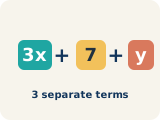
Término
Término
One part of an expression, separated from the others by + or −.
ES Una parte de una expresión, separada de las demás por + o −.
Student: explain. Partner: ask “How do you know?” Then switch. Working solo? Say or write your explanation; bring a question to a trusted adult at school.Estudiante: explica. Acompañante: pregunta «¿Cómo lo sabes?» Luego cambien. ¿Trabajas a solas? Di o escribe tu explicación; lleva una pregunta a un adulto de confianza en la escuela.
Stay at the concert, but make it simpler: a snack stand sells drinks for $5 each. Let d be the number of drinks.
Sigan en el concierto, pero háganlo más sencillo: un puesto vende bebidas a $5 cada una. Sea d el número de bebidas.
Work side by side. You ask questions; your student does the thinking. Trabajen juntos. Tú haces preguntas; tu estudiante piensa.
Write an expression for the cost of d drinks. What does "$5 each" tell you to do?
Escriban una expresión para el costo de d bebidas. ¿Qué les dice "$5 cada una" que hagan?
Now suppose they also pay a flat $3 for a cup. Add that fee to your expression.
Ahora supongan que también pagan $3 fijos por un vaso. Sumen esa tarifa a su expresión.
Check together: in 5d + 3, which part changes with the number of drinks, and which part stays the same?
Revisen juntos: en 5d + 3, ¿qué parte cambia con el número de bebidas y qué parte se queda igual?
Do these together. Start at ★ and climb to ★★★ when ready. Háganlos juntos. Empiecen en ★ y suban a ★★★ cuando estén listos.
Which expression represents 'a number d divided by 4'?¿Qué expresión representa 'un número d dividido entre 4'?
C. d ÷ 4C. d ÷ 4
Which key word tells you to multiply?¿Qué palabra clave te indica que debes multiplicar?
A. ProductA. Producto
Line 3: A verse says 'twice a number of speakers' (use s). Which expression matches?Verso 3: una estrofa dice 'el doble de un número de bocinas' (usa s). ¿Qué expresión corresponde?
A. 2s
Which expression models the total cost for h hours?¿Qué expresión modela el costo total de h horas?
B. 25 + 8h
A dog walker charges $8 for each walk plus a one-time $5 sign-up fee. Write an expression for the cost of w walks. Then find the cost of 12 walks and explain what each number in your expression means.Un paseador de perros cobra $8 por cada paseo más una cuota única de inscripción de $5. Escribe una expresión para el costo de w paseos. Luego halla el costo de 12 paseos y explica qué significa cada número de tu expresión.
8w + 5. For 12 walks: 8(12) + 5 = 96 + 5 = $101. The 8 is the cost per walk (it is multiplied by w), w is the number of walks, and 5 is the one-time fee added once.8w + 5. Para 12 paseos: 8(12) + 5 = 96 + 5 = $101. El 8 es el costo por paseo (se multiplica por w), w es el número de paseos y 5 es la cuota única que se suma una vez.
Point and name → finish the sentence → explain in your own words.Señala y nombra → completa la oración → explica con tus propias palabras.
My representation shows ___. I checked it by ___.Mi representación muestra ___. La comprobé usando ___.
Check: I answered the question, showed my thinking, labeled units, and explained why.Reviso: respondí la pregunta, mostré mi razonamiento, indiqué las unidades y expliqué por qué.
"Can you show me how you see that in your work or a quick sketch?" "¿Puedes mostrarme cómo ves eso en tu trabajo o en un dibujo rápido?"
Follow-up: Point to where each number from the problem shows up. Seguimiento: Señala dónde aparece cada número del problema.
Try the recommended mission. Student: explain; partner: ask one question, then switch. Paper drawings work for every object. Prueba la misión recomendada. Estudiante: explica; acompañante: haz una pregunta, luego cambien. Puedes dibujar los objetos en papel.
One mission is enough. You can also work solo and explain in writing.Una misión es suficiente. También puedes trabajar a solas y explicar por escrito.
Write a rule for the cost of notebooks at $3 each. Make two equivalent expressions for buying n notebooks and two $1 pencils. Test both with n = 4.
Escribe una regla para el costo de cuadernos de $3 cada uno. Haz dos expresiones equivalentes para comprar n cuadernos y dos lápices de $1. Prueba ambas con n = 4.
Show a labeled drawing, table, or equation. Your partner asks one question; working alone, write your explanation.
Muestra un dibujo con etiquetas, una tabla o una ecuación. Tu acompañante hace una pregunta; a solas, escribe tu explicación.
⏱️ About 8 minutes for the 6 problems below. The extra practice at the bottom is optional. ⏱️ Unos 8 minutos para los 6 problemas de abajo. La práctica extra al final es opcional.
A few problems to practice together. Each one has a step-by-step guide, a picture to draw on, and a space to show your work. Use Check This Problem for instant feedback — no need to finish everything at once. Unos problemas para practicar juntos. Cada uno tiene una guía paso a paso, un dibujo para trabajar y un espacio para mostrar el trabajo. Usen Revisar esta pregunta para retroalimentación al instante — no tienen que terminar todo de una vez.
Easier problems to practice the idea. Do these first together. Problemas más fáciles para practicar la idea. Hagan estos primero juntos.
Say the question in your own words. Circle what you know and underline what you need to find.
Explica la pregunta con tus propias palabras. Encierra lo que sabes y subraya lo que debes hallar.
Attach the variable to the action: 'each' means multiply by the variable; 'spent' means subtract; 'split equally' means divide.
Une la variable con la acción: 'cada' significa multiplicar por la variable; 'gastó' significa restar; 'repartir en partes iguales' significa dividir.
Start here: Ask for each row: is the amount repeating (multiply), being taken away (subtract), or being shared (divide)?
Empieza aquí: Pregunta en cada fila: ¿la cantidad se repite (multiplicar), se quita (restar) o se reparte (dividir)?
Write an algebraic expression for each real-world situation.Escribe una expresión algebraica para cada situación de la vida real.
👪 Encourage your student to show work on paper if a box feels tricky.👪 Animen a mostrar el trabajo en papel si una casilla se siente difícil.
| SituationSituación | Variable | ExpressionExpresión |
|---|---|---|
| Movie tickets cost $12 eachLos boletos de cine cuestan $12 cada uno | t = number of ticketst = cantidad de boletos |
|
| You had $50 and spent some moneyTenías $50 y gastaste parte del dinero | s = dollars spents = dólares gastados |
|
| Each student gets 3 pencils plus 2 erasersCada estudiante recibe 3 lápices más 2 borradores | n = number of studentsn = cantidad de estudiantes |
|
| A pizza is split equally among friendsUna pizza se reparte en partes iguales entre amigos | f = number of friends, pizza = 24 slicesf = cantidad de amigos, pizza = 24 rebanadas |
|
Answer key for families — compare, then talk about why.Clave de respuestas para la familia — comparen y hablen del porqué.
Not tried yet? Close this and give it one try first. A wrong first try still helps.¿Todavía no lo intentaron? Ciérrenla y hagan un intento primero. Un primer intento equivocado también ayuda.
Why:Por qué: Each situation turns into an expression by matching the action to an operation: $12 per ticket repeats for every ticket, so it is 12t; money spent is taken away from the $50, so it is 50 − s; each student receives 3 + 2 = 5 supplies, so 3n + 2n or 5n; and 24 slices shared equally is 24 ÷ f.Cada situación se convierte en una expresión al relacionar la acción con una operación: $12 por boleto se repite en cada boleto, así que es 12t; el dinero gastado se quita de los $50, así que es 50 − s; cada estudiante recibe 3 + 2 = 5 útiles, así que 3n + 2n o 5n; y 24 rebanadas repartidas en partes iguales es 24 ÷ f.
Say the question in your own words. Circle what you know and underline what you need to find.
Explica la pregunta con tus propias palabras. Encierra lo que sabes y subraya lo que debes hallar.
Translate the phrase yourself first, then compare your expression with the card's before placing it.
Traduce tú mismo la frase primero y luego compara tu expresión con la de la tarjeta antes de colocarla.
Start here: Each card already pairs a phrase with an expression. Check that the expression truly matches the phrase.
Empieza aquí: Cada tarjeta ya empareja una frase con una expresión. Revisa que la expresión de verdad coincida con la frase.
Match each word phrase to its correct algebraic expression.Une cada frase con su expresión algebraica correcta.
👪 On a phone, use Move to. On a computer, drag cards or tap a card then tap a column.👪 En el teléfono usen Mover a. En la computadora arrastren o toquen tarjeta y columna.
💡 Each card already pairs a phrase with an expression. Check that the expression truly matches the phrase.Cada tarjeta ya empareja una frase con una expresión. Revisa que la expresión de verdad coincida con la frase.
💡 Translate the phrase yourself first, then compare your expression with the card's before placing it.Traduce tú mismo la frase primero y luego compara tu expresión con la de la tarjeta antes de colocarla.
💡 First card: 'twice a number k' means two of them. Does 2k say that? If yes, it's correctly matched.Primera tarjeta: 'el doble de un número k' significa dos de ellos. ¿Dice eso 2k? Si sí, está bien emparejada.
Answer key for families — compare, then talk about why.Clave de respuestas para la familia — comparen y hablen del porqué.
Not tried yet? Close this and give it one try first. A wrong first try still helps.¿Todavía no lo intentaron? Ciérrenla y hagan un intento primero. Un primer intento equivocado también ayuda.
Why:Por qué: Checking a card means translating the phrase yourself and comparing: twice k is 2k, b divided by 5 is b ÷ 5, the sum of d and 15 is d + 15, 10 decreased by r is 10 − r, 4 more than triple c is 3c + 4, and half of h is h ÷ 2. All six pairings hold up, so every card belongs in Correctly Matched.Revisar una tarjeta significa traducir la frase por tu cuenta y comparar: el doble de k es 2k, b dividido entre 5 es b ÷ 5, la suma de d y 15 es d + 15, 10 disminuido en r es 10 − r, 4 más que el triple de c es 3c + 4, y la mitad de h es h ÷ 2. Las seis parejas se sostienen, así que todas las tarjetas van en Emparejado correctamente.
Say the question in your own words. Circle what you know and underline what you need to find.
Explica la pregunta con tus propias palabras. Encierra lo que sabes y subraya lo que debes hallar.
Watch order-flippers: 'less than' reverses what you write. Translate the phrase before hunting for its match.
Cuidado con las que invierten el orden: 'menos que' voltea lo que escribes. Traduce la frase antes de buscar su pareja.
Start here: Find the operation word in each phrase first: product, less than, increased by, twice, divided by, more than.
Empieza aquí: Busca primero la palabra de operación en cada frase: producto, menos que, aumentado en, el doble, dividido entre, más que.
Match each word phrase to its algebraic expression.Une cada frase con su expresión algebraica.
👪 Say each term out loud, then talk through which match makes sense before choosing.👪 Digan cada término en voz alta y hablen de cuál pareja tiene sentido antes de elegir.
Answer key for families — compare, then talk about why.Clave de respuestas para la familia — comparen y hablen del porqué.
Not tried yet? Close this and give it one try first. A wrong first try still helps.¿Todavía no lo intentaron? Ciérrenla y hagan un intento primero. Un primer intento equivocado también ayuda.
Why:Por qué: The key word in each phrase points straight to its match: product gives 5n, increased by gives p + 12, twice … plus 3 gives 2x + 3, divided by gives y ÷ 4, and more than gives z + 7. Only "8 less than a number w" reverses the order, so it becomes w − 8 rather than 8 − w.La palabra clave de cada frase apunta directo a su pareja: producto da 5n, aumentado en da p + 12, el doble … más 3 da 2x + 3, dividido entre da y ÷ 4, y más que da z + 7. Solo "8 menos que un número w" invierte el orden, así que queda como w − 8 y no 8 − w.
Try these once the warm-up feels easy. It's okay to use the steps and pictures. Intenten estos cuando el calentamiento sea fácil. Está bien usar los pasos y los dibujos.
Say the question in your own words. Circle what you know and underline what you need to find.
Explica la pregunta con tus propias palabras. Encierra lo que sabes y subraya lo que debes hallar.
Pick something bought or earned 'per item' for the 4, and a flat fee or starting amount for the 10.
Escoge algo comprado o ganado 'por artículo' para el 4, y una cuota fija o cantidad inicial para el 10.
Start here: 4n + 10 has two pieces: 4n repeats with n, and 10 is a one-time amount that never changes.
Empieza aquí: 4n + 10 tiene dos piezas: 4n se repite con n, y 10 es una cantidad única que nunca cambia.
Write a real-world situation that could be modeled by the expression 4n + 10. Explain what the variable n represents, what the coefficient 4 means, and what the constant 10 represents.Escribe una situación de la vida real que se pueda modelar con la expresión 4n + 10. Explica qué representa la variable n, qué significa el coeficiente 4 y qué representa la constante 10.
👪 A complete sentence with math vocabulary is the goal — not a perfect paragraph.👪 Una oración completa con vocabulario matemático es la meta — no un párrafo perfecto.
Answer key for families — compare, then talk about why.Clave de respuestas para la familia — comparen y hablen del porqué.
Not tried yet? Close this and give it one try first. A wrong first try still helps.¿Todavía no lo intentaron? Ciérrenla y hagan un intento primero. Un primer intento equivocado también ayuda.
Why:Por qué: A strong situation gives every part of 4n + 10 a job: n counts something that changes, the coefficient 4 is the amount added for each one of them, and the constant 10 is a one-time amount that stays the same. For example, if n is the number of hours you skate, 4n is the $4 charged per hour and 10 is the flat $10 rental fee.Una buena situación le da una función a cada parte de 4n + 10: n cuenta algo que cambia, el coeficiente 4 es la cantidad que se agrega por cada uno, y la constante 10 es una cantidad única que no cambia. Por ejemplo, si n es el número de horas que patinas, 4n son los $4 que se cobran por hora y 10 es la cuota fija de $10 por la renta.
Say the question in your own words. Circle what you know and underline what you need to find.
Explica la pregunta con tus propias palabras. Encierra lo que sabes y subraya lo que debes hallar.
'Twice the sum' needs parentheses around the sum; 'less than' flips the order — the subtracted number goes last.
'El doble de la suma' necesita paréntesis alrededor de la suma; 'menos que' invierte el orden y el número restado va al final.
Start here: Each phrase has TWO operations. Find both, and notice which part happens first.
Empieza aquí: Cada frase tiene DOS operaciones. Halla ambas y fíjate cuál parte ocurre primero.
Translate each two-step word phrase into an algebraic expression. Be careful with the order!Traduce cada frase de dos pasos a una expresión algebraica. ¡Cuidado con el orden!
| Word PhraseFrase verbal | Algebraic ExpressionExpresión algebraica |
|---|---|
| 5 more than triple a number x5 más que el triple de un número x |
|
| twice the sum of a number y and 4el doble de la suma del número y con 4 |
|
| 10 less than the product of 7 and a number z10 menos que el producto de 7 y un número z |
|
Answer key for families — compare, then talk about why.Clave de respuestas para la familia — comparen y hablen del porqué.
Not tried yet? Close this and give it one try first. A wrong first try still helps.¿Todavía no lo intentaron? Ciérrenla y hagan un intento primero. Un primer intento equivocado también ayuda.
Why:Por qué: Each phrase holds two operations, and the wording says which one happens first. "Triple a number x" builds 3x and then 5 is added, giving 3x + 5; "twice the sum" means the addition happens first, so it needs parentheses as 2(y + 4); and "10 less than the product" reverses the order, giving 7z − 10.Cada frase tiene dos operaciones, y las palabras indican cuál ocurre primero. "El triple de un número x" forma 3x y luego se le suma 5, lo que da 3x + 5; "el doble de la suma" indica que la suma ocurre primero, así que necesita paréntesis: 2(y + 4); y "10 menos que el producto" invierte el orden y da 7z − 10.
Say the question in your own words. Circle what you know and underline what you need to find.
Explica la pregunta con tus propias palabras. Encierra lo que sabes y subraya lo que debes hallar.
Substitute each value of s and evaluate.
Sustituye cada valor de s y evalúa.
Start here: Write the per-student term and the one-time constant separately.
Empieza aquí: Escribe por separado el término por estudiante y la constante del cargo único.
Field day needs one $4.25 item per student plus a one-time $23.50 shipping fee. Write the expression, then find the cost for 30 students AND for 60 students. Does doubling the students double the cost? Explain.El día de campo necesita un artículo de $4.25 por estudiante más un cargo único de envío de $23.50. Escribe la expresión, luego halla el costo para 30 estudiantes Y para 60 estudiantes. ¿Duplicar los estudiantes duplica el costo? Explica.
Answer key for families — compare, then talk about why.Clave de respuestas para la familia — comparen y hablen del porqué.
Not tried yet? Close this and give it one try first. A wrong first try still helps.¿Todavía no lo intentaron? Ciérrenla y hagan un intento primero. Un primer intento equivocado también ayuda.
Why:Por qué: Answers will vary. Check that the reasoning is explained in a complete sentence.Las respuestas varían. Revisen que el razonamiento se explique en una oración completa.
Optional. Only if your student wants more — these are bonus problems. Opcional. Solo si tu estudiante quiere más — son problemas adicionales.
Say the question in your own words. Circle what you know and underline what you need to find.
Explica la pregunta con tus propias palabras. Encierra lo que sabes y subraya lo que debes hallar.
Find the operation word first, then write your own expression before you go looking for the card that matches it.
Busca primero la palabra de la operación y luego escribe tu propia expresión antes de ir a buscar la tarjeta que le corresponde.
Start here: Each lyric describes what to do to an unknown amount, and the expression is that description written in symbols.
Empieza aquí: Cada letra describe qué hacer con una cantidad desconocida, y la expresión es esa descripción escrita con símbolos.
Match each studio lyric to its algebraic expression.Une cada letra del estudio con su expresión algebraica.
Answer key for families — compare, then talk about why.Clave de respuestas para la familia — comparen y hablen del porqué.
Not tried yet? Close this and give it one try first. A wrong first try still helps.¿Todavía no lo intentaron? Ciérrenla y hagan un intento primero. Un primer intento equivocado también ayuda.
Why:Por qué: Translating each lyric produces its match: product gives 6f, more than gives e + 10, decreased by gives q − 4, divided by gives d ÷ 2, and sum gives s + 11. The trickiest is "3 less than twice a number of beats b," where "twice" builds 2b first and "less than" puts the 3 after it, giving 2b − 3.Traducir cada letra produce su pareja: producto da 6f, más que da e + 10, disminuido en da q − 4, dividido entre da d ÷ 2, y suma da s + 11. La más difícil es "3 menos que el doble de un número de ritmos b", donde "el doble" forma primero 2b y "menos que" coloca el 3 después, lo que da 2b − 3.
Say the question in your own words. Circle what you know and underline what you need to find.
Explica la pregunta con tus propias palabras. Encierra lo que sabes y subraya lo que debes hallar.
Test with plain numbers: the product of 6 and 2 is 12. Which operation turned 6 and 2 into 12?
Pruébalo con números simples: el producto de 6 y 2 es 12. ¿Qué operación convirtió 6 y 2 en 12?
Start here: Underline the key word 'product.' Every operation has a code word — which operation does 'product' name?
Empieza aquí: Subraya la palabra clave 'producto'. Cada operación tiene su palabra clave: ¿qué operación nombra 'producto'?
Which expression represents 'the product of 6 and a number n'?¿Qué expresión representa 'el producto de 6 y un número n'?
👪 Read the question together, then let your student pick an answer before you discuss why.👪 Lean la pregunta juntos; dejen que su estudiante elija antes de hablar del porqué.
Answer key for families — compare, then talk about why.Clave de respuestas para la familia — comparen y hablen del porqué.
Not tried yet? Close this and give it one try first. A wrong first try still helps.¿Todavía no lo intentaron? Ciérrenla y hagan un intento primero. Un primer intento equivocado también ayuda.
Why:Por qué: 'Product' means multiplication, so the product of 6 and n is 6n.'Producto' significa multiplicación, así que el producto de 6 y n es 6n.
Say the question in your own words. Circle what you know and underline what you need to find.
Explica la pregunta con tus propias palabras. Encierra lo que sabes y subraya lo que debes hallar.
Try it with numbers: '9 less than 20' means 20 − 9, not 9 − 20. Start with the amount you're taking from.
Pruébalo con números: '9 menos que 20' significa 20 − 9, no 9 − 20. Empieza con la cantidad de la que quitas.
Start here: 'Less than' is a tricky phrase — it flips the order of what you write.
Empieza aquí: 'Menos que' es una frase tramposa: invierte el orden de lo que escribes.
Which expression represents '9 less than a number y'?¿Qué expresión representa '9 menos que un número y'?
Answer key for families — compare, then talk about why.Clave de respuestas para la familia — comparen y hablen del porqué.
Not tried yet? Close this and give it one try first. A wrong first try still helps.¿Todavía no lo intentaron? Ciérrenla y hagan un intento primero. Un primer intento equivocado también ayuda.
Why:Por qué: 'Less than' means subtract from the number, so it's y − 9.'Menos que' significa restar del número, así que es y − 9.
Say the question in your own words. Circle what you know and underline what you need to find.
Explica la pregunta con tus propias palabras. Encierra lo que sabes y subraya lo que debes hallar.
Check with numbers: the sum of 2 and 15 is 17. What did you do to 2 and 15 to get 17?
Compruébalo con números: la suma de 2 y 15 es 17. ¿Qué le hiciste a 2 y 15 para obtener 17?
Start here: Circle the key word 'sum.' Which operation gives you a sum?
Empieza aquí: Encierra la palabra clave 'suma'. ¿Qué operación da una suma?
Which expression represents 'the sum of a number m and 15'?¿Qué expresión representa 'la suma de un número m y 15'?
Answer key for families — compare, then talk about why.Clave de respuestas para la familia — comparen y hablen del porqué.
Not tried yet? Close this and give it one try first. A wrong first try still helps.¿Todavía no lo intentaron? Ciérrenla y hagan un intento primero. Un primer intento equivocado también ayuda.
Why:Por qué: 'Sum' means addition, so the sum of m and 15 is m + 15.'Suma' significa adición, así que la suma de m y 15 es m + 15.
Say the question in your own words. Circle what you know and underline what you need to find.
Explica la pregunta con tus propias palabras. Encierra lo que sabes y subraya lo que debes hallar.
8 × 6 = 48.
8 × 6 = 48.
Start here: Replace n with 6.
Empieza aquí: Reemplaza n por 6.
The expression 8n + 15 gives the cost of n tickets plus a fee. What is the cost for 6 tickets?La expresión 8n + 15 da el costo de n boletos más una cuota. ¿Cuál es el costo de 6 boletos?
Answer key for families — compare, then talk about why.Clave de respuestas para la familia — comparen y hablen del porqué.
Not tried yet? Close this and give it one try first. A wrong first try still helps.¿Todavía no lo intentaron? Ciérrenla y hagan un intento primero. Un primer intento equivocado también ayuda.
Why:Por qué: Substitute n = 6: 8 × 6 + 15 = 48 + 15 = $63.Sustituye n = 6: 8 × 6 + 15 = 48 + 15 = $63.
Say the question in your own words. Circle what you know and underline what you need to find.
Explica la pregunta con tus propias palabras. Encierra lo que sabes y subraya lo que debes hallar.
4.25 × 10 = ?
4.25 × 10 = ?
Start here: Replace s with 10.
Empieza aquí: Reemplaza s por 10.
Evaluate 4.25s + 23.50 when s = 10.Evalúa 4.25s + 23.50 cuando s = 10.
Answer key for families — compare, then talk about why.Clave de respuestas para la familia — comparen y hablen del porqué.
Not tried yet? Close this and give it one try first. A wrong first try still helps.¿Todavía no lo intentaron? Ciérrenla y hagan un intento primero. Un primer intento equivocado también ayuda.
Why:Por qué: Substitute s = 10: 4.25 × 10 + 23.50. Multiply first: 42.50, then add: 42.50 + 23.50 = $66.00.Sustituye s = 10: 4.25 × 10 + 23.50. Multiplica primero: 42.50, luego suma: 42.50 + 23.50 = $66.00.
Say the question in your own words. Circle what you know and underline what you need to find.
Explica la pregunta con tus propias palabras. Encierra lo que sabes y subraya lo que debes hallar.
'More than' is an addition signal, and addition can be written in either order.
'Más que' es una señal de suma, y la suma se puede escribir en cualquier orden.
Start here: Find the key word in the phrase — it names the operation you need.
Empieza aquí: Busca la palabra clave de la frase: ella nombra la operación que necesitas.
Line 1: A lyric says '7 more than a number of beats n.' Which expression matches?Verso 1: una letra dice '7 más que un número de tiempos n'. ¿Qué expresión corresponde?
Answer key for families — compare, then talk about why.Clave de respuestas para la familia — comparen y hablen del porqué.
Not tried yet? Close this and give it one try first. A wrong first try still helps.¿Todavía no lo intentaron? Ciérrenla y hagan un intento primero. Un primer intento equivocado también ayuda.
Why:Por qué: 'More than' means addition, so '7 more than n' is n + 7.'Más que' significa adición, así que '7 más que n' es n + 7.
Say the question in your own words. Circle what you know and underline what you need to find.
Explica la pregunta con tus propias palabras. Encierra lo que sabes y subraya lo que debes hallar.
Decide which quantity you start with. '5 less than x' begins at x.
Decide con qué cantidad empiezas. '5 menos que x' empieza en x.
Start here: 'Less than' is a subtraction signal, and subtraction is not reversible.
Empieza aquí: 'Menos que' es una señal de resta, y la resta no se puede invertir.
Line 2: The chorus says '5 less than a number of tracks x.' Which expression matches?Verso 2: el coro dice '5 menos que un número de pistas x'. ¿Qué expresión corresponde?
Answer key for families — compare, then talk about why.Clave de respuestas para la familia — comparen y hablen del porqué.
Not tried yet? Close this and give it one try first. A wrong first try still helps.¿Todavía no lo intentaron? Ciérrenla y hagan un intento primero. Un primer intento equivocado también ayuda.
Why:Por qué: 'Less than' subtracts from the number: start with x and take away 5, so x − 5.'Menos que' resta del número: empieza con x y quítale 5, así que es x − 5.
Pick a game and play as a team. Nothing here is timed, and every game can be replayed as many times as you like. Escojan un juego y jueguen en equipo. Nada aquí tiene cronómetro, y pueden repetir cada juego cuantas veces quieran.
Choose ONE game. Quick Quiz practices this lesson; the other games review related skills. Play together or solo, without a timer. Elige UN juego. Reto rápido practica esta lección; los demás repasan temas relacionados. Juega acompañado o a solas, sin cronómetro.
Flip two cards to find each problem's twin answer. Fewer flips = sharper memory! Volteen dos tarjetas para encontrar la pareja de cada problema. ¡Menos vueltas = mejor memoria!
Matches: 0 / 4 · Flips: 0 Parejas: 0 / 4 · Vueltas: 0
🎉 All twins found! Can you beat your flip count on a rematch?¡Encontraron todas las parejas! ¿Pueden lograrlo con menos vueltas en la revancha?
Take turns — student answers one, then a family member answers the next. Watch for the trick statements! Por turnos: el estudiante responde una y luego un familiar responde la siguiente. ¡Cuidado con las trampas!
Tap a card, then tap the bin it belongs in. Talk it through before you tap! Toquen una tarjeta y luego el cesto al que pertenece. ¡Conversen antes de tocar!
Everyone votes and says WHY. Then tap to see what the math says — sometimes it is a tie! Todos votan y dicen POR QUÉ. Luego toquen para ver qué dicen las matemáticas: ¡a veces es empate!
🔎 What the math saysLo que dicen las matemáticas
Reinforce tonight's topic with a quick family game. You ask; your student decides! Refuercen el tema de hoy con un juego rápido en familia. ¡Ustedes preguntan; su estudiante decide!
🎮 Play together! Substitute the value, then follow order of operations. 🎮 ¡Jueguen juntos! Sustituyan el valor, luego sigan el orden de operaciones.
The bigger review game for tonight's lesson — sort, match and choose. A wrong answer gives a hint and lets your student try again. No timer. El juego de repaso más grande para la lección de hoy — clasificar, emparejar y elegir. Si se equivocan, reciben una pista y lo intentan otra vez. Sin cronómetro.
Explain one answer aloud or on paper: “I got ___ because ___. I checked by ___.” Include your strategy and units. Then you are done.Explica una respuesta en voz alta o en papel: “Obtuve ___ porque ___. Comprobé usando ___.” Incluye tu estrategia y las unidades. Después termina.
Name one strategy that helped, or one question to ask next time. You can stop here; no adult signature is needed.
Di una estrategia que te ayudó o una pregunta para la próxima vez. Puedes terminar aquí; no necesitas la firma de un adulto.
Answers save automatically on this device. Tap Check This Problem anytime. Las respuestas se guardan solas en este dispositivo. Toquen Revisar esta pregunta cuando quieran.
These extras are not required. Photos, recordings and reflections stay on this device. To send anything to Mr. Neft, use ClassDojo.Estos extras no son obligatorios. Las fotos, grabaciones y reflexiones quedan en este dispositivo. Para enviar algo al Sr. Neft, usa ClassDojo.
Saved on:Guardado el:
🔥 1-Night StreakRacha de 1 noche
Question draft (not sent):Borrador de pregunta (no enviado):
Family reflection:Reflexión familiar:
Student Work Photo:Foto del trabajo:
Student Voice Memo:Nota de voz del estudiante:
A personal record of practice for . Saved on this device; not submitted to the teacher.
Practice partner (optional)
Date
Use this as a photobooth for the work itself: point the camera at tonight's notebook page, the scratchpad or the whiteboard and take the picture — or pose holding it up. Choose a frame, add stickers, then download it, print it, or add it to your optional reflection. The photo is never uploaded; it stays on this device. Úsenla como cabina de fotos del trabajo: apunten la cámara a la página del cuaderno, al borrador o a la pizarra y tomen la foto, o posen sosteniéndola. Elijan un marco, agreguen calcomanías y luego descárguenla, imprímanla o agréguenla a la reflexión opcional. La foto nunca se sube a internet; se queda en este dispositivo.
Camera Ready!¡Cámara lista!
Tap “Start Camera” to photograph tonight’s work, or use “Upload Work” below. The photo stays on this device.Toca “Iniciar Cámara” para fotografiar el trabajo de hoy, o usa “Subir Foto”. La foto se queda en este dispositivo.
Holding your open notebook or paper up next to your smile makes the best shot! You can also snap a photo of just your written work. ¡Sostener el cuaderno abierto junto a su sonrisa crea la mejor foto! También pueden tomar la foto solo de su trabajo escrito.
What key word do you see? Does it tell us to add, subtract, or multiply?
¿Qué palabra clave ves? ¿Nos dice sumar, restar o multiplicar?
Which number stays the same no matter what, and which one changes?
¿Qué número se queda igual pase lo que pase, y cuál cambia?
Let's read the phrase out loud and write it one piece at a time.
Leamos la frase en voz alta y escribámosla parte por parte.
"5 less than a number" means 5 minus the number.
"5 menos que un número" significa 5 menos el número.
Just put the numbers in the order you read them.
Solo pon los números en el orden en que los lees.
A letter next to a number means add them.
Una letra junto a un número significa sumarlos.
These links go to specific videos and lessons about tonight's topic — not general math pages. Estos enlaces van a videos y lecciones específicas sobre el tema de hoy — no páginas generales.