Write and Evaluate Algebraic Expressions
I can write an algebraic expression for a real situation and evaluate it for a given value of the variable.
How to Use This Deck
Click Present or press F11 for fullscreen. Use arrow keys to advance.
Blue boxes show exactly what to say, ask, and how long to spend.
Text boxes, polls, and drag-sort save automatically in the browser.
Press N or click 📝 in the toolbar for pacing tips and answers.
Launch the full HTML activity for independent practice.
File → Print or the print button for handout copies.
🎯 Content Objective / Objetivo de contenido
I can write an algebraic expression for a real situation and evaluate it for a given value of the variable.
Today's Flow
Total pacing: ~45 min · Progress bar at top tracks your place
LAUNCH
⏱ ~10 min
⏱️ 3 MIN · THINK-PAIR-SHARE
The items cost $1.50, $12.95 and $0.65 per student, plus one $23.50 shipping fee. Which of those numbers gets multiplied by the number of students, and which does not — and why?
Check for Understanding #1
Teacher: If >30% thumbs down, re-teach with a fresh example before moving on.
Class Field Day
Evelyn is helping to plan the sixth-grade field day. The committee will order the items shown for each student participating in field day. They do not yet know how many students will be participating. The shipping cost for all items is a one-time cost of $23.50. What expression can Evelyn use to determine how much the committee will need to purchase the items?
Concept Launch
💡 How do we turn words into an expression?
An algebraic expression uses numbers, a variable (a letter for an unknown number), and operations. We read a word phrase and write it with math symbols.
Writing & Evaluating Algebraic Expressions. 1. Define the variable to represent the unknown quantity. 2. Translate mathematical phrases into operations, coefficients, and constants. 3. Evaluate by substituting given numerical values for the variable
Check for Understanding #2
Teacher: If >30% thumbs down, re-teach with a fresh example before moving on.
Your turn — now evaluate it
VOCABULARY
⏱ ~8 min
| Term / Término | Meaning / Significado | Example / Ejemplo | Visual |
|---|---|---|---|
| Write Algebraic Expressions Escribir expresiones algebraicas |
Translate words or a situation into numbers, variables, and operation symbols. Traducir palabras o una situación a números, variables y símbolos de operaciones. |
Five more than n becomes n + 5. | |
| Variable Variable |
A letter that stands for a number that is unknown or can change. Una letra que representa un número desconocido o que puede cambiar. |
In 5t + 20, t could be hours worked — if t = 3, the expression equals 35; if t = 8, it equals 60 | |
| Algebraic Expression Expresión algebraica |
A math phrase that has at least one letter. Una frase matemática que tiene al menos una letra. |
3n + 7 means 'triple a number, then add 7' — it has a variable (n), a coefficient (3), and a constant (7) | |
| Coefficient Coeficiente |
The number in front of a letter, like the 3 in 3x. El número frente a una letra, como el 3 en 3x. |
In 8x, the coefficient 8 means '8 groups of x' — if x = 3, then 8x = 8 × 3 = 24 | |
| Constant Constante |
A fixed number in an expression or equation that does not change. Un número fijo en una expresión o ecuación que no cambia. |
In 3n + 7, the 7 never changes no matter what n is — like a flat fee that stays the same | |
| Like terms Términos semejantes |
Terms with the same letter raised to the same power, like 2x and 5x. Términos con la misma letra elevada a la misma potencia, como 2x y 5x. |
4x + 2x = 6x (like terms, same variable); but 4x + 2y cannot be combined (different variables) |
Which Word Fits?
Turn the words into numbers, operations and a ___.
Use It In a Sentence
Check for Understanding #3
Teacher: If >30% thumbs down, re-teach with a fresh example before moving on.
Turn & Talk — Launch
The items cost $1.50, $12.95 and $0.65 per student, plus one $23.50 shipping fee. Which of those numbers gets multiplied by the number of students, and which does not — and why?
👂 Listen For
Students say the $1.50, $12.95 and $0.65 prices are each paid once per student, so each is multiplied by the number of students s (1.50s + 12.95s + 0.65s, or 15.10s), and the $23.50 shipping fee is paid once for the whole order, so it is a constant that is added, not multiplied: 15.10s + 23.50.
Extend: If each student also gets a $2.00 water bottle and the school pays a one-time $10 setup fee, how does your expression change? Explain which new number gets a variable and which does not.
EXPLORE & PRACTICE
⏱ ~18 min
Visual Modeling Workspace
Use the drawing tray below to annotate the visual model. Teacher: say "Click to reveal" on key steps.
Explore Activity
Read each word phrase and sort it into the correct algebraic expression.
✍️ Explore Discourse
What key words helped you decide which operation to use? How can the same phrase be written differently?
Whiteboard Moment
Show your work clearly. Be ready to explain your thinking to a partner.
Turn & Talk — Explore
How do you turn words into an expression? Why does '12 less than a number g' become g − 12 and not 12 − g?
👂 Listen For
A strong answer matches key words to operations (sum/more than = add, less than = subtract, product = multiply) and explains '12 less than g' starts with g, giving g − 12.
Extend: Translate 'twice the sum of a number y and 4' and explain why it needs parentheses. How is it different from 'twice a number y, plus 4'?
Practice Check A
The expression 8n + 15 gives the cost of n tickets plus a fee. What is the cost for 6 tickets?
✍️ Show Your Work
Explain why your answer is correct using today's vocabulary.
Practice Check B
Which expression represents 'the product of 6 and a number n'?
✍️ Show Your Work
Explain why your answer is correct using today's vocabulary.
Equivalent Ratio Sort
Complete the interactive activity using today's strategy.
✍️ Justify Your Thinking
Match each word phrase to its correct algebraic expression.
A classmate turned in the work below. One step has a mistake. Read every step, find it, name it, and fix it.
Choose ONE option to show what you know — then do it in the workspace below.
Use evidence from today's lesson to complete each frame.
Today's key idea is: "Writing & Evaluating Algebraic Expressions. 1. Define the variable to represent the unknown quantity. 2. Translate mathematical phrases into operations, coefficients, and constants. 3. Evaluate by substituting given numerical values for the variable" — and it works because ___.
Because Write Algebraic Expressions means ___, but a tricky part is ___, so I have to ___.
A common mistake with Write Algebraic Expressions is ___. It happens because ___, and the fix is ___.
I can prove my answer is correct by ___, using Variable to check my work.
✍️ TWR · WRITE 3 SENTENCES · 7 MIN
Writing & Evaluating Algebraic Expressions. 1. Define the variable to represent the unknown quantity. 2. Translate mathematical phrases into operations, coefficients, and constants. 3. Evaluate by substituting given numerical values for the variable because ___
Writing & Evaluating Algebraic Expressions. 1. Define the variable to represent the unknown quantity. 2. Translate mathematical phrases into operations, coefficients, and constants. 3. Evaluate by substituting given numerical values for the variable but ___
Writing & Evaluating Algebraic Expressions. 1. Define the variable to represent the unknown quantity. 2. Translate mathematical phrases into operations, coefficients, and constants. 3. Evaluate by substituting given numerical values for the variable so ___
🌱 TWR · GROW THE KERNEL · 6 MIN
Answer these to add detail
Sentence starters (tap to use)
Student Workspace
Read each word phrase and sort it into the correct algebraic expression.
| Column A | Column B |
|---|---|
✏️ Sketch Your Strategy
Differentiation Paths
Step-by-step with a worked model and sentence frames.
Which expression represents 'the product of 6 and a number n'?
Core practice aligned to the standard.
Extension with error analysis or multi-step reasoning.
Partner Activity
Work with your partner on the practice problems at your differentiation path level. Explain each step using math vocabulary.
Check for Understanding #4
Teacher: If >30% thumbs down, re-teach with a fresh example before moving on.
Real-World Connection
🌍 Math in the Wild
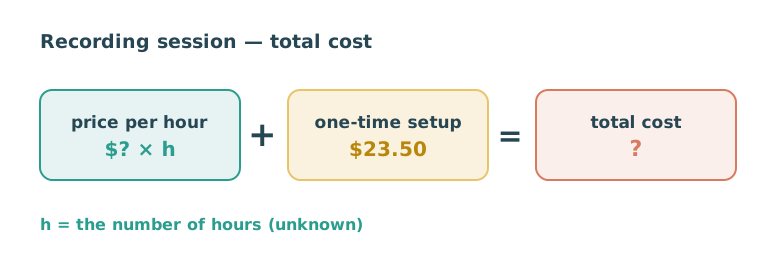
A music studio charges a $25 setup fee plus $8 per hour of recording time. Let h represent the number of hours.
✍️ Connection Reasoning
Write an expression for the total cost. What does each part of the expression represent?
The total cost is ___ + ___h. The ___ represents the ___ and ___h represents the ___.
Turn & Talk — Connect
A studio charges a $25 setup fee plus $8 per recording hour. With h hours, what expression models the cost, and what does each part represent?
👂 Listen For
Students write 25 + 8h, identify 25 as the constant setup fee and 8 as the coefficient (cost per hour) multiplying the variable h.
Extend: Another studio charges no setup fee but $11 per hour: 11h. For how many hours is the first studio (25 + 8h) the better deal? Justify your reasoning.
Summarize: Write and Evaluate Algebraic Expressions
Writing & Evaluating Algebraic Expressions. 1. Define the variable to represent the unknown quantity. 2. Translate mathematical phrases into operations, coefficients, and constants. 3. Evaluate by substituting given numerical values for the variable
In your own words:
CLOSURE & REFLECT
⏱ ~8 min
Today I learned that ___ because ___.
One thing I am still not sure about is ___.
A club orders one $4.25 shirt for each student plus a one-time $23.50 shipping fee. Write the expression for s students, then find the cost for 30 students.
Bonus Exit Check
Which expression represents '9 less than a number y'?
✍️ Show Your Work
Explain why your answer is correct using today's vocabulary.
Reflection & Self-Assessment
Continue Learning
Launch the Full Interactive Activity
Students continue practice in the HTML lesson engine with auto-check, hints, and differentiation.
Family Connection
Share tonight's family homework and discuss one vocabulary word at home.
Open Family Homework ↗Teacher Notes
⏱️ Pacing Guide
- Launch & vocab: 12 min
- I Do / We Do / You Do: 15 min
- Explore & practice: 15 min
- Connect & closure: 8 min
Total: ~45 min
🎯 Listen For · Common Errors
• Students say the $1.50, $12.95 and $0.65 prices are each paid once per student, so each is multiplied by the number of students s (1.50s + 12.95s + 0.65s, or 15.10s), and the $23.50 shipping fee is paid once for the whole order, so it is a constant that is added, not multiplied: 15.10s + 23.50.
• A strong answer matches key words to operations (sum/more than = add, less than = subtract, product = multiply) and explains '12 less than g' starts with g, giving g − 12.
• Students write 25 + 8h, identify 25 as the constant setup fee and 8 as the coefficient (cost per hour) multiplying the variable h.
• Listen for students naming a specific strategy tied to 6.AT.6a — not just "I multiplied." They should connect steps to the key idea.
Common mistake: A common mistake in Write Algebraic Expressions is treating 'each' or 'per' as if it means add instead of multiply, and attaching the variable to the wrong number. For 'a $25 setup fee plus $8 per hour, h,' students often write 25 + 8 + h (adding all three numbers) or 25h + 8 (multiplying the flat fee by h) instead of the correct 8h + 25. Since $8 applies per hour, it must multiply the variable (8h), and the flat $25 fee is a constant added only once — check that the per-unit rate, not the flat fee, is the number multiplied by the variable.
Answer Key (Teacher Appendix)
Hide this slide during presentation or move to the end of your copy.
✓ Practice 1: $63 — Substitute n = 6: 8 × 6 + 15 = 48 + 15 = $63.
✓ Practice 2: 6n — 'Product' means multiplication, so the product of 6 and n is 6n.
✓ Practice 3: y − 9 — 'Less than' means subtract from the number, so it's y − 9.
✓ Practice 4: m + 15 — 'Sum' means addition, so the sum of m and 15 is m + 15.
✓ Exit ticket: 4.25s + 23.50; for s = 30 the cost is $151.00 — “Each student” attaches to the variable: 4.25s. The shipping fee is charged once, so it is a constant: 4.25s + 23.50. Substituting s = 30 gives 4.25 × 30 + 23.50 = 127.50 + 23.50 = $151.00.