Unit 8 · Standard 6.AT.9
🔑 Write and Represent Inequalities — Vocab Explorer
① Word Wall
Look at the picture, read the meaning, and tap 🔊 to hear each word.
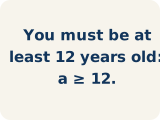
ES Escribir desigualdades
Represent a range of possible values with <, >, ≤, or ≥.
Representar un rango de valores posibles con <, >, ≤ o ≥.

ES Desigualdad
A math sentence that compares two sides with <, >, ≤, or ≥.
Una oración matemática que compara dos lados con <, >, ≤ o ≥.
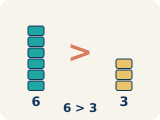
ES Mayor que
The > sign, showing one number is bigger.
El signo >, que muestra que un número es mayor.
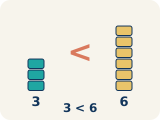
ES Menor que
The < sign, showing one number is smaller.
El signo <, que muestra que un número es menor.
ES Al menos / A lo más
'At least' means ≥. 'At most' means ≤.
'Al menos' significa ≥. 'Como máximo' significa ≤.

ES Variable
A letter that stands for a number that is unknown or can change.
Una letra que representa un número desconocido o que puede cambiar.
ES No más de
A phrase meaning less than or equal to (≤).
Una frase que significa menor o igual que (≤).
ES Restricción
A limit that a solution must satisfy.
Un límite que una solución debe cumplir.

ES Conjunto solución
All the values that make an inequality true.
Todos los valores que hacen verdadera una desigualdad.
② Match it
Tap a word, then tap its meaning.
③ Fill in the blank
Use the word bank to finish each sentence.
- 1Use <, >, ≤ or ≥ when the answer is a of values rather than one.
- 2A math sentence comparing values with <, >, ≤, or ≥ is an .
- 3The symbol > that means one value is larger than another means .
- 4The symbol < that means one value is smaller than another means .
- 5'At least' means greater than or equal to, and 'at most' means than or equal to.
- 6A letter that stands for an unknown number is a .
- 7The phrase that means less than or equal to is "no more than," written with the symbol.
- 8A limit that every solution must satisfy is a .
- 9All the values that make an inequality true form its .
④ Use it in a sentence
Pick one word and finish the sentence in your own words.
A is .