Google Innovator Telemetry ยท Real-Time Micro-Clustering

โšก Real-Time Diagnostic Pulse Engine

Gemini automatically scans 3-minute entry responses and clusters students by specific root-cause misconception patterns, avoiding static ability tracking.

Cluster 1
Procedural Mastery (4 Students)

Students mastered basic algorithmic steps. Assigned to Station C for Far-Transfer Challenge Problem.

Target: Multi-Step Real World Synthesis
Cluster 2
Root-Cause Misconception (5 Students)

Confusing operation procedures or place-value models. Direct intervention with Teacher Studio.

Target: Epistemic Surgical Questioning
Cluster 3
Representation Gap (5 Students)

Struggling to connect abstract symbols to visual models. Assigned to Astra Dual-Coding Manipulative Sandbox.

Target: Tactile-to-Symbolic Schema Bridge
Grouping verified with 0% historical tracking bias

๐ŸŽฏ Today's Learning Objectives

Read through today's Content Goal and Language Goal. Click ๐Ÿ”Š to listen via Read Along audio narration!

Content Objective

I can find the greatest common factor (GCF) of two numbers by listing or comparing their factors.
Student finding GCF by listing factors
๐Ÿ”ข Visual Model: Student listing factor pairs on her desk grid mat to compare GCF.
๐Ÿ’ฌ Talk about it
In your own words, what will you be able to do by the end of this lesson? Give one example.

Language Objective

I can explain how I found the GCF using the words factor, common factor, divisible, and greatest common factor.
Students explaining GCF math terms
๐Ÿ—ฃ๏ธ Visual Model: Student partners pointing to vocabulary callout badges and using academic sentence frames.
๐Ÿ’ฌ Talk about it
Which math words in this goal are new to you? How would you explain this goal to a partner?

Content Objective

I can multiply and divide fractions by whole numbers and fractions using visual fraction bar models.

Student modeling fraction division
๐Ÿงฉ Visual Model: Student dividing fraction bar strips on her desk grid mat to solve quotient problems.
๐Ÿ’ฌ Talk about it
In your own words, what will you be able to do by the end of this lesson? Give one example.

Language Objective

I can describe fraction division using academic terms like numerator, denominator, reciprocal, and quotient.

Students explaining fraction terms
๐Ÿ—ฃ๏ธ Visual Model: Student partners pointing to fraction vocabulary callout badges.
๐Ÿ’ฌ Talk about it
Which math words in this goal are new to you? How would you explain this goal to a partner?

Content Objective

I can model equivalent ratios and unit rates using double number lines, ratio tables, and tape diagrams.

Student modeling ratio lines
๐Ÿ“Š Visual Model: Student plotting ratio points on double number line strips.
๐Ÿ’ฌ Talk about it
In your own words, what will you be able to do by the end of this lesson? Give one example.

Language Objective

I can state ratio relationships using phrases like "for every X units, there are Y units" and "proportional rate".

Students explaining ratio phrases
๐Ÿ—ฃ๏ธ Visual Model: Student partners reciting ratio sentence starters.
๐Ÿ’ฌ Talk about it
Which math words in this goal are new to you? How would you explain this goal to a partner?

Content Objective

I can evaluate algebraic expressions and simplify terms using the order of operations and distributive property.
Student simplifying expression
โœจ Visual Model: Student applying distributive tile arrays to simplify expressions.
๐Ÿ’ฌ Talk about it
In your own words, what will you be able to do by the end of this lesson? Give one example.

Language Objective

I can identify expression parts using math vocabulary terms like term, coefficient, constant, and exponent.

Students labeling expression parts
๐Ÿ—ฃ๏ธ Visual Model: Student partners pointing to coefficient and term callout badges.
๐Ÿ’ฌ Talk about it
Which math words in this goal are new to you? How would you explain this goal to a partner?

Content Objective

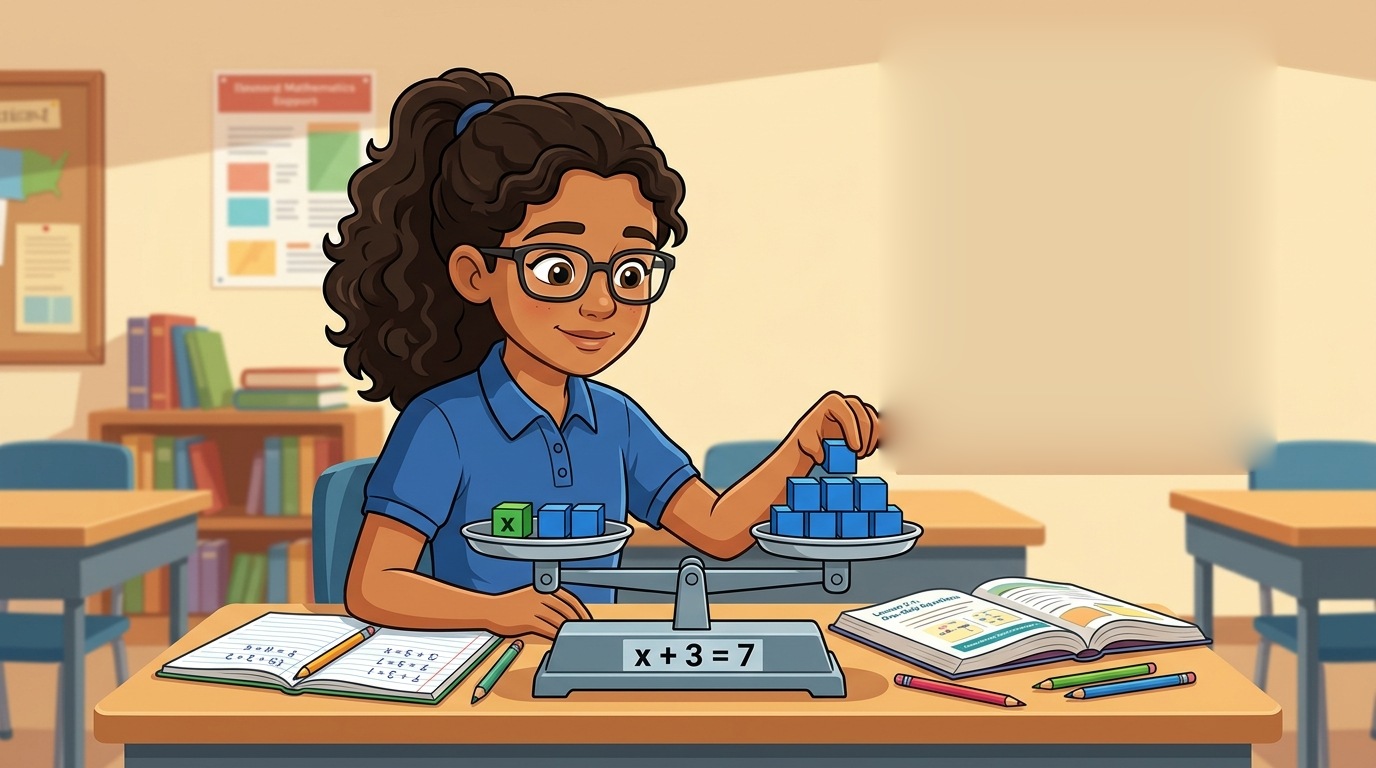
I can solve one-step algebraic equations (x + 3 = 7) by isolating the variable x using an interactive balance scale model.

Student balancing algebraic scale
โš–๏ธ Visual Model: Student avatar actively balancing an algebraic scale with variable blocks to isolate x.
๐Ÿ’ฌ Talk about it
In your own words, what will you be able to do by the end of this lesson? Give one example.

Language Objective

I can explain equation-solving steps using academic vocabulary terms like variable, isolate, and inverse operation.

Students explaining algebra
๐Ÿ—ฃ๏ธ Visual Model: Student partners discussing algebraic balance steps using sentence frames.
๐Ÿ’ฌ Talk about it
Which math words in this goal are new to you? How would you explain this goal to a partner?

Content Objective

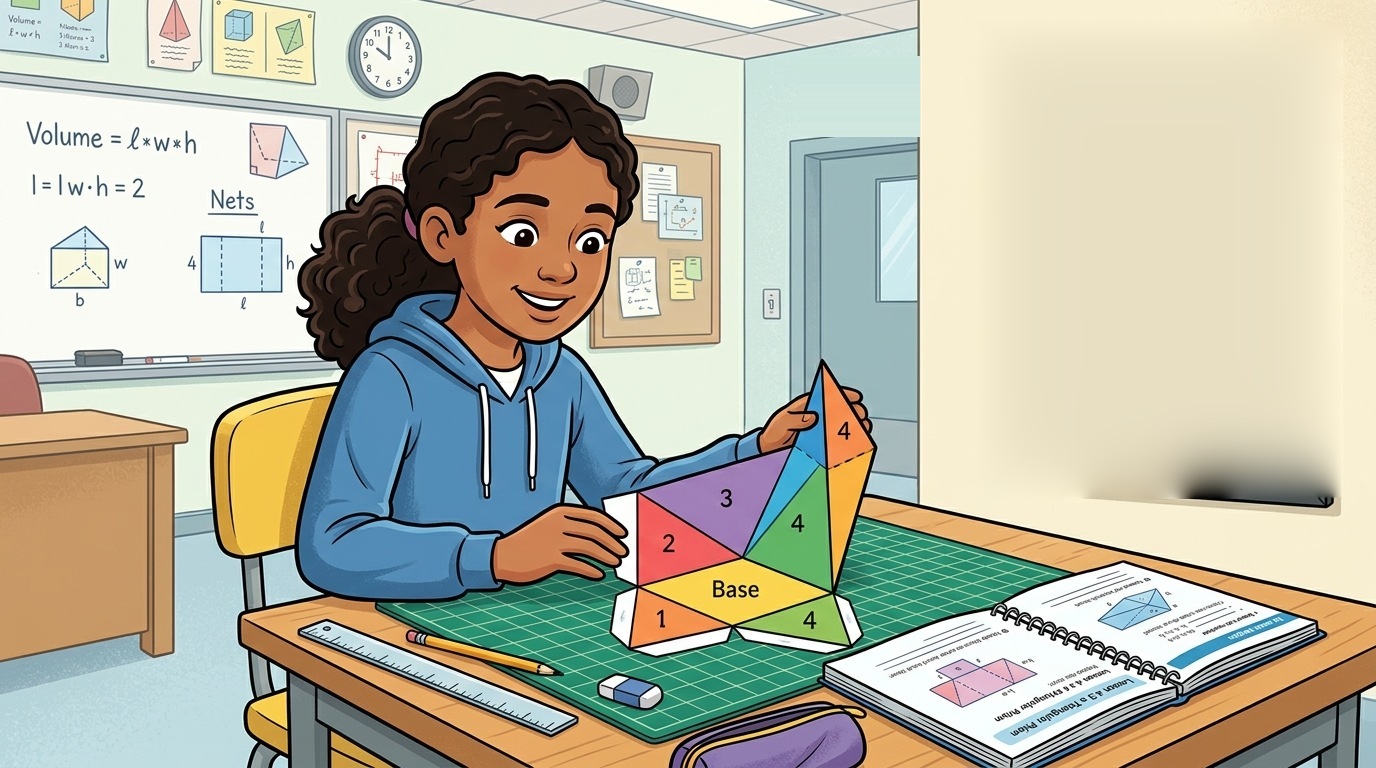
I can calculate the total surface area of a 3D triangular prism by unfolding it into a 2D net and adding all 5 face areas together.

Student unfolding 3D net
๐Ÿ“ Visual Model: Student laying flat the 3D prism into a 2D net on her desk grid mat.
๐Ÿ’ฌ Talk about it
In your own words, what will you be able to do by the end of this lesson? Give one example.

Language Objective

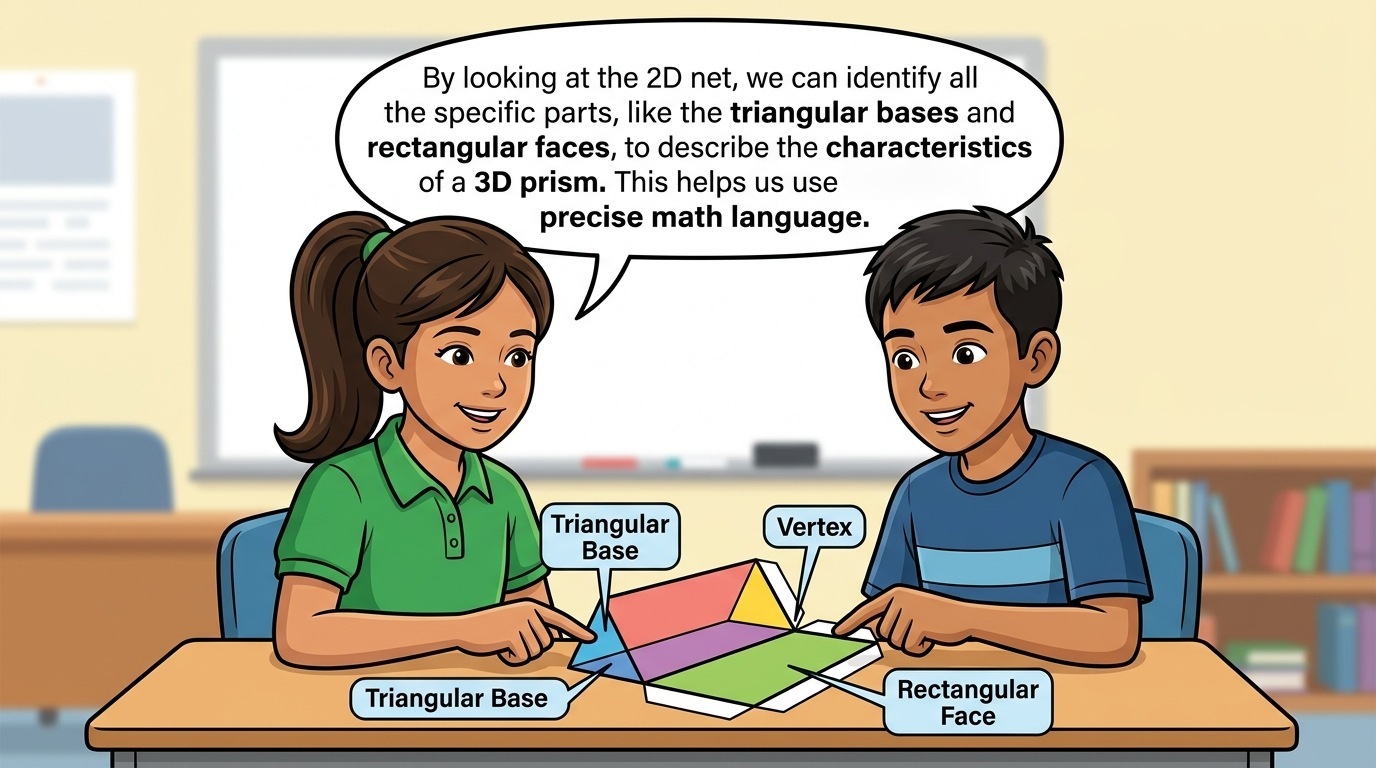
I can describe geometry features using academic terms like triangular base, rectangular face, and vertex.

Students explaining 3D nets
๐Ÿ—ฃ๏ธ Visual Model: Student partners pointing to geometry vocabulary badges.
๐Ÿ’ฌ Talk about it
Which math words in this goal are new to you? How would you explain this goal to a partner?

Content Objective

I can locate and plot ordered pairs (x,y) across all 4 quadrants of the Cartesian coordinate plane.

Student plotting coordinate points
๐ŸŽฏ Visual Model: Student plotting coordinate points (x,y) on a 4-quadrant grid mat.
๐Ÿ’ฌ Talk about it
In your own words, what will you be able to do by the end of this lesson? Give one example.

Language Objective

I can explain coordinate positions using vocabulary terms like x-axis, y-axis, origin, and quadrant.

Students explaining coordinates
๐Ÿ—ฃ๏ธ Visual Model: Student partners reciting coordinate sentence starters.
๐Ÿ’ฌ Talk about it
Which math words in this goal are new to you? How would you explain this goal to a partner?

Content Objective

I can calculate measures of center (mean, median, mode) and display data distributions using box plots and dot plots.

Student drawing box plot
๐Ÿ“ˆ Visual Model: Student drawing a 5-number summary box plot on a grid mat.
๐Ÿ’ฌ Talk about it
In your own words, what will you be able to do by the end of this lesson? Give one example.

Language Objective

I can summarize data distributions using statistical vocabulary like mean, median, interquartile range, and outlier.

Students explaining statistics
๐Ÿ—ฃ๏ธ Visual Model: Student partners discussing median and IQR.
๐Ÿ’ฌ Talk about it
Which math words in this goal are new to you? How would you explain this goal to a partner?
Google Innovator Studio ยท Tri-Rotation Engine

๐Ÿ’ก Small-Group Tri-Rotation Studio

3 concurrent 10-minute rotations designed for deep schema building, peer dialectics, and physical-digital manipulative exploration.

Station 1
Teacher Direct Studio
๐Ÿ’ก Epistemic Surgical Questioning
"If we change the denominator in 3/4 to 8, why does the numerator also double? Prove it with an area model."
Live Observation Quick-Tag:
Station 2
Peer Dialectic Lab
๐Ÿ—ฃ๏ธ Socratic Pair Debate Prompt:
"Partner A says x + 5 = 12 means x is 7. Partner B says x is 17. Debate which inverse operation isolates x correctly."
Active Speaker Telemetry: 50/50 Equity
Station 3
Project Astra Dual-Coding Sandbox
x +3 = 7 Interactive Balance Scale Model
Value Parameter: 5
Google Innovator Transfer Engine ยท Longitudinal Spaced Practice

๐Ÿ”„ Lesson Synthesis & 21-Day Spaced Echo

Consolidate small-group observational notes and schedule automated far-transfer challenges to ensure long-term schema retention.

๐Ÿ“ Automated Observational Digest

โ€ข 85% of students mastered direct visual representations.
โ€ข 2 students scheduled for follow-up intervention on inverse operation vocabulary.
โ€ข Observational quick-tags synced to Google Classroom gradebook.

๐Ÿ“… 21-Day Spaced Transfer Schedule

Day 7 Echo: Interleaved review in Science class.
Day 14 Echo: Real-world scaling application.
Day 21 Echo: Far-transfer challenge problem.

โญ Mastery Celebration

Congratulations! You have completed today's Grade 6 Small-Group Math Studio session.

๐ŸŽ‰ ๐Ÿง  ๐Ÿ“