Unit 1 · Math Is... Unidad 1 · Las matemáticas son...
Family Math HomeworkTarea de matemáticas en familia
Math is Exploring and ThinkingLas matemáticas son explorar y pensar
📚 Standard:Estándar: 5.NF.B.4 ▾
This lesson builds proficiency in Grade 6 mathematical standard 5.NF.B.4.Esta lección desarrolla destrezas en el estándar matemático de 6.º grado 5.NF.B.4.
Optional, ungraded practice. Work with someone or on your own; no adult signature is needed. Práctica opcional, sin calificación. Trabaja con alguien o a solas; no necesitas la firma de un adulto.
- 5 stops5 paradas
Choose a practice pathElige una ruta de práctica
All practice is optional and ungraded. Choose the time that works for your family; your route choice is saved on this device.Toda la práctica es opcional y no lleva calificación. Elijan el tiempo que les funcione; la ruta queda guardada en este dispositivo.
Family Math Studio selected: 6 problems, key words, one home mission, and one math game. Go at your own pace. Estudio familiar seleccionado: 6 problemas, palabras clave, una misión en casa y un juego de matemáticas. Avancen a su ritmo.
💡 Draw fraction bars, tape diagrams, equations, or line up decimals together!💡 ¡Dibujen barras de fracciones, modelos o alineen decimales juntos!
📖 What we're learning tonightQué aprendemos hoy
Tonight we make sense of a problem, plan a strategy, and use a fraction of a whole number to compare two amounts.
- quantity
- relationship
- strategy
Esta noche entendemos un problema, planeamos una estrategia y usamos una fracción de un número entero para comparar dos cantidades.
- cantidad
- relación
- estrategia
For the grown-up helping tonightPara el adulto que ayuda hoy
- If they get stuck, ask:Si se atora, pregunten: How many equal groups make the whole, and how many do we need?¿Cuántos grupos iguales forman el total y cuántos necesitamos?
- Try not to say:Eviten decir: Use a rule before checking what this question asks.Usa una regla sin revisar qué pide esta pregunta.
🎯 The big ideaLa idea principal
3/5 × 20 = 12; 6/5 × 20 = 24
-
Set upPlanteaStep 1Paso 1
Real example: a garden has 60 pea pods.
Ejemplo real: un huerto tiene 60 vainas de guisantes.
More detailMás detalle
Two thirds (2/3) of them are ready to pick. How many are ready?
Dos tercios (2/3) están listas para cosechar. ¿Cuántas están listas?
-
ModelModelaStep 2Paso 2
Divide by the bottom number (3), because thirds means 3 equal groups: 60 ÷ 3 = 20.
Divide entre el número de abajo (3), porque tercios significa 3 grupos iguales: 60 ÷ 3 = 20.
-
SolveResuelveStep 3Paso 3
Multiply by the top number (2), because we want 2 of those groups: 20 × 2 = 40.
Multiplica por el número de arriba (2), porque queremos 2 de esos grupos: 20 × 2 = 40.
-
CheckRevisaStep 4Paso 4
So 40 pods are ready.
Entonces 40 vainas están listas.
More detailMás detalle
Check that it is reasonable: 40 is less than 60 and more than half — that fits 2/3.
Comprueba que es razonable: 40 es menos de 60 y más de la mitad, y eso corresponde a 2/3.
Watch for these (3)Ten en cuenta (3)
-
Listen for "strategy" (estrategia) — the plan chosen before doing the math.
Escucha la palabra "estrategia": el plan que se elige antes de hacer las cuentas.
-
Divide first, multiply second. Doing it backwards still works, but dividing first keeps the numbers small.
Primero divide y luego multiplica. Al revés también funciona, pero dividir primero mantiene los números pequeños.
-
For a positive starting amount, multiplying by a fraction between 0 and 1 makes it smaller; multiplying by 1 keeps it the same; multiplying by more than 1 makes it larger. For example, 6/5 × 540 = 648.
Para una cantidad inicial positiva, multiplicar por una fracción entre 0 y 1 la reduce; multiplicar por 1 la mantiene igual; multiplicar por más de 1 la aumenta. Por ejemplo, 6/5 × 540 = 648.
Model a fraction of a wholeRepresenta una fracción de un total
Draw 3 equal boxes for 60 pea pods. Put 20 in each box. Shade 2 boxes: ⅔ of 60 is 40. Now draw 4 equal boxes for 24 apples and shade 3. Explain what each box means.Dibuja 3 cajas iguales para 60 vainas. Pon 20 en cada caja. Sombrea 2 cajas: ⅔ de 60 es 40. Ahora dibuja 4 cajas iguales para 24 manzanas y sombrea 3. Explica qué representa cada caja.
Build and compare fraction pieces to represent tonight's question.Construyan y comparen partes para representar la pregunta de hoy.
Need to build it? Open Fraction Strips¿Necesitan construirlo? Abran Tiras de fracciones Only the tool for tonight's lesson is included.Solo se incluye la herramienta de la lección de hoy.
Use Fraction Strips to create one example together before solving the practice problems.Usen Tiras de fracciones para crear un ejemplo juntos antes de resolver los problemas.
Parent Coaching Tips & Real-World ConnectionConsejos para Padres y Conexión Real Tap to view coaching questions, common traps & everyday examplesToca para ver preguntas guía, errores comunes y ejemplos
Scale a snack Escala una merienda
Imagine 20 crackers. Draw 5 equal groups; each group has 4 crackers. Imagina 20 galletas. Dibuja 5 grupos iguales de 4 galletas.
Using a familiar rule before identifying what this question asks. Usar una regla conocida sin identificar qué pide esta pregunta.
6/5 × 20 = ? 6/5 × 20 = ?
📚 Words to knowPalabras clave
1. Tap a card to flip it. 2. Play the quiz. 3. Match the words. 1. Toca una tarjeta para voltearla. 2. Juega el quiz. 3. Empareja las palabras.
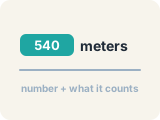
quantity cantidad
cantidad
quantity cantidad
cantidad
An amount in a problem — a number with a meaning attached, like 540 meters.
ES Una cantidad en un problema: un número con un significado, como 540 metros.
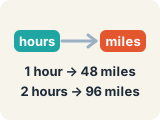
relationship relación
relación
relationship relación
relación
How two quantities compare or connect to each other.
ES Cómo se comparan o se conectan dos cantidades entre sí.
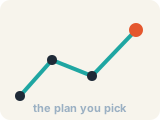
strategy estrategia
estrategia
strategy estrategia
estrategia
A plan for how to solve a problem before you start computing.
ES Un plan para resolver un problema antes de empezar a calcular.
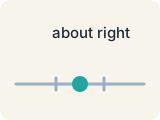
reasonable razonable
razonable
reasonable razonable
razonable
A solution that makes sense in the context of the problem.
ES Una solución que tiene sentido en el contexto del problema.
persevere perseverar
perseverar
persevere perseverar
perseverar
To keep working on a problem, checking your progress and adjusting your plan when you get stuck.
ES Seguir trabajando en un problema, revisando tu progreso y ajustando tu plan cuando te atascas.
🎯 Word QuizQuiz de palabras
Which word fits?¿Qué palabra encaja?
🎉 Quiz done!¡Quiz terminado!
First-try stars:Estrellas al primer intento:
Match the Words Empareja las palabras
Tap a word on the left, then tap its matching definition on the right! ¡Toca una palabra a la izquierda y su significado a la derecha!
✅ Quick checkRepaso rápido
Complete the 6 problems below. The extra practice at the bottom is optional. Completa los 6 problemas de abajo. La práctica extra al final es opcional.
A few problems to practice together. Each one has a step-by-step guide, a picture to draw on, and a space to show your work. Use Check This Problem for instant feedback — no need to finish everything at once. Unos problemas para practicar juntos. Cada uno tiene una guía paso a paso, un dibujo para trabajar y un espacio para mostrar el trabajo. Usen Revisar esta pregunta para retroalimentación al instante — no tienen que terminar todo de una vez.
🌱 Warm-up — start here 🌱 Calentamiento — empiecen aquí
Easier problems to practice the idea. Do these first together. Problemas más fáciles para practicar la idea. Hagan estos primero juntos.
🪜 Coach me step by stepGuíame paso a paso No answer spoilersSin revelar la respuesta
-
Say the question in your own words. Circle what you know and underline what you need to find.
Explica la pregunta con tus propias palabras. Encierra lo que sabes y subraya lo que debes hallar.
-
Multiplying by a fraction less than 1 makes the result smaller.
Multiplicar por una fracción menor que 1 hace el resultado más pequeño.
-
Start here: Is 5/6 more or less than 1?
Empieza aquí: ¿5/6 es más o menos que 1?
You calculate 5/6 × 540 and get 650 meters. What does the checking step of your plan tell you?Calculas 5/6 × 540 y obtienes 650 metros. ¿Qué te dice el paso de revisión de tu plan?
👪 Read the question together, then let your student pick an answer before you discuss why.👪 Lean la pregunta juntos; dejen que su estudiante elija antes de hablar del porqué.
✏️ Show my work: drawing pad and notes✏️ Mostrar mi trabajo: dibujo y notas
Show the answerVer la respuesta
Answer key for families — compare, then talk about why.Clave de respuestas para la familia — comparen y hablen del porqué.
Not tried yet? Close this and give it one try first. A wrong first try still helps.¿Todavía no lo intentaron? Ciérrenla y hagan un intento primero. Un primer intento equivocado también ayuda.
- The answer is unreasonable — 5/6 of 540 must be LESS than 540
Why:Por qué: 5/6 is less than 1, so 5/6 of 540 must land below 540. Getting 650 means the plan needs adjusting — which is exactly what checking is for.5/6 es menor que 1, así que 5/6 de 540 debe quedar por debajo de 540. Obtener 650 significa que hay que ajustar el plan — para eso sirve revisar.
🪜 Coach me step by stepGuíame paso a paso No answer spoilersSin revelar la respuesta
-
Say the question in your own words. Circle what you know and underline what you need to find.
Explica la pregunta con tus propias palabras. Encierra lo que sabes y subraya lo que debes hallar.
-
A fraction less than 1 shrinks the 540; a fraction greater than 1 stretches it.
Una fracción menor que 1 encoge los 540; una fracción mayor que 1 los estira.
-
Start here: Compare the numerator to the denominator before you multiply anything.
Empieza aquí: Compara el numerador con el denominador antes de multiplicar nada.
Sort each building plan: shorter or taller than 540 meters?Clasifica cada plan: ¿más bajo o más alto que 540 metros?
👪 On a phone, use Move to. On a computer, drag cards or tap a card then tap a column.👪 En el teléfono usen Mover a. En la computadora arrastren o toquen tarjeta y columna.
💡 Compare the numerator to the denominator before you multiply anything.Compara el numerador con el denominador antes de multiplicar nada.
💡 A fraction less than 1 shrinks the 540; a fraction greater than 1 stretches it.Una fracción menor que 1 encoge los 540; una fracción mayor que 1 los estira.
Show the answerVer la respuesta
Answer key for families — compare, then talk about why.Clave de respuestas para la familia — comparen y hablen del porqué.
Not tried yet? Close this and give it one try first. A wrong first try still helps.¿Todavía no lo intentaron? Ciérrenla y hagan un intento primero. Un primer intento equivocado también ayuda.
- Shorter than 540 m (fraction less than 1): 9/10 of 540, 5/6 of 540, 3/4 of 540Más bajo que 540 m (fracción menor que 1): 9/10 de 540, 5/6 de 540, 3/4 de 540
- Taller than 540 m (fraction greater than 1): 6/5 of 540, 11/10 of 540, 7/6 of 540Más alto que 540 m (fracción mayor que 1): 6/5 de 540, 11/10 de 540, 7/6 de 540
Why:Por qué: No computation is needed: when the numerator is smaller than the denominator (9/10, 5/6, 3/4) the fraction is less than 1, so the building is shorter than 540 m. When the numerator is larger (6/5, 11/10, 7/6) the fraction is greater than 1, so the building is taller.No hace falta calcular: cuando el numerador es menor que el denominador (9/10, 5/6, 3/4), la fracción es menor que 1 y el edificio es más bajo que 540 m. Cuando el numerador es mayor (6/5, 11/10, 7/6), la fracción es mayor que 1 y el edificio es más alto.
🪜 Coach me step by stepGuíame paso a paso No answer spoilersSin revelar la respuesta
-
Say the question in your own words. Circle what you know and underline what you need to find.
Explica la pregunta con tus propias palabras. Encierra lo que sabes y subraya lo que debes hallar.
-
What makes your answer reasonable? Use the question to check it.
¿Por qué es razonable tu respuesta? Usa la pregunta para comprobarla.
-
Start here: Draw the total in equal-sized parts. Decide whether you are finding a portion or counting groups.
Empieza aquí: Dibuja el total en partes iguales. Decide si buscas una porción o cuentas grupos.
The lesson says we check on our progress toward a solution and adjust our plan as needed. Describe one way YOU can check on your progress while solving a problem.La lección dice que revisamos nuestro avance hacia una solución y ajustamos el plan cuando hace falta. Describe una manera en que TÚ puedes revisar tu avance mientras resuelves un problema.
👪 A complete sentence with math vocabulary is the goal — not a perfect paragraph.👪 Una oración completa con vocabulario matemático es la meta — no un párrafo perfecto.
✏️ Show my work: drawing pad and notes✏️ Mostrar mi trabajo: dibujo y notas
Show the answerVer la respuesta
Answer key for families — compare, then talk about why.Clave de respuestas para la familia — comparen y hablen del porqué.
Not tried yet? Close this and give it one try first. A wrong first try still helps.¿Todavía no lo intentaron? Ciérrenla y hagan un intento primero. Un primer intento equivocado también ayuda.
- I can stop partway and ask whether my numbers still make sense in the story — for example, if a building is supposed to be a fraction less than 1 of 540 meters, my answer so far should be under 540. If it isn't, I go back and adjust my plan.
Why:Por qué: Answers will vary. Check that the reasoning is explained in a complete sentence.Las respuestas varían. Revisen que el razonamiento se explique en una oración completa.
🚀 Level up — a little harder 🚀 Sube de nivel — un poco más difícil
Try these once the warm-up feels easy. It's okay to use the steps and pictures. Intenten estos cuando el calentamiento sea fácil. Está bien usar los pasos y los dibujos.
🪜 Coach me step by stepGuíame paso a paso No answer spoilersSin revelar la respuesta
-
Say the question in your own words. Circle what you know and underline what you need to find.
Explica la pregunta con tus propias palabras. Encierra lo que sabes y subraya lo que debes hallar.
-
What makes your answer reasonable? Use the question to check it.
¿Por qué es razonable tu respuesta? Usa la pregunta para comprobarla.
-
Start here: Draw the total in equal-sized parts. Decide whether you are finding a portion or counting groups.
Empieza aquí: Dibuja el total en partes iguales. Decide si buscas una porción o cuentas grupos.
Apply — City Blocks. A city block has 12 buildings. The block to the north is planned to hold 2/3 as many buildings, and the block to the east is planned to hold 3/2 as many. WITHOUT computing, say which block will hold the most buildings and how you know. Then find the number of buildings on each block and check that your answers make sense.Aplica — Cuadras de la ciudad. Una cuadra tiene 12 edificios. Se planea que la cuadra del norte tenga 2/3 de esa cantidad de edificios, y que la cuadra del este tenga 3/2 de esa cantidad. SIN calcular, di cuál cuadra tendrá más edificios y cómo lo sabes. Luego halla el número de edificios de cada cuadra y revisa que tus respuestas tengan sentido.
✏️ Show my work: drawing pad and notes✏️ Mostrar mi trabajo: dibujo y notas
Show the answerVer la respuesta
Answer key for families — compare, then talk about why.Clave de respuestas para la familia — comparen y hablen del porqué.
Not tried yet? Close this and give it one try first. A wrong first try still helps.¿Todavía no lo intentaron? Ciérrenla y hagan un intento primero. Un primer intento equivocado también ayuda.
- The east block will hold the most, because 3/2 is greater than 1 and the other fractions are less than 1 — and all three describe the same 12 buildings. North: 2/3 × 12 = 8 buildings. East: 3/2 × 12 = 18 buildings. The original block has 12. The answers make sense because 8 is less than 12 and 18 is more than 12, which is what the fractions predicted.
Why:Por qué: Answers will vary. Check that the reasoning is explained in a complete sentence.Las respuestas varían. Revisen que el razonamiento se explique en una oración completa.
🪜 Coach me step by stepGuíame paso a paso No answer spoilersSin revelar la respuesta
-
Say the question in your own words. Circle what you know and underline what you need to find.
Explica la pregunta con tus propias palabras. Encierra lo que sabes y subraya lo que debes hallar.
-
540 ÷ 10 = 54 and 540 ÷ 5 = 108 — both divide evenly, which is why these fractions are friendly.
540 ÷ 10 = 54 y 540 ÷ 5 = 108: ambos dividen exacto, por eso estas fracciones son amigables.
-
Start here: Divide 540 by the denominator first, then multiply by the numerator.
Empieza aquí: Divide 540 entre el denominador primero y luego multiplica por el numerador.
Compute each building's height as a fraction of 540 meters.Calcula la altura de cada edificio como fracción de 540 metros.
👪 Encourage your student to show work on paper if a box feels tricky.👪 Animen a mostrar el trabajo en papel si una casilla se siente difícil.
| Building planPlan del edificio | Fraction of 540 mFracción de 540 m | Height (m)Altura (m) |
|---|---|---|
| Rio de JaneiroRío de Janeiro | 9/10 of 5409/10 de 540 |
|
| TokyoTokio | 6/5 of 5406/5 de 540 |
|
| PrototypePrototipo | 1/2 of 5401/2 de 540 |
|
✏️ Show my work: drawing pad and notes✏️ Mostrar mi trabajo: dibujo y notas
Show the answerVer la respuesta
Answer key for families — compare, then talk about why.Clave de respuestas para la familia — comparen y hablen del porqué.
Not tried yet? Close this and give it one try first. A wrong first try still helps.¿Todavía no lo intentaron? Ciérrenla y hagan un intento primero. Un primer intento equivocado también ayuda.
- Rio de Janeiro · Height (m): 486Río de Janeiro · Altura (m): 486
- Tokyo · Height (m): 648Tokio · Altura (m): 648
- Prototype · Height (m): 270Prototipo · Altura (m): 270
Why:Por qué: For 9/10 of 540: 540 ÷ 10 = 54, then 54 × 9 = 486. For 6/5 of 540: 540 ÷ 5 = 108, then 108 × 6 = 648 — taller than the original, as a fraction greater than 1 predicts. Half of 540 is 270.Para 9/10 de 540: 540 ÷ 10 = 54, luego 54 × 9 = 486. Para 6/5 de 540: 540 ÷ 5 = 108, luego 108 × 6 = 648, más alto que el original, como predice una fracción mayor que 1. La mitad de 540 es 270.
🪜 Coach me step by stepGuíame paso a paso No answer spoilersSin revelar la respuesta
-
Say the question in your own words. Circle what you know and underline what you need to find.
Explica la pregunta con tus propias palabras. Encierra lo que sabes y subraya lo que debes hallar.
-
540 ÷ 10 = 54.
540 ÷ 10 = 54.
-
Start here: First find one tenth of 540.
Empieza aquí: Halla primero un décimo de 540.
The Rio de Janeiro building will be 9/10 as tall as One World Trade Center (540 meters). How tall will it be?El edificio de Río de Janeiro será 9/10 de alto que el One World Trade Center (540 metros). ¿Qué altura tendrá?
✏️ Show my work: drawing pad and notes✏️ Mostrar mi trabajo: dibujo y notas
Show the answerVer la respuesta
Answer key for families — compare, then talk about why.Clave de respuestas para la familia — comparen y hablen del porqué.
Not tried yet? Close this and give it one try first. A wrong first try still helps.¿Todavía no lo intentaron? Ciérrenla y hagan un intento primero. Un primer intento equivocado también ayuda.
- 486 meters
Why:Por qué: 9/10 × 540: one tenth of 540 is 54, and 9 tenths is 9 × 54 = 486 meters.9/10 × 540: un décimo de 540 es 54, y 9 décimos son 9 × 54 = 486 metros.
➕ More practice — open for extra problems ➕ Más práctica — abre para más problemas
Optional. Only if your student wants more — these are bonus problems. Opcional. Solo si tu estudiante quiere más — son problemas adicionales.
🪜 Coach me step by stepGuíame paso a paso No answer spoilersSin revelar la respuesta
-
Say the question in your own words. Circle what you know and underline what you need to find.
Explica la pregunta con tus propias palabras. Encierra lo que sabes y subraya lo que debes hallar.
-
540 ÷ 6 = 90.
540 ÷ 6 = 90.
-
Start here: First find one sixth of 540.
Empieza aquí: Halla primero un sexto de 540.
The London building will be 5/6 as tall as One World Trade Center, which is 540 meters. How tall will the London building be?El edificio de Londres será 5/6 de alto que el One World Trade Center, que mide 540 metros. ¿Qué altura tendrá el edificio de Londres?
✏️ Show my work: drawing pad and notes✏️ Mostrar mi trabajo: dibujo y notas
Show the answerVer la respuesta
Answer key for families — compare, then talk about why.Clave de respuestas para la familia — comparen y hablen del porqué.
Not tried yet? Close this and give it one try first. A wrong first try still helps.¿Todavía no lo intentaron? Ciérrenla y hagan un intento primero. Un primer intento equivocado también ayuda.
- 450 meters
Why:Por qué: 5/6 × 540: one sixth of 540 is 90, and 5 sixths is 5 × 90 = 450 meters.5/6 × 540: un sexto de 540 es 90, y 5 sextos son 5 × 90 = 450 metros.
🪜 Coach me step by stepGuíame paso a paso No answer spoilersSin revelar la respuesta
-
Say the question in your own words. Circle what you know and underline what you need to find.
Explica la pregunta con tus propias palabras. Encierra lo que sabes y subraya lo que debes hallar.
-
540 ÷ 5 = 108.
540 ÷ 5 = 108.
-
Start here: First find one fifth of 540.
Empieza aquí: Halla primero un quinto de 540.
The Tokyo building will be 6/5 as tall as One World Trade Center (540 meters). How tall will it be?El edificio de Tokio será 6/5 de alto que el One World Trade Center (540 metros). ¿Qué altura tendrá?
✏️ Show my work: drawing pad and notes✏️ Mostrar mi trabajo: dibujo y notas
Show the answerVer la respuesta
Answer key for families — compare, then talk about why.Clave de respuestas para la familia — comparen y hablen del porqué.
Not tried yet? Close this and give it one try first. A wrong first try still helps.¿Todavía no lo intentaron? Ciérrenla y hagan un intento primero. Un primer intento equivocado también ayuda.
- 648 meters
Why:Por qué: 6/5 × 540: one fifth of 540 is 108, and 6 fifths is 6 × 108 = 648 meters — taller than 540, because 6/5 is greater than 1.6/5 × 540: un quinto de 540 es 108, y 6 quintos son 6 × 108 = 648 metros — más alto que 540, porque 6/5 es mayor que 1.
🪜 Coach me step by stepGuíame paso a paso No answer spoilersSin revelar la respuesta
-
Say the question in your own words. Circle what you know and underline what you need to find.
Explica la pregunta con tus propias palabras. Encierra lo que sabes y subraya lo que debes hallar.
-
5/6 < 1, 9/10 < 1, 6/5 > 1.
5/6 < 1, 9/10 < 1, 6/5 > 1.
-
Start here: Compare each fraction to 1.
Empieza aquí: Compara cada fracción con 1.
Without calculating, which new building must be TALLER than One World Trade Center, and why?Sin calcular, ¿cuál edificio nuevo debe ser MÁS ALTO que el One World Trade Center, y por qué?
✏️ Show my work: drawing pad and notes✏️ Mostrar mi trabajo: dibujo y notas
Show the answerVer la respuesta
Answer key for families — compare, then talk about why.Clave de respuestas para la familia — comparen y hablen del porqué.
Not tried yet? Close this and give it one try first. A wrong first try still helps.¿Todavía no lo intentaron? Ciérrenla y hagan un intento primero. Un primer intento equivocado también ayuda.
- Tokyo, because 6/5 is greater than 1
Why:Por qué: Multiplying 540 by a fraction greater than 1 gives more than 540. Only 6/5 is greater than 1; 5/6 and 9/10 are both less than 1.Multiplicar 540 por una fracción mayor que 1 da más de 540. Solo 6/5 es mayor que 1; 5/6 y 9/10 son ambas menores que 1.
🪜 Coach me step by stepGuíame paso a paso No answer spoilersSin revelar la respuesta
-
Say the question in your own words. Circle what you know and underline what you need to find.
Explica la pregunta con tus propias palabras. Encierra lo que sabes y subraya lo que debes hallar.
-
Compare each fraction to 1, then compare 5/6 and 9/10 to each other.
Compara cada fracción con 1, y luego compara 5/6 y 9/10 entre sí.
-
Start here: All three are fractions of the SAME 540 meters, so just compare the fractions.
Empieza aquí: Las tres son fracciones de los MISMOS 540 metros, así que solo compara las fracciones.
Without computing the exact heights, order the three new buildings from shortest to tallest. (London: 5/6 of 540 m, Rio de Janeiro: 9/10 of 540 m, Tokyo: 6/5 of 540 m.)Sin calcular las alturas exactas, ordena los tres edificios nuevos del más bajo al más alto. (Londres: 5/6 de 540 m, Río de Janeiro: 9/10 de 540 m, Tokio: 6/5 de 540 m.)
✏️ Show my work: drawing pad and notes✏️ Mostrar mi trabajo: dibujo y notas
Show the answerVer la respuesta
Answer key for families — compare, then talk about why.Clave de respuestas para la familia — comparen y hablen del porqué.
Not tried yet? Close this and give it one try first. A wrong first try still helps.¿Todavía no lo intentaron? Ciérrenla y hagan un intento primero. Un primer intento equivocado también ayuda.
- London, Rio de Janeiro, Tokyo
Why:Por qué: Compare the fractions: 5/6 ≈ 0.83 is less than 9/10 = 0.9, and both are less than 6/5 = 1.2. Same whole, so the order of the fractions is the order of the heights.Compara las fracciones: 5/6 ≈ 0.83 es menor que 9/10 = 0.9, y ambas son menores que 6/5 = 1.2. El mismo entero, así que el orden de las fracciones es el orden de las alturas.
🪜 Coach me step by stepGuíame paso a paso No answer spoilersSin revelar la respuesta
-
Say the question in your own words. Circle what you know and underline what you need to find.
Explica la pregunta con tus propias palabras. Encierra lo que sabes y subraya lo que debes hallar.
-
6/5 is one fifth MORE than the whole — so add one fifth of 540.
6/5 es un quinto MÁS que el total, así que suma un quinto de 540.
-
Start here: 9/10 is one tenth LESS than the whole — so subtract one tenth of 540.
Empieza aquí: 9/10 es una décima MENOS que el total, así que resta una décima de 540.
Match each fraction of 540 to a shortcut that computes it.Empareja cada fracción de 540 con un atajo que la calcula.
👪 Say each term out loud, then talk through which match makes sense before choosing.👪 Digan cada término en voz alta y hablen de cuál pareja tiene sentido antes de elegir.
Show the answerVer la respuesta
Answer key for families — compare, then talk about why.Clave de respuestas para la familia — comparen y hablen del porqué.
Not tried yet? Close this and give it one try first. A wrong first try still helps.¿Todavía no lo intentaron? Ciérrenla y hagan un intento primero. Un primer intento equivocado también ayuda.
- 9/10 of 540 → 540 − 549/10 de 540 → 540 − 54
- 6/5 of 540 → 540 + 1086/5 de 540 → 540 + 108
- 5/6 of 540 → 540 − 905/6 de 540 → 540 − 90
- 1/2 of 540 → 540 ÷ 21/2 de 540 → 540 ÷ 2
Why:Por qué: Each shortcut rewrites the fraction around the whole: 9/10 = 1 − 1/10, so subtract 54; 6/5 = 1 + 1/5, so add 108; 5/6 = 1 − 1/6, so subtract 90; and 1/2 is simply dividing by 2. Seeing fractions as 'the whole, adjusted' is the strategy-planning move of this lesson.Cada atajo reescribe la fracción alrededor del total: 9/10 = 1 − 1/10, así que resta 54; 6/5 = 1 + 1/5, así que suma 108; 5/6 = 1 − 1/6, así que resta 90; y 1/2 es simplemente dividir entre 2. Ver las fracciones como 'el total, ajustado' es la estrategia de esta lección.
🪜 Coach me step by stepGuíame paso a paso No answer spoilersSin revelar la respuesta
-
Say the question in your own words. Circle what you know and underline what you need to find.
Explica la pregunta con tus propias palabras. Encierra lo que sabes y subraya lo que debes hallar.
-
What makes your answer reasonable? Use the question to check it.
¿Por qué es razonable tu respuesta? Usa la pregunta para comprobarla.
-
Start here: Draw the total in equal-sized parts. Decide whether you are finding a portion or counting groups.
Empieza aquí: Dibuja el total en partes iguales. Decide si buscas una porción o cuentas grupos.
What can you do if you're stuck on a problem?¿Qué puedes hacer si te atoras en un problema?
✏️ Show my work: drawing pad and notes✏️ Mostrar mi trabajo: dibujo y notas
Show the answerVer la respuesta
Answer key for families — compare, then talk about why.Clave de respuestas para la familia — comparen y hablen del porqué.
Not tried yet? Close this and give it one try first. A wrong first try still helps.¿Todavía no lo intentaron? Ciérrenla y hagan un intento primero. Un primer intento equivocado también ayuda.
- I can check that I have answered the question and that my solution makes sense, go back to what I know from the problem, or try a different strategy instead of giving up.
Why:Por qué: Answers will vary. Check that the reasoning is explained in a complete sentence.Las respuestas varían. Revisen que el razonamiento se explique en una oración completa.
🪜 Coach me step by stepGuíame paso a paso No answer spoilersSin revelar la respuesta
-
Say the question in your own words. Circle what you know and underline what you need to find.
Explica la pregunta con tus propias palabras. Encierra lo que sabes y subraya lo que debes hallar.
-
What makes your answer reasonable? Use the question to check it.
¿Por qué es razonable tu respuesta? Usa la pregunta para comprobarla.
-
Start here: Draw the total in equal-sized parts. Decide whether you are finding a portion or counting groups.
Empieza aquí: Dibuja el total en partes iguales. Decide si buscas una porción o cuentas grupos.
A classmate says, "In math, only the final answer matters." Using this lesson, write what you would say back.Un compañero dice: "En matemáticas, solo importa la respuesta final." Usando esta lección, escribe qué le responderías.
✏️ Show my work: drawing pad and notes✏️ Mostrar mi trabajo: dibujo y notas
Show the answerVer la respuesta
Answer key for families — compare, then talk about why.Clave de respuestas para la familia — comparen y hablen del porqué.
Not tried yet? Close this and give it one try first. A wrong first try still helps.¿Todavía no lo intentaron? Ciérrenla y hagan un intento primero. Un primer intento equivocado también ayuda.
- I would say the thinking matters just as much. In the buildings problem we knew London and Rio would be under 540 meters and Tokyo would be over BEFORE calculating, because we compared the fractions to 1. That checking is what catches mistakes — when we do math, we make sense of problems, check our progress, and try other strategies at dead ends.
Why:Por qué: Answers will vary. Check that the reasoning is explained in a complete sentence.Las respuestas varían. Revisen que el razonamiento se explique en una oración completa.
🎮 PlayJugar
Pick a game and play as a team. Nothing here is timed, and every game can be replayed as many times as you like. Escojan un juego y jueguen en equipo. Nada aquí tiene cronómetro, y pueden repetir cada juego cuantas veces quieran.
Try the recommended mission. Student: explain; partner: ask one question, then switch. Paper drawings work for every object. Prueba la misión recomendada. Estudiante: explica; acompañante: haz una pregunta, luego cambien. Puedes dibujar los objetos en papel.
One mission is enough. You can also work solo and explain in writing.Una misión es suficiente. También puedes trabajar a solas y explicar por escrito.
Use the math at homeUsa las matemáticas en casa ⏱️ ~5 min 🧰 Paper and pencil; real objects are optional🧰 Papel y lápiz; los objetos reales son opcionales
-
Draw 20 buttons in 5 equal groups. Suppose 3/5 are blue. Find the number of blue buttons and check against the whole. Try 4/5 next.
Dibuja 20 botones en 5 grupos iguales. Supón que 3/5 son azules. Halla cuántos botones azules hay y compara con el total. Luego prueba con 4/5.
-
Show a labeled drawing, table, or equation. Your partner asks one question; working alone, write your explanation.
Muestra un dibujo con etiquetas, una tabla o una ecuación. Tu acompañante hace una pregunta; a solas, escribe tu explicación.
Choose ONE game. Quick Quiz practices this lesson; the other games review related skills. Play together or solo, without a timer. Elige UN juego. Reto rápido practica esta lección; los demás repasan temas relacionados. Juega acompañado o a solas, sin cronómetro.
🧩 Math Dominoes: Build the ChainDominó matemático: arma la cadena
Build a chain. The left side of each domino is the match for the problem on the end of the chain. Tap the domino that fits next. Armen una cadena. El lado izquierdo de cada ficha es la pareja del problema al final de la cadena. Toquen la ficha que encaja.
🎉 Chain complete! The last problem links back to the first domino: a perfect loop.¡Cadena completa! El último problema conecta con la primera ficha: un círculo perfecto.
🎯 True or False? Family Face-Off¿Verdadero o falso? Duelo Familiar
Take turns — student answers one, then a family member answers the next. Watch for the trick statements! Por turnos: el estudiante responde una y luego un familiar responde la siguiente. ¡Cuidado con las trampas!
🗂️ Sort It!¡A clasificar!
Tap a card, then tap the bin it belongs in. Talk it through before you tap! Toquen una tarjeta y luego el cesto al que pertenece. ¡Conversen antes de tocar!
🤔 Would You Rather?¿Qué prefieres?
Everyone votes and says WHY. Then tap to see what the math says — sometimes it is a tie! Todos votan y dicen POR QUÉ. Luego toquen para ver qué dicen las matemáticas: ¡a veces es empate!
🔎 What the math saysLo que dicen las matemáticas
⚡ Quick QuizReto rápido
Reinforce tonight's topic with a quick family game. You ask; your student decides! Refuercen el tema de hoy con un juego rápido en familia. ¡Ustedes preguntan; su estudiante decide!
Scale a quantity Escala una cantidad
🎮 Play together! Divide the quantity into the number of equal parts named by the denominator, then take the number of parts named by the numerator. Factors above one can make a larger product. 🎮 ¡Jueguen juntos! Divide la cantidad en tantas partes iguales como indica el denominador y toma las que indica el numerador. Un factor mayor que uno puede aumentar el producto.
🕹️ Big ArcadeSala grande
↗ Full screen↗ Pantalla completaThe bigger review game for tonight's lesson — sort, match and choose. A wrong answer gives a hint and lets your student try again. No timer. El juego de repaso más grande para la lección de hoy — clasificar, emparejar y elegir. Si se equivocan, reciben una pista y lo intentan otra vez. Sin cronómetro.
🎉 Finished for todayTerminaste por hoy
Explain one answer aloud or on paper: “I got ___ because ___. I checked by ___.” Include your strategy and units. Then you are done.Explica una respuesta en voz alta o en papel: “Obtuve ___ porque ___. Comprobé usando ___.” Incluye tu estrategia y las unidades. Después termina.
Name one strategy that helped, or one question to ask next time. You can stop here; no adult signature is needed.
Di una estrategia que te ayudó o una pregunta para la próxima vez. Puedes terminar aquí; no necesitas la firma de un adulto.
Answers save automatically on this device. Tap Check This Problem anytime. Las respuestas se guardan solas en este dispositivo. Toquen Revisar esta pregunta cuando quieran.
Want to do more?¿Quieren hacer más?
These extras are not required. Photos, recordings and reflections stay on this device. To send anything to Mr. Neft, use ClassDojo.Estos extras no son obligatorios. Las fotos, grabaciones y reflexiones quedan en este dispositivo. Para enviar algo al Sr. Neft, usa ClassDojo.
Reflection, voice memo and badgesReflexión, nota de voz e insignias
✍️ Optional reflection on this deviceReflexión opcional en este dispositivo
Reflection saved on this device Reflexión guardada en este dispositivo
Saved on:Guardado el:
🔥 1-Night StreakRacha de 1 noche
Question draft (not sent):Borrador de pregunta (no enviado):
Family reflection:Reflexión familiar:
Student Work Photo:Foto del trabajo:
Student Voice Memo:Nota de voz del estudiante:
EDU WONDERLAB MATH
Family Math Practice Record
A personal record of practice for . Saved on this device; not submitted to the teacher.
Practice partner (optional)
Date
Celebrate & Snap Your Math Work! ¡Celebra y toma foto de tu trabajo matemático!
Use this as a photobooth for the work itself: point the camera at tonight's notebook page, the scratchpad or the whiteboard and take the picture — or pose holding it up. Choose a frame, add stickers, then download it, print it, or add it to your optional reflection. The photo is never uploaded; it stays on this device. Úsenla como cabina de fotos del trabajo: apunten la cámara a la página del cuaderno, al borrador o a la pizarra y tomen la foto, o posen sosteniéndola. Elijan un marco, agreguen calcomanías y luego descárguenla, imprímanla o agréguenla a la reflexión opcional. La foto nunca se sube a internet; se queda en este dispositivo.
Camera Ready!¡Cámara lista!
Tap “Start Camera” to photograph tonight’s work, or use “Upload Work” below. The photo stays on this device.Toca “Iniciar Cámara” para fotografiar el trabajo de hoy, o usa “Subir Foto”. La foto se queda en este dispositivo.
🎨 Photobooth StudioEstudio de Fotos
Holding your open notebook or paper up next to your smile makes the best shot! You can also snap a photo of just your written work. ¡Sostener el cuaderno abierto junto a su sonrisa crea la mejor foto! También pueden tomar la foto solo de su trabajo escrito.
💬 If your student gets stuckSi se atora
✅ What to sayQué decir
Multiply by the fraction: a factor below 1 shrinks a positive quantity; a factor above 1 enlarges it.
Multiplica por la fracción: un factor menor que 1 reduce una cantidad positiva; uno mayor que 1 la aumenta.
Imagine 20 crackers. Draw 5 equal groups; each group has 4 crackers.
Imagina 20 galletas. Dibuja 5 grupos iguales de 4 galletas.
Find 3/5 of 20 by taking 3 groups. Now find 6/5 of 20 by taking 6 groups.
Halla 3/5 de 20 tomando 3 grupos. Luego halla 6/5 de 20 tomando 6 grupos.
🚫 What NOT to sayQué evitar
Use a rule before checking what this question asks.
Usa una regla sin revisar qué pide esta pregunta.
💡 Quick help topicsTemas de ayuda
🌐 Learn more onlineAprende más en línea
Practice with the AI Learning Lab — your student can ask questions and get safe, step-by-step help on tonight's topic. Practica con el Laboratorio de IA — tu estudiante puede hacer preguntas y recibir ayuda segura, paso a paso, sobre el tema de hoy. No internet at home? Download the paper version — the same problems in a document you can print or open offline. ¿No hay internet en casa? Descarga la versión en papel — los mismos problemas en un documento que puedes imprimir o abrir sin conexión.These links go to specific videos and lessons about tonight's topic — not general math pages. Estos enlaces van a videos y lecciones específicas sobre el tema de hoy — no páginas generales.