Touch and changeToca y cambia
Move, type, tap, or drag in the model. Watch what changes.Mueve, escribe, toca o arrastra en el modelo. Observa qué cambia.
Unit 10 · Math Is... Unidad 10 · Las matemáticas son...
Math is BeautyLas matemáticas son belleza
MPP.7 ▾This lesson builds proficiency in Grade 6 mathematical standard MPP.7.Esta lección desarrolla destrezas en el estándar matemático de 6.º grado MPP.7.
Optional, ungraded practice. Work with someone or on your own; no adult signature is needed. Práctica opcional, sin calificación. Trabaja con alguien o a solas; no necesitas la firma de un adulto.
All practice is optional and ungraded. Choose the time that works for your family; your route choice is saved on this device.Toda la práctica es opcional y no lleva calificación. Elijan el tiempo que les funcione; la ruta queda guardada en este dispositivo.
Family Math Studio selected: 6 problems, key words, one home mission, and one math game. Go at your own pace. Estudio familiar seleccionado: 6 problemas, palabras clave, una misión en casa y un juego de matemáticas. Avancen a su ritmo.
💡 Draw fraction bars, tape diagrams, equations, or line up decimals together!💡 ¡Dibujen barras de fracciones, modelos o alineen decimales juntos!
Tonight we use bilateral symmetry — two sides that are mirror images — to describe shapes in nature and in things people build.
Esta noche usamos la simetría bilateral —dos lados que son imágenes reflejadas— para describir formas en la naturaleza y en las cosas que la gente construye.
For the grown-up helping tonightPara el adulto que ayuda hoy
Real example: a butterfly.
Ejemplo real: una mariposa.
Its left and right sides look like mirror images.
Sus lados izquierdo y derecho se ven como imágenes reflejadas.
Draw a line straight down the middle of the butterfly's body.
Tracen una línea recta por el centro del cuerpo de la mariposa.
Everything on the left is reflected on the right, so the butterfly is symmetric.
Todo lo del lado izquierdo se refleja a la derecha, así que la mariposa es simétrica.
In plants and animals this is called bilateral symmetry.
En plantas y animales esto se llama simetría bilateral.
Buildings, letters, and faces often have it too.
Los edificios, las letras y las caras también suelen tenerla.
Listen for "line of symmetry" (eje de simetría) — the fold line that makes both halves match.
Escucha "eje de simetría": la línea de doblez que hace coincidir las dos mitades.
Test it by folding: if the halves land exactly on each other, the line is real.
Pruébenlo doblando: si las mitades coinciden exactamente, el eje es real.
Almost-matching is not symmetry. The two halves must be exact mirror images.
Casi coincidir no es simetría. Las dos mitades deben ser imágenes reflejadas exactas.
Move the point. Use its position to describe or compare the numbers.Mueve el punto. Usa su posición para describir o comparar los números.
🌐 Esta herramienta interactiva por ahora solo está en inglés. Para qué sirve: Coloca valores etiquetados en una recta numérica para ver el tamaño, el orden y la distancia en vez de adivinarlos. Usen los pasos en español de esta tarjeta para guiarse.
Move, type, tap, or drag in the model. Watch what changes.Mueve, escribe, toca o arrastra en el modelo. Observa qué cambia.
Record one equation, value, or relationship you can see.Escribe una ecuación, un valor o una relación que puedas ver.
I notice ___ changes when ___ changes. This shows ___.Noto que ___ cambia cuando ___ cambia. Esto muestra ___.
Ask: "Where do you see the numbers from tonight's math in this model?"Pregunta: "¿Dónde ves los números de la tarea de hoy en este modelo?"
Mathematicians, scientists, and software designers use this exact mathematical model to solve real-world problems every single day! ¡Matemáticos, científicos y desarrolladores usan este mismo modelo para resolver problemas en la vida real todos los días!
Rushing to compute an answer without drawing or visualizing the problem first. Apurarse a calcular sin dibujar o visualizar el problema primero.
1. Tap a card to flip it. 2. Play the quiz. 3. Match the words. 1. Toca una tarjeta para voltearla. 2. Juega el quiz. 3. Empareja las palabras.
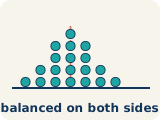
simétrico
simétrico
Having two halves that match — one side is a mirror image of the other.
ES Que tiene dos mitades que coinciden: un lado es la imagen reflejada del otro.
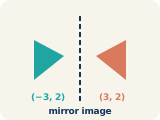
imagen reflejada
imagen reflejada
A copy of a figure flipped across a line, so the two halves face each other.
ES Una copia de una figura volteada al otro lado de una línea, de modo que las dos mitades se miran entre sí.
simetría bilateral
simetría bilateral
Reflective symmetry in plants and animals — the two sides of the body mirror each other.
ES La simetría reflectiva en plantas y animales: los dos lados del cuerpo se reflejan entre sí.
eje de simetría
eje de simetría
The line you can draw through a figure so each side is a reflection of the other.
ES La línea que puedes trazar por una figura de modo que cada lado sea el reflejo del otro.
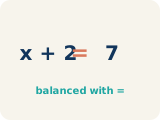
equilibrio
equilibrio
An even, steady arrangement — neither side feels heavier than the other.
ES Una disposición pareja y estable: ningún lado se siente más pesado que el otro.
Which word fits?¿Qué palabra encaja?
🎉 Quiz done!¡Quiz terminado!
First-try stars:Estrellas al primer intento:
Tap a word on the left, then tap its matching definition on the right! ¡Toca una palabra a la izquierda y su significado a la derecha!
Complete the 6 problems below. The extra practice at the bottom is optional. Completa los 6 problemas de abajo. La práctica extra al final es opcional.
A few problems to practice together. Each one has a step-by-step guide, a picture to draw on, and a space to show your work. Use Check This Problem for instant feedback — no need to finish everything at once. Unos problemas para practicar juntos. Cada uno tiene una guía paso a paso, un dibujo para trabajar y un espacio para mostrar el trabajo. Usen Revisar esta pregunta para retroalimentación al instante — no tienen que terminar todo de una vez.
Easier problems to practice the idea. Do these first together. Problemas más fáciles para practicar la idea. Hagan estos primero juntos.
Say the question in your own words. Circle what you know and underline what you need to find.
Explica la pregunta con tus propias palabras. Encierra lo que sabes y subraya lo que debes hallar.
What must exist for the two sides to reflect across?
¿Qué debe existir para que los dos lados se reflejen?
Start here: Go back to the definition, not the feeling.
Empieza aquí: Vuelve a la definición, no a lo que sientes.
Which is the best test for whether a figure has bilateral symmetry?¿Cuál es la mejor prueba para saber si una figura tiene simetría bilateral?
👪 Read the question together, then let your student pick an answer before you discuss why.👪 Lean la pregunta juntos; dejen que su estudiante elija antes de hablar del porqué.
Answer key for families — compare, then talk about why.Clave de respuestas para la familia — comparen y hablen del porqué.
Not tried yet? Close this and give it one try first. A wrong first try still helps.¿Todavía no lo intentaron? Ciérrenla y hagan un intento primero. Un primer intento equivocado también ayuda.
Why:Por qué: Bilateral symmetry means exactly this: there is a line across which the two sides are mirror images.La simetría bilateral significa exactamente esto: hay una línea a través de la cual los dos lados son imágenes reflejadas.
Say the question in your own words. Circle what you know and underline what you need to find.
Explica la pregunta con tus propias palabras. Encierra lo que sabes y subraya lo que debes hallar.
It describes the two sides of a body.
Describe los dos lados de un cuerpo.
Start here: The word starts with 'bi-', meaning two.
Empieza aquí: La palabra empieza con 'bi-', que significa dos.
In plants and animals, reflective symmetry is called:En plantas y animales, la simetría de reflexión se llama:
Answer key for families — compare, then talk about why.Clave de respuestas para la familia — comparen y hablen del porqué.
Not tried yet? Close this and give it one try first. A wrong first try still helps.¿Todavía no lo intentaron? Ciérrenla y hagan un intento primero. Un primer intento equivocado también ayuda.
Why:Por qué: The lesson says it directly: all butterflies have reflective symmetry, and in plants and animals this is called bilateral symmetry.La lección lo dice directamente: todas las mariposas tienen simetría de reflexión, y en plantas y animales esto se llama simetría bilateral.
Say the question in your own words. Circle what you know and underline what you need to find.
Explica la pregunta con tus propias palabras. Encierra lo que sabes y subraya lo que debes hallar.
You need something for the sides to reflect ACROSS.
Necesitas algo A TRAVÉS de lo cual los lados se reflejen.
Start here: Symmetry is about two sides matching.
Empieza aquí: La simetría se trata de que dos lados coincidan.
How can you SHOW that a layer of two leaves has bilateral symmetry?¿Cómo puedes MOSTRAR que una capa de dos hojas tiene simetría bilateral?
Answer key for families — compare, then talk about why.Clave de respuestas para la familia — comparen y hablen del porqué.
Not tried yet? Close this and give it one try first. A wrong first try still helps.¿Todavía no lo intentaron? Ciérrenla y hagan un intento primero. Un primer intento equivocado también ayuda.
Why:Por qué: The lesson's method: draw a line down the middle of the layer, along the center of each leaf, and see that one side is a mirror image of the other.El método de la lección: traza una línea por el medio de la capa, por el centro de cada hoja, y observa que un lado es imagen reflejada del otro.
Try these once the warm-up feels easy. It's okay to use the steps and pictures. Intenten estos cuando el calentamiento sea fácil. Está bien usar los pasos y los dibujos.
Say the question in your own words. Circle what you know and underline what you need to find.
Explica la pregunta con tus propias palabras. Encierra lo que sabes y subraya lo que debes hallar.
Does the definition say which direction the line must point?
¿La definición dice en qué dirección debe apuntar la línea?
Start here: Apply the same test to both flowers.
Empieza aquí: Aplica la misma prueba a las dos flores.
Your friend insists that only ONE of two flowers has bilateral symmetry, but both pass the mirror-image test — just across lines pointing in different directions. What is the best response?Tu amigo insiste en que solo UNA de dos flores tiene simetría bilateral, pero ambas pasan la prueba de la imagen reflejada — solo que con líneas que apuntan en direcciones distintas. ¿Cuál es la mejor respuesta?
Answer key for families — compare, then talk about why.Clave de respuestas para la familia — comparen y hablen del porqué.
Not tried yet? Close this and give it one try first. A wrong first try still helps.¿Todavía no lo intentaron? Ciérrenla y hagan un intento primero. Un primer intento equivocado también ayuda.
Why:Por qué: The test for bilateral symmetry is whether SOME line makes the two sides mirror images — the direction of that line does not matter.La prueba de la simetría bilateral es si ALGUNA línea hace que los dos lados sean imágenes reflejadas — la dirección de esa línea no importa.
Say the question in your own words. Circle what you know and underline what you need to find.
Explica la pregunta con tus propias palabras. Encierra lo que sabes y subraya lo que debes hallar.
A rectangle's diagonal fold does NOT match the halves; a square's does.
El doblez diagonal de un rectángulo NO hace coincidir las mitades; el de un cuadrado sí.
Start here: Count every fold that maps the figure onto itself — sides AND diagonals.
Empieza aquí: Cuenta cada doblez que hace coincidir la figura consigo misma: por los lados Y por las diagonales.
How many lines of symmetry does each figure have?¿Cuántas líneas de simetría tiene cada figura?
👪 Encourage your student to show work on paper if a box feels tricky.👪 Animen a mostrar el trabajo en papel si una casilla se siente difícil.
| FigureFigura | Think about the foldsPiensa en los dobleces | Lines of symmetryEjes de simetría |
|---|---|---|
| SquareCuadrado | 2 through the sides + 2 through the corners2 que pasan por los lados + 2 que pasan por las esquinas |
|
| Rectangle (not a square)Rectángulo (no cuadrado) | through the sides only — corner folds failsolo por los lados: los dobleces por las esquinas no coinciden |
|
| Equilateral triangleTriángulo equilátero | one through each corneruno que pasa por cada esquina |
|
| The letter HLa letra H | one vertical + one horizontaluno vertical + uno horizontal |
|
Answer key for families — compare, then talk about why.Clave de respuestas para la familia — comparen y hablen del porqué.
Not tried yet? Close this and give it one try first. A wrong first try still helps.¿Todavía no lo intentaron? Ciérrenla y hagan un intento primero. Un primer intento equivocado también ayuda.
Why:Por qué: A square has 4 lines (two through midpoints, two through corners); a non-square rectangle keeps only the two midpoint lines, because its diagonal folds do not match; an equilateral triangle has 3; the letter H has a vertical and a horizontal line, so 2. Counting folds precisely is what upgrades 'looks symmetric' into geometry.Un cuadrado tiene 4 líneas (dos por los puntos medios y dos por las esquinas); un rectángulo no cuadrado conserva solo las dos de los puntos medios, porque sus dobleces diagonales no coinciden; un triángulo equilátero tiene 3; la letra H tiene una vertical y una horizontal, es decir 2. Contar los dobleces con precisión convierte el 'se ve simétrico' en geometría.
Say the question in your own words. Circle what you know and underline what you need to find.
Explica la pregunta con tus propias palabras. Encierra lo que sabes y subraya lo que debes hallar.
What does bilateral symmetry provide that brains favor?
¿Qué proporciona la simetría bilateral que el cerebro prefiere?
Start here: The answer is about how our brains respond.
Empieza aquí: La respuesta tiene que ver con cómo responde nuestro cerebro.
Why do people find symmetry pleasing?¿Por qué a las personas les agrada la simetría?
Answer key for families — compare, then talk about why.Clave de respuestas para la familia — comparen y hablen del porqué.
Not tried yet? Close this and give it one try first. A wrong first try still helps.¿Todavía no lo intentaron? Ciérrenla y hagan un intento primero. Un primer intento equivocado también ayuda.
Why:Por qué: The lesson says it directly: our brains are wired to favor balance, and bilateral symmetry provides balance.La lección lo dice directamente: nuestro cerebro está hecho para preferir el equilibrio, y la simetría bilateral da equilibrio.
Optional. Only if your student wants more — these are bonus problems. Opcional. Solo si tu estudiante quiere más — son problemas adicionales.
Say the question in your own words. Circle what you know and underline what you need to find.
Explica la pregunta con tus propias palabras. Encierra lo que sabes y subraya lo que debes hallar.
Imagine a mirror standing along the butterfly's body.
Imagina un espejo colocado a lo largo del cuerpo de la mariposa.
Start here: Think about what you see on the left wing versus the right wing.
Empieza aquí: Piensa en lo que ves en el ala izquierda comparado con el ala derecha.
What does it mean that a butterfly is symmetric?¿Qué significa que una mariposa sea simétrica?
Answer key for families — compare, then talk about why.Clave de respuestas para la familia — comparen y hablen del porqué.
Not tried yet? Close this and give it one try first. A wrong first try still helps.¿Todavía no lo intentaron? Ciérrenla y hagan un intento primero. Un primer intento equivocado también ayuda.
Why:Por qué: Symmetric means one side is a mirror image of the other — that is exactly what we see across the butterfly's body.Simétrico significa que un lado es imagen reflejada del otro — eso es exactamente lo que vemos a ambos lados del cuerpo de la mariposa.
Say the question in your own words. Circle what you know and underline what you need to find.
Explica la pregunta con tus propias palabras. Encierra lo que sabes y subraya lo que debes hallar.
What makes your answer reasonable? Use the question to check it.
¿Por qué es razonable tu respuesta? Usa la pregunta para comprobarla.
Start here: Use this space for a sketch, labels, or calculations that explain your answer.
Empieza aquí: Usa este espacio para un dibujo, etiquetas o cálculos que expliquen tu respuesta.
The lesson says bilateral symmetry influences human creations 'from art to music to architecture.' Pick ONE of those three and describe how symmetry appears in it.La lección dice que la simetría bilateral influye en las creaciones humanas 'del arte a la música y a la arquitectura'. Escoge UNA de esas tres y describe cómo aparece la simetría en ella.
👪 A complete sentence with math vocabulary is the goal — not a perfect paragraph.👪 Una oración completa con vocabulario matemático es la meta — no un párrafo perfecto.
Answer key for families — compare, then talk about why.Clave de respuestas para la familia — comparen y hablen del porqué.
Not tried yet? Close this and give it one try first. A wrong first try still helps.¿Todavía no lo intentaron? Ciérrenla y hagan un intento primero. Un primer intento equivocado también ayuda.
Why:Por qué: Answers will vary. Check that the reasoning is explained in a complete sentence.Las respuestas varían. Revisen que el razonamiento se explique en una oración completa.
Say the question in your own words. Circle what you know and underline what you need to find.
Explica la pregunta con tus propias palabras. Encierra lo que sabes y subraya lo que debes hallar.
Try folding the figure in your mind — symmetric shapes fold onto themselves exactly.
Imagina doblar la figura: las formas simétricas se pliegan exactamente sobre sí mismas.
Start here: Run the mirror test: can you draw a line so each half is the other's mirror image?
Empieza aquí: Haz la prueba del espejo: ¿puedes trazar una línea de modo que cada mitad sea el reflejo de la otra?
Sort each figure by whether it has a line of symmetry.Clasifica cada figura según si tiene una línea de simetría.
👪 On a phone, use Move to. On a computer, drag cards or tap a card then tap a column.👪 En el teléfono usen Mover a. En la computadora arrastren o toquen tarjeta y columna.
💡 Run the mirror test: can you draw a line so each half is the other's mirror image?Haz la prueba del espejo: ¿puedes trazar una línea de modo que cada mitad sea el reflejo de la otra?
💡 Try folding the figure in your mind — symmetric shapes fold onto themselves exactly.Imagina doblar la figura: las formas simétricas se pliegan exactamente sobre sí mismas.
Answer key for families — compare, then talk about why.Clave de respuestas para la familia — comparen y hablen del porqué.
Not tried yet? Close this and give it one try first. A wrong first try still helps.¿Todavía no lo intentaron? Ciérrenla y hagan un intento primero. Un primer intento equivocado también ayuda.
Why:Por qué: The butterfly, the letter A, the square, and the heart all pass the mirror test — a vertical fold matches the halves (the square passes four different folds). F, J, R, and P fail every possible fold: no line splits them into mirror images. The mirror test, not appearance or beauty, is what decides.La mariposa, la letra A, el cuadrado y el corazón pasan la prueba del espejo: un doblez vertical hace coincidir las mitades (el cuadrado pasa cuatro dobleces distintos). F, J, R y P fallan con cualquier doblez: ninguna línea las divide en imágenes especulares. La prueba del espejo, no la apariencia ni la belleza, es lo que decide.
Say the question in your own words. Circle what you know and underline what you need to find.
Explica la pregunta con tus propias palabras. Encierra lo que sabes y subraya lo que debes hallar.
What makes your answer reasonable? Use the question to check it.
¿Por qué es razonable tu respuesta? Usa la pregunta para comprobarla.
Start here: Use this space for a sketch, labels, or calculations that explain your answer.
Empieza aquí: Usa este espacio para un dibujo, etiquetas o cálculos que expliquen tu respuesta.
Name one animal besides a butterfly that has bilateral symmetry.Nombra un animal además de la mariposa que tenga simetría bilateral.
Answer key for families — compare, then talk about why.Clave de respuestas para la familia — comparen y hablen del porqué.
Not tried yet? Close this and give it one try first. A wrong first try still helps.¿Todavía no lo intentaron? Ciérrenla y hagan un intento primero. Un primer intento equivocado también ayuda.
Why:Por qué: Answers will vary. Check that the reasoning is explained in a complete sentence.Las respuestas varían. Revisen que el razonamiento se explique en una oración completa.
Say the question in your own words. Circle what you know and underline what you need to find.
Explica la pregunta con tus propias palabras. Encierra lo que sabes y subraya lo que debes hallar.
14 + 9 = 23 on one side.
14 + 9 = 23 en un lado.
Start here: First find the total for one side.
Empieza aquí: Halla primero el total de un lado.
A symmetric garden design puts the same planting on each side of a center path. One side uses 14 tulips and 9 daisies. How many flowers does the WHOLE symmetric design use?Un diseño de jardín simétrico pone la misma siembra a cada lado de un camino central. Un lado usa 14 tulipanes y 9 margaritas. ¿Cuántas flores usa TODO el diseño simétrico?
Answer key for families — compare, then talk about why.Clave de respuestas para la familia — comparen y hablen del porqué.
Not tried yet? Close this and give it one try first. A wrong first try still helps.¿Todavía no lo intentaron? Ciérrenla y hagan un intento primero. Un primer intento equivocado también ayuda.
Why:Por qué: One side uses 14 + 9 = 23 flowers, and the mirror side uses the same 23, so the whole design uses 23 × 2 = 46 flowers.Un lado usa 14 + 9 = 23 flores, y el lado reflejado usa las mismas 23, así que todo el diseño usa 23 × 2 = 46 flores.
Say the question in your own words. Circle what you know and underline what you need to find.
Explica la pregunta con tus propias palabras. Encierra lo que sabes y subraya lo que debes hallar.
What makes your answer reasonable? Use the question to check it.
¿Por qué es razonable tu respuesta? Usa la pregunta para comprobarla.
Start here: Use this space for a sketch, labels, or calculations that explain your answer.
Empieza aquí: Usa este espacio para un dibujo, etiquetas o cálculos que expliquen tu respuesta.
The lesson says math CREATES the beautiful designs we find in nature. Someone argues back: 'Nature is beautiful, but that has nothing to do with math.' Use the butterfly, the plant, or symmetry in your answer to respond.La lección dice que las matemáticas CREAN los hermosos diseños que encontramos en la naturaleza. Alguien responde: 'La naturaleza es hermosa, pero eso no tiene nada que ver con las matemáticas.' Usa la mariposa, la planta o la simetría en tu respuesta.
Answer key for families — compare, then talk about why.Clave de respuestas para la familia — comparen y hablen del porqué.
Not tried yet? Close this and give it one try first. A wrong first try still helps.¿Todavía no lo intentaron? Ciérrenla y hagan un intento primero. Un primer intento equivocado también ayuda.
Why:Por qué: Answers will vary. Check that the reasoning is explained in a complete sentence.Las respuestas varían. Revisen que el razonamiento se explique en una oración completa.
Say the question in your own words. Circle what you know and underline what you need to find.
Explica la pregunta con tus propias palabras. Encierra lo que sabes y subraya lo que debes hallar.
Does 'all' leave any out?
¿'Todas' deja alguna fuera?
Start here: Read the statement carefully: ALL butterflies.
Empieza aquí: Lee el enunciado con cuidado: TODAS las mariposas.
There are over 17,000 species of butterflies, and ALL butterflies have reflective symmetry. About how many of those species have reflective symmetry?Hay más de 17,000 especies de mariposas, y TODAS las mariposas tienen simetría de reflexión. ¿Aproximadamente cuántas de esas especies tienen simetría de reflexión?
Answer key for families — compare, then talk about why.Clave de respuestas para la familia — comparen y hablen del porqué.
Not tried yet? Close this and give it one try first. A wrong first try still helps.¿Todavía no lo intentaron? Ciérrenla y hagan un intento primero. Un primer intento equivocado también ayuda.
Why:Por qué: 'All butterflies have reflective symmetry' means every one of the 17,000+ species — no exceptions.'Todas las mariposas tienen simetría de reflexión' significa cada una de las más de 17,000 especies — sin excepciones.
Say the question in your own words. Circle what you know and underline what you need to find.
Explica la pregunta con tus propias palabras. Encierra lo que sabes y subraya lo que debes hallar.
What makes your answer reasonable? Use the question to check it.
¿Por qué es razonable tu respuesta? Usa la pregunta para comprobarla.
Start here: Use this space for a sketch, labels, or calculations that explain your answer.
Empieza aquí: Usa este espacio para un dibujo, etiquetas o cálculos que expliquen tu respuesta.
Where else do you see bilateral symmetry — in nature OR in something humans made?¿En qué otro lugar ves simetría bilateral — en la naturaleza O en algo hecho por los humanos?
Answer key for families — compare, then talk about why.Clave de respuestas para la familia — comparen y hablen del porqué.
Not tried yet? Close this and give it one try first. A wrong first try still helps.¿Todavía no lo intentaron? Ciérrenla y hagan un intento primero. Un primer intento equivocado también ayuda.
Why:Por qué: Answers will vary. Check that the reasoning is explained in a complete sentence.Las respuestas varían. Revisen que el razonamiento se explique en una oración completa.
Pick a game and play as a team. Nothing here is timed, and every game can be replayed as many times as you like. Escojan un juego y jueguen en equipo. Nada aquí tiene cronómetro, y pueden repetir cada juego cuantas veces quieran.
Try the recommended mission. Student: explain; partner: ask one question, then switch. Paper drawings work for every object. Prueba la misión recomendada. Estudiante: explica; acompañante: haz una pregunta, luego cambien. Puedes dibujar los objetos en papel.
One mission is enough. You can also work solo and explain in writing.Una misión es suficiente. También puedes trabajar a solas y explicar por escrito.
Choose an earlier math problem and solve it again, using paper if needed. Compare the strategies. Explain one improvement, one useful mistake, and one question you want to explore next.
Elige un problema anterior y resuélvelo otra vez, en papel si hace falta. Compara las estrategias. Explica una mejora, un error útil y una pregunta que quieras explorar después.
Show a labeled drawing, table, or equation. Your partner asks one question; working alone, write your explanation.
Muestra un dibujo con etiquetas, una tabla o una ecuación. Tu acompañante hace una pregunta; a solas, escribe tu explicación.
Choose ONE game. Quick Quiz practices this lesson; the other games review related skills. Play together or solo, without a timer. Elige UN juego. Reto rápido practica esta lección; los demás repasan temas relacionados. Juega acompañado o a solas, sin cronómetro.
Build a chain. The left side of each domino is the match for the problem on the end of the chain. Tap the domino that fits next. Armen una cadena. El lado izquierdo de cada ficha es la pareja del problema al final de la cadena. Toquen la ficha que encaja.
🎉 Chain complete! The last problem links back to the first domino: a perfect loop.¡Cadena completa! El último problema conecta con la primera ficha: un círculo perfecto.
Take turns — student answers one, then a family member answers the next. Watch for the trick statements! Por turnos: el estudiante responde una y luego un familiar responde la siguiente. ¡Cuidado con las trampas!
Tap a card, then tap the bin it belongs in. Talk it through before you tap! Toquen una tarjeta y luego el cesto al que pertenece. ¡Conversen antes de tocar!
Everyone votes and says WHY. Then tap to see what the math says — sometimes it is a tie! Todos votan y dicen POR QUÉ. Luego toquen para ver qué dicen las matemáticas: ¡a veces es empate!
🔎 What the math saysLo que dicen las matemáticas
Reinforce tonight's topic with a quick family game. You ask; your student decides! Refuercen el tema de hoy con un juego rápido en familia. ¡Ustedes preguntan; su estudiante decide!
🎮 Play together! Use tonight's vocabulary words as you play! 🎮 ¡Jueguen juntos! ¡Usen las palabras del vocabulario de hoy mientras juegan!
The bigger review game for tonight's lesson — sort, match and choose. A wrong answer gives a hint and lets your student try again. No timer. El juego de repaso más grande para la lección de hoy — clasificar, emparejar y elegir. Si se equivocan, reciben una pista y lo intentan otra vez. Sin cronómetro.
Explain one answer aloud or on paper: “I got ___ because ___. I checked by ___.” Include your strategy and units. Then you are done.Explica una respuesta en voz alta o en papel: “Obtuve ___ porque ___. Comprobé usando ___.” Incluye tu estrategia y las unidades. Después termina.
Name one strategy that helped, or one question to ask next time. You can stop here; no adult signature is needed.
Di una estrategia que te ayudó o una pregunta para la próxima vez. Puedes terminar aquí; no necesitas la firma de un adulto.
Answers save automatically on this device. Tap Check This Problem anytime. Las respuestas se guardan solas en este dispositivo. Toquen Revisar esta pregunta cuando quieran.
These extras are not required. Photos, recordings and reflections stay on this device. To send anything to Mr. Neft, use ClassDojo.Estos extras no son obligatorios. Las fotos, grabaciones y reflexiones quedan en este dispositivo. Para enviar algo al Sr. Neft, usa ClassDojo.
Saved on:Guardado el:
🔥 1-Night StreakRacha de 1 noche
Question draft (not sent):Borrador de pregunta (no enviado):
Family reflection:Reflexión familiar:
Student Work Photo:Foto del trabajo:
Student Voice Memo:Nota de voz del estudiante:
A personal record of practice for . Saved on this device; not submitted to the teacher.
Practice partner (optional)
Date
Use this as a photobooth for the work itself: point the camera at tonight's notebook page, the scratchpad or the whiteboard and take the picture — or pose holding it up. Choose a frame, add stickers, then download it, print it, or add it to your optional reflection. The photo is never uploaded; it stays on this device. Úsenla como cabina de fotos del trabajo: apunten la cámara a la página del cuaderno, al borrador o a la pizarra y tomen la foto, o posen sosteniéndola. Elijan un marco, agreguen calcomanías y luego descárguenla, imprímanla o agréguenla a la reflexión opcional. La foto nunca se sube a internet; se queda en este dispositivo.
Camera Ready!¡Cámara lista!
Tap “Start Camera” to photograph tonight’s work, or use “Upload Work” below. The photo stays on this device.Toca “Iniciar Cámara” para fotografiar el trabajo de hoy, o usa “Subir Foto”. La foto se queda en este dispositivo.
Holding your open notebook or paper up next to your smile makes the best shot! You can also snap a photo of just your written work. ¡Sostener el cuaderno abierto junto a su sonrisa crea la mejor foto! También pueden tomar la foto solo de su trabajo escrito.
Where could you fold it so both halves match?
¿Dónde podrías doblarlo para que las dos mitades coincidan?
Does the left side look like the right side?
¿El lado izquierdo se ve como el derecho?
Is there more than one line that works?
¿Hay más de una línea que funcione?
Everything has symmetry somewhere.
Todo tiene simetría en alguna parte.
Close enough counts.
Con que se parezca, basta.
Symmetry is only about left and right.
La simetría solo se trata de izquierda y derecha.
These links go to specific videos and lessons about tonight's topic — not general math pages. Estos enlaces van a videos y lecciones específicas sobre el tema de hoy — no páginas generales.