Math is Boundless
I can create and describe geometric designs using repetition, patterns, and rhythm, and use a pattern unit to predict what comes next.
How to Use This Deck
Click Present or press F11 for fullscreen. Use arrow keys to advance.
Blue boxes show exactly what to say, ask, and how long to spend.
Text boxes, polls, and drag-sort save automatically in the browser.
Press N or click 📝 in the toolbar for pacing tips and answers.
Launch the full HTML activity for independent practice.
File → Print or the print button for handout copies.
🎯 Content Objective / Objetivo de contenido
I can create and describe geometric designs using repetition, patterns, and rhythm, and use a pattern unit to predict what comes next.
Today's Flow
Total pacing: ~45 min · Progress bar at top tracks your place
LAUNCH
⏱ ~10 min
⏱️ 3 MIN · THINK-PAIR-SHARE
A border repeats pink circle, purple square, blue triangle. Using its pattern unit, how do you predict what shape number 12 is without drawing all 12 shapes?
Check for Understanding #1
Teacher: If >30% thumbs down, re-teach with a fresh example before moving on.
Unit 10 · Lesson 5
Geometry is an integral part of design. Geometric patterns have been used to decorate homes and buildings for centuries — in art, architecture, and clothing. This lesson looks at three elements of geometric design: repetition, pattern, and rhythm.
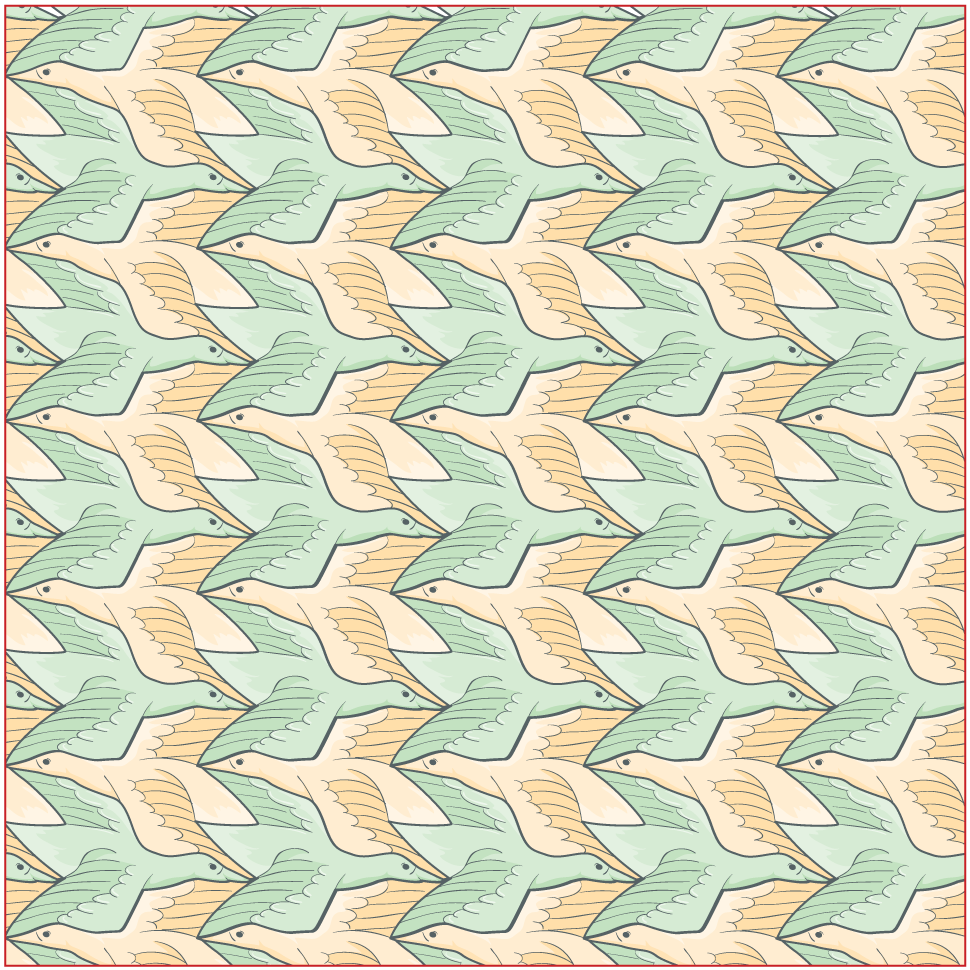
Concept Launch
💡 Repetition, pattern, and rhythm
The first element of design is repetition: the same object or shape repeated multiple times. Because it involves one object, it has predictability. The second element is a pattern: a set of objects or shapes repeated and arranged in a regular order.
Tessellations, Geometry & Mathematical Art. 1. Tessellation: Repeating pattern of polygons covering a plane with zero gaps and no overlaps. 2. Interior angles around every vertex must sum to exactly 360°. 3. Use translations, rotations, and reflections to generate symmetrical tile patterns
Check for Understanding #2
Teacher: If >30% thumbs down, re-teach with a fresh example before moving on.
Now you try
VOCABULARY
⏱ ~8 min
| Term / Término | Meaning / Significado | Example / Ejemplo | Visual |
|---|---|---|---|
| repetition repetición |
The same object, shape, or form repeated multiple times. El mismo objeto, figura o forma repetido varias veces. |
A row of identical squares across a tiled wall. | The same tile, over and over, all the way along the border. |
| pattern patrón |
A set of objects or shapes that are repeated and arranged in a regular order. Un conjunto de objetos o figuras que se repiten y se organizan en un orden regular. |
Circle, square, triangle — circle, square, triangle — again and again. | Circle, square, triangle, circle, square, triangle … |
| pattern unit unidad del patrón |
The smallest chunk of a pattern that repeats. La parte más pequeña de un patrón que se repite. |
In circle-square-triangle repeated, the pattern unit is those three shapes. | circle · square · triangle — the chunk that starts over. |
| rhythm ritmo |
A design element created by varying the placement, size, orientation, or order of the same objects or shapes. Un elemento de diseño creado al variar la posición, el tamaño, la orientación o el orden de los mismos objetos o figuras. |
Circles of different sizes and colors scattered with a flow, like in a painting. | The same circles, but sizes and spacing change as your eye travels. |
| predictability previsibilidad |
Being able to know what comes next because the design follows a rule. Poder saber qué viene después porque el diseño sigue una regla. |
Repetition and patterns have it; rhythm often lacks it. | Shape 25 must be a circle — the unit repeats every 3. |
Which Word Fits?
The same object or shape repeated multiple times is ___.
Use It In a Sentence
Check for Understanding #3
Teacher: If >30% thumbs down, re-teach with a fresh example before moving on.
Turn & Talk — Launch
A border repeats pink circle, purple square, blue triangle. Using its pattern unit, how do you predict what shape number 12 is without drawing all 12 shapes?
👂 Listen For
A strong answer divides 12 by 3, gets remainder 0, and explains that means the LAST shape in the unit. A weak answer just guesses the shape without dividing.
Extend: Using the same pattern, predict shape number 20 — and explain what a remainder of 2 tells you that a remainder of 0 does not.
EXPLORE & PRACTICE
⏱ ~18 min
Visual Modeling Workspace
Use the drawing tray below to annotate the visual model. Teacher: say "Click to reveal" on key steps.
Explore Activity
Repetition and patterns have predictability — you know what comes next. Rhythm uses the same objects but varies their size, orientation, and order, so it often lacks predictability. After sorting, tell a partner which kind of design you find more visually appealing.
✍️ Explore Discourse
Pick a card you called rhythm and your partner called repetition. What is the pattern unit, and what would have to change for it to stop being predictable?
Whiteboard Moment
Show your work clearly. Be ready to explain your thinking to a partner.
Turn & Talk — Explore
When you sorted design descriptions into 'predictable' and 'rhythm (varies),' what made the circle painting belong with rhythm instead of pattern?
👂 Listen For
Listen for students naming the missing repeating unit as the reason it's rhythm, not just 'it looks random.'
Extend: Could a design have BOTH a pattern and rhythm at the same time, in different parts of the same picture? Give an example to defend your answer.
Practice Check A
The pattern unit circle-square-triangle repeats. What is shape number 12?
✍️ Show Your Work
Explain why your answer is correct using today's vocabulary.
Practice Check B
Same pattern. What is shape number 20?
✍️ Show Your Work
Explain why your answer is correct using today's vocabulary.
Net Fold Explorer
Complete the interactive activity using today's strategy.
✍️ Justify Your Thinking
A shape tessellates when copies of it cover the plane with no gaps and no overlaps. Sort each regular shape.
A classmate turned in the work below. One step has a mistake. Read every step, find it, name it, and fix it.
No worked steps provided for this lesson.
Choose ONE option to show what you know — then do it in the workspace below.
Use evidence from today's lesson to complete each frame.
Today's key idea is: "Tessellations, Geometry & Mathematical Art. 1. Tessellation: Repeating pattern of polygons covering a plane with zero gaps and no overlaps. 2. Interior angles around every vertex must sum to exactly 360°. 3. Use translations, rotations, and reflections to generate symmetrical tile patterns" — and it works because ___.
Because repetition means ___, but a tricky part is ___, so I have to ___.
I can justify my method by showing ___, which proves my answer makes sense.
I can prove my answer is correct by ___, using pattern to check my work.
✍️ TWR · WRITE 3 SENTENCES · 7 MIN
Tessellations, Geometry & Mathematical Art. 1. Tessellation: Repeating pattern of polygons covering a plane with zero gaps and no overlaps. 2. Interior angles around every vertex must sum to exactly 360°. 3. Use translations, rotations, and reflections to generate symmetrical tile patterns because ___
Tessellations, Geometry & Mathematical Art. 1. Tessellation: Repeating pattern of polygons covering a plane with zero gaps and no overlaps. 2. Interior angles around every vertex must sum to exactly 360°. 3. Use translations, rotations, and reflections to generate symmetrical tile patterns but ___
Tessellations, Geometry & Mathematical Art. 1. Tessellation: Repeating pattern of polygons covering a plane with zero gaps and no overlaps. 2. Interior angles around every vertex must sum to exactly 360°. 3. Use translations, rotations, and reflections to generate symmetrical tile patterns so ___
🌱 TWR · GROW THE KERNEL · 6 MIN
Answer these to add detail
Sentence starters (tap to use)
Student Workspace
Repetition and patterns have predictability — you know what comes next. Rhythm uses the same objects but varies their size, orientation, and order, so it often lacks predictability. After sorting, tell a partner which kind of design you find more visually appealing.
| Column A | Column B |
|---|---|
✏️ Sketch Your Strategy
Differentiation Paths
Step-by-step with a worked model and sentence frames.
In geometric design, what is repetition?
The pattern unit circle-square-triangle repeats. What is shape number 12?
The circle-square-triangle pattern continues. What is shape number 25?
Partner Activity
Work with your partner on the practice problems at your differentiation path level. Explain each step using math vocabulary.
Check for Understanding #4
Teacher: If >30% thumbs down, re-teach with a fresh example before moving on.
Real-World Connection
🌍 Math in the Wild
An artist's painting shows rows of circles. The colors and sizes of the circles vary, as does the number of concentric circles within each circle. The painting has rhythm.
✍️ Connection Reasoning
How is a design with rhythm different from a pattern?
The circle painting's colors and sizes ___, which is why it differs from a ___ — you cannot ___ what the next circle will look like.
Turn & Talk — Connect
The circle-square-triangle border and a tiled wall border both use pattern units. If a tiled wall's unit is 4 tiles long, how would you predict tile number 25?
👂 Listen For
A strong answer transfers the divide-and-check-remainder method to a different unit length and correctly computes 25 ÷ 4. A weak answer just says 'do the same thing' without applying it.
Extend: If tile number 25 in the 4-tile pattern unit design lands on the 1st tile of its unit, what does that tell you about tile number 29? Justify your reasoning.
Summarize: Math is Boundless
Tessellations, Geometry & Mathematical Art. 1. Tessellation: Repeating pattern of polygons covering a plane with zero gaps and no overlaps. 2. Interior angles around every vertex must sum to exactly 360°. 3. Use translations, rotations, and reflections to generate symmetrical tile patterns
In your own words:
CLOSURE & REFLECT
⏱ ~8 min
Today I learned that ___ because ___.
One thing I am still not sure about is ___.
Which statement best matches this lesson's summary of 'Math is Boundless'?
Bonus Exit Check
How many COMPLETE pattern units appear in the first 18 shapes of the circle-square-triangle border?
✍️ Show Your Work
Explain why your answer is correct using today's vocabulary.
Reflection & Self-Assessment
Continue Learning
Launch the Full Interactive Activity
Students continue practice in the HTML lesson engine with auto-check, hints, and differentiation.
Family Connection
Share tonight's family homework and discuss one vocabulary word at home.
Open Family Homework ↗Teacher Notes
⏱️ Pacing Guide
- Launch & vocab: 12 min
- I Do / We Do / You Do: 15 min
- Explore & practice: 15 min
- Connect & closure: 8 min
Total: ~45 min
🎯 Listen For · Common Errors
• A strong answer divides 12 by 3, gets remainder 0, and explains that means the LAST shape in the unit. A weak answer just guesses the shape without dividing.
• Listen for students naming the missing repeating unit as the reason it's rhythm, not just 'it looks random.'
• A strong answer transfers the divide-and-check-remainder method to a different unit length and correctly computes 25 ÷ 4. A weak answer just says 'do the same thing' without applying it.
• Listen for students naming division and remainder as the specific strategy, not just "I counted it out."
Common mistake: Calling every repeated design a 'pattern.' One identical shape repeated is repetition; a pattern needs a unit of shapes repeating in a regular order; and rhythm varies the shapes' size and order, so it is neither.
Answer Key (Teacher Appendix)
Hide this slide during presentation or move to the end of your copy.
✓ Practice 1: The blue triangle — 12 ÷ 3 = 4 with no remainder, so shape 12 ends a complete unit — the triangle, which is the last shape of the unit.
✓ Practice 2: The purple square — 20 ÷ 3 = 6 remainder 2 (since 6 × 3 = 18 and 20 − 18 = 2), and the second shape in the unit is the purple square.
✓ Practice 3: 6 units — Each unit is 3 shapes, and 18 ÷ 3 = 6 complete units.
✓ Practice 4: Rhythm varies size, orientation, and order, so it often lacks predictability; a pattern repeats in a regular order — A pattern repeats its unit in a regular arrangement, so it is predictable. Rhythm keeps the same objects but varies how they appear, giving flow without predictability.
✓ Exit ticket: Math can be used to create beautiful designs, which often have repetition, patterns, and rhythm — The summary names all three elements — repetition, patterns, and rhythm — as the ways math creates beautiful, endless designs.