One fixed answerUna respuesta fija
How many books are on this shelf right now?¿Cuántos libros hay en este estante ahora?
One shelf + one moment → one count. Not statistical.Un estante + un momento → una cantidad. No es estadística.
Unit 2 · Understanding the World Around Us Through Statistics Unidad 2 · Entender el mundo que nos rodea con la estadística
Understand Statistical QuestionsComprender las preguntas estadísticas
6.DS.1 ▾This lesson builds proficiency in Grade 6 mathematical standard 6.DS.1.Esta lección desarrolla destrezas en el estándar matemático de 6.º grado 6.DS.1.
Optional, ungraded practice. Work with someone or on your own; no adult signature is needed. Práctica opcional, sin calificación. Trabaja con alguien o a solas; no necesitas la firma de un adulto.
All practice is optional and ungraded. Choose the time that works for your family; your route choice is saved on this device.Toda la práctica es opcional y no lleva calificación. Elijan el tiempo que les funcione; la ruta queda guardada en este dispositivo.
Family Math Studio selected: 6 problems, key words, one home mission, and one math game. Go at your own pace. Estudio familiar seleccionado: 6 problemas, palabras clave, una misión en casa y un juego de matemáticas. Avancen a su ritmo.
💡 Draw fraction bars, tape diagrams, equations, or line up decimals together!💡 ¡Dibujen barras de fracciones, modelos o alineen decimales juntos!
Tonight we learn to tell the difference between a statistical question and a question with just one fixed answer.
Esta noche aprendemos a notar la diferencia entre una pregunta estadística y una pregunta con una sola respuesta fija.
For the grown-up helping tonightPara el adulto que ayuda hoy
How many books are on this shelf right now?¿Cuántos libros hay en este estante ahora?
One shelf + one moment → one count. Not statistical.Un estante + un momento → una cantidad. No es estadística.
How many books are on each shelf in this room?¿Cuántos libros hay en cada estante de este cuarto?
Collect a count from each shelf. The counts can vary. Statistical.Recopila una cantidad de cada estante. Las cantidades pueden variar. Es estadística.
Read: “How many books are on this shelf right now?” It asks about one shelf at one moment.
Lee: «¿Cuántos libros hay en este estante ahora?» Pregunta sobre un estante en un momento.
Count the books once: 4 books.
Cuenta los libros una vez: 4 libros.
One fixed count answers the question, so it is not statistical.
Una sola cantidad fija responde la pregunta, así que no es estadística.
Compare: “How many books are on each shelf in this room?” Collect a count from every shelf.
Compara: «¿Cuántos libros hay en cada estante de este cuarto?» Recopila una cantidad de cada estante.
The counts can vary: 4, 7, 10.
Las cantidades pueden variar: 4, 7, 10.
The second question is statistical: it calls for data and anticipates variation across shelves.
La segunda pregunta es estadística: pide datos y espera variación entre estantes.
Decide from what the question asks, not just a keyword or whether the answers are numbers.
Decide según lo que pide la pregunta, no solo por una palabra clave ni porque las respuestas sean números.
A statistical question asks for data that are expected to vary. Observations can come from different people or from the same person on different days.
Una pregunta estadística pide datos que se espera que varíen. Las observaciones pueden venir de distintas personas o de la misma persona en distintos días.
The answers can be categories, such as favorite sports. They do not have to be numbers.
Las respuestas pueden ser categorías, como deportes favoritos. No tienen que ser números.
The word “each” alone does not make a question statistical. Matching observed answers do not rule out a statistical question if variation was expected.
La palabra «cada» por sí sola no hace estadística una pregunta. Respuestas observadas iguales no descartan una pregunta estadística si se esperaba variación.
TOUCH & TRYTOCA Y PRUEBA
A statistical question is answered with data and anticipates variation. Read the question, identify what data you would collect, and make your choice before seeing an example.Una pregunta estadística se responde con datos y espera variación. Lee la pregunta, identifica qué datos recopilarías y elige antes de ver un ejemplo.
One shelf, at one moment. Count its books once.Un estante, en un momento. Cuenta sus libros una vez.
Example data: This shelf: 4 booksDatos de ejemplo: Este estante: 4 libros
This asks for one fixed count. We do not expect a set of varying answers to answer this question.Se pide una sola cantidad fija. No se espera un conjunto de respuestas variadas para responder esta pregunta.
Several shelves. Collect one book count from each shelf.Varios estantes. Recopila una cantidad de libros de cada estante.
Example data: Shelf A: 4 · Shelf B: 7 · Shelf C: 10 booksDatos de ejemplo: Estante A: 4 · Estante B: 7 · Estante C: 10 libros
The book counts can vary from shelf to shelf. We collect a set of data to answer the question.Las cantidades de libros pueden variar de un estante a otro. Recopilamos un conjunto de datos para responder la pregunta.
The same trip, observed on several days. Collect one travel time per day.El mismo viaje, observado durante varios días. Recopila un tiempo de viaje por día.
Example data: Monday: 18 · Tuesday: 25 · Wednesday: 21 minutesDatos de ejemplo: Lunes: 18 · Martes: 25 · Miércoles: 21 minutos
Travel time can vary across days. A question about one person or one bus can be statistical when it asks about repeated observations.El tiempo de viaje puede variar entre días. Una pregunta sobre una persona o un autobús puede ser estadística si pide observaciones repetidas.
Several students. Collect one sport preference from each student.Varios estudiantes. Recopila el deporte preferido de cada estudiante.
Example data: Student A: soccer · Student B: basketball · Student C: swimmingDatos de ejemplo: Estudiante A: fútbol · Estudiante B: baloncesto · Estudiante C: natación
Preferences can vary. Statistical data can be categories, such as sports; the answers do not have to be numbers.Las preferencias pueden variar. Los datos estadísticos pueden ser categorías, como deportes; las respuestas no tienen que ser números.
Calendar weeks all have a fixed length of seven days.Todas las semanas del calendario tienen una duración fija de siete días.
Example data: Week A: 7 · Week B: 7 · Week C: 7 daysDatos de ejemplo: Semana A: 7 · Semana B: 7 · Semana C: 7 días
The word 'each' is not enough. A calendar week always has seven days, so this question does not anticipate variation.La palabra «cada» no basta. Una semana del calendario siempre tiene siete días, así que esta pregunta no espera variación.
Survey the class. Pet counts can vary, even if the first few answers match.Encuesta a la clase. Las cantidades de mascotas pueden variar, aunque las primeras respuestas coincidan.
Example data: First three students: 0, 0, 0 petsDatos de ejemplo: Primeros tres estudiantes: 0, 0, 0 mascotas
We anticipate variation before collecting the data. Matching answers in a small sample do not make the question non-statistical.Esperamos variación antes de recopilar los datos. Respuestas iguales en una muestra pequeña no hacen que la pregunta deje de ser estadística.
Explain: I would collect ___ from ___. I expect the answers to ___, so this question is ___.Explica: Recopilaría ___ de ___. Espero que las respuestas ___, así que esta pregunta es ___.
Choose: “How many books are on my shelf?” or “How many books are on each shelf in this room?” Elige: «¿Cuántos libros hay en mi estante?» o «¿Cuántos libros hay en cada estante de este cuarto?»
Using a familiar rule before identifying what this question asks. Usar una regla conocida sin identificar qué pide esta pregunta.
1. Tap a card to flip it. 2. Play the quiz. 3. Match the words. 1. Toca una tarjeta para voltearla. 2. Juega el quiz. 3. Empareja las palabras.
Preguntas estadísticas y datos
Preguntas estadísticas y datos
A statistical question expects varied answers that can be collected as data.
ES Una pregunta estadística espera respuestas variadas que se pueden recopilar como datos.
Pregunta estadística
Pregunta estadística
A question answered with data that are expected to vary.
ES Una pregunta que se responde con datos que se espera que varíen.
Pregunta no estadística
Pregunta no estadística
A question that does not anticipate variability in the data used to answer it. It may ask for one fact or measurement.
ES Una pregunta que no anticipa variabilidad en los datos usados para responderla. Puede pedir un solo dato o una medición.
Datos
Datos
Facts and numbers you collect, like answers to a survey.
ES Datos y números que recoges, como respuestas a una encuesta.
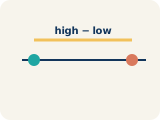
Variabilidad
Variabilidad
How spread out the numbers are.
ES Qué tan separados están los números.
Encuesta
Encuesta
Collecting facts by asking people questions.
ES Recoger datos haciendo preguntas a las personas.
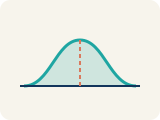
Distribución de datos
Distribución de datos
How the data looks: where it sits and how spread out it is.
ES Cómo se ven los datos: dónde están y qué tan separados están.
Diagrama de puntos
Diagrama de puntos
A number line with one dot for each data value.
ES Una recta numérica con un punto por cada valor de los datos.
Which word fits?¿Qué palabra encaja?
🎉 Quiz done!¡Quiz terminado!
First-try stars:Estrellas al primer intento:
Tap a word on the left, then tap its matching definition on the right! ¡Toca una palabra a la izquierda y su significado a la derecha!
Complete the 6 problems below. The extra practice at the bottom is optional. Completa los 6 problemas de abajo. La práctica extra al final es opcional.
A few problems to practice together. Each one has a step-by-step guide, a picture to draw on, and a space to show your work. Use Check This Problem for instant feedback — no need to finish everything at once. Unos problemas para practicar juntos. Cada uno tiene una guía paso a paso, un dibujo para trabajar y un espacio para mostrar el trabajo. Usen Revisar esta pregunta para retroalimentación al instante — no tienen que terminar todo de una vez.
Easier problems to practice the idea. Do these first together. Problemas más fáciles para practicar la idea. Hagan estos primero juntos.
Say the question in your own words. Circle what you know and underline what you need to find.
Explica la pregunta con tus propias palabras. Encierra lo que sabes y subraya lo que debes hallar.
Scan each card for phrases like 'each player' or 'each teammate', and notice which cards ask about a rule or a piece of equipment instead.
Busca en cada tarjeta frases como 'cada jugador' o 'cada compañero', y fíjate en cuáles preguntan por una regla o por el equipo.
Start here: A statistical question expects answers that differ from player to player; a non-statistical one has a single fixed answer.
Empieza aquí: Una pregunta estadística espera respuestas que cambien de un jugador a otro; una no estadística tiene una sola respuesta fija.
Drag each scouting question into the right bin. A statistical question expects answers that VARY from player to player; a non-statistical question has one fixed answer.Arrastra cada pregunta de exploración al grupo correcto. Una pregunta estadística espera respuestas que VARÍAN de un jugador a otro; una pregunta no estadística tiene una sola respuesta fija.
👪 On a phone, use Move to. On a computer, drag cards or tap a card then tap a column.👪 En el teléfono usen Mover a. En la computadora arrastren o toquen tarjeta y columna.
💡 A statistical question expects answers that differ from player to player; a non-statistical one has a single fixed answer.Una pregunta estadística espera respuestas que cambien de un jugador a otro; una no estadística tiene una sola respuesta fija.
💡 Scan each card for phrases like 'each player' or 'each teammate', and notice which cards ask about a rule or a piece of equipment instead.Busca en cada tarjeta frases como 'cada jugador' o 'cada compañero', y fíjate en cuáles preguntan por una regla o por el equipo.
💡 Take the first card — push-ups in one minute for each player: would two teammates give the same number? Answer that before you drop it in a bin.Toma la primera tarjeta: las lagartijas en un minuto de cada jugador. ¿Dos compañeros darían el mismo número? Responde eso antes de colocarla en un grupo.
Answer key for families — compare, then talk about why.Clave de respuestas para la familia — comparen y hablen del porqué.
Not tried yet? Close this and give it one try first. A wrong first try still helps.¿Todavía no lo intentaron? Ciérrenla y hagan un intento primero. Un primer intento equivocado también ayuda.
Why:Por qué: The four statistical cards all measure something for each player — push-ups, points averaged, sprint seconds, free throws made — so the answers form a set of different values. The other three ask about rules or equipment: players allowed on the court, hoop diameter, and quarters per game each have one fixed answer.Las cuatro tarjetas estadísticas miden algo de cada jugador —lagartijas, promedio de puntos, segundos de velocidad, tiros libres encestados—, así que las respuestas forman un conjunto de valores distintos. Las otras tres preguntan por reglas o equipo: los jugadores permitidos en la cancha, el diámetro del aro y los cuartos por partido tienen cada uno una sola respuesta fija.
Say the question in your own words. Circle what you know and underline what you need to find.
Explica la pregunta con tus propias palabras. Encierra lo que sabes y subraya lo que debes hallar.
Column 2: write Yes if answers would differ person to person, No if there's only one possible answer. Column 3: explain using 'varies' or 'fixed'.
Columna 2: escribe Sí si las respuestas difieren de persona a persona, y No si solo hay una respuesta posible. Columna 3: explica usando 'varía' o 'fija'.
Start here: For each row, check whether the question asks about many people ('each student', 'each player') or one fixed fact about the game.
Empieza aquí: En cada fila, revisa si la pregunta trata de muchas personas ('cada estudiante', 'cada jugador') o de un dato fijo del juego.
Decide if each question is statistical and explain why.Decide si cada pregunta es estadística y explica por qué.
👪 Encourage your student to show work on paper if a box feels tricky.👪 Animen a mostrar el trabajo en papel si una casilla se siente difícil.
| QuestionPregunta | Statistical?¿Estadística? | Why?¿Por qué? |
|---|---|---|
| How many push-ups can each student do in one minute?¿Cuántas lagartijas puede hacer cada estudiante en un minuto? |
|
|
| How many sides does a basketball court have?¿Cuántos lados tiene una cancha de baloncesto? |
|
|
| How far does each player kick the ball?¿Qué distancia patea la pelota cada jugador? |
|
|
Answer key for families — compare, then talk about why.Clave de respuestas para la familia — comparen y hablen del porqué.
Not tried yet? Close this and give it one try first. A wrong first try still helps.¿Todavía no lo intentaron? Ciérrenla y hagan un intento primero. Un primer intento equivocado también ayuda.
Why:Por qué: Rows 1 and 3 ask about each student and each player, so the push-up counts and kick distances differ from person to person — that variability makes both statistical. Row 2 asks how many sides a basketball court has, which is always 4, so there is nothing to vary and the answer is No.Las filas 1 y 3 preguntan por cada estudiante y por cada jugador, así que la cantidad de lagartijas y las distancias de las patadas cambian de una persona a otra; esa variabilidad hace que las dos sean estadísticas. La fila 2 pregunta cuántos lados tiene una cancha de básquetbol, que siempre son 4, así que no hay nada que varíe y la respuesta es No.
Say the question in your own words. Circle what you know and underline what you need to find.
Explica la pregunta con tus propias palabras. Encierra lo que sabes y subraya lo que debes hallar.
Ask: will all athletes report the same hours of sleep? What we call it when collected answers differ is the key to this question.
Pregunta: ¿todos los atletas reportarán las mismas horas de sueño? Cómo se llama cuando las respuestas recolectadas difieren es la clave de esta pregunta.
Start here: Notice the words 'each athlete' — the coach plans to collect one number from every runner on the team.
Empieza aquí: Fíjate en las palabras 'cada atleta': el entrenador planea recolectar un número de cada corredor del equipo.
A coach asks: "How many hours does each athlete on the track team sleep the night before a meet?" Why is this a statistical question?Un entrenador pregunta: «¿Cuántas horas duerme cada atleta del equipo de atletismo la noche antes de una competencia?» ¿Por qué es una pregunta estadística?
👪 Read the question together, then let your student pick an answer before you discuss why.👪 Lean la pregunta juntos; dejen que su estudiante elija antes de hablar del porqué.
Answer key for families — compare, then talk about why.Clave de respuestas para la familia — comparen y hablen del porqué.
Not tried yet? Close this and give it one try first. A wrong first try still helps.¿Todavía no lo intentaron? Ciérrenla y hagan un intento primero. Un primer intento equivocado también ayuda.
Why:Por qué: A statistical question anticipates variability. Different athletes sleep different amounts, so the data collected will vary.Una pregunta estadística anticipa variabilidad. Distintos atletas duermen cantidades distintas, así que los datos recolectados van a variar.
Try these once the warm-up feels easy. It's okay to use the steps and pictures. Intenten estos cuando el calentamiento sea fácil. Está bien usar los pasos y los dibujos.
Say the question in your own words. Circle what you know and underline what you need to find.
Explica la pregunta con tus propias palabras. Encierra lo que sabes y subraya lo que debes hallar.
Ask what those 30 answers probably look like: all identical, or a mix like 2, 5, 0, 7...? That property is what makes a question statistical.
Pregunta cómo se verían probablemente esas 30 respuestas: ¿todas idénticas o una mezcla como 2, 5, 0, 7…? Esa propiedad es lo que hace estadística a una pregunta.
Start here: Re-read the setup: 30 students each report how many books they read — that's 30 separate answers collected.
Empieza aquí: Vuelve a leer el planteamiento: 30 estudiantes reportan cada uno cuántos libros leyeron; eso son 30 respuestas separadas recolectadas.
A survey asks 30 students how many books they read last month, collecting 30 answers. What makes this a statistical question?Una encuesta pregunta a 30 estudiantes cuántos libros leyeron el mes pasado y recoge 30 respuestas. ¿Qué hace que esta sea una pregunta estadística?
Answer key for families — compare, then talk about why.Clave de respuestas para la familia — comparen y hablen del porqué.
Not tried yet? Close this and give it one try first. A wrong first try still helps.¿Todavía no lo intentaron? Ciérrenla y hagan un intento primero. Un primer intento equivocado también ayuda.
Why:Por qué: Statistical questions anticipate variability in the data collected across many people.Las preguntas estadísticas anticipan variabilidad en los datos recolectados entre muchas personas.
Say the question in your own words. Circle what you know and underline what you need to find.
Explica la pregunta con tus propias palabras. Encierra lo que sabes y subraya lo que debes hallar.
Read each choice and decide whether it would give you one answer or many different answers.
Lee cada opción y decide si te daría una sola respuesta o muchas respuestas distintas.
Start here: A statistical question expects the answers to vary; a non-statistical question has one fixed answer.
Empieza aquí: Una pregunta estadística espera que las respuestas varíen; una pregunta no estadística tiene una sola respuesta fija.
The team analyst writes four questions for the scouting report. Which one is a statistical question?El analista del equipo escribe cuatro preguntas para el informe de exploración. ¿Cuál es una pregunta estadística?
Answer key for families — compare, then talk about why.Clave de respuestas para la familia — comparen y hablen del porqué.
Not tried yet? Close this and give it one try first. A wrong first try still helps.¿Todavía no lo intentaron? Ciérrenla y hagan un intento primero. Un primer intento equivocado también ayuda.
Why:Por qué: "How many rebounds does each player grab per game?" anticipates variability — different players grab different numbers of rebounds, so you must collect data. The other three each have one fixed answer.«¿Cuántos rebotes atrapa cada jugador por partido?» anticipa variabilidad: distintos jugadores atrapan distintos números de rebotes, así que hay que recolectar datos. Las otras tres tienen una sola respuesta fija.
Say the question in your own words. Circle what you know and underline what you need to find.
Explica la pregunta con tus propias palabras. Encierra lo que sabes y subraya lo que debes hallar.
Imagine collecting an answer from every athlete. Would the list be all the same number, or a mix of numbers?
Imagina que recoges una respuesta de cada atleta. ¿Sería la lista siempre el mismo número o una mezcla de números?
Start here: The test for a statistical question is variability, not the topic or the units used.
Empieza aquí: La prueba para una pregunta estadística es la variabilidad, no el tema ni las unidades que se usan.
Why does the question "How many minutes did each athlete warm up before the game?" count as a statistical question?¿Por qué la pregunta «¿Cuántos minutos calentó cada atleta antes del partido?» cuenta como una pregunta estadística?
Answer key for families — compare, then talk about why.Clave de respuestas para la familia — comparen y hablen del porqué.
Not tried yet? Close this and give it one try first. A wrong first try still helps.¿Todavía no lo intentaron? Ciérrenla y hagan un intento primero. Un primer intento equivocado también ayuda.
Why:Por qué: A statistical question anticipates variability. Different athletes warm up for different amounts of time, so the data you collect will vary.Una pregunta estadística anticipa variabilidad. Distintos atletas calientan durante tiempos distintos, así que los datos que recolectes van a variar.
Optional. Only if your student wants more — these are bonus problems. Opcional. Solo si tu estudiante quiere más — son problemas adicionales.
Say the question in your own words. Circle what you know and underline what you need to find.
Explica la pregunta con tus propias palabras. Encierra lo que sabes y subraya lo que debes hallar.
For each weak card, look for the version that keeps the same topic but measures many people or many moments.
Para cada tarjeta débil, busca la versión que mantiene el mismo tema pero mide a muchas personas o muchos momentos.
Start here: A weak question has a single fixed answer; its stronger partner asks about EACH person so the answers can vary.
Empieza aquí: Una pregunta débil tiene una sola respuesta fija; su pareja más fuerte pregunta por CADA persona para que las respuestas puedan variar.
Match each weak (non-statistical) scouting question to a stronger version that becomes statistical by adding variability.Une cada pregunta débil (no estadística) con una versión más fuerte que se vuelve estadística al agregar variabilidad.
👪 Say each term out loud, then talk through which match makes sense before choosing.👪 Digan cada término en voz alta y hablen de cuál pareja tiene sentido antes de elegir.
Answer key for families — compare, then talk about why.Clave de respuestas para la familia — comparen y hablen del porqué.
Not tried yet? Close this and give it one try first. A wrong first try still helps.¿Todavía no lo intentaron? Ciérrenla y hagan un intento primero. Un primer intento equivocado también ayuda.
Why:Por qué: Each weak question has one fixed answer, and its stronger partner keeps the topic but measures every person or moment: roster size becomes minutes played by each player, the game's start time becomes each fan's arrival time, the court's length becomes each player's usual shooting distance, and the team total becomes points scored by each player.Cada pregunta débil tiene una sola respuesta fija, y su versión más fuerte mantiene el tema pero mide a cada persona o momento: el tamaño de la plantilla se convierte en los minutos que juega cada jugador, la hora de inicio del partido en la hora de llegada de cada aficionado, el largo de la cancha en la distancia desde la que suele tirar cada jugador, y el total del equipo en los puntos que anotó cada jugador.
Say the question in your own words. Circle what you know and underline what you need to find.
Explica la pregunta con tus propias palabras. Encierra lo que sabes y subraya lo que debes hallar.
Brainstorm cafeteria data: minutes in line, lunches bought per week. For the non-statistical one, use a fixed fact like the number of tables.
Piensa en datos de cafetería: minutos en la fila, almuerzos comprados por semana. Para la no estadística, usa un dato fijo como el número de mesas.
Start here: You need TWO questions about the cafeteria: one where classmates would answer differently, and one with a single fixed answer.
Empieza aquí: Necesitas DOS preguntas sobre la cafetería: una donde los compañeros responderían distinto y otra con una sola respuesta fija.
Write one statistical question and one non-statistical question about your school's cafeteria. Explain why each question is or is not statistical, and describe what the data would look like for the statistical question.Escribe una pregunta estadística y una pregunta no estadística sobre la cafetería de tu escuela. Explica por qué cada pregunta es o no es estadística y describe cómo se verían los datos de la pregunta estadística.
👪 A complete sentence with math vocabulary is the goal — not a perfect paragraph.👪 Una oración completa con vocabulario matemático es la meta — no un párrafo perfecto.
Answer key for families — compare, then talk about why.Clave de respuestas para la familia — comparen y hablen del porqué.
Not tried yet? Close this and give it one try first. A wrong first try still helps.¿Todavía no lo intentaron? Ciérrenla y hagan un intento primero. Un primer intento equivocado también ayuda.
Why:Por qué: A strong statistical cafeteria question asks about each person, such as 'How many minutes does each student wait in the lunch line?' — the data would be a spread of values like 2, 5, 7, and 11 minutes. A non-statistical one, such as 'How many tables are in the cafeteria?', has a single fixed answer, so there is nothing to collect or compare.Una buena pregunta estadística sobre la cafetería pregunta por cada persona, como '¿Cuántos minutos espera cada estudiante en la fila del almuerzo?': los datos serían valores variados como 2, 5, 7 y 11 minutos. Una no estadística, como '¿Cuántas mesas hay en la cafetería?', tiene una sola respuesta fija, así que no hay nada que recolectar ni comparar.
Say the question in your own words. Circle what you know and underline what you need to find.
Explica la pregunta con tus propias palabras. Encierra lo que sabes y subraya lo que debes hallar.
Check each choice: is it a fact of the calendar, clock, or math (never changes), or a survey where classmates would answer differently?
Revisa cada opción: ¿es un dato del calendario, del reloj o de matemáticas (nunca cambia), o una encuesta donde los compañeros responderían distinto?
Start here: The capital word VARIES is the clue — you need the question whose answers change from student to student.
Empieza aquí: La palabra en mayúsculas VARÍA es la pista: necesitas la pregunta cuyas respuestas cambian de estudiante a estudiante.
Which of these would collect data that VARIES (making it a statistical question)?¿Cuál de estas recolectaría datos que VARÍAN (lo que la convierte en una pregunta estadística)?
Answer key for families — compare, then talk about why.Clave de respuestas para la familia — comparen y hablen del porqué.
Not tried yet? Close this and give it one try first. A wrong first try still helps.¿Todavía no lo intentaron? Ciérrenla y hagan un intento primero. Un primer intento equivocado también ayuda.
Why:Por qué: Number of siblings varies from student to student, so the collected data will vary — that makes it statistical. The others each have one fixed answer.El número de hermanos varía de un estudiante a otro, así que los datos recolectados van a variar, y eso la hace estadística. Las demás tienen una sola respuesta fija.
Say the question in your own words. Circle what you know and underline what you need to find.
Explica la pregunta con tus propias palabras. Encierra lo que sabes y subraya lo que debes hallar.
For each choice ask: 'Would each player or runner give a different number?' The odd one out is a rule of the game, not data you collect.
En cada opción pregunta: '¿daría cada jugador o corredor un número distinto?' La que sobra es una regla del juego, no datos que recolectas.
Start here: Careful — this asks for the question that is NOT statistical: the one with a single fixed answer instead of varying data.
Empieza aquí: Cuidado: se pide la pregunta que NO es estadística, la que tiene una sola respuesta fija en lugar de datos que varían.
Which question is NOT a statistical question?¿Cuál pregunta NO es una pregunta estadística?
Answer key for families — compare, then talk about why.Clave de respuestas para la familia — comparen y hablen del porqué.
Not tried yet? Close this and give it one try first. A wrong first try still helps.¿Todavía no lo intentaron? Ciérrenla y hagan un intento primero. Un primer intento equivocado también ayuda.
Why:Por qué: "How many innings are in a baseball game?" has one fixed answer (9) — no variability. The other questions all produce different answers for different people.«¿Cuántas entradas tiene un partido de béisbol?» tiene una sola respuesta fija (9): no hay variabilidad. Las otras preguntas dan respuestas distintas para distintas personas.
Say the question in your own words. Circle what you know and underline what you need to find.
Explica la pregunta con tus propias palabras. Encierra lo que sabes y subraya lo que debes hallar.
Think: if you asked every student how long they slept, would you get one number or many different numbers? That idea is called variability.
Piensa: si le preguntaras a cada estudiante cuánto durmió, ¿obtendrías un número o muchos números distintos? Esa idea se llama variabilidad.
Start here: The question asks WHY it's statistical — focus on what happens when many students answer, not on the topic of sleep.
Empieza aquí: La pregunta es POR QUÉ es estadística: concéntrate en lo que pasa cuando muchos estudiantes responden, no en el tema del sueño.
Why is 'How many hours of sleep did each student get last night?' a statistical question?¿Por qué «¿Cuántas horas durmió cada estudiante anoche?» es una pregunta estadística?
Answer key for families — compare, then talk about why.Clave de respuestas para la familia — comparen y hablen del porqué.
Not tried yet? Close this and give it one try first. A wrong first try still helps.¿Todavía no lo intentaron? Ciérrenla y hagan un intento primero. Un primer intento equivocado también ayuda.
Why:Por qué: A statistical question anticipates variability — different students slept different amounts, so the data will vary.Una pregunta estadística anticipa variabilidad: distintos estudiantes durmieron cantidades distintas, así que los datos van a variar.
Say the question in your own words. Circle what you know and underline what you need to find.
Explica la pregunta con tus propias palabras. Encierra lo que sabes y subraya lo que debes hallar.
The rewritten version should produce different answers for different people.
La versión reescrita debe producir respuestas distintas para personas distintas.
Start here: To make a question statistical, add variability by asking about 'each' person or observation.
Empieza aquí: Para hacer estadística una pregunta, agrega variabilidad preguntando por 'cada' persona u observación.
Match each non-statistical question with its statistical rewrite.Une cada pregunta no estadística con su versión reescrita como estadística.
💡 To make a question statistical, add variability by asking about 'each' person or observation.Para hacer estadística una pregunta, agrega variabilidad preguntando por 'cada' persona u observación.
💡 The rewritten version should produce different answers for different people.La versión reescrita debe producir respuestas distintas para personas distintas.
Answer key for families — compare, then talk about why.Clave de respuestas para la familia — comparen y hablen del porqué.
Not tried yet? Close this and give it one try first. A wrong first try still helps.¿Todavía no lo intentaron? Ciérrenla y hagan un intento primero. Un primer intento equivocado también ayuda.
Why:Por qué: Each rewrite keeps the same topic but shifts the question to 'each' person, which is what creates variability. Counting 6th graders gives one number, but the hours each 6th grader studies differ; the school's start time is fixed, but the time each student arrives differs.Cada versión reescrita mantiene el mismo tema, pero cambia la pregunta a 'cada' persona, que es lo que crea variabilidad. Contar a los estudiantes de sexto grado da un solo número, pero las horas que estudia cada estudiante de sexto son distintas; la hora de entrada de la escuela es fija, pero la hora en que llega cada estudiante es distinta.
Say the question in your own words. Circle what you know and underline what you need to find.
Explica la pregunta con tus propias palabras. Encierra lo que sabes y subraya lo que debes hallar.
A reliable trick: add the word 'each' plus a measurement — 'How many ___ does each ___...?' Then describe who would give different answers.
Un truco confiable: agrega la palabra 'cada' más una medida — '¿Cuántos ___ hace cada ___?' Luego describe quién daría respuestas distintas.
Start here: Each row starts with a one-answer question. Your rewrite should ask about MANY players or teams so the answers can differ.
Empieza aquí: Cada fila empieza con una pregunta de una sola respuesta. Tu versión nueva debe preguntar por MUCHOS jugadores o equipos para que las respuestas difieran.
Rewrite each non-statistical question to make it statistical and explain the variability.Reescribe cada pregunta no estadística para volverla estadística y explica la variabilidad.
| Non-Statistical QuestionPregunta no estadística | Rewritten as StatisticalReescrita como pregunta estadística | What Variability Exists?¿Qué variabilidad hay? |
|---|---|---|
| How many players are on the team?¿Cuántos jugadores hay en el equipo? |
|
|
| What sport does this league play?¿Qué deporte se juega en esta liga? |
|
|
Answer key for families — compare, then talk about why.Clave de respuestas para la familia — comparen y hablen del porqué.
Not tried yet? Close this and give it one try first. A wrong first try still helps.¿Todavía no lo intentaron? Ciérrenla y hagan un intento primero. Un primer intento equivocado también ayuda.
Why:Por qué: Each rewrite trades a one-answer count for a measurement taken on every member of the group. 'How many players are on the team?' becomes minutes played per game, which varies because starters play more than bench players, and the league's sport becomes wins per team, which varies because some teams win more games than others.Cada versión reescrita cambia un conteo de una sola respuesta por una medición tomada a cada integrante del grupo. '¿Cuántos jugadores hay en el equipo?' se convierte en los minutos jugados por partido, que varían porque los titulares juegan más que los suplentes, y el deporte de la liga se convierte en los partidos ganados por equipo, que varían porque algunos equipos ganan más que otros.
Say the question in your own words. Circle what you know and underline what you need to find.
Explica la pregunta con tus propias palabras. Encierra lo que sabes y subraya lo que debes hallar.
A statistical question expects variability — many answers that differ. Sort each choice into 'one fixed answer' or 'answers that vary'.
Una pregunta estadística espera variabilidad — muchas respuestas distintas. Clasifica cada opción en 'una sola respuesta fija' o 'respuestas que varían'.
Start here: Re-read each question and ask: would different people or games give different answers, or is there just one fixed answer?
Empieza aquí: Vuelve a leer cada pregunta y pregunta: ¿personas o juegos distintos darían respuestas distintas, o hay una sola respuesta fija?
Which of the following is a statistical question?¿Cuál de las siguientes es una pregunta estadística?
Answer key for families — compare, then talk about why.Clave de respuestas para la familia — comparen y hablen del porqué.
Not tried yet? Close this and give it one try first. A wrong first try still helps.¿Todavía no lo intentaron? Ciérrenla y hagan un intento primero. Un primer intento equivocado también ayuda.
Why:Por qué: "How many points did each player score?" is statistical because different players will have different scores — there is variability in the data.«¿Cuántos puntos anotó cada jugador?» es estadística porque distintos jugadores tendrán puntajes distintos: hay variabilidad en los datos.
Pick a game and play as a team. Nothing here is timed, and every game can be replayed as many times as you like. Escojan un juego y jueguen en equipo. Nada aquí tiene cronómetro, y pueden repetir cada juego cuantas veces quieran.
Try the recommended mission. Student: explain; partner: ask one question, then switch. Paper drawings work for every object. Prueba la misión recomendada. Estudiante: explica; acompañante: haz una pregunta, luego cambien. Puedes dibujar los objetos en papel.
One mission is enough. You can also work solo and explain in writing.Una misión es suficiente. También puedes trabajar a solas y explicar por escrito.
Collect six page counts from books, or use 8, 12, 12, 16, 20, 28. Apply tonight’s statistical question, display, or measure. Label what the numbers represent and explain one conclusion.
Recoge seis cantidades de páginas de libros, o usa 8, 12, 12, 16, 20, 28. Usa la pregunta, representación o medida estadística de hoy. Indica qué representan los números y explica una conclusión.
Show a labeled drawing, table, or equation. Your partner asks one question; working alone, write your explanation.
Muestra un dibujo con etiquetas, una tabla o una ecuación. Tu acompañante hace una pregunta; a solas, escribe tu explicación.
Choose ONE game. Quick Quiz practices this lesson; the other games review related skills. Play together or solo, without a timer. Elige UN juego. Reto rápido practica esta lección; los demás repasan temas relacionados. Juega acompañado o a solas, sin cronómetro.
Build a chain. The left side of each domino is the match for the problem on the end of the chain. Tap the domino that fits next. Armen una cadena. El lado izquierdo de cada ficha es la pareja del problema al final de la cadena. Toquen la ficha que encaja.
🎉 Chain complete! The last problem links back to the first domino: a perfect loop.¡Cadena completa! El último problema conecta con la primera ficha: un círculo perfecto.
Take turns — student answers one, then a family member answers the next. Watch for the trick statements! Por turnos: el estudiante responde una y luego un familiar responde la siguiente. ¡Cuidado con las trampas!
Tap a card, then tap the bin it belongs in. Talk it through before you tap! Toquen una tarjeta y luego el cesto al que pertenece. ¡Conversen antes de tocar!
Everyone votes and says WHY. Then tap to see what the math says — sometimes it is a tie! Todos votan y dicen POR QUÉ. Luego toquen para ver qué dicen las matemáticas: ¡a veces es empate!
🔎 What the math saysLo que dicen las matemáticas
Reinforce tonight's topic with a quick family game. You ask; your student decides! Refuercen el tema de hoy con un juego rápido en familia. ¡Ustedes preguntan; su estudiante decide!
🎮 Play together! Statistical questions expect many different answers from a group. 🎮 ¡Jueguen juntos! Las preguntas estadísticas esperan muchas respuestas diferentes de un grupo.
The bigger review game for tonight's lesson — sort, match and choose. A wrong answer gives a hint and lets your student try again. No timer. El juego de repaso más grande para la lección de hoy — clasificar, emparejar y elegir. Si se equivocan, reciben una pista y lo intentan otra vez. Sin cronómetro.
Explain one answer aloud or on paper: “I got ___ because ___. I checked by ___.” Include your strategy and units. Then you are done.Explica una respuesta en voz alta o en papel: “Obtuve ___ porque ___. Comprobé usando ___.” Incluye tu estrategia y las unidades. Después termina.
Name one strategy that helped, or one question to ask next time. You can stop here; no adult signature is needed.
Di una estrategia que te ayudó o una pregunta para la próxima vez. Puedes terminar aquí; no necesitas la firma de un adulto.
Answers save automatically on this device. Tap Check This Problem anytime. Las respuestas se guardan solas en este dispositivo. Toquen Revisar esta pregunta cuando quieran.
These extras are not required. Photos, recordings and reflections stay on this device. To send anything to Mr. Neft, use ClassDojo.Estos extras no son obligatorios. Las fotos, grabaciones y reflexiones quedan en este dispositivo. Para enviar algo al Sr. Neft, usa ClassDojo.
Saved on:Guardado el:
🔥 1-Night StreakRacha de 1 noche
Question draft (not sent):Borrador de pregunta (no enviado):
Family reflection:Reflexión familiar:
Student Work Photo:Foto del trabajo:
Student Voice Memo:Nota de voz del estudiante:
A personal record of practice for . Saved on this device; not submitted to the teacher.
Practice partner (optional)
Date
Use this as a photobooth for the work itself: point the camera at tonight's notebook page, the scratchpad or the whiteboard and take the picture — or pose holding it up. Choose a frame, add stickers, then download it, print it, or add it to your optional reflection. The photo is never uploaded; it stays on this device. Úsenla como cabina de fotos del trabajo: apunten la cámara a la página del cuaderno, al borrador o a la pizarra y tomen la foto, o posen sosteniéndola. Elijan un marco, agreguen calcomanías y luego descárguenla, imprímanla o agréguenla a la reflexión opcional. La foto nunca se sube a internet; se queda en este dispositivo.
Camera Ready!¡Cámara lista!
Tap “Start Camera” to photograph tonight’s work, or use “Upload Work” below. The photo stays on this device.Toca “Iniciar Cámara” para fotografiar el trabajo de hoy, o usa “Subir Foto”. La foto se queda en este dispositivo.
Holding your open notebook or paper up next to your smile makes the best shot! You can also snap a photo of just your written work. ¡Sostener el cuaderno abierto junto a su sonrisa crea la mejor foto! También pueden tomar la foto solo de su trabajo escrito.
One shelf has one count. Counting each shelf gives 4, 7, and 10 books: varied answers worth collecting.
Un estante tiene una sola cantidad. Al contar cada estante obtenemos 4, 7 y 10 libros: respuestas variadas que podemos recopilar.
Choose: “How many books are on my shelf?” or “How many books are on each shelf in this room?”
Elige: «¿Cuántos libros hay en mi estante?» o «¿Cuántos libros hay en cada estante de este cuarto?»
Explain which question expects a set of answers that may vary. Count three shelves or use 4, 7, 10.
Explica qué pregunta espera varias respuestas que pueden variar. Cuenta tres estantes o usa 4, 7, 10.
Use a rule before checking what this question asks.
Usa una regla sin revisar qué pide esta pregunta.
These links go to specific videos and lessons about tonight's topic — not general math pages. Estos enlaces van a videos y lecciones específicas sobre el tema de hoy — no páginas generales.