Divide Multi-Digit Numbers Using an Algorithm
I can divide multi-digit whole numbers and explain the meaning of the quotient and remainder.
How to Use This Deck
Click Present or press F11 for fullscreen. Use arrow keys to advance.
Blue boxes show exactly what to say, ask, and how long to spend.
Text boxes, polls, and drag-sort save automatically in the browser.
Press N or click 📝 in the toolbar for pacing tips and answers.
Launch the full HTML activity for independent practice.
File → Print or the print button for handout copies.
🎯 Content Objective / Objetivo de contenido
I can divide multi-digit whole numbers and explain the meaning of the quotient and remainder.
Today's Flow
Total pacing: ~45 min · Progress bar at top tracks your place
LAUNCH
⏱ ~10 min
⏱️ 3 MIN · THINK-PAIR-SHARE
The station must divide 1,344 nutrition bars equally among 12 crew sections. Before dividing, about how many bars should each section get, and how do you know?
Check for Understanding #1
Teacher: If >30% thumbs down, re-teach with a fresh example before moving on.
Space Station Supply Division
The space station has 1,344 nutrition bars that must be divided equally among 12 crew sections for a 4-week rotation. How many bars does each section receive?
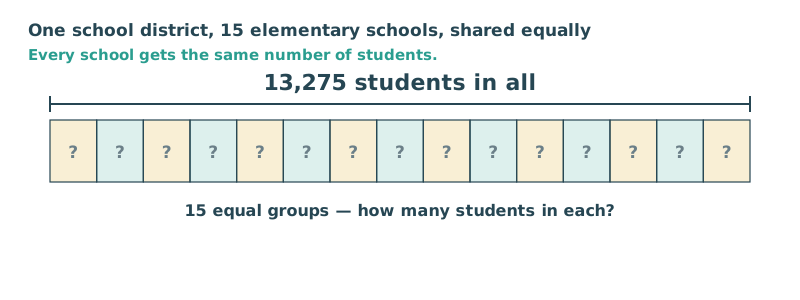
Concept Launch
💡 How do you divide big numbers?
Dividing means splitting a total into equal groups. Long division finds the quotient one digit at a time by repeating the same four steps: divide, multiply, subtract, bring down.
Algorithm: A step-by-step set of rules or instructions to solve a math problem. Long Division Algorithm: D (Divide), M (Multiply), S (Subtract), B (Bring Down). Formula: Divisor ) Dividend = Quotient R Remainder. 1. D - Divide: write quotient digit above the bar. 2. M - Multiply: digit × divisor. 3. S - Subtract: find the difference. 4. B - Bring down: next digit from dividend. 5. Repeat: continue until no digits remain (leftover = remainder). Example: 1,344 ÷ 12 = 112
Check for Understanding #2
Teacher: If >30% thumbs down, re-teach with a fresh example before moving on.
Now it's your turn
VOCABULARY
⏱ ~8 min
| Term / Término | Meaning / Significado | Example / Ejemplo | Visual |
|---|---|---|---|
| Algorithm Algoritmo |
A step-by-step set of rules or instructions to solve a math problem. Un conjunto de pasos o instrucciones para resolver un problema de matemáticas. |
📐 | |
| Dividend Dividendo |
The total number being divided into equal groups (the number inside the division bracket). El número total que se divide en grupos iguales (el número dentro de la galera de división). |
In 1,344 ÷ 12 = 112, the dividend is 1,344 — the total amount being divided | |
| Divisor Divisor |
The number of equal groups you are dividing into (the number outside the division bracket). El número de grupos iguales en que divides (el número fuera de la galera de división). |
In 1,344 ÷ 12 = 112, the divisor is 12 — the number of equal groups | |
| Quotient Cociente |
The answer when you divide. La respuesta cuando divides. |
In 156 ÷ 12 = 13, the quotient is 13 — there are 13 groups | |
| Remainder Residuo |
What is left over when a number does not divide evenly. Lo que sobra cuando un número no se divide de forma exacta. |
17 ÷ 5 = 3 R 2 means 3 groups of 5 with 2 left over | |
| Divide Multi-Digit Numbers Dividir números de varias cifras |
Separate a multi-digit number into equal groups to find a quotient. Separar un número de varias cifras en grupos iguales para hallar un cociente. |
1,344 ÷ 12 = 112 |
Which Word Fits?
A step-by-step set of rules to solve a problem is called an ___.
Use It In a Sentence
Check for Understanding #3
Teacher: If >30% thumbs down, re-teach with a fresh example before moving on.
Turn & Talk — Launch
The station must divide 1,344 nutrition bars equally among 12 crew sections. Before dividing, about how many bars should each section get, and how do you know?
👂 Listen For
Students estimate using 1,200 ÷ 12 = 100 (or similar) to predict roughly 100+ bars per section, identifying 1,344 as the dividend and 12 as the divisor.
Extend: Will 1,344 divide evenly by 12, or will there be a remainder? Predict before computing and justify your reasoning.
EXPLORE & PRACTICE
⏱ ~18 min
Visual Modeling Workspace
Use the drawing tray below to annotate the visual model. Teacher: say "Click to reveal" on key steps.
Explore Activity
Divide 2,184 ÷ 14 by repeating divide → multiply → subtract → bring down. The tool checks each step as you go, so you can see exactly where a round went wrong.
✍️ Explore Discourse
You ran the cycle three times. What is 2,184 ÷ 14, and how did you know when to stop repeating divide, multiply, subtract, bring down?
Whiteboard Moment
Show your work clearly. Be ready to explain your thinking to a partner.
Turn & Talk — Explore
You used long division for 1,344 ÷ 12. Walk through your divide, multiply, subtract, and bring down steps — what did each one tell you?
👂 Listen For
Students walk the cycle: 13 ÷ 12 → 1, then 1 × 12 = 12, then 13 − 12 = 1, then bring down the 4 to make 14 — repeating until the quotient is 112 with no remainder.
Extend: Why do you have to write a digit in the quotient every single time you bring one down — even when the divisor does not fit and that digit has to be 0?
Practice Check A
A warehouse has 2,184 items to pack into boxes of 14. How many boxes are needed?
✍️ Show Your Work
Explain why your answer is correct using today's vocabulary.
Practice Check B
What is 936 ÷ 12?
✍️ Show Your Work
Explain why your answer is correct using today's vocabulary.
Ratio Table Builder
Fill the ratio table. Each row must be equivalent.
| Factor | A | B |
|---|---|---|
| ×1 | ||
| ×2 | ||
| ×3 |
✍️ Justify Your Thinking
A classmate turned in the work below. One step has a mistake. Read every step, find it, name it, and fix it.
Choose ONE option to show what you know — then do it in the workspace below.
Use evidence from today's lesson to complete each frame.
Today's key idea is: "Algorithm: A step-by-step set of rules or instructions to solve a math problem. Long Division Algorithm: D (Divide), M (Multiply), S (Subtract), B (Bring Down). Formula: Divisor ) Dividend = Quotient R Remainder. 1. D - Divide: write quotient digit above the bar. 2. M - Multiply: digit × divisor. 3. S - Subtract: find the difference. 4. B - Bring down: next digit from dividend. 5. Repeat: continue until no digits remain (leftover = remainder). Example: 1,344 ÷ 12 = 112" — and it works because ___.
Because Algorithm means ___, but a tricky part is ___, so I have to ___.
A common mistake with Algorithm is ___. It happens because ___, and the fix is ___.
I can prove my answer is correct by ___, using Dividend to check my work.
✍️ TWR · WRITE 3 SENTENCES · 7 MIN
Algorithm: A step-by-step set of rules or instructions to solve a math problem. Long Division Algorithm: D (Divide), M (Multiply), S (Subtract), B (Bring Down). Formula: Divisor ) Dividend = Quotient R Remainder. 1. D - Divide: write quotient digit above the bar. 2. M - Multiply: digit × divisor. 3. S - Subtract: find the difference. 4. B - Bring down: next digit from dividend. 5. Repeat: continue until no digits remain (leftover = remainder). Example: 1,344 ÷ 12 = 112 because ___
Algorithm: A step-by-step set of rules or instructions to solve a math problem. Long Division Algorithm: D (Divide), M (Multiply), S (Subtract), B (Bring Down). Formula: Divisor ) Dividend = Quotient R Remainder. 1. D - Divide: write quotient digit above the bar. 2. M - Multiply: digit × divisor. 3. S - Subtract: find the difference. 4. B - Bring down: next digit from dividend. 5. Repeat: continue until no digits remain (leftover = remainder). Example: 1,344 ÷ 12 = 112 but ___
Algorithm: A step-by-step set of rules or instructions to solve a math problem. Long Division Algorithm: D (Divide), M (Multiply), S (Subtract), B (Bring Down). Formula: Divisor ) Dividend = Quotient R Remainder. 1. D - Divide: write quotient digit above the bar. 2. M - Multiply: digit × divisor. 3. S - Subtract: find the difference. 4. B - Bring down: next digit from dividend. 5. Repeat: continue until no digits remain (leftover = remainder). Example: 1,344 ÷ 12 = 112 so ___
🌱 TWR · GROW THE KERNEL · 6 MIN
Answer these to add detail
Sentence starters (tap to use)
Student Workspace
Divide 2,184 ÷ 14 by repeating divide → multiply → subtract → bring down. The tool checks each step as you go, so you can see exactly where a round went wrong.
| Column A | Column B |
|---|---|
✏️ Sketch Your Strategy
Differentiation Paths
Step-by-step with a worked model and sentence frames.
What is 936 ÷ 12?
Core practice aligned to the standard.
Extension with error analysis or multi-step reasoning.
Partner Activity
Work with your partner on the practice problems at your differentiation path level. Explain each step using math vocabulary.
Check for Understanding #4
Teacher: If >30% thumbs down, re-teach with a fresh example before moving on.
Real-World Connection
🌍 Math in the Wild
A school is ordering 1,680 pencils to distribute equally to 24 classrooms for the school year.
✍️ Connection Reasoning
How does multi-digit division help the school figure out how many pencils each classroom gets?
Each classroom gets ___ pencils because 1,680 ÷ 24 = ___.
Turn & Talk — Connect
The station's observation deck seats 2,160 visitors equally across 18 viewing sections. How does multi-digit division tell each section's seat count, and how can you check it?
👂 Listen For
Students compute 2,160 ÷ 18 = 120 and verify with 18 × 120 = 2,160, explaining the quotient is the per-section seat count.
Extend: If the deck held 2,170 visitors instead, what would the quotient and remainder be, and what would the remainder mean in this situation?
Summarize: Divide Multi-Digit Numbers Using an Algorithm
Algorithm: A step-by-step set of rules or instructions to solve a math problem. Long Division Algorithm: D (Divide), M (Multiply), S (Subtract), B (Bring Down). Formula: Divisor ) Dividend = Quotient R Remainder. 1. D - Divide: write quotient digit above the bar. 2. M - Multiply: digit × divisor. 3. S - Subtract: find the difference. 4. B - Bring down: next digit from dividend. 5. Repeat: continue until no digits remain (leftover = remainder). Example: 1,344 ÷ 12 = 112
In your own words:
CLOSURE & REFLECT
⏱ ~8 min
Today I learned that ___ because ___.
One thing I am still not sure about is ___.
What is 2,352 ÷ 16?
Bonus Exit Check
What is 2,485 ÷ 5?
✍️ Show Your Work
Explain why your answer is correct using today's vocabulary.
Reflection & Self-Assessment
Continue Learning
Launch the Full Interactive Activity
Students continue practice in the HTML lesson engine with auto-check, hints, and differentiation.
Family Connection
Share tonight's family homework and discuss one vocabulary word at home.
Open Family Homework ↗Teacher Notes
⏱️ Pacing Guide
- Launch & vocab: 12 min
- I Do / We Do / You Do: 15 min
- Explore & practice: 15 min
- Connect & closure: 8 min
Total: ~45 min
🎯 Listen For · Common Errors
• Students estimate using 1,200 ÷ 12 = 100 (or similar) to predict roughly 100+ bars per section, identifying 1,344 as the dividend and 12 as the divisor.
• Students walk the cycle: 13 ÷ 12 → 1, then 1 × 12 = 12, then 13 − 12 = 1, then bring down the 4 to make 14 — repeating until the quotient is 112 with no remainder.
• Students compute 2,160 ÷ 18 = 120 and verify with 18 × 120 = 2,160, explaining the quotient is the per-section seat count.
• Students explain the quotient is the number in each group while the remainder is the amount left that cannot be shared equally, and a remainder of 0 means it divides evenly.
Common mistake: A common mistake in Divide Multi-Digit Numbers is skipping a placeholder zero in the quotient when a digit doesn't divide evenly, which shifts every digit after it out of place. For example, dividing 3,216 ÷ 3: 3 ÷ 3 = 1, but the next digit 2 doesn't divide by 3, so a 0 must be written before continuing — bring down the 1 to make 21 ÷ 3 = 7, then bring down 6 ÷ 3 = 2, giving the correct quotient 1,072. A student who skips writing that 0 and jumps straight to 21 ÷ 3 = 7 ends up with 172 instead of 1,072 — an answer off by a factor of ten. Always check: does a digit in your quotient go missing every time you 'can't divide'? If so, you dropped a placeholder zero.
Answer Key (Teacher Appendix)
Hide this slide during presentation or move to the end of your copy.
✓ Practice 1: 156 boxes — 2,184 ÷ 14 = 156. Check: 14 × 156 = 14 × 150 + 14 × 6 = 2,100 + 84 = 2,184.
✓ Practice 2: 78 — 12 × 78 = 936. You can verify: 12 × 70 = 840, 12 × 8 = 96, 840 + 96 = 936.
✓ Practice 3: 497 — 5 × 497 = 2,485. Running the cycle: 24 ÷ 5 → 4 with 4 left, 48 ÷ 5 → 9 with 3 left, 35 ÷ 5 → 7 with 0 left, so the quotient is 497 and the remainder is 0.
✓ Practice 4: 84 — 9 × 84 = 756. Running the cycle: 75 ÷ 9 → 8 with 3 left, then 36 ÷ 9 → 4 with 0 left, so the quotient is 84 and the remainder is 0.
✓ Exit ticket: 147 — 16 × 147 = 2,352. Running the cycle: 23 ÷ 16 → 1 with 7 left, 75 ÷ 16 → 4 with 11 left, 112 ÷ 16 → 7 with 0 left, so the quotient is 147 with no remainder.