Touch and changeToca y cambia
Move, type, tap, or drag in the model. Watch what changes.Mueve, escribe, toca o arrastra en el modelo. Observa qué cambia.
Unit 3 · Ratios and Rates Unidad 3 · Razones y tasas
Ratio Reasoning: Convert Measurements within the Same SystemUsar razones para convertir medidas dentro del mismo sistema
6.AT.3c ▾This lesson builds proficiency in Grade 6 mathematical standard 6.AT.3c.Esta lección desarrolla destrezas en el estándar matemático de 6.º grado 6.AT.3c.
Optional, ungraded practice. Choose ONE plan below. Work with someone or on your own; no adult signature is needed. Práctica opcional, sin calificación. Elige UN plan abajo. Trabaja con alguien o a solas; no necesitas la firma de un adulto.
Choose one plan, not all three. Each plan tells you what to do and when to stop. Switching keeps your answers.Elige un plan, no los tres. Cada plan indica qué hacer y cuándo terminar. Al cambiar, conservas tus respuestas.
Learn & practice selected: 4 focused stops and all 6 core problems, about 20 minutes. Ruta de aprendizaje: 4 paradas y los 6 problemas, unos 20 minutos.
The Photobooth is a camera you can open any time — photograph the notebook page, the scratchpad or the whiteboard, add a frame and stickers, then download or print it. It is optional, and the photo stays on this device. La cabina de fotos es una cámara que pueden abrir cuando quieran: fotografíen la página del cuaderno, el borrador o la pizarra, agreguen un marco y calcomanías, y descárguenla o imprímanla. Es opcional, y la foto se queda en este dispositivo.
💡 Draw fraction bars, tape diagrams, equations, or line up decimals together!💡 ¡Dibujen barras de fracciones, modelos o alineen decimales juntos!
Tonight we convert one measurement unit into another within the same system, like feet into inches, using a unit ratio.
Esta noche convertimos una unidad de medida en otra dentro del mismo sistema, como pies a pulgadas, usando una razón unitaria.
For the grown-up helping tonightPara el adulto que ayuda hoy
Real example: a cabinet is 5 feet tall.
Ejemplo real: un gabinete mide 5 pies de alto.
We want to know how many inches that is.
Queremos saber cuántas pulgadas es eso.
The conversion factor is 1 foot = 12 inches.
El factor de conversión es 1 pie = 12 pulgadas.
Inches are smaller than feet, so we multiply by the factor: 5 × 12.
Las pulgadas son más pequeñas que los pies, así que multiplicamos por el factor: 5 × 12.
5 × 12 = 60.
5 × 12 = 60.
So 5 feet = 60 inches. Changing to a smaller unit gives a bigger number.
Así que 5 pies = 60 pulgadas. Cambiar a una unidad más pequeña da un número más grande.
Listen for "factor de conversión" (conversion factor) — it is the ratio between two units, like 12 inches in 1 foot.
Escucha "factor de conversión" — es la razón entre dos unidades, como 12 pulgadas en 1 pie.
Listen for "unidad" (unit) — to a smaller unit you multiply; to a bigger unit you divide.
Escucha "unidad" — a una unidad más pequeña multiplicas; a una más grande divides.
Let your student decide first. Ask "Are we going to a smaller or bigger unit?" before helping.
Deja que tu estudiante decida primero. Pregunta "¿Vamos a una unidad más pequeña o más grande?" antes de ayudar.
Change the starting pair. Multiply both quantities by the same number to keep the ratio equivalent.Cambia el par inicial. Multiplica ambas cantidades por el mismo número para conservar la razón.
🌐 Esta herramienta interactiva por ahora solo está en inglés. Para qué sirve: Amplía y reduce una razón en una tabla para que aparezca toda una familia de razones equivalentes a partir de un solo par. Usen los pasos en español de esta tarjeta para guiarse.
Move, type, tap, or drag in the model. Watch what changes.Mueve, escribe, toca o arrastra en el modelo. Observa qué cambia.
Record one equation, value, or relationship you can see.Escribe una ecuación, un valor o una relación que puedas ver.
I notice ___ changes when ___ changes. This shows ___.Noto que ___ cambia cuando ___ cambia. Esto muestra ___.
Ask: "Where do you see the numbers from tonight's math in this model?"Pregunta: "¿Dónde ves los números de la tarea de hoy en este modelo?"
Animators at Pixar use equivalent ratios to scale characters across 4K movie screens, tablets, and phones without distorting their proportions. If Woody's hat is 1:4 of his height, it stays 1:4 on any screen size! Los animadores de Pixar usan razones equivalentes para cambiar de escala los personajes en pantallas de cine 4K, tabletas y teléfonos sin deformarlos. Si el sombrero de Woody mide 1:4 de su estatura, ¡se mantiene 1:4 en cualquier pantalla!
Multiplying when the new unit is bigger (or dividing when it is smaller), so the answer moves the wrong way. Multiplicar cuando la nueva unidad es más grande (o dividir cuando es más pequeña), y el resultado va al revés.
Tap a word on the left, then tap its matching definition on the right! ¡Toca una palabra a la izquierda y su significado a la derecha!
Tap any card to flip and explore its definition and example. Toca cualquier tarjeta para voltearla y explorar su definición y ejemplo.
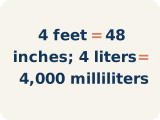
Convertir medidas dentro del mismo sistema
Convertir medidas dentro del mismo sistema
Rewriting a measurement in a different unit of the SAME system, such as feet into inches or liters into milliliters.
ES Reescribir una medida en otra unidad del MISMO sistema, como pies a pulgadas o litros a mililitros.
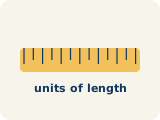
Factor de conversión
Factor de conversión
The ratio that links two units in the same measurement system, such as 12 inches to 1 foot. Within one system it is exact.
ES La razón que relaciona dos unidades del mismo sistema de medición, como 12 pulgadas a 1 pie. Dentro de un mismo sistema es exacta.
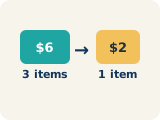
Razón unitaria
Razón unitaria
A ratio that compares an amount to exactly 1 unit of another quantity, like 12 inches to 1 foot.
ES Una razón que compara una cantidad con exactamente 1 unidad de otra cantidad, como 12 pulgadas por 1 pie.
Convertir
Convertir
To change a measurement from one unit to another without changing how much it is.
ES Cambiar una medida de una unidad a otra sin cambiar la cantidad que representa.
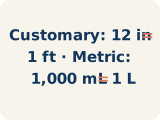
Sistema de medidas
Sistema de medidas
A family of units that go together — customary units like inches and feet, or metric units like milliliters and liters.
ES Una familia de unidades que van juntas: unidades usuales como pulgadas y pies, o métricas como mililitros y litros.
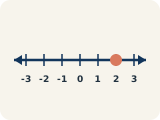
Recta numérica doble
Recta numérica doble
Two number lines lined up so matching tick marks show two units for the same amount.
ES Dos rectas numéricas alineadas para que las marcas correspondientes muestren dos unidades de la misma cantidad.
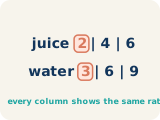
Tabla de razones
Tabla de razones
A table of equal ratios that lets you scale a conversion up or down one row at a time.
ES Una tabla de razones iguales que permite escalar una conversión hacia arriba o hacia abajo fila por fila.
Unidades del sistema usual
Unidades del sistema usual
The U.S. system of units: inch, foot, yard, mile, ounce, pound, cup, quart, gallon.
ES El sistema de unidades de EE. UU.: pulgada, pie, yarda, milla, onza, libra, taza, cuarto, galón.
Unidades métricas
Unidades métricas
The base-10 system of units: meter, gram, liter.
ES El sistema de unidades en base 10: metro, gramo, litro.
Student: explain. Partner: ask “How do you know?” Then switch. Working solo? Say or write your explanation; bring a question to a trusted adult at school.Estudiante: explica. Acompañante: pregunta «¿Cómo lo sabes?» Luego cambien. ¿Trabajas a solas? Di o escribe tu explicación; lleva una pregunta a un adulto de confianza en la escuela.
A wire is 4 yards long. The conversion factor is 1 yard = 3 feet. How many feet is the wire?
Un cable mide 4 yardas de largo. El factor de conversión es 1 yarda = 3 pies. ¿Cuántos pies mide el cable?
Work side by side. You ask questions; your student does the thinking. Trabajen juntos. Tú haces preguntas; tu estudiante piensa.
Are feet smaller or bigger than yards? Do you multiply or divide?
¿Los pies son más pequeños o más grandes que las yardas? ¿Multiplicas o divides?
Now do the math. How many feet is 4 yards?
Ahora hagan la cuenta. ¿Cuántos pies son 4 yardas?
Check together: should the number get bigger going from yards to feet?
Revisen juntos: ¿el número debe hacerse más grande al pasar de yardas a pies?
Do these together. Start at ★ and climb to ★★★ when ready. Háganlos juntos. Empiecen en ★ y suban a ★★★ cuando estén listos.
There are 3 feet in 1 yard. How many feet are in 7 yards?Hay 3 pies en 1 yarda. ¿Cuántos pies hay en 7 yardas?
B. 21B. 21
There are 2 cups in 1 pint. How many pints is 12 cups?Hay 2 tazas en 1 pinta. ¿Cuántas pintas son 12 tazas?
C. 6C. 6
Chef Reyes's stock order lists 3 quarts of broth, but her measuring cup is marked in cups. There are 4 cups in 1 quart. How many cups of broth is that?El pedido de caldo de la chef Reyes dice 3 cuartos de galón, pero su taza medidora está marcada en tazas. Hay 4 tazas en 1 cuarto de galón. ¿Cuántas tazas de caldo son?
C. 12 cupsC. 12 tazas
Chef Reyes's spice bin holds 48 teaspoons of salt. Her recipe card measures salt in tablespoons, and 3 teaspoons = 1 tablespoon. How many tablespoons of salt are in the bin?El recipiente de especias de la chef Reyes tiene 48 cucharaditas de sal. Su tarjeta de receta mide la sal en cucharadas, y 3 cucharaditas = 1 cucharada. ¿Cuántas cucharadas de sal hay en el recipiente?
B. 16 tablespoonsB. 16 cucharadas
You have 2 gallons of lemonade. Each glass holds 2 cups. (1 gallon = 4 quarts, 1 quart = 4 cups) How many glasses can you fill?Tienes 2 galones de limonada. Cada vaso lleva 2 tazas. (1 galón = 4 cuartos, 1 cuarto = 4 tazas) ¿Cuántos vasos puedes llenar?
A. 16A. 16
Point and name → finish the sentence → explain in your own words.Señala y nombra → completa la oración → explica con tus propias palabras.
___ and ___ name the same measurement because ___.___ y ___ nombran la misma medida porque ___.
Check: I answered the question, showed my thinking, labeled units, and explained why.Reviso: respondí la pregunta, mostré mi razonamiento, indiqué las unidades y expliqué por qué.
"Can you show me how you see that in your work or a quick sketch?" "¿Puedes mostrarme cómo ves eso en tu trabajo o en un dibujo rápido?"
Follow-up: Point to where each number from the problem shows up. Seguimiento: Señala dónde aparece cada número del problema.
Try the recommended mission. Student: explain; partner: ask one question, then switch. Paper drawings work for every object. Prueba la misión recomendada. Estudiante: explica; acompañante: haz una pregunta, luego cambien. Puedes dibujar los objetos en papel.
One mission is enough. You can also work solo and explain in writing.Una misión es suficiente. También puedes trabajar a solas y explicar por escrito.
Sketch a shelf 2 feet long. Label it in inches using 1 foot = 12 inches. Draw a second shelf 36 inches long. Compare them in the same unit, then check by converting back.
Dibuja un estante de 2 pies. Expresa su longitud en pulgadas usando 1 pie = 12 pulgadas. Dibuja otro de 36 pulgadas. Compáralos en la misma unidad y comprueba convirtiendo de regreso.
Show a labeled drawing, table, or equation. Your partner asks one question; working alone, write your explanation.
Muestra un dibujo con etiquetas, una tabla o una ecuación. Tu acompañante hace una pregunta; a solas, escribe tu explicación.
⏱️ About 8 minutes for the 6 problems below. The extra practice at the bottom is optional. ⏱️ Unos 8 minutos para los 6 problemas de abajo. La práctica extra al final es opcional.
A few problems to practice together. Each one has a step-by-step guide, a picture to draw on, and a space to show your work. Use Check This Problem for instant feedback — no need to finish everything at once. Unos problemas para practicar juntos. Cada uno tiene una guía paso a paso, un dibujo para trabajar y un espacio para mostrar el trabajo. Usen Revisar esta pregunta para retroalimentación al instante — no tienen que terminar todo de una vez.
Easier problems to practice the idea. Do these first together. Problemas más fáciles para practicar la idea. Hagan estos primero juntos.
Say the question in your own words. Circle what you know and underline what you need to find.
Explica la pregunta con tus propias palabras. Encierra lo que sabes y subraya lo que debes hallar.
Customary: inch, foot, ounce, pound, cup, quart, gallon.
Sistema usual: pulgada, pie, onza, libra, taza, cuarto de galón, galón.
Start here: Sort each unit as customary or metric.
Empieza aquí: Clasifica cada unidad como usual o métrica.
Which pair belongs to the SAME measurement system?¿Cuál par pertenece al MISMO sistema de medidas?
👪 Read the question together, then let your student pick an answer before you discuss why.👪 Lean la pregunta juntos; dejen que su estudiante elija antes de hablar del porqué.
Answer key for families — compare, then talk about why.Clave de respuestas para la familia — comparen y hablen del porqué.
Not tried yet? Close this and give it one try first. A wrong first try still helps.¿Todavía no lo intentaron? Ciérrenla y hagan un intento primero. Un primer intento equivocado también ayuda.
Why:Por qué: Cups and quarts are both customary units of capacity. The other pairs each mix a customary unit with a metric one.Las tazas y los cuartos de galón son unidades usuales de capacidad. Los otros pares mezclan una unidad usual con una métrica.
Say the question in your own words. Circle what you know and underline what you need to find.
Explica la pregunta con tus propias palabras. Encierra lo que sabes y subraya lo que debes hallar.
Multiply the liters by 1,000.
Multiplica los litros por 1,000.
Start here: The unit ratio is 1,000 mL : 1 L.
Empieza aquí: La razón unitaria es 1,000 mL : 1 L.
There are 1,000 milliliters in 1 liter. Complete the double number line as a table.Hay 1,000 mililitros en 1 litro. Completa la recta numérica doble como tabla.
👪 Encourage your student to show work on paper if a box feels tricky.👪 Animen a mostrar el trabajo en papel si una casilla se siente difícil.
| LitersLitros | MillilitersMililitros |
|---|---|
| 1 | 1,000 |
| 2 |
|
| 4 |
|
Answer key for families — compare, then talk about why.Clave de respuestas para la familia — comparen y hablen del porqué.
Not tried yet? Close this and give it one try first. A wrong first try still helps.¿Todavía no lo intentaron? Ciérrenla y hagan un intento primero. Un primer intento equivocado también ayuda.
Say the question in your own words. Circle what you know and underline what you need to find.
Explica la pregunta con tus propias palabras. Encierra lo que sabes y subraya lo que debes hallar.
Convert the feet to inches with the 12 : 1 unit ratio.
Convierte los pies a pulgadas con la razón unitaria 12 : 1.
Start here: You cannot compare two different units directly.
Empieza aquí: No puedes comparar dos unidades distintas directamente.
A child is 4 feet tall. A ride requires 44 inches. Can the child ride?Un niño mide 4 pies de estatura. Un juego mecánico exige 44 pulgadas. ¿Puede subir el niño?
Answer key for families — compare, then talk about why.Clave de respuestas para la familia — comparen y hablen del porqué.
Not tried yet? Close this and give it one try first. A wrong first try still helps.¿Todavía no lo intentaron? Ciérrenla y hagan un intento primero. Un primer intento equivocado también ayuda.
Why:Por qué: Convert first so both measurements use the same unit: 4 × 12 = 48 inches. 48 > 44, so the child can ride.Convierte primero para que las dos medidas usen la misma unidad: 4 × 12 = 48 pulgadas. 48 > 44, así que el niño sí puede subir.
Try these once the warm-up feels easy. It's okay to use the steps and pictures. Intenten estos cuando el calentamiento sea fácil. Está bien usar los pasos y los dibujos.
Say the question in your own words. Circle what you know and underline what you need to find.
Explica la pregunta con tus propias palabras. Encierra lo que sabes y subraya lo que debes hallar.
Divide by the ounces in one bag — then think about whether you can buy part of a bag.
Divide entre las onzas de una bolsa — y luego piensa si puedes comprar parte de una bolsa.
Start here: Find the total ounces of mix first.
Empieza aquí: Halla primero el total de onzas de mezcla.
Michael's mother is setting four fence posts. Each post needs 250 ounces of concrete mix, one bag holds 80 ounces, and each bag needs 1 quart of water. How many bags and how many cups of water does she need? Show your conversions.La mamá de Michael está colocando cuatro postes de cerca. Cada poste necesita 250 onzas de mezcla de concreto, una bolsa contiene 80 onzas, y cada bolsa necesita 1 cuarto de galón de agua. ¿Cuántas bolsas y cuántas tazas de agua necesita? Muestra tus conversiones.
👪 A complete sentence with math vocabulary is the goal — not a perfect paragraph.👪 Una oración completa con vocabulario matemático es la meta — no un párrafo perfecto.
Answer key for families — compare, then talk about why.Clave de respuestas para la familia — comparen y hablen del porqué.
Not tried yet? Close this and give it one try first. A wrong first try still helps.¿Todavía no lo intentaron? Ciérrenla y hagan un intento primero. Un primer intento equivocado también ayuda.
Why:Por qué: Answers will vary. Check that the reasoning is explained in a complete sentence.Las respuestas varían. Revisen que el razonamiento se explique en una oración completa.
Say the question in your own words. Circle what you know and underline what you need to find.
Explica la pregunta con tus propias palabras. Encierra lo que sabes y subraya lo que debes hallar.
4 liters is 4,000 milliliters.
4 litros son 4,000 mililitros.
Start here: Get both amounts into the same unit first.
Empieza aquí: Pon primero las dos cantidades en la misma unidad.
Diamond needs 4 liters of water. Her bottle holds 500 milliliters. How many times must she fill it?Diamond necesita 4 litros de agua. Su botella contiene 500 mililitros. ¿Cuántas veces debe llenarla?
Answer key for families — compare, then talk about why.Clave de respuestas para la familia — comparen y hablen del porqué.
Not tried yet? Close this and give it one try first. A wrong first try still helps.¿Todavía no lo intentaron? Ciérrenla y hagan un intento primero. Un primer intento equivocado también ayuda.
Why:Por qué: Convert first: 4 L = 4,000 mL. Then solve ? × 500 = 4,000, giving 8 fills.Convierte primero: 4 L = 4,000 mL. Luego resuelve ? × 500 = 4,000, lo que da 8 llenadas.
Say the question in your own words. Circle what you know and underline what you need to find.
Explica la pregunta con tus propias palabras. Encierra lo que sabes y subraya lo que debes hallar.
Converting to the larger unit divides.
Convertir a la unidad más grande es dividir.
Start here: Which unit is larger?
Empieza aquí: ¿Cuál unidad es más grande?
How many liters is 2,000 milliliters?¿Cuántos litros son 2,000 mililitros?
Answer key for families — compare, then talk about why.Clave de respuestas para la familia — comparen y hablen del porqué.
Not tried yet? Close this and give it one try first. A wrong first try still helps.¿Todavía no lo intentaron? Ciérrenla y hagan un intento primero. Un primer intento equivocado también ayuda.
Why:Por qué: Liters are the larger unit, so divide: 2,000 ÷ 1,000 = 2 liters.Los litros son la unidad más grande, así que divide: 2,000 ÷ 1,000 = 2 litros.
Optional. Only if your student wants more — these are bonus problems. Opcional. Solo si tu estudiante quiere más — son problemas adicionales.
Say the question in your own words. Circle what you know and underline what you need to find.
Explica la pregunta con tus propias palabras. Encierra lo que sabes y subraya lo que debes hallar.
Inches are smaller, so the number gets bigger — multiply.
Las pulgadas son más pequeñas, así que el número se hace mayor — multiplica.
Start here: Write the unit ratio first: 12 inches : 1 foot.
Empieza aquí: Escribe primero la razón unitaria: 12 pulgadas : 1 pie.
There are 12 inches in 1 foot. How many inches are in 5 feet?Hay 12 pulgadas en 1 pie. ¿Cuántas pulgadas hay en 5 pies?
Answer key for families — compare, then talk about why.Clave de respuestas para la familia — comparen y hablen del porqué.
Not tried yet? Close this and give it one try first. A wrong first try still helps.¿Todavía no lo intentaron? Ciérrenla y hagan un intento primero. Un primer intento equivocado también ayuda.
Why:Por qué: Inches are smaller than feet, so multiply by the unit ratio: 5 × 12 = 60 inches.Las pulgadas son más pequeñas que los pies, así que multiplica por la razón unitaria: 5 × 12 = 60 pulgadas.
Say the question in your own words. Circle what you know and underline what you need to find.
Explica la pregunta con tus propias palabras. Encierra lo que sabes y subraya lo que debes hallar.
Milliliters are smaller, so multiply.
Los mililitros son más pequeños, así que multiplica.
Start here: The unit ratio is 1,000 mL : 1 L.
Empieza aquí: La razón unitaria es 1,000 mL : 1 L.
There are 1,000 milliliters in 1 liter. How many milliliters are in 3 liters?Hay 1,000 mililitros en 1 litro. ¿Cuántos mililitros hay en 3 litros?
Answer key for families — compare, then talk about why.Clave de respuestas para la familia — comparen y hablen del porqué.
Not tried yet? Close this and give it one try first. A wrong first try still helps.¿Todavía no lo intentaron? Ciérrenla y hagan un intento primero. Un primer intento equivocado también ayuda.
Why:Por qué: Multiply by the unit ratio: 3 × 1,000 = 3,000 milliliters.Multiplica por la razón unitaria: 3 × 1,000 = 3,000 mililitros.
Say the question in your own words. Circle what you know and underline what you need to find.
Explica la pregunta con tus propias palabras. Encierra lo que sabes y subraya lo que debes hallar.
Cups are the smaller unit, so multiply the quarts by 4.
Las tazas son la unidad más pequeña, así que multiplica los cuartos de galón por 4.
Start here: Row 1 is the unit ratio: 1 quart is 4 cups.
Empieza aquí: La fila 1 es la razón unitaria: 1 cuarto de galón son 4 tazas.
There are 4 cups in 1 quart. Complete the conversion table.Hay 4 tazas en 1 cuarto de galón. Completa la tabla de conversión.
| QuartsCuartos de galón | CupsTazas |
|---|---|
| 1 | 4 |
| 3 |
|
| 6 |
|
Answer key for families — compare, then talk about why.Clave de respuestas para la familia — comparen y hablen del porqué.
Not tried yet? Close this and give it one try first. A wrong first try still helps.¿Todavía no lo intentaron? Ciérrenla y hagan un intento primero. Un primer intento equivocado también ayuda.
Say the question in your own words. Circle what you know and underline what you need to find.
Explica la pregunta con tus propias palabras. Encierra lo que sabes y subraya lo que debes hallar.
Multiply to reach the smaller unit.
Multiplica para llegar a la unidad más pequeña.
Start here: The unit ratio is 12 : 1.
Empieza aquí: La razón unitaria es 12 : 1.
How many inches are in 2 feet?¿Cuántas pulgadas hay en 2 pies?
Answer key for families — compare, then talk about why.Clave de respuestas para la familia — comparen y hablen del porqué.
Not tried yet? Close this and give it one try first. A wrong first try still helps.¿Todavía no lo intentaron? Ciérrenla y hagan un intento primero. Un primer intento equivocado también ayuda.
Why:Por qué: 2 × 12 = 24 inches.2 × 12 = 24 pulgadas.
Say the question in your own words. Circle what you know and underline what you need to find.
Explica la pregunta con tus propias palabras. Encierra lo que sabes y subraya lo que debes hallar.
Which unit has 1,000 tiny parts?
¿Por qué es razonable tu respuesta? Usa la pregunta para comprobarla.
Start here: Read each ratio as 'this many small units per 1 big unit'.
Empieza aquí: Indica ambas cantidades y sus unidades. Haz una tabla con un par conocido.
Match each unit ratio to its conversion.Une cada razón unitaria con su conversión.
👪 Say each term out loud, then talk through which match makes sense before choosing.👪 Digan cada término en voz alta y hablen de cuál pareja tiene sentido antes de elegir.
Answer key for families — compare, then talk about why.Clave de respuestas para la familia — comparen y hablen del porqué.
Not tried yet? Close this and give it one try first. A wrong first try still helps.¿Todavía no lo intentaron? Ciérrenla y hagan un intento primero. Un primer intento equivocado también ayuda.
Why:Por qué: Every unit ratio says how many of the smaller unit fit inside exactly 1 of the larger one.
Say the question in your own words. Circle what you know and underline what you need to find.
Explica la pregunta con tus propias palabras. Encierra lo que sabes y subraya lo que debes hallar.
Customary units are the ones used on U.S. recipes and rulers.
¿Por qué es razonable tu respuesta? Usa la pregunta para comprobarla.
Start here: Metric units use prefixes like milli- and kilo-.
Empieza aquí: Indica ambas cantidades y sus unidades. Haz una tabla con un par conocido.
Sort the items into the correct groups.Clasifica los elementos en los grupos correctos.
👪 On a phone, use Move to. On a computer, drag cards or tap a card then tap a column.👪 En el teléfono usen Mover a. En la computadora arrastren o toquen tarjeta y columna.
💡 Metric units use prefixes like milli- and kilo-.
💡 Customary units are the ones used on U.S. recipes and rulers.
💡 Liter, gram, milliliter are metric.
Answer key for families — compare, then talk about why.Clave de respuestas para la familia — comparen y hablen del porqué.
Not tried yet? Close this and give it one try first. A wrong first try still helps.¿Todavía no lo intentaron? Ciérrenla y hagan un intento primero. Un primer intento equivocado también ayuda.
Why:Por qué: Conversions in this lesson stay inside one system — customary with customary, metric with metric.
Say the question in your own words. Circle what you know and underline what you need to find.
Explica la pregunta con tus propias palabras. Encierra lo que sabes y subraya lo que debes hallar.
Converting to the larger unit takes fewer of them, so divide.
Convertir a la unidad más grande requiere menos de ellas, así que divide.
Start here: Which unit is larger, an ounce or a pound?
Empieza aquí: ¿Cuál unidad es más grande, una onza o una libra?
There are 16 ounces in 1 pound. How many pounds is 48 ounces?Hay 16 onzas en 1 libra. ¿Cuántas libras son 48 onzas?
Answer key for families — compare, then talk about why.Clave de respuestas para la familia — comparen y hablen del porqué.
Not tried yet? Close this and give it one try first. A wrong first try still helps.¿Todavía no lo intentaron? Ciérrenla y hagan un intento primero. Un primer intento equivocado también ayuda.
Why:Por qué: Pounds are the LARGER unit, so divide: 48 ÷ 16 = 3 pounds.Las libras son la unidad MÁS GRANDE, así que divide: 48 ÷ 16 = 3 libras.
Say the question in your own words. Circle what you know and underline what you need to find.
Explica la pregunta con tus propias palabras. Encierra lo que sabes y subraya lo que debes hallar.
More small units are needed to make the same amount.
¿Por qué es razonable tu respuesta? Usa la pregunta para comprobarla.
Start here: Ask which unit is smaller.
Empieza aquí: Indica ambas cantidades y sus unidades. Haz una tabla con un par conocido.
Sort the items into the correct groups.Clasifica los elementos en los grupos correctos.
💡 Ask which unit is smaller.
💡 More small units are needed to make the same amount.
💡 Smaller unit → bigger number.
Answer key for families — compare, then talk about why.Clave de respuestas para la familia — comparen y hablen del porqué.
Not tried yet? Close this and give it one try first. A wrong first try still helps.¿Todavía no lo intentaron? Ciérrenla y hagan un intento primero. Un primer intento equivocado también ayuda.
Why:Por qué: Going to a smaller unit takes more of them, so the number grows. Going to a larger unit takes fewer, so the number shrinks. The amount itself never changes.
Pick a game and play as a team. Nothing here is timed, and every game can be replayed as many times as you like. Escojan un juego y jueguen en equipo. Nada aquí tiene cronómetro, y pueden repetir cada juego cuantas veces quieran.
Choose ONE game. Quick Quiz practices this lesson; the other games review related skills. Play together or solo, without a timer. Elige UN juego. Reto rápido practica esta lección; los demás repasan temas relacionados. Juega acompañado o a solas, sin cronómetro.
Flip two cards to find each problem's twin answer. Fewer flips = sharper memory! Volteen dos tarjetas para encontrar la pareja de cada problema. ¡Menos vueltas = mejor memoria!
Matches: 0 / 4 · Flips: 0 Parejas: 0 / 4 · Vueltas: 0
🎉 All twins found! Can you beat your flip count on a rematch?¡Encontraron todas las parejas! ¿Pueden lograrlo con menos vueltas en la revancha?
Take turns — student answers one, then a family member answers the next. Watch for the trick statements! Por turnos: el estudiante responde una y luego un familiar responde la siguiente. ¡Cuidado con las trampas!
Tap a card, then tap the bin it belongs in. Talk it through before you tap! Toquen una tarjeta y luego el cesto al que pertenece. ¡Conversen antes de tocar!
Everyone votes and says WHY. Then tap to see what the math says — sometimes it is a tie! Todos votan y dicen POR QUÉ. Luego toquen para ver qué dicen las matemáticas: ¡a veces es empate!
🔎 What the math saysLo que dicen las matemáticas
Reinforce tonight's topic with a quick family game. You ask; your student decides! Refuercen el tema de hoy con un juego rápido en familia. ¡Ustedes preguntan; su estudiante decide!
🎮 Play together! Use the same multiplier on BOTH parts of the ratio. 🎮 ¡Jueguen juntos! Usen el mismo multiplicador en AMBAS partes de la razón.
The bigger review game for tonight's lesson — sort, match and choose. A wrong answer gives a hint and lets your student try again. No timer. El juego de repaso más grande para la lección de hoy — clasificar, emparejar y elegir. Si se equivocan, reciben una pista y lo intentan otra vez. Sin cronómetro.
Explain one answer aloud or on paper: “I got ___ because ___. I checked by ___.” Include your strategy and units. Then you are done.Explica una respuesta en voz alta o en papel: “Obtuve ___ porque ___. Comprobé usando ___.” Incluye tu estrategia y las unidades. Después termina.
Name one strategy that helped, or one question to ask next time. You can stop here; no adult signature is needed.
Di una estrategia que te ayudó o una pregunta para la próxima vez. Puedes terminar aquí; no necesitas la firma de un adulto.
Answers save automatically on this device. Tap Check This Problem anytime. Las respuestas se guardan solas en este dispositivo. Toquen Revisar esta pregunta cuando quieran.
These extras are not required. Photos, recordings and reflections stay on this device. To send anything to Mr. Neft, use ClassDojo.Estos extras no son obligatorios. Las fotos, grabaciones y reflexiones quedan en este dispositivo. Para enviar algo al Sr. Neft, usa ClassDojo.
Saved on:Guardado el:
🔥 1-Night StreakRacha de 1 noche
Question draft (not sent):Borrador de pregunta (no enviado):
Family reflection:Reflexión familiar:
Student Work Photo:Foto del trabajo:
Student Voice Memo:Nota de voz del estudiante:
A personal record of practice for . Saved on this device; not submitted to the teacher.
Practice partner (optional)
Date
Use this as a photobooth for the work itself: point the camera at tonight's notebook page, the scratchpad or the whiteboard and take the picture — or pose holding it up. Choose a frame, add stickers, then download it, print it, or add it to your optional reflection. The photo is never uploaded; it stays on this device. Úsenla como cabina de fotos del trabajo: apunten la cámara a la página del cuaderno, al borrador o a la pizarra y tomen la foto, o posen sosteniéndola. Elijan un marco, agreguen calcomanías y luego descárguenla, imprímanla o agréguenla a la reflexión opcional. La foto nunca se sube a internet; se queda en este dispositivo.
Camera Ready!¡Cámara lista!
Tap “Start Camera” to photograph tonight’s work, or use “Upload Work” below. The photo stays on this device.Toca “Iniciar Cámara” para fotografiar el trabajo de hoy, o usa “Subir Foto”. La foto se queda en este dispositivo.
Holding your open notebook or paper up next to your smile makes the best shot! You can also snap a photo of just your written work. ¡Sostener el cuaderno abierto junto a su sonrisa crea la mejor foto! También pueden tomar la foto solo de su trabajo escrito.
Are we changing to a smaller unit or a bigger unit?
¿Estamos cambiando a una unidad más pequeña o más grande?
Smaller unit means more pieces, so do we multiply or divide?
Una unidad más pequeña significa más piezas, ¿así que multiplicamos o dividimos?
What is the conversion factor between these two units?
¿Cuál es el factor de conversión entre estas dos unidades?
Always multiply when you convert units.
Siempre multiplica cuando conviertes unidades.
The number stays the same, only the unit name changes.
El número se queda igual, solo cambia el nombre de la unidad.
Just guess whether to multiply or divide.
Solo adivina si multiplicar o dividir.
These links go to specific videos and lessons about tonight's topic — not general math pages. Estos enlaces van a videos y lecciones específicas sobre el tema de hoy — no páginas generales.