Touch and changeToca y cambia
Move, type, tap, or drag in the model. Watch what changes.Mueve, escribe, toca o arrastra en el modelo. Observa qué cambia.
Unit 6 · Numerical and Algebraic ExpressionsUnidad 6 · Expresiones numéricas y algebraicas
TicketBoleto
The rec center has swim class every 4 days and art club every 6 days. Both are today. When will both fall on the same day again?El centro recreativo tiene clase de natación cada 4 días y club de arte cada 6 días. Hoy hay las dos. ¿Cuándo volverán a caer el mismo día?
Five short steps, about 15–20 minutes: watch the idea, try one together, solve 10 in three levels, check, celebrate.Cinco pasos cortos, unos 15–20 minutos: miren la idea, prueben uno juntos, resuelvan 10 en tres niveles, revisen y celebren.
Optional. No grades, no account. Your place is saved on this device.Opcional. Sin calificaciones ni cuenta. Su avance se guarda en este dispositivo.
Tonight's ideaLa idea de hoy Find the least common multiple: the smallest number that two numbers both go into.Hallar el mínimo común múltiplo: el menor número al que entran los dos números.
💡 Draw fraction bars, tape diagrams, equations, or line up decimals together!💡 ¡Dibujen barras de fracciones, modelos o alineen decimales juntos!
Step 1 of 5Paso 1 de 5
Read the goal and look at the picture. Then go through the example one step at a time.Lean la meta y miren el dibujo. Luego sigan el ejemplo un paso a la vez.
Find the least common multiple: the smallest number that two numbers both go into.
Hallar el mínimo común múltiplo: el menor número al que entran los dos números.
In class we usedEn clase usamos two skip-count listsdos listas de conteo salteado.
Why it worksPor qué funciona Both 12 and 24 are numbers that 4 and 6 go into evenly. The lists show that 12 comes first, so 12 is the least common multiple. Check: 12 ÷ 4 = 3 and 12 ÷ 6 = 2.Tanto 12 como 24 son números en los que caben 4 y 6 exactamente. Las listas muestran que 12 viene primero, así que 12 es el mínimo común múltiplo. Comprobación: 12 ÷ 4 = 3 y 12 ÷ 6 = 2.
The example:El ejemplo: I want the LCM of 4 and 6. I skip count the multiples of 4: 4, 8, 12, 16, 20, 24.Quiero el mínimo común múltiplo de 4 y 6. Cuento de salto los múltiplos de 4: 4, 8, 12, 16, 20, 24.
Your case:Su caso: Tonight we find the least common multiple (LCM) of two numbers. It is the smallest number that both numbers go into.Esta noche encontramos el mínimo común múltiplo (mcm) de dos números. Es el número más pequeño al que llegan los dos.
Tap a clue to read what it means.Toquen una pista para leer qué significa.
Look at the picture and the story. Say it out loud, or type a few words. There is no wrong answer here.Mira el dibujo y la historia. Dilo en voz alta o escribe unas palabras. Aquí no hay respuestas incorrectas.
Just for you. It stays on this device. We ask again at the end.Solo para ti. Se queda en este dispositivo. Preguntamos otra vez al final.
What is the third multiple of 9?¿Cuál es el tercer múltiplo de 9?
Not yet. Try another look.Todavía no. Intenta otra mirada.
Count by 9: 9, 18, 27. The third multiple is 27.Cuenta de 9 en 9: 9, 18, 27. El tercer múltiplo es 27.
What is 3²?¿Cuánto es 3²?
Not yet. Try another look.Todavía no. Intenta otra mirada.
3² means 3 × 3, and 3 × 3 = 9.3² significa 3 × 3, y 3 × 3 = 9.
Step 2 of 5Paso 2 de 5
Do this one side by side. Use the model, and ask for a hint whenever you want one.Háganlo lado a lado. Usen el modelo y pidan una pista cuando quieran.
Try this one togetherPrueben este juntos
Two astronauts start checks at the same time. Find the LCM of 3 and 5 to see when their schedules line up again.Dos astronautas empiezan sus revisiones al mismo tiempo. Encuentren el mcm de 3 y 5 para ver cuándo coinciden sus horarios otra vez.
Skip count the multiples of 3 up to 15. What are they?Cuenten salteado los múltiplos de 3 hasta 15. ¿Cuáles son?
3, 6, 9, 12, 15 — add 3 each time.3, 6, 9, 12, 15 — sumen 3 cada vez.
Counting out loud together makes the pattern easier to hear.Contar en voz alta juntos hace que el patrón se escuche más fácil.
Now skip count the multiples of 5 up to 15. What are they?Ahora cuenten salteado los múltiplos de 5 hasta 15. ¿Cuáles son?
5, 10, 15 — add 5 each time.5, 10, 15 — sumen 5 cada vez.
Write each list on its own line so they are easy to compare.Escriban cada lista en su propia línea para compararlas fácil.
Which number is the FIRST one in both lists? That is the LCM.¿Qué número es el PRIMERO que aparece en las dos listas? Ese es el mcm.
15 is the first shared number, so the LCM of 3 and 5 is 15.El 15 es el primer número compartido, así que el mcm de 3 y 5 es 15.
Remind them the LCM is the smallest shared multiple, not the largest.Recuérdenles que el mcm es el múltiplo compartido más pequeño, no el más grande.
Watch how the dependent variable changes as you step the independent variable.Observa cómo cambia la variable dependiente al cambiar la variable independiente.
Change one value. Watch what changes in the picture and answer.Cambia un valor. Mira qué cambia en el dibujo y la respuesta. Say: “When ___ changes, ___ changes.”Di: “Cuando ___ cambia, ___ cambia.”
Before you go on: say one thing the model showed you.Antes de seguir: digan una cosa que les mostró el modelo.
Change the two numbers. Find the first multiple they share.Cambia los dos números. Encuentra el primer múltiplo que comparten.
Move, type, tap, or drag in the model. Watch what changes.Mueve, escribe, toca o arrastra en el modelo. Observa qué cambia.
Record one equation, value, or relationship you can see.Escribe una ecuación, un valor o una relación que puedas ver.
I notice ___ changes when ___ changes. This shows ___.Noto que ___ cambia cuando ___ cambia. Esto muestra ___.
Ask: "Where do you see the numbers from tonight's math in this model?"Pregunta: "¿Dónde ves los números de la tarea de hoy en este modelo?"
Find the least common multiple: the smallest number that two numbers both go into.
Hallar el mínimo común múltiplo: el menor número al que entran los dos números.
4 × 3 = 6 × 2 = 12
Choose the smallest positive common multiple.
Elige el menor múltiplo común positivo.
Find the LCM of 4 and 6.
Halla el mcm de 4 y 6.
Skip count by 4: 4, 8, 12, 16, 20, 24.
Cuenta salteado de 4 en 4: 4, 8, 12, 16, 20, 24.
Skip count by 6: 6, 12, 18, 24.
Cuenta salteado de 6 en 6: 6, 12, 18, 24.
Look for the first number in BOTH lists.
Busca el primer número que está en LAS DOS listas.
12 is in both, and it comes before 24.
12 está en las dos, y aparece antes que 24.
Check: the LCM of 4 and 6 is 12, because 12 ÷ 4 = 3 and 12 ÷ 6 = 2.
Comprueba: el mcm de 4 y 6 es 12, porque 12 ÷ 4 = 3 y 12 ÷ 6 = 2.
Listen for "mínimo común múltiplo" — it means the smallest number that two numbers both go into.
Escuchen "mínimo común múltiplo" — significa el número más pequeño al que llegan los dos números.
Listen for "conteo salteado" — it means counting by a number, like 6, 12, 18, to list its multiples.
Escuchen "conteo salteado" — significa contar de un número en un número, como 6, 12, 18, para listar sus múltiplos.
Let your student try first. Ask "What is the first number in both lists?" before helping.
Dejen que su estudiante intente primero. Pregunten "¿Cuál es el primer número en las dos listas?" antes de ayudar.
Step 3 of 5Paso 3 de 5
One at a time. Work on your own; a grown-up can watch.Uno a la vez. Trabaja solo; un adulto puede observar.
10 problems. Hints are always okay. 10 problemas. Las pistas siempre están bien.
+0 bonusextraSkip count: add 6 each time.
Cuenta salteado: suma 6 cada vez.
What do you get when you count by 6s starting at 6?
¿Qué obtienes al contar de 6 en 6 empezando en 6?
Count by 6s: 6, 12, 18, 24.
Cuenta de 6 en 6: 6, 12, 18, 24.
Which list shows the first four multiples of 6?¿Cuál lista muestra los primeros cuatro múltiplos de 6?
Answer key for families — compare, then talk about why.Clave de respuestas para la familia — comparen y hablen del porqué.
Not tried yet? Close this and give it one try first. A wrong first try still helps.¿Todavía no lo intentaron? Ciérrenla y hagan un intento primero. Un primer intento equivocado también ayuda.
Why:Por qué: Count by 6s: 6, 12, 18, 24.Cuenta de 6 en 6: 6, 12, 18, 24.
Skip count by the larger number and test each stop.
Cuenta salteado con el número mayor y prueba cada parada.
What does LCM stand for, and which word tells you to pick the smallest?
¿Qué significan las siglas mcm y cuál palabra te dice que elijas el más pequeño?
Multiples of 5: 5, 10. Multiples of 2: 2, 4, 6, 8, 10. The first match is 10.
Múltiplos de 5: 5, 10. Múltiplos de 2: 2, 4, 6, 8, 10. La primera coincidencia es 10.
What is the LCM of 2 and 5?¿Cuál es el mcm de 2 y 5?
Answer key for families — compare, then talk about why.Clave de respuestas para la familia — comparen y hablen del porqué.
Not tried yet? Close this and give it one try first. A wrong first try still helps.¿Todavía no lo intentaron? Ciérrenla y hagan un intento primero. Un primer intento equivocado también ayuda.
Why:Por qué: Multiples of 5: 5, 10. Multiples of 2: 2, 4, 6, 8, 10. The first match is 10.Múltiplos de 5: 5, 10. Múltiplos de 2: 2, 4, 6, 8, 10. La primera coincidencia es 10.
What makes your answer reasonable? Use the question to check it.
¿Por qué es razonable tu respuesta? Usa la pregunta para comprobarla.
A multiple is what you get when you count by a number: 4, 8, 12. The LCM is the first number that shows up in both numbers' lists.
Un múltiplo es lo que obtienes al contar de un número: 4, 8, 12. El mcm es el primer número que aparece en las listas de los dos números.
Multiples of 10: 10, 20, 30. Multiples of 15: 15, 30. The first shared number is 30.
Múltiplos de 10: 10, 20, 30. Múltiplos de 15: 15, 30. El primer número en común es 30.
One bus stops every 10 minutes. Another bus stops every 15 minutes. Both stop together now. In how many minutes will they stop together again?Un autobús para cada 10 minutos. Otro autobús para cada 15 minutos. Los dos paran juntos ahora. ¿Dentro de cuántos minutos volverán a parar juntos?
Answer key for families — compare, then talk about why.Clave de respuestas para la familia — comparen y hablen del porqué.
Not tried yet? Close this and give it one try first. A wrong first try still helps.¿Todavía no lo intentaron? Ciérrenla y hagan un intento primero. Un primer intento equivocado también ayuda.
Why:Por qué: Multiples of 10: 10, 20, 30. Multiples of 15: 15, 30. The first shared number is 30.Múltiplos de 10: 10, 20, 30. Múltiplos de 15: 15, 30. El primer número en común es 30.
List a few multiples of each number and look for a match.
Haz una lista de algunos múltiplos de cada número y busca uno que coincida.
Which choice can be divided evenly by 3 AND by 4?
¿Cuál opción se puede dividir exactamente entre 3 Y entre 4?
12 is in the list of 3s (3, 6, 9, 12) and in the list of 4s (4, 8, 12).
12 está en la lista de los 3 (3, 6, 9, 12) y en la lista de los 4 (4, 8, 12).
Which number is a common multiple of 3 and 4?¿Cuál número es un múltiplo común de 3 y 4?
Answer key for families — compare, then talk about why.Clave de respuestas para la familia — comparen y hablen del porqué.
Not tried yet? Close this and give it one try first. A wrong first try still helps.¿Todavía no lo intentaron? Ciérrenla y hagan un intento primero. Un primer intento equivocado también ayuda.
Why:Por qué: 12 is in the list of 3s (3, 6, 9, 12) and in the list of 4s (4, 8, 12).12 está en la lista de los 3 (3, 6, 9, 12) y en la lista de los 4 (4, 8, 12).
Skip count by 9 and check each one against 6.
Cuenta salteado de 9 en 9 y revisa cada uno con el 6.
Which number is first on both lists of multiples?
¿Cuál número aparece primero en las dos listas de múltiplos?
Multiples of 9: 9, 18. Multiples of 6: 6, 12, 18. The first match is 18.
Múltiplos de 9: 9, 18. Múltiplos de 6: 6, 12, 18. La primera coincidencia es 18.
What is the LCM of 6 and 9?¿Cuál es el mcm de 6 y 9?
Answer key for families — compare, then talk about why.Clave de respuestas para la familia — comparen y hablen del porqué.
Not tried yet? Close this and give it one try first. A wrong first try still helps.¿Todavía no lo intentaron? Ciérrenla y hagan un intento primero. Un primer intento equivocado también ayuda.
Why:Por qué: Multiples of 9: 9, 18. Multiples of 6: 6, 12, 18. The first match is 18.Múltiplos de 9: 9, 18. Múltiplos de 6: 6, 12, 18. La primera coincidencia es 18.
Start with the larger number's multiples.
Empieza con los múltiplos del número mayor.
Does 4 go into the larger number evenly?
¿El 4 entra exactamente en el número mayor?
12 is already a multiple of 4 (4 × 3), so the LCM is 12.
12 ya es múltiplo de 4 (4 × 3), así que el mcm es 12.
What is the LCM of 4 and 12?¿Cuál es el mcm de 4 y 12?
Answer key for families — compare, then talk about why.Clave de respuestas para la familia — comparen y hablen del porqué.
Not tried yet? Close this and give it one try first. A wrong first try still helps.¿Todavía no lo intentaron? Ciérrenla y hagan un intento primero. Un primer intento equivocado también ayuda.
Why:Por qué: 12 is already a multiple of 4 (4 × 3), so the LCM is 12.12 ya es múltiplo de 4 (4 × 3), así que el mcm es 12.
List the times for each bus and find the first match.
Haz la lista de tiempos de cada autobús y busca la primera coincidencia.
When do the buses return? Is that a list of multiples?
¿Cuándo regresan los autobuses? ¿Es una lista de múltiplos?
Multiples of 6: 6, 12, 18, 24. Multiples of 8: 8, 16, 24. They next meet at 24 minutes.
Múltiplos de 6: 6, 12, 18, 24. Múltiplos de 8: 8, 16, 24. Se encuentran de nuevo a los 24 minutos.
One bus returns to the station every 6 minutes and another every 8 minutes. They are both there now. In how many minutes will they next be there together?Un autobús regresa a la estación cada 6 minutos y otro cada 8 minutos. Ahora los dos están ahí. ¿En cuántos minutos volverán a estar juntos?
Answer key for families — compare, then talk about why.Clave de respuestas para la familia — comparen y hablen del porqué.
Not tried yet? Close this and give it one try first. A wrong first try still helps.¿Todavía no lo intentaron? Ciérrenla y hagan un intento primero. Un primer intento equivocado también ayuda.
Why:Por qué: Multiples of 6: 6, 12, 18, 24. Multiples of 8: 8, 16, 24. They next meet at 24 minutes.Múltiplos de 6: 6, 12, 18, 24. Múltiplos de 8: 8, 16, 24. Se encuentran de nuevo a los 24 minutos.
Easier problems to practice the idea. Do these first together. Problemas más fáciles para practicar la idea. Hagan estos primero juntos.
Skip count by the larger cycle time and stop at the first value the smaller time divides evenly; then compare that LCM with 25 minutes.
Cuenta de en de en el tiempo de ciclo mayor y detente en el primer valor que el tiempo menor divida exactamente; luego compara ese m.c.m. con 25 minutos.
Before you can sort a card you need the time the two systems meet again, and that time is the LCM of their two cycle times.
Antes de clasificar una tarjeta necesitas el momento en que los dos sistemas vuelven a coincidir, y ese momento es el m.c.m. de sus dos tiempos de ciclo.
Each schedule syncs again at the LCM of its two cycle times: reactor checks 4 and 6 at 12 min, window shutters 8 and 12 at 24 min, and galley ovens 2 and 7 at 14 min all land under 25 minutes, while solar arrays 6 and 10 at 30 min, coolant pumps 5 and 8 at 40 min, and antenna sweeps 4 and 9 at 36 min are 25 minutes or more.
Cada horario se vuelve a sincronizar en el m.c.m. de sus dos tiempos de ciclo: las revisiones del reactor de 4 y 6 a los 12 min, las persianas de las ventanas de 8 y 12 a los 24 min y los hornos de la cocina de 2 y 7 a los 14 min quedan por debajo de 25 minutos, mientras que los paneles solares de 6 y 10 a los 30 min, las bombas de refrigerante de 5 y 8 a los 40 min y los barridos de antena de 4 y 9 a los 36 min son de 25 minutos o más.
Stop 4 — Mission Control: Each clue points to your next stop. Sort each crew schedule by whether the two systems sync again in UNDER 25 minutes or 25 MINUTES OR MORE. Skip count to find each LCM.Parada 4 — Control de Misión: Cada pista señala tu siguiente parada. Clasifica cada horario de la tripulación según si los dos sistemas se sincronizan otra vez en MENOS DE 25 minutos o en 25 MINUTOS O MÁS. Cuenta salteado para encontrar cada mcm.
💡 Before you can sort a card you need the time the two systems meet again, and that time is the LCM of their two cycle times.Antes de clasificar una tarjeta necesitas el momento en que los dos sistemas vuelven a coincidir, y ese momento es el m.c.m. de sus dos tiempos de ciclo.
💡 Skip count by the larger cycle time and stop at the first value the smaller time divides evenly; then compare that LCM with 25 minutes.Cuenta de en de en el tiempo de ciclo mayor y detente en el primer valor que el tiempo menor divida exactamente; luego compara ese m.c.m. con 25 minutos.
💡 Reactor checks (4 and 6 min): count by 6s — 6, 12, 18 … — and stop at the first value that is also a multiple of 4, then decide which bin it belongs in.Revisiones del reactor (4 y 6 min): cuenta de 6 en 6 — 6, 12, 18 … — y detente en el primer valor que también sea múltiplo de 4; luego decide en qué grupo va.
Answer key for families — compare, then talk about why.Clave de respuestas para la familia — comparen y hablen del porqué.
Not tried yet? Close this and give it one try first. A wrong first try still helps.¿Todavía no lo intentaron? Ciérrenla y hagan un intento primero. Un primer intento equivocado también ayuda.
Why:Por qué: Each schedule syncs again at the LCM of its two cycle times: reactor checks 4 and 6 at 12 min, window shutters 8 and 12 at 24 min, and galley ovens 2 and 7 at 14 min all land under 25 minutes, while solar arrays 6 and 10 at 30 min, coolant pumps 5 and 8 at 40 min, and antenna sweeps 4 and 9 at 36 min are 25 minutes or more.Cada horario se vuelve a sincronizar en el m.c.m. de sus dos tiempos de ciclo: las revisiones del reactor de 4 y 6 a los 12 min, las persianas de las ventanas de 8 y 12 a los 24 min y los hornos de la cocina de 2 y 7 a los 14 min quedan por debajo de 25 minutos, mientras que los paneles solares de 6 y 10 a los 30 min, las bombas de refrigerante de 5 y 8 a los 40 min y los barridos de antena de 4 y 9 a los 36 min son de 25 minutos o más.
For each pair, ask: do the two numbers share a factor bigger than 1? Sharing a factor is what pulls the LCM below the product.
Para cada pareja pregunta: ¿comparten un factor mayor que 1? Compartir un factor es lo que baja el mcm por debajo del producto.
For each pair, work out the LCM and the product yourself, then compare them. The interesting question is WHY some LCMs fall short of the product.
Lee bien cada tarjeta: muestra la pareja, su mcm y el producto. La pregunta es POR QUÉ algunos mcm quedan por debajo del producto.
The pairs 3 and 7, 5 and 11, and 2 and 9 share no factor larger than 1, so nothing overlaps early and the LCM equals the full product. The pairs 4 and 6, 6 and 8, and 10 and 15 each share a factor (2, 2, and 5), and that shared factor gets counted once instead of twice, pulling the LCM below the product.
Los pares 3 y 7, 5 y 11, y 2 y 9 no comparten ningún factor mayor que 1, así que nada se traslapa antes y el m.c.m. es igual al producto completo. Los pares 4 y 6, 6 y 8, y 10 y 15 comparten un factor (2, 2 y 5), y ese factor compartido se cuenta una sola vez en lugar de dos, lo que hace que el m.c.m. quede por debajo del producto.
Sort each pair: does the LCM equal the product of the two numbers, or is the LCM less than the product?Clasifica cada pareja: ¿el mcm es igual al producto de los dos números o el mcm es menor que el producto?
💡 For each pair, work out the LCM and the product yourself, then compare them. The interesting question is WHY some LCMs fall short of the product.Lee bien cada tarjeta: muestra la pareja, su mcm y el producto. La pregunta es POR QUÉ algunos mcm quedan por debajo del producto.
💡 For each pair, ask: do the two numbers share a factor bigger than 1? Sharing a factor is what pulls the LCM below the product.Para cada pareja pregunta: ¿comparten un factor mayor que 1? Compartir un factor es lo que baja el mcm por debajo del producto.
💡 Take '3 and 7': both prime, nothing shared, so the LCM equals 3 × 7 — Equals Product group. Now test 4 and 6 for a shared factor.Toma '3 y 7': ambos primos, no comparten nada, así que el mcm es igual a 3 × 7 — grupo Igual al Producto. Ahora revisa si 4 y 6 comparten factor.
Answer key for families — compare, then talk about why.Clave de respuestas para la familia — comparen y hablen del porqué.
Not tried yet? Close this and give it one try first. A wrong first try still helps.¿Todavía no lo intentaron? Ciérrenla y hagan un intento primero. Un primer intento equivocado también ayuda.
Why:Por qué: The pairs 3 and 7, 5 and 11, and 2 and 9 share no factor larger than 1, so nothing overlaps early and the LCM equals the full product. The pairs 4 and 6, 6 and 8, and 10 and 15 each share a factor (2, 2, and 5), and that shared factor gets counted once instead of twice, pulling the LCM below the product.Los pares 3 y 7, 5 y 11, y 2 y 9 no comparten ningún factor mayor que 1, así que nada se traslapa antes y el m.c.m. es igual al producto completo. Los pares 4 y 6, 6 y 8, y 10 y 15 comparten un factor (2, 2 y 5), y ese factor compartido se cuenta una sola vez en lugar de dos, lo que hace que el m.c.m. quede por debajo del producto.
Skip count carefully and keep the lists parallel — write a few multiples of each number before hunting for the overlap.
Cuenta con cuidado y mantén las listas parejas: escribe varios múltiplos de cada número antes de buscar la coincidencia.
The columns walk you through the method: list each number's multiples in order until one value shows up in BOTH columns.
Las columnas te guían por el método: escribe los múltiplos de cada número en orden hasta que un valor aparezca en AMBAS columnas.
In each row the LCM is the first value that shows up in both multiple columns: 6 and 10 first meet at 30, 8 and 12 first meet at 24, and 9 and 12 first meet at 36. Listing the multiples in order guarantees the first match you reach is the least one.
En cada fila el m.c.m. es el primer valor que aparece en las dos columnas de múltiplos: 6 y 10 coinciden por primera vez en 30, 8 y 12 en 24, y 9 y 12 en 36. Escribir los múltiplos en orden garantiza que la primera coincidencia que encuentres sea la menor.
List multiples of each number until you find the LCM.Escribe los múltiplos de cada número hasta encontrar el mcm.
| NumbersNúmeros | Multiples of FirstMúltiplos del primero | Multiples of SecondMúltiplos del segundo | LCMmcm |
|---|---|---|---|
| 6 and 106 y 10 | 6, 12, 18, 24, 30 | 10, 20, 30 |
|
| 8 and 128 y 12 | 8, 16, 24 | 12, 24 |
|
| 9 and 129 y 12 | 9, 18, 27, 36 | 12, 24, 36 |
|
Answer key for families — compare, then talk about why.Clave de respuestas para la familia — comparen y hablen del porqué.
Not tried yet? Close this and give it one try first. A wrong first try still helps.¿Todavía no lo intentaron? Ciérrenla y hagan un intento primero. Un primer intento equivocado también ayuda.
Why:Por qué: In each row the LCM is the first value that shows up in both multiple columns: 6 and 10 first meet at 30, 8 and 12 first meet at 24, and 9 and 12 first meet at 36. Listing the multiples in order guarantees the first match you reach is the least one.En cada fila el m.c.m. es el primer valor que aparece en las dos columnas de múltiplos: 6 y 10 coinciden por primera vez en 30, 8 y 12 en 24, y 9 y 12 en 36. Escribir los múltiplos en orden garantiza que la primera coincidencia que encuentres sea la menor.
Try these once the warm-up feels easy. It's okay to use the steps and pictures. Intenten estos cuando el calentamiento sea fácil. Está bien usar los pasos y los dibujos.
List each rover's return times in minutes and look for the first time that appears in both lists, then add it to 8:00 AM.
Escribe los minutos de regreso de cada vehículo y busca el primer tiempo que aparezca en ambas listas; luego súmalo a las 8:00 AM.
Both rovers start together at 8:00 — they meet again after a number of minutes that both 15 and 20 divide evenly.
Los dos vehículos salen juntos a las 8:00 y vuelven a coincidir después de una cantidad de minutos que 15 y 20 dividen exacto.
LCM(15, 20) = 60 minutes. Both rovers return together 60 minutes after 8:00 AM, at 9:00 AM.
MCM(15, 20) = 60 minutos. Los dos vehículos regresan juntos 60 minutos después de las 8:00 AM, es decir, a las 9:00 AM.
Two rovers leave the space station at 8:00 AM. Rover A returns every 15 minutes and Rover B returns every 20 minutes. When is the next time both rovers are at the station together?Dos vehículos exploradores salen de la estación espacial a las 8:00 AM. El vehículo A regresa cada 15 minutos y el vehículo B regresa cada 20 minutos. ¿Cuándo es la próxima vez que los dos vehículos están juntos en la estación?
Answer key for families — compare, then talk about why.Clave de respuestas para la familia — comparen y hablen del porqué.
Not tried yet? Close this and give it one try first. A wrong first try still helps.¿Todavía no lo intentaron? Ciérrenla y hagan un intento primero. Un primer intento equivocado también ayuda.
Why:Por qué: LCM(15, 20) = 60 minutes. Both rovers return together 60 minutes after 8:00 AM, at 9:00 AM.MCM(15, 20) = 60 minutos. Los dos vehículos regresan juntos 60 minutos después de las 8:00 AM, es decir, a las 9:00 AM.
For each card, skip count by the larger cycle time and test each value to see whether the smaller time divides it evenly.
Para cada tarjeta, cuenta salteado usando el tiempo de ciclo mayor y prueba cada valor para ver si el tiempo menor lo divide exactamente.
Two repeating cycles line up again at a time that is a multiple of BOTH cycle times — that is the LCM, not the sum of the two times.
Dos ciclos que se repiten vuelven a coincidir en un momento que es múltiplo de LOS DOS tiempos de ciclo; eso es el m.c.m., no la suma de los dos tiempos.
Two systems sync again at the first time that is a multiple of both cycle times, which is their LCM: solar panels 6 and 10 sync at 30 min, coolant pumps 5 and 8 at 40 min, lab fans 4 and 6 at 12 min, and the comms relay 3 and 9 at 9 min because 9 is already a multiple of 3.
Dos sistemas se vuelven a sincronizar en el primer momento que es múltiplo de los dos tiempos de ciclo, es decir, su m.c.m.: los paneles solares de 6 y 10 se sincronizan a los 30 min, las bombas de refrigerante de 5 y 8 a los 40 min, los ventiladores del laboratorio de 4 y 6 a los 12 min, y el relé de comunicaciones de 3 y 9 a los 9 min porque 9 ya es múltiplo de 3.
Stop 3 — Engineering Deck: Match each pair of station systems to the LCM of their cycle times (when they next sync).Parada 3 — Cubierta de Ingeniería: Une cada pareja de sistemas de la estación con el mcm de sus tiempos de ciclo (cuándo se sincronizan otra vez).
Answer key for families — compare, then talk about why.Clave de respuestas para la familia — comparen y hablen del porqué.
Not tried yet? Close this and give it one try first. A wrong first try still helps.¿Todavía no lo intentaron? Ciérrenla y hagan un intento primero. Un primer intento equivocado también ayuda.
Why:Por qué: Two systems sync again at the first time that is a multiple of both cycle times, which is their LCM: solar panels 6 and 10 sync at 30 min, coolant pumps 5 and 8 at 40 min, lab fans 4 and 6 at 12 min, and the comms relay 3 and 9 at 9 min because 9 is already a multiple of 3.Dos sistemas se vuelven a sincronizar en el primer momento que es múltiplo de los dos tiempos de ciclo, es decir, su m.c.m.: los paneles solares de 6 y 10 se sincronizan a los 30 min, las bombas de refrigerante de 5 y 8 a los 40 min, los ventiladores del laboratorio de 4 y 6 a los 12 min, y el relé de comunicaciones de 3 y 9 a los 9 min porque 9 ya es múltiplo de 3.
For each pair, skip count by the LARGER number and test each value against the smaller one; match the first shared multiple.
Para cada pareja, cuenta de MAYOR en mayor y prueba cada valor con el número menor; une el primer múltiplo compartido.
Each match must be a multiple of BOTH numbers in its pair. Check divisibility both ways before you connect.
Cada pareja debe ser múltiplo de AMBOS números. Revisa la divisibilidad en los dos sentidos antes de unirlas.
Each answer is the smallest number that both numbers in the pair divide evenly. LCM(5, 7) = 35 and LCM(3, 8) = 24 equal the products because those pairs share no factor bigger than 1, while LCM(4, 6) = 12 and LCM(6, 9) = 18 are smaller than the products because those pairs share a factor.
Cada respuesta es el número más pequeño que ambos números del par dividen exactamente. m.c.m.(5, 7) = 35 y m.c.m.(3, 8) = 24 son iguales a los productos porque esos pares no comparten ningún factor mayor que 1, mientras que m.c.m.(4, 6) = 12 y m.c.m.(6, 9) = 18 son menores que los productos porque esos pares sí comparten un factor.
Match each pair of numbers to their LCM.Une cada pareja de números con su mcm.
Answer key for families — compare, then talk about why.Clave de respuestas para la familia — comparen y hablen del porqué.
Not tried yet? Close this and give it one try first. A wrong first try still helps.¿Todavía no lo intentaron? Ciérrenla y hagan un intento primero. Un primer intento equivocado también ayuda.
Why:Por qué: Each answer is the smallest number that both numbers in the pair divide evenly. LCM(5, 7) = 35 and LCM(3, 8) = 24 equal the products because those pairs share no factor bigger than 1, while LCM(4, 6) = 12 and LCM(6, 9) = 18 are smaller than the products because those pairs share a factor.Cada respuesta es el número más pequeño que ambos números del par dividen exactamente. m.c.m.(5, 7) = 35 y m.c.m.(3, 8) = 24 son iguales a los productos porque esos pares no comparten ningún factor mayor que 1, mientras que m.c.m.(4, 6) = 12 y m.c.m.(6, 9) = 18 son menores que los productos porque esos pares sí comparten un factor.
Optional. Only if your student wants more — these are bonus problems. Opcional. Solo si tu estudiante quiere más — son problemas adicionales.
Skip count by 3s in one row and by 5s in another row, then scan for the first number that appears in both rows.
Cuenta de 3 en 3 en una fila y de 5 en 5 en otra, y luego busca el primer número que aparezca en las dos filas.
LCM is about MULTIPLES (counting UP by each number), not factors. You want the smallest number BOTH lists reach.
El mcm se trata de MÚLTIPLOS (contar HACIA ARRIBA de cada número), no de factores. Buscas el menor número al que llegan AMBAS listas.
Multiples of 3: 3, 6, 9, 12, 15, ... Multiples of 5: 5, 10, 15, ... The smallest common multiple is 15.
Múltiplos de 3: 3, 6, 9, 12, 15, ... Múltiplos de 5: 5, 10, 15, ... El menor múltiplo común es 15.
What is the LCM of 3 and 5?¿Cuál es el MCM (mínimo común múltiplo) de 3 y 5?
Answer key for families — compare, then talk about why.Clave de respuestas para la familia — comparen y hablen del porqué.
Not tried yet? Close this and give it one try first. A wrong first try still helps.¿Todavía no lo intentaron? Ciérrenla y hagan un intento primero. Un primer intento equivocado también ayuda.
Why:Por qué: Multiples of 3: 3, 6, 9, 12, 15, ... Multiples of 5: 5, 10, 15, ... The smallest common multiple is 15.Múltiplos de 3: 3, 6, 9, 12, 15, ... Múltiplos de 5: 5, 10, 15, ... El menor múltiplo común es 15.
List multiples of the LARGER number, 8, and check each one: is it also divisible by 6? Stop at the first hit.
Escribe los múltiplos del número MAYOR, el 8, y revisa cada uno: ¿también es divisible entre 6? Detente en el primero que sí.
Careful: 6 + 8 is not a multiple of either number. You need a number that both 6 AND 8 divide into evenly.
Cuidado: 6 + 8 no es múltiplo de ninguno de los dos. Necesitas un número al que 6 Y 8 dividan exacto.
Multiples of 6: 6, 12, 18, 24, ... Multiples of 8: 8, 16, 24, ... The smallest common multiple is 24.
Múltiplos de 6: 6, 12, 18, 24, ... Múltiplos de 8: 8, 16, 24, ... El menor múltiplo común es 24.
What is the LCM of 6 and 8?¿Cuál es el MCM de 6 y 8?
Answer key for families — compare, then talk about why.Clave de respuestas para la familia — comparen y hablen del porqué.
Not tried yet? Close this and give it one try first. A wrong first try still helps.¿Todavía no lo intentaron? Ciérrenla y hagan un intento primero. Un primer intento equivocado también ayuda.
Why:Por qué: Multiples of 6: 6, 12, 18, 24, ... Multiples of 8: 8, 16, 24, ... The smallest common multiple is 24.Múltiplos de 6: 6, 12, 18, 24, ... Múltiplos de 8: 8, 16, 24, ... El menor múltiplo común es 24.
List the multiples of 10 (the bigger number) and test each one for divisibility by 4.
Escribe los múltiplos de 10 (el número mayor) y revisa cada uno para ver si es divisible entre 4.
The LCM is the smallest number both 4 and 10 count into — it is often much smaller than 4 × 10 = 40.
El mcm es el menor número al que llegan tanto 4 como 10; muchas veces es bastante menor que 4 × 10 = 40.
Multiples of 4: 4, 8, 12, 16, 20, ... Multiples of 10: 10, 20, ... The smallest common multiple is 20.
Múltiplos de 4: 4, 8, 12, 16, 20, ... Múltiplos de 10: 10, 20, ... El menor múltiplo común es 20.
What is the LCM of 4 and 10?¿Cuál es el MCM de 4 y 10?
Answer key for families — compare, then talk about why.Clave de respuestas para la familia — comparen y hablen del porqué.
Not tried yet? Close this and give it one try first. A wrong first try still helps.¿Todavía no lo intentaron? Ciérrenla y hagan un intento primero. Un primer intento equivocado también ayuda.
Why:Por qué: Multiples of 4: 4, 8, 12, 16, 20, ... Multiples of 10: 10, 20, ... The smallest common multiple is 20.Múltiplos de 4: 4, 8, 12, 16, 20, ... Múltiplos de 10: 10, 20, ... El menor múltiplo común es 20.
List the multiples of 7 and find the first one that 2 also divides — in other words, the first EVEN multiple of 7.
Escribe los múltiplos de 7 y busca el primero que 2 también divida, es decir, el primer múltiplo PAR de 7.
Notice that 2 and 7 are both prime — they share no common factor. That makes this a special, faster case.
Fíjate que 2 y 7 son ambos primos: no comparten ningún factor. Eso hace que este sea un caso especial y más rápido.
Since 2 and 7 share no common factors (they are relatively prime), LCM = 2 × 7 = 14.
Como 2 y 7 no comparten factores comunes (son primos entre sí), el MCM = 2 × 7 = 14.
What is the LCM of 2 and 7?¿Cuál es el MCM de 2 y 7?
Answer key for families — compare, then talk about why.Clave de respuestas para la familia — comparen y hablen del porqué.
Not tried yet? Close this and give it one try first. A wrong first try still helps.¿Todavía no lo intentaron? Ciérrenla y hagan un intento primero. Un primer intento equivocado también ayuda.
Why:Por qué: Since 2 and 7 share no common factors (they are relatively prime), LCM = 2 × 7 = 14.Como 2 y 7 no comparten factores comunes (son primos entre sí), el MCM = 2 × 7 = 14.
List the multiples of each number and watch for the first value that shows up in both lists.
Escribe los múltiplos de cada número y busca el primer valor que aparezca en las dos listas.
They line up again at a time that is a multiple of 4 and also a multiple of 6 — that is the least common multiple.
Vuelven a coincidir en un momento que es múltiplo de 4 y también de 6: ese es el mínimo común múltiplo.
Skip count: multiples of 4 are 4, 8, 12; multiples of 6 are 6, 12. The first shared multiple is LCM(4, 6) = 12 minutes.
Cuenta salteado: los múltiplos de 4 son 4, 8, 12; los múltiplos de 6 son 6, 12. El primer múltiplo compartido es MCM(4, 6) = 12 minutos.
On the space station, the air filter runs every 4 min and the water pump runs every 6 min. They just ran together. In how many minutes do they run together again?En la estación espacial, el filtro de aire funciona cada 4 min y la bomba de agua funciona cada 6 min. Acaban de funcionar juntos. ¿En cuántos minutos vuelven a funcionar juntos?
Answer key for families — compare, then talk about why.Clave de respuestas para la familia — comparen y hablen del porqué.
Not tried yet? Close this and give it one try first. A wrong first try still helps.¿Todavía no lo intentaron? Ciérrenla y hagan un intento primero. Un primer intento equivocado también ayuda.
Why:Por qué: Skip count: multiples of 4 are 4, 8, 12; multiples of 6 are 6, 12. The first shared multiple is LCM(4, 6) = 12 minutes.Cuenta salteado: los múltiplos de 4 son 4, 8, 12; los múltiplos de 6 son 6, 12. El primer múltiplo compartido es MCM(4, 6) = 12 minutos.
Skip count by each number separately, then look for the first time the two counts land on the same value.
Cuenta salteado con cada número por separado y busca la primera vez que los dos conteos caen en el mismo valor.
Both pods dock together at a time that is a multiple of 8 and also a multiple of 12.
Las dos cápsulas se acoplan juntas en un momento que es múltiplo de 8 y también de 12.
LCM(8, 12) = 24. Multiples of 8: 8, 16, 24; multiples of 12: 12, 24. The first shared multiple is 24 minutes.
MCM(8, 12) = 24. Múltiplos de 8: 8, 16, 24; múltiplos de 12: 12, 24. El primer múltiplo compartido es 24 minutos.
One supply pod docks at the space station every 8 min, and another docks every 12 min. They just docked together. In how many minutes do they dock together again?Una cápsula de suministros se acopla a la estación espacial cada 8 min y otra se acopla cada 12 min. Acaban de acoplarse juntas. ¿En cuántos minutos vuelven a acoplarse juntas?
Answer key for families — compare, then talk about why.Clave de respuestas para la familia — comparen y hablen del porqué.
Not tried yet? Close this and give it one try first. A wrong first try still helps.¿Todavía no lo intentaron? Ciérrenla y hagan un intento primero. Un primer intento equivocado también ayuda.
Why:Por qué: LCM(8, 12) = 24. Multiples of 8: 8, 16, 24; multiples of 12: 12, 24. The first shared multiple is 24 minutes.MCM(8, 12) = 24. Múltiplos de 8: 8, 16, 24; múltiplos de 12: 12, 24. El primer múltiplo compartido es 24 minutos.
Step 4 of 5Paso 4 de 5
See what each answer shows. Fix one, then try a fresh one.Vean qué muestra cada respuesta. Corrijan una y prueben una nueva.
Finish Your Turn first. Then this page shows what each answer tells us.Primero terminen Tu turno. Luego esta página muestra qué nos dice cada respuesta.
Step 5 of 5Paso 5 de 5
Celebrate what you did, see what it showed, then take one next step or stop here.Celebren lo que hicieron, vean lo que mostró y den un siguiente paso o paren aquí.
Saved only on this device. Your teacher has not received it.Se guarda solo en este dispositivo. Su maestro o maestra no lo ha recibido.
The last stepEl último paso
Compare it with how you felt at the start.Compáralo con cómo te sentías al empezar.
Weekends never break it. Saved only on this device.Los fines de semana no la interrumpen. Se guarda solo en este dispositivo.
Name one strategy that helped, or one question to ask next time. You can stop here; no adult signature is needed.
Di una estrategia que te ayudó o una pregunta para la próxima vez. Puedes terminar aquí; no necesitas la firma de un adulto.
Answers save automatically on this device. Tap Check This Problem anytime. Las respuestas se guardan solas en este dispositivo. Toquen Revisar esta pregunta cuando quieran.
These extras are not required. Photos, recordings and reflections stay on this device. To send anything to Mr. Neft, use ClassDojo.Estos extras no son obligatorios. Las fotos, grabaciones y reflexiones quedan en este dispositivo. Para enviar algo al Sr. Neft, usa ClassDojo.
Saved on:Guardado el:
🔥 1-Night StreakRacha de 1 noche
Question draft (not sent):Borrador de pregunta (no enviado):
Family reflection:Reflexión familiar:
Student Work Photo:Foto del trabajo:
Student Voice Memo:Nota de voz del estudiante:
A personal record of practice for . Saved on this device; not submitted to the teacher.
Practice partner (optional)
Date
Ask at the table
Are you looking for factors that divide a number or multiples made by repeating it?
Try it together
Draw 12 and 18 counters. List the factors of each, show their prime factorizations, and find the smallest equal total you can make with groups of 12 and groups of 18. Explain with your drawings.
To start talking
My representation shows ___. I checked it by ___.
Pregunten en la mesa
¿Buscas factores que dividen un número o múltiplos formados al repetirlo?
Prueben juntos
Dibuja 12 y 18 fichas. Enumera los factores, muestra sus factorizaciones primas y halla el menor total igual que puedes formar con grupos de 12 y de 18. Explica con tus dibujos.
Para empezar a hablar
Mi representación muestra ___. La comprobé usando ___.
Are you looking for factors that divide a number or multiples made by repeating it?¿Buscas factores que dividen un número o múltiplos formados al repetirlo?
A strong answer sounds like:Una respuesta sólida suena así: In class we skip count the multiples of 4 (4, 8, 12, 16, 20, 24) and of 6 (6, 12, 18, 24), then pick the first number in both lists: 12.En clase contamos de salto los múltiplos de 4 (4, 8, 12, 16, 20, 24) y de 6 (6, 12, 18, 24), y escogemos el primer número que está en las dos listas: 12.
No grown-up nearby? Say your answer out loud to yourself, then write one sentence that proves it. Either language is fine.¿No hay un adulto cerca? Di tu respuesta en voz alta y escribe una oración que la pruebe. Sirve cualquiera de los dos idiomas.
Using a familiar rule before identifying what this question asks. Usar una regla conocida sin identificar qué pide esta pregunta.
Grown-up: you will say one wrong answer, on purpose. Student: you are the math coach. Fix it, and explain why. Nothing is timed, and nobody has to know the answer first. Adulto: van a decir una respuesta equivocada, a propósito. Estudiante: tú eres el entrenador de matemáticas. Corrígela y explica por qué. Nada tiene cronómetro y nadie necesita saber la respuesta primero.
Round 1 of 3Ronda 1 de 3
The problem:El problema: A board 6 feet long is cut into pieces 3/4 foot long. How many pieces are there?Una tabla de 6 pies de largo se corta en piezas de 3/4 de pie. ¿Cuántas piezas hay?
🎭 Grown-up says (out loud, with confidence):🎭 El adulto dice (en voz alta, con seguridad):
“I'm pretty sure the answer is 4 1/2 pieces.”“Estoy casi seguro de que la respuesta es 4 1/2 piezas.”
Your job: fix the answer. Which one is right?Tu trabajo: corregir la respuesta. ¿Cuál es la correcta?
🎉 You fixed it!¡Lo corregiste! 6 ÷ 3/4 = 6 × 4/3 = 24/3 = 8 pieces.6 ÷ 3/4 = 6 × 4/3 = 24/3 = 8 piezas.
Why this slip is easy to make:Por qué es fácil cometer este error: This is 6 × 3/4 — multiplying instead of dividing. Ask how many 3/4-foot pieces fit in 6 feet.Esto es 6 × 3/4 — multiplicar en vez de dividir. Pregúntate cuántos pedazos de 3/4 de pie caben en 6 pies.
Question to ask next time:Pregunta para la próxima vez: Before we compute, should the answer be bigger or smaller than the number we started with?Antes de calcular, ¿la respuesta debe ser mayor o menor que el número con el que empezamos?
Round 2 of 3Ronda 2 de 3
The problem:El problema: A recipe needs 2/3 cup of oats per serving. How many servings can be made from 4 cups?Una receta necesita 2/3 de taza de avena por porción. ¿Cuántas porciones se pueden hacer con 4 tazas?
🎭 Grown-up says (out loud, with confidence):🎭 El adulto dice (en voz alta, con seguridad):
“I'm pretty sure the answer is 2 2/3 servings.”“Estoy casi seguro de que la respuesta es 2 2/3 porciones.”
Your job: fix the answer. Which one is right?Tu trabajo: corregir la respuesta. ¿Cuál es la correcta?
🎉 You fixed it!¡Lo corregiste! 4 ÷ 2/3 = 4 × 3/2 = 12/2 = 6 servings.4 ÷ 2/3 = 4 × 3/2 = 12/2 = 6 porciones.
Why this slip is easy to make:Por qué es fácil cometer este error: This is 4 × 2/3 — multiplying instead of dividing. Ask how many 2/3-cup servings fit in 4 cups.Esto es 4 × 2/3 — multiplicar en vez de dividir. Pregúntate cuántas porciones de 2/3 de taza caben en 4 tazas.
Question to ask next time:Pregunta para la próxima vez: Before we compute, should the answer be bigger or smaller than the number we started with?Antes de calcular, ¿la respuesta debe ser mayor o menor que el número con el que empezamos?
Round 3 of 3Ronda 3 de 3
The problem:El problema: A runner covers 2 1/2 miles in 1/2 hour. What is the speed in miles per hour?Un corredor recorre 2 1/2 millas en 1/2 hora. ¿Cuál es la velocidad en millas por hora?
🎭 Grown-up says (out loud, with confidence):🎭 El adulto dice (en voz alta, con seguridad):
“I'm pretty sure the answer is 1 1/4 miles per hour.”“Estoy casi seguro de que la respuesta es 1 1/4 millas por hora.”
Your job: fix the answer. Which one is right?Tu trabajo: corregir la respuesta. ¿Cuál es la correcta?
🎉 You fixed it!¡Lo corregiste! 2 1/2 ÷ 1/2 = 5/2 × 2/1 = 5 miles per hour.2 1/2 ÷ 1/2 = 5/2 × 2/1 = 5 millas por hora.
Why this slip is easy to make:Por qué es fácil cometer este error: This is 2 1/2 × 1/2 — multiplying instead of dividing. Speed is distance divided by time.Esto es 2 1/2 × 1/2 — multiplicar en vez de dividir. La velocidad es distancia dividida entre tiempo.
Question to ask next time:Pregunta para la próxima vez: Before we compute, should the answer be bigger or smaller than the number we started with?Antes de calcular, ¿la respuesta debe ser mayor o menor que el número con el que empezamos?
Quick practice shows round 1. Choose Learn & practice for every round.La práctica breve muestra la ronda 1. Elijan Aprender y practicar para ver todas las rondas.
List a clap every 4 counts: 4, 8, 12, 16. List a tap every 6: 6, 12, 18. Anota una palmada cada 4 tiempos: 4, 8, 12, 16. Anota un toque cada 6: 6, 12, 18.
Try it at homePruébenlo en casa
Draw 12 and 18 counters. List the factors of each, show their prime factorizations, and find the smallest equal total you can make with groups of 12 and groups of 18. Explain with your drawings.Dibuja 12 y 18 fichas. Enumera los factores, muestra sus factorizaciones primas y halla el menor total igual que puedes formar con grupos de 12 y de 18. Explica con tus dibujos.
Tonight's mystery challengeEl reto misterioso de hoy
It is the last problem in Level up. It is the hardest one — and you can do it.Es el último problema de «Sube de nivel». Es el más difícil, y tú puedes resolverlo.
Locked. Finish 10 problems and it opens. Bloqueado. Termina 10 problemas y se abre.
1. Tap a card to flip it. 2. Play the quiz. 3. Match the words. 1. Toca una tarjeta para voltearla. 2. Haz la prueba. 3. Empareja las palabras.
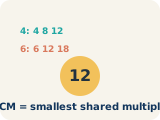
Mínimo común múltiplo
Mínimo común múltiplo
The smallest number both numbers count up to.
ES El número más pequeño al que llegan ambos al contar.
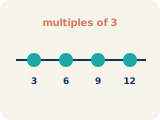
Múltiplo
Múltiplo
A number you land on when you count by it.
ES Un número al que llegas al contar de a saltos con otro.
Múltiplo común
Múltiplo común
A number you reach when counting by each number.
ES Un número al que llegas contando de a saltos con cada número.
Conteo salteado
Conteo salteado
Counting by a number, like 2, 4, 6.
ES Contar de un número en un número, como 2, 4, 6.
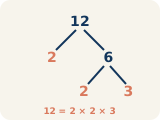
Factorización prima
Factorización prima
A number written as a product of primes.
ES Un número escrito como producto de números primos.
Which word fits?¿Qué palabra encaja?
🎉 Quiz done!¡Prueba terminada!
First-try stars:Estrellas al primer intento:
Tap a word on the left, then tap its matching definition on the right! ¡Toca una palabra a la izquierda y su significado a la derecha!
Pick a game and play as a team. Nothing here is timed, and every game can be replayed as many times as you like. Escojan un juego y jueguen en equipo. Nada aquí tiene cronómetro, y pueden repetir cada juego cuantas veces quieran.
Try the recommended mission. Student: explain; partner: ask one question, then switch. Paper drawings work for every object. Prueba la misión recomendada. Estudiante: explica; acompañante: haz una pregunta, luego cambien. Puedes dibujar los objetos en papel.
One mission is enough. You can also work solo and explain in writing.Una misión es suficiente. También puedes trabajar a solas y explicar por escrito.
Draw 12 and 18 counters. List the factors of each, show their prime factorizations, and find the smallest equal total you can make with groups of 12 and groups of 18. Explain with your drawings.
Dibuja 12 y 18 fichas. Enumera los factores, muestra sus factorizaciones primas y halla el menor total igual que puedes formar con grupos de 12 y de 18. Explica con tus dibujos.
Show a labeled drawing, table, or equation. Your partner asks one question; working alone, write your explanation.
Muestra un dibujo con etiquetas, una tabla o una ecuación. Tu acompañante hace una pregunta; a solas, escribe tu explicación.
Choose ONE game. Quick Quiz practices this lesson; the other games review related skills. Play together or solo, without a timer. Elige UN juego. Reto rápido practica esta lección; los demás repasan temas relacionados. Juega acompañado o a solas, sin cronómetro.
Build a chain. The left side of each domino is the match for the problem on the end of the chain. Tap the domino that fits next. Armen una cadena. El lado izquierdo de cada ficha es la pareja del problema al final de la cadena. Toquen la ficha que encaja.
A student and a grown-up share one chain. Take turns placing, and switch coach and player each time. There is no winner and no timer.Un estudiante y un adulto comparten una cadena. Colocan fichas por turnos y cambian de entrenador y jugador cada vez. No hay ganador ni cronómetro.
🎉 Chain complete! The last problem links back to the first domino: a perfect loop.¡Cadena completa! El último problema conecta con la primera ficha: un círculo perfecto.
Take turns — student answers one, then a family member answers the next. Watch for the trick statements! Por turnos: el estudiante responde una y luego un familiar responde la siguiente. ¡Cuidado con las trampas!
Tap a card, then tap the bin it belongs in. Talk it through before you tap! Toquen una tarjeta y luego el cesto al que pertenece. ¡Conversen antes de tocar!
Everyone votes and says WHY. Then tap to see what the math says — sometimes it is a tie! Todos votan y dicen POR QUÉ. Luego toquen para ver qué dicen las matemáticas: ¡a veces es empate!
🔎 What the math saysLo que dicen las matemáticas
Reinforce tonight's topic with a quick family game. You ask; your student decides! Refuercen el tema de hoy con un juego rápido en familia. ¡Ustedes preguntan; su estudiante decide!
🎮 Play together! Break numbers apart until only primes remain. 🎮 ¡Jueguen juntos! Descompongan hasta que solo queden primos.
The bigger review game for tonight's lesson — sort, match and choose. A wrong answer gives a hint and lets your student try again. No timer. El juego de repaso más grande para la lección de hoy — clasificar, emparejar y elegir. Si se equivocan, reciben una pista y lo intentan otra vez. Sin cronómetro.
Use this as a photobooth for the work itself: point the camera at tonight's notebook page, the scratchpad or the whiteboard and take the picture — or pose holding it up. Choose a frame, add stickers, then download it, print it, or add it to your optional reflection. The photo is never uploaded; it stays on this device. Úsenla como cabina de fotos del trabajo: apunten la cámara a la página del cuaderno, al borrador o a la pizarra y tomen la foto, o posen sosteniéndola. Elijan un marco, agreguen calcomanías y luego descárguenla, imprímanla o agréguenla a la reflexión opcional. La foto nunca se sube a internet; se queda en este dispositivo.
Camera Ready!¡Cámara lista!
Tap “Start Camera” to photograph tonight’s work, or use “Upload Work” below. The photo stays on this device.Toca “Iniciar Cámara” para fotografiar el trabajo de hoy, o usa “Subir Foto”. La foto se queda en este dispositivo.
Holding your open notebook or paper up next to your smile makes the best shot! You can also snap a photo of just your written work. ¡Sostener el cuaderno abierto junto a su sonrisa crea la mejor foto! También pueden tomar la foto solo de su trabajo escrito.
Choose the smallest positive common multiple.
Elige el menor múltiplo común positivo.
List a clap every 4 counts: 4, 8, 12, 16. List a tap every 6: 6, 12, 18.
Anota una palmada cada 4 tiempos: 4, 8, 12, 16. Anota un toque cada 6: 6, 12, 18.
Find the first positive count on both lists: 12. It is the LCM.
Encuentra el primer número positivo en ambas listas: 12. Es el MCM.
Use a rule before checking what this question asks.
Usa una regla sin revisar qué pide esta pregunta.
These links go to specific videos about tonight's topic — not general math pages. Estos enlaces van a videos específicos sobre el tema de hoy — no a páginas generales.
Family Math Studio
Lesson 6.126.NOS.4
Least Common Multiple
Find the least common multiple: the smallest number that two numbers both go into.
NameDate
Tonight's spark
The rec center has swim class every 4 days and art club every 6 days. Both are today. When will both fall on the same day again?
Guess first: will it happen before day 10, or after?
Try it
Work it out on paper. Write one answer on each line.
Which list shows the first four multiples of 6?
My answer
Which number is a common multiple of 3 and 4?
My answer
What is the LCM of 2 and 5?
My answer
What is the LCM of 6 and 9?
My answer
What is the LCM of 4 and 12?
My answer
One bus returns to the station every 6 minutes and another every 8 minutes. They are both there now. In how many minutes will they next be there together?
My answer
Talk about it
Is there a smaller number that both 4 and 6 go into?
Home mission
Count by 4s out loud while your student counts by 6s. Stop at the first number you both say. Which number is it?
If we get stuck, ask
Family Math Studio
Lección 6.126.NOS.4
Mínimo común múltiplo
Hallar el mínimo común múltiplo: el menor número al que entran los dos números.
NombreFecha
La chispa de hoy
El centro recreativo tiene clase de natación cada 4 días y club de arte cada 6 días. Hoy hay las dos. ¿Cuándo volverán a caer el mismo día?
Primero adivina: ¿pasará antes del día 10 o después?
Inténtalo
Resuélvelo en papel. Escribe una respuesta en cada línea.
¿Cuál lista muestra los primeros cuatro múltiplos de 6?
Mi respuesta
¿Cuál número es un múltiplo común de 3 y 4?
Mi respuesta
¿Cuál es el mcm de 2 y 5?
Mi respuesta
¿Cuál es el mcm de 6 y 9?
Mi respuesta
¿Cuál es el mcm de 4 y 12?
Mi respuesta
Un autobús regresa a la estación cada 6 minutos y otro cada 8 minutos. Ahora los dos están ahí. ¿En cuántos minutos volverán a estar juntos?
Mi respuesta
Conversen
¿Hay un número menor al que entren el 4 y el 6?
Misión en casa
Cuenten de 4 en 4 en voz alta mientras su estudiante cuenta de 6 en 6. Paren en el primer número que digan los dos. ¿Cuál es?
Si se atoran, pregunten