Find Factors and Multiples
I can find the greatest common factor and the least common multiple of two numbers, and use each to solve a real problem.
How to Use This Deck
Click Present or press F11 for fullscreen. Use arrow keys to advance.
Blue boxes show exactly what to say, ask, and how long to spend.
Text boxes, polls, and drag-sort save automatically in the browser.
Press N or click 📝 in the toolbar for pacing tips and answers.
Launch the full HTML activity for independent practice.
File → Print or the print button for handout copies.
🎯 Content Objective / Objetivo de contenido
I can find the greatest common factor and the least common multiple of two numbers, and use each to solve a real problem.
Today's Flow
Total pacing: ~45 min · Progress bar at top tracks your place
LAUNCH
⏱ ~10 min
⏱️ 3 MIN · THINK-PAIR-SHARE
Mission Control must split 24 food packs and 36 water containers into equal crew pods, with each pod getting the same of each. Why won't the answer just be 24 or 36?
Check for Understanding #1
Teacher: If >30% thumbs down, re-teach with a fresh example before moving on.
Supply Sort Specialist
The station quartermaster has two jobs today. First, split the pencil and notebook stock into identical combo packs with nothing left over — that is a factor question. Second, work out when two supply runs that repeat on different cycles will land in the same week — that is a multiple question. Same lesson, opposite tools.
Concept Launch
💡 Factors split things up; multiples count forward
A factor divides a number evenly, so factors answer questions about splitting a stock into equal groups. A multiple is where you land when you skip-count, so multiples answer questions about when repeating events line up.
Greatest Common Factor (GCF) & Least Common Multiple (LCM). 1. GCF: Largest factor shared by two numbers — used to simplify fractions or divide into equal groups. 2. LCM: Smallest shared multiple — used to find common denominators. 3. Use prime factor trees or list method to find common factors/multiples
Check for Understanding #2
Teacher: If >30% thumbs down, re-teach with a fresh example before moving on.
Your turn — now a multiples question
VOCABULARY
⏱ ~8 min
| Term / Término | Meaning / Significado | Example / Ejemplo | Visual |
|---|---|---|---|
| Find Factors and Multiples Hallar factores y múltiplos |
Listing what divides a number evenly (its factors) and what it divides into evenly (its multiples), then finding what two numbers share. Listar lo que divide un número exactamente (sus factores) y lo que el número forma al contar de esa cantidad (sus múltiplos), y luego hallar lo que dos números comparten. |
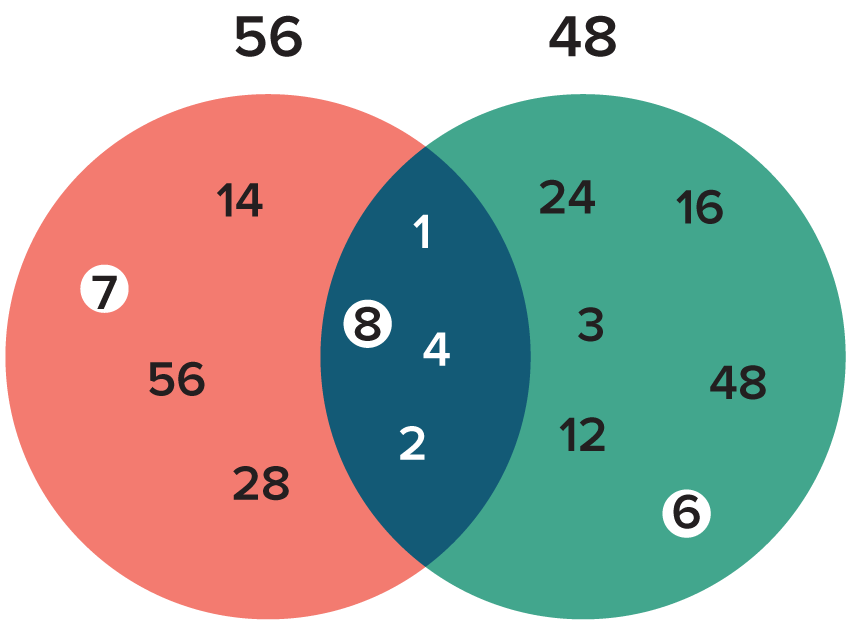
GCF of 48 and 36 is 12 · LCM of 6 and 8 is 24 | |
| Factor Factor |
A whole number that divides another number evenly, with no remainder. Un número entero que divide a otro exactamente, sin residuo. |
Factors of 36: 1, 2, 3, 4, 6, 9, 12, 18, 36 | |
| Multiple Múltiplo |
The result of multiplying a number by 1, 2, 3, and so on — where you land when you skip-count by it. El resultado de multiplicar un número por 1, 2, 3, y así sucesivamente: donde caes al contar de esa cantidad. |
Multiples of 8: 8, 16, 24, 32, 40 … | |
| Greatest common factor (GCF) Máximo común divisor (MCD) |
The largest number that is a factor of two or more numbers. It answers “how many equal groups can I make?” El número más grande que es factor de dos o más números. Responde “¿cuántos grupos iguales puedo formar?” |
48 and 36 share 1, 2, 3, 4, 6, 12 → GCF = 12 | |
| Least common multiple (LCM) Mínimo común múltiplo (mcm) |
The smallest number that is a multiple of two or more numbers. It answers “when will these line up again?” El número más pequeño que es múltiplo de dos o más números. Responde “¿cuándo volverán a coincidir?” |
6, 12, 18, 24 and 8, 16, 24 → LCM = 24 | |
| Factor pair Par de factores |
Two factors that multiply to make a number. In a word problem, one is the number of groups and the other is the size of each group. Dos factores que se multiplican para formar un número. En un problema, uno es la cantidad de grupos y el otro el tamaño de cada grupo. |
48 = 2 × 24, so 2 packs of 24 pencils |
Which Word Fits?
Factors ___ a number; multiples are what it ___.
Use It In a Sentence
Check for Understanding #3
Teacher: If >30% thumbs down, re-teach with a fresh example before moving on.
Turn & Talk — Launch
Mission Control must split 24 food packs and 36 water containers into equal crew pods, with each pod getting the same of each. Why won't the answer just be 24 or 36?
👂 Listen For
Students see the number of pods has to be a common factor of 24 and 36, so it must divide both with nothing left over, ruling out numbers that only divide one of them.
Extend: If Mission Control added one more food pack (25 packs and 36 containers), how would that change the greatest number of equal pods? Justify your reasoning.
EXPLORE & PRACTICE
⏱ ~18 min
Visual Modeling Workspace
Use the drawing tray below to annotate the visual model. Teacher: say "Click to reveal" on key steps.
Explore Activity
Each question is solved by one tool. Sort it under the one that answers it.
✍️ Explore Discourse
Both problems say “common.” How do you decide whether a problem wants the GCF or the LCM?
Whiteboard Moment
Show your work clearly. Be ready to explain your thinking to a partner.
Turn & Talk — Explore
How did you find the factors that 24 and 36 share, and how did you decide which one is the GCF?
👂 Listen For
Students list common factors 1, 2, 3, 4, 6, 12 of 24 and 36 and identify 12 as the GCF because it is the largest factor shared by both.
Extend: Could you find the GCF of 24 and 36 with prime factorization instead of listing factors? Show how the shared primes give 12.
Practice Check A
Using prime factors, 48 = 2 × 2 × 2 × 2 × 3 and 36 = 2 × 2 × 3 × 3. What is their GCF?
✍️ Show Your Work
Explain why your answer is correct using today's vocabulary.
Practice Check B
Ayasha has painting every 8 weeks and pottery every 6 weeks, both this week. When do they next fall in the same week?
✍️ Show Your Work
Explain why your answer is correct using today's vocabulary.
Expression Simplify
Complete the interactive activity using today's strategy.
✍️ Justify Your Thinking
Sort each label into the correct box.
A classmate turned in the work below. One step has a mistake. Read every step, find it, name it, and fix it.
Choose ONE option to show what you know — then do it in the workspace below.
Use evidence from today's lesson to complete each frame.
Today's key idea is: "Greatest Common Factor (GCF) & Least Common Multiple (LCM). 1. GCF: Largest factor shared by two numbers — used to simplify fractions or divide into equal groups. 2. LCM: Smallest shared multiple — used to find common denominators. 3. Use prime factor trees or list method to find common factors/multiples" — and it works because ___.
Because Find Factors and Multiples means ___, but a tricky part is ___, so I have to ___.
A common mistake with Find Factors and Multiples is ___. It happens because ___, and the fix is ___.
I can prove my answer is correct by ___, using Factor to check my work.
✍️ TWR · WRITE 3 SENTENCES · 7 MIN
Greatest Common Factor (GCF) & Least Common Multiple (LCM). 1. GCF: Largest factor shared by two numbers — used to simplify fractions or divide into equal groups. 2. LCM: Smallest shared multiple — used to find common denominators. 3. Use prime factor trees or list method to find common factors/multiples because ___
Greatest Common Factor (GCF) & Least Common Multiple (LCM). 1. GCF: Largest factor shared by two numbers — used to simplify fractions or divide into equal groups. 2. LCM: Smallest shared multiple — used to find common denominators. 3. Use prime factor trees or list method to find common factors/multiples but ___
Greatest Common Factor (GCF) & Least Common Multiple (LCM). 1. GCF: Largest factor shared by two numbers — used to simplify fractions or divide into equal groups. 2. LCM: Smallest shared multiple — used to find common denominators. 3. Use prime factor trees or list method to find common factors/multiples so ___
🌱 TWR · GROW THE KERNEL · 6 MIN
Answer these to add detail
Sentence starters (tap to use)
Student Workspace
Fill in the table using today's strategy.
| Column A | Column B |
|---|---|
✏️ Sketch Your Strategy
Differentiation Paths
Step-by-step with a worked model and sentence frames.
Which list shows all the factors of 12?
Core practice aligned to the standard.
Extension with error analysis or multi-step reasoning.
Partner Activity
Work with your partner on the practice problems at your differentiation path level. Explain each step using math vocabulary.
Check for Understanding #4
Teacher: If >30% thumbs down, re-teach with a fresh example before moving on.
Real-World Connection
🌍 Math in the Wild
The school store has 48 pencils and 36 notebooks. Every combo pack must hold the same number of pencils and the same number of notebooks, using all the stock with nothing left over.
✍️ Connection Reasoning
What is the greatest number of combo packs the manager can make, and what goes in each one?
The number of packs must be a ___ of both 48 and 36. Their common factors are 1, 2, 3, 4, 6, and ___. The greatest of these is the ___, so the manager makes ___ packs, each holding ___ pencils and 3 notebooks.
Turn & Talk — Connect
A florist has 18 roses and 24 tulips and wants identical bouquets with no flowers left over. How does the GCF tell her the most bouquets she can make?
👂 Listen For
Students compute GCF(18, 24) = 6, so 6 bouquets, each with 3 roses and 4 tulips, and explain why a bigger number would leave flowers over.
Extend: Why does the florist use the GREATEST common factor instead of just any common factor like 3? What changes if she picks a smaller one?
Summarize: Find Factors and Multiples
Greatest Common Factor (GCF) & Least Common Multiple (LCM). 1. GCF: Largest factor shared by two numbers — used to simplify fractions or divide into equal groups. 2. LCM: Smallest shared multiple — used to find common denominators. 3. Use prime factor trees or list method to find common factors/multiples
In your own words:
CLOSURE & REFLECT
⏱ ~8 min
Today I learned that ___ because ___.
One thing I am still not sure about is ___.
Two supply runs repeat every 6 weeks and every 8 weeks, and both happen this week. When will they next happen in the same week?
Bonus Exit Check
Which list shows all the factors of 12?
✍️ Show Your Work
Explain why your answer is correct using today's vocabulary.
Reflection & Self-Assessment
Continue Learning
Launch the Full Interactive Activity
Students continue practice in the HTML lesson engine with auto-check, hints, and differentiation.
Family Connection
Share tonight's family homework and discuss one vocabulary word at home.
Open Family Homework ↗Teacher Notes
⏱️ Pacing Guide
- Launch & vocab: 12 min
- I Do / We Do / You Do: 15 min
- Explore & practice: 15 min
- Connect & closure: 8 min
Total: ~45 min
🎯 Listen For · Common Errors
• Students see the number of pods has to be a common factor of 24 and 36, so it must divide both with nothing left over, ruling out numbers that only divide one of them.
• Students list common factors 1, 2, 3, 4, 6, 12 of 24 and 36 and identify 12 as the GCF because it is the largest factor shared by both.
• Students compute GCF(18, 24) = 6, so 6 bouquets, each with 3 roses and 4 tulips, and explain why a bigger number would leave flowers over.
• Students contrast GCF (largest factor that divides both, used to split into equal groups) with LCM (smallest shared multiple) and connect GCF to making equal groups with nothing left over.
Common mistake: A common mistake is reaching for the wrong tool: listing FACTORS for a problem about repeating cycles. Ayasha's classes repeat every 6 and 8 weeks, so the weeks they land on are multiples — answering with the GCF of 2 claims a class that meets every 8 weeks happens in week 2. Use the size of the answer as a check: a GCF is never larger than the smaller number, and an LCM is never smaller than the larger one.
Answer Key (Teacher Appendix)
Hide this slide during presentation or move to the end of your copy.
✓ Practice 1: 12, from the shared 2 × 2 × 3 — Take only the primes both numbers have: two 2s and one 3. Multiplying them gives 2 × 2 × 3 = 12, matching the answer from the factor lists.
✓ Practice 2: In 24 weeks — Multiples of 8: 8, 16, 24 …; multiples of 6: 6, 12, 18, 24 …. The first week they share is week 24.
✓ Practice 3: 1, 2, 3, 4, 6, 12 — A factor divides 12 evenly. Every one of 1, 2, 3, 4, 6, and 12 does, and nothing else does.
✓ Practice 4: 8, 16, 24, 32 — Multiples come from multiplying by 1, 2, 3, 4: 8, 16, 24, and 32 — the numbers you say skip-counting by 8.
✓ Exit ticket: Week 24, the least common multiple of 6 and 8 — Repeating cycles land on multiples. Multiples of 6 are 6, 12, 18, 24 … and of 8 are 8, 16, 24 …, so the first shared week is 24 — the LCM.