Touch and changeToca y cambia
Move, type, tap, or drag in the model. Watch what changes.Mueve, escribe, toca o arrastra en el modelo. Observa qué cambia.
Unit 7 · Integers, Rational Numbers, and the Coordinate Plane Unidad 7 · Enteros, números racionales y el plano de coordenadas
Represent Rational Numbers on the Coordinate PlaneRepresentar números racionales en el plano de coordenadas
6.NOS.6 ▾This lesson builds proficiency in Grade 6 mathematical standard 6.NOS.6.Esta lección desarrolla destrezas en el estándar matemático de 6.º grado 6.NOS.6.
Optional, ungraded practice. Choose ONE plan below. Work with someone or on your own; no adult signature is needed. Práctica opcional, sin calificación. Elige UN plan abajo. Trabaja con alguien o a solas; no necesitas la firma de un adulto.
Choose one plan, not all three. Each plan tells you what to do and when to stop. Switching keeps your answers.Elige un plan, no los tres. Cada plan indica qué hacer y cuándo terminar. Al cambiar, conservas tus respuestas.
Learn & practice selected: 4 focused stops and all 6 core problems, about 20 minutes. Ruta de aprendizaje: 4 paradas y los 6 problemas, unos 20 minutos.
The Photobooth is a camera you can open any time — photograph the notebook page, the scratchpad or the whiteboard, add a frame and stickers, then download or print it. It is optional, and the photo stays on this device. La cabina de fotos es una cámara que pueden abrir cuando quieran: fotografíen la página del cuaderno, el borrador o la pizarra, agreguen un marco y calcomanías, y descárguenla o imprímanla. Es opcional, y la foto se queda en este dispositivo.
💡 Draw fraction bars, tape diagrams, equations, or line up decimals together!💡 ¡Dibujen barras de fracciones, modelos o alineen decimales juntos!
Tonight we plot points on a grid called the coordinate plane. We use two numbers, called an ordered pair, to say exactly where a point goes.
Esta noche marcamos puntos en una cuadrícula llamada plano cartesiano. Usamos dos números, llamados par ordenado, para decir exactamente dónde va un punto.
For the grown-up helping tonightPara el adulto que ayuda hoy
Real example: a treasure map says to plot the point (5, 4).
Ejemplo real: un mapa del tesoro dice marcar el punto (5, 4).
The 5 is the first number and the 4 is the second number.
El 5 es el primer número y el 4 es el segundo número.
Start at the origin, the point (0, 0) in the center where the two lines cross.
Empieza en el origen, el punto (0, 0) en el centro donde se cruzan las dos líneas.
Move sideways first.
Muévete de lado primero.
The first number is 5, so move 5 units to the right.
El primer número es 5, así que muévete 5 unidades a la derecha.
Now move up.
Ahora sube.
The second number is 4, so move 4 units up and place the dot. That is the point (5, 4).
El segundo número es 4, así que muévete 4 unidades hacia arriba y pon el punto. Ese es el punto (5, 4).
Listen for "par ordenado" — it means the two numbers (x, y) that say where a point is.
Escucha la palabra "par ordenado" — significa los dos números (x, y) que dicen dónde está un punto.
Listen for "origen" — it means the center point (0, 0), where you always start.
Escucha la palabra "origen" — significa el punto del centro (0, 0), donde siempre empiezas.
Let your student try first. Ask "Which number do we use first, the sideways one or the up one?" before helping.
Deja que tu estudiante intente primero. Pregunta "¿Qué número usamos primero, el de lado o el de arriba?" antes de ayudar.
Plot the points. Read each pair across first, then up or down.Marca los puntos. Lee cada par: primero a lo ancho, luego hacia arriba o abajo.
🌐 Esta herramienta interactiva por ahora solo está en inglés. Para qué sirve: Marca los puntos indicados a la derecha y luego hacia arriba para ver los pares ordenados, los cuadrantes y la forma que crean los puntos. Usen los pasos en español de esta tarjeta para guiarse.
Move, type, tap, or drag in the model. Watch what changes.Mueve, escribe, toca o arrastra en el modelo. Observa qué cambia.
Record one equation, value, or relationship you can see.Escribe una ecuación, un valor o una relación que puedas ver.
I notice ___ changes when ___ changes. This shows ___.Noto que ___ cambia cuando ___ cambia. Esto muestra ___.
Ask: "Where do you see the numbers from tonight's math in this model?"Pregunta: "¿Dónde ves los números de la tarea de hoy en este modelo?"
Plot ordered pairs on the same coordinate grid used in tonight's lesson.Ubiquen pares ordenados en la cuadrícula de la lección de hoy.
Every GPS in smartphones and delivery drones uses coordinate geometry (latitude and longitude) just like the (x, y) grid to pinpoint your doorstep within inches! ¡Los teléfonos y drones de reparto usan geometría de coordenadas (latitud y longitud) igual que la cuadrícula (x, y) para llegar a tu puerta con exactitud!
Reversing the x and y coordinates (moving vertical first instead of horizontal). Invertir las coordenadas x e y (moverse en vertical primero en vez de horizontal).
Tap a word on the left, then tap its matching definition on the right! ¡Toca una palabra a la izquierda y su significado a la derecha!
Tap any card to flip and explore its definition and example. Toca cualquier tarjeta para voltearla y explorar su definición y ejemplo.
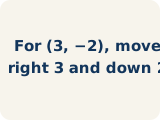
Representar en el plano de coordenadas
Representar en el plano de coordenadas
Plot a point by moving horizontally to its x-coordinate and vertically to its y-coordinate.
ES Ubicar un punto moviéndose horizontalmente hasta su coordenada x y verticalmente hasta su coordenada y.
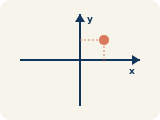
Plano cartesiano
Plano cartesiano
A grid with a line going across and a line going up to plot points.
ES Una cuadrícula con una línea horizontal y una vertical para marcar puntos.
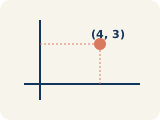
Par ordenado
Par ordenado
Two numbers (x, y) that tell where a point is on a grid.
ES Dos números (x, y) que dicen dónde está un punto en una cuadrícula.
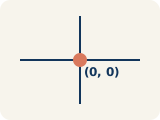
Origen
Origen
The point (0, 0) where the two grid lines cross.
ES El punto (0, 0) donde se cruzan las dos líneas de la cuadrícula.
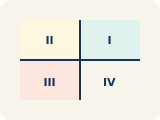
Cuadrante
Cuadrante
One of the four parts of a coordinate grid, numbered I to IV.
ES Una de las cuatro partes de una cuadrícula de coordenadas, numeradas I a IV.
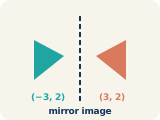
Reflexión
Reflexión
A flipped, mirror image across a line.
ES Una imagen reflejada al otro lado de una línea.
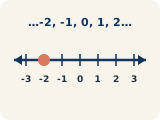
Número entero
Número entero
Whole numbers and their opposites, like -2, -1, 0, 1, 2.
ES Números enteros y sus opuestos, como -2, -1, 0, 1, 2.
Coordenada x
Coordenada x
The first number in an ordered pair; how far right or left.
ES El primer número de un par ordenado; cuánto hacia la derecha o la izquierda.
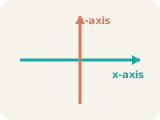
Eje x
Eje x
The horizontal number line through the origin.
ES La recta numérica horizontal que pasa por el origen.
Eje y
Eje y
The vertical number line through the origin.
ES La recta numérica vertical que pasa por el origen.
Student: explain. Partner: ask “How do you know?” Then switch. Working solo? Say or write your explanation; bring a question to a trusted adult at school.Estudiante: explica. Acompañante: pregunta «¿Cómo lo sabes?» Luego cambien. ¿Trabajas a solas? Di o escribe tu explicación; lleva una pregunta a un adulto de confianza en la escuela.
Captain Vega's map says the next waypoint is the point (2, 1). Plot it together using an easier, smaller number.
El mapa de la capitana Vega dice que el siguiente punto es (2, 1). Márquenlo juntos usando un número más pequeño y fácil.
Work side by side. You ask questions; your student does the thinking. Trabajen juntos. Tú haces preguntas; tu estudiante piensa.
Where do we start on the grid?
¿Dónde empezamos en la cuadrícula?
The first number is 2. Which way do we move, and how far?
El primer número es 2. ¿Hacia dónde nos movemos, y cuánto?
The second number is 1. Which way now? State the move and name the point.
El primer número es 1. ¿Hacia dónde ahora? Indiquen el movimiento y nombren el punto.
Do these together. Start at ★ and climb to ★★★ when ready. Háganlos juntos. Empiecen en ★ y suban a ★★★ cuando estén listos.
A map puts the school at (2, 6). How do you get there from the origin?Un mapa pone la escuela en (2, 6). ¿Cómo llegas allí desde el origen?
A. Right 2, up 6A. 2 a la derecha, 6 hacia arriba
Where is the point (0, 4)?¿Dónde está el punto (0, 4)?
D. On the y-axis, 4 units upD. En el eje y, 4 unidades hacia arriba
In the ordered pair (3, 6), what does the 3 tell the drone?En el par ordenado (3, 6), ¿qué le dice el 3 al dron?
A. Move 3 units horizontally, along the x-axisA. Moverse 3 unidades horizontalmente, a lo largo del eje x
What shape does the flight path make?¿Qué forma hace la ruta de vuelo?
C. A triangleC. Un triángulo
A rectangular playground has three corners at (1.5, 1), (1.5, 4.5), and (6, 4.5). Where is the fourth corner?Un patio de juegos rectangular tiene tres esquinas en (1.5, 1), (1.5, 4.5) y (6, 4.5). ¿Dónde está la cuarta esquina?
B. (6, 1)B. (6, 1)
Point and name → finish the sentence → explain in your own words.Señala y nombra → completa la oración → explica con tus propias palabras.
To plot (___, ___), I move ___ along the x-axis, then ___ along the y-axis.Para ubicar (___, ___), me muevo ___ en el eje x y luego ___ en el eje y.
Check: I answered the question, showed my thinking, labeled units, and explained why.Reviso: respondí la pregunta, mostré mi razonamiento, indiqué las unidades y expliqué por qué.
"Can you show me how you see that in your work or a quick sketch?" "¿Puedes mostrarme cómo ves eso en tu trabajo o en un dibujo rápido?"
Follow-up: Point to where each number from the problem shows up. Seguimiento: Señala dónde aparece cada número del problema.
Try the recommended mission. Student: explain; partner: ask one question, then switch. Paper drawings work for every object. Prueba la misión recomendada. Estudiante: explica; acompañante: haz una pregunta, luego cambien. Puedes dibujar los objetos en papel.
One mission is enough. You can also work solo and explain in writing.Una misión es suficiente. También puedes trabajar a solas y explicar por escrito.
Draw a neighborhood grid with home at (0, 0). Plot a park at (3, 2), a store at (−4, 1), a school at (−2, −3), and a library at (5, −1). Name each quadrant and explain how the signs told you which way to move.
Dibuja una cuadrícula del vecindario con la casa en (0, 0). Ubica un parque en (3, 2), una tienda en (−4, 1), una escuela en (−2, −3) y una biblioteca en (5, −1). Nombra cada cuadrante y explica cómo los signos te indicaron hacia dónde moverte.
Show a labeled drawing, table, or equation. Your partner asks one question; working alone, write your explanation.
Muestra un dibujo con etiquetas, una tabla o una ecuación. Tu acompañante hace una pregunta; a solas, escribe tu explicación.
Use Coordinate Grid to create one example together before solving the practice problems.Usen Cuadrícula de coordenadas para crear un ejemplo juntos antes de resolver los problemas.
⏱️ About 8 minutes for the 6 problems below. The extra practice at the bottom is optional. ⏱️ Unos 8 minutos para los 6 problemas de abajo. La práctica extra al final es opcional.
A few problems to practice together. Each one has a step-by-step guide, a picture to draw on, and a space to show your work. Use Check This Problem for instant feedback — no need to finish everything at once. Unos problemas para practicar juntos. Cada uno tiene una guía paso a paso, un dibujo para trabajar y un espacio para mostrar el trabajo. Usen Revisar esta pregunta para retroalimentación al instante — no tienen que terminar todo de una vez.
Easier problems to practice the idea. Do these first together. Problemas más fáciles para practicar la idea. Hagan estos primero juntos.
Say the question in your own words. Circle what you know and underline what you need to find.
Explica la pregunta con tus propias palabras. Encierra lo que sabes y subraya lo que debes hallar.
Think: start point, then horizontal move, then vertical move, then mark the dot. Order the cards to tell that story.
Piensa: punto de inicio, luego movimiento horizontal, luego vertical y luego marcar el punto. Ordena las tarjetas para contar esa historia.
Start here: Every plotting routine begins at the same home spot before any moving happens.
Empieza aquí: Toda rutina para graficar empieza en el mismo lugar de origen antes de cualquier movimiento.
Put these steps in order for plotting the point (4, 5).Ordena estos pasos para trazar el punto (4, 5).
👪 Use the ▲ ▼ buttons to reorder steps, or drag the row handles on a computer.👪 Usen ▲ ▼ para reordenar, o arrastren las filas en la computadora.
Answer key for families — compare, then talk about why.Clave de respuestas para la familia — comparen y hablen del porqué.
Not tried yet? Close this and give it one try first. A wrong first try still helps.¿Todavía no lo intentaron? Ciérrenla y hagan un intento primero. Un primer intento equivocado también ayuda.
Why:Por qué: Plotting always begins at the origin (0, 0), because every ordered pair counts its moves from there. The first number, 4, is the x-coordinate, so the move right along the x-axis comes next; the second number, 5, is the y-coordinate, so the move up follows; then you mark the dot at (4, 5).Ubicar un punto siempre empieza en el origen (0, 0), porque todo par ordenado cuenta sus movimientos desde ahí. El primer número, 4, es la coordenada x, así que sigue el movimiento hacia la derecha sobre el eje x; el segundo número, 5, es la coordenada y, así que después va el movimiento hacia arriba; y por último marcas el punto en (4, 5).
Say the question in your own words. Circle what you know and underline what you need to find.
Explica la pregunta con tus propias palabras. Encierra lo que sabes y subraya lo que debes hallar.
An ordered pair is (x, y): x is the right/left distance, y is the up/down distance. Match each move to its slot.
Un par ordenado es (x, y): x es la distancia derecha/izquierda y y es la distancia arriba/abajo. Une cada movimiento con su lugar.
Start here: Re-read the moves: 3 units right, then 7 units up. Which move comes first in an ordered pair?
Empieza aquí: Vuelve a leer los movimientos: 3 unidades a la derecha y luego 7 unidades hacia arriba. ¿Cuál movimiento va primero en un par ordenado?
Which ordered pair names a point 3 units right and 7 units up from the origin?¿Qué par ordenado nombra un punto que está 3 unidades a la derecha y 7 unidades hacia arriba desde el origen?
👪 Read the question together, then let your student pick an answer before you discuss why.👪 Lean la pregunta juntos; dejen que su estudiante elija antes de hablar del porqué.
Answer key for families — compare, then talk about why.Clave de respuestas para la familia — comparen y hablen del porqué.
Not tried yet? Close this and give it one try first. A wrong first try still helps.¿Todavía no lo intentaron? Ciérrenla y hagan un intento primero. Un primer intento equivocado también ayuda.
Why:Por qué: The first coordinate is horizontal (right 3), the second is vertical (up 7). So (3, 7).La primera coordenada es horizontal (3 a la derecha) y la segunda es vertical (7 hacia arriba). Entonces (3, 7).
Say the question in your own words. Circle what you know and underline what you need to find.
Explica la pregunta con tus propias palabras. Encierra lo que sabes y subraya lo que debes hallar.
First number = x = horizontal (right/left). Second number = y = vertical (up/down). Positive means right or up.
Primer número = x = horizontal (derecha/izquierda). Segundo número = y = vertical (arriba/abajo). Positivo significa derecha o arriba.
Start here: In (6, 2), the 6 is the FIRST number. First and second positions have different jobs.
Empieza aquí: En (6, 2), el 6 es el PRIMER número. La primera y la segunda posición tienen trabajos distintos.
A point is at (6, 2). What does the 6 tell you?Un punto está en (6, 2). ¿Qué te indica el 6?
Answer key for families — compare, then talk about why.Clave de respuestas para la familia — comparen y hablen del porqué.
Not tried yet? Close this and give it one try first. A wrong first try still helps.¿Todavía no lo intentaron? Ciérrenla y hagan un intento primero. Un primer intento equivocado también ayuda.
Why:Por qué: The first number (x-coordinate) tells you horizontal movement. 6 means go right 6 units from the origin.El primer número (la coordenada x) indica el movimiento horizontal. El 6 significa avanzar 6 unidades a la derecha desde el origen.
Try these once the warm-up feels easy. It's okay to use the steps and pictures. Intenten estos cuando el calentamiento sea fácil. Está bien usar los pasos y los dibujos.
Say the question in your own words. Circle what you know and underline what you need to find.
Explica la pregunta con tus propias palabras. Encierra lo que sabes y subraya lo que debes hallar.
Start at the origin and think about which axis you travel along before you go up.
Empieza en el origen y piensa sobre qué eje te desplazas antes de subir.
Start here: In an ordered pair, the first number always describes movement along the x-axis.
Empieza aquí: En un par ordenado, el primer número siempre describe el movimiento sobre el eje x.
Spot 2 — The map marks the Lookout Tower at (4, 9). What does the 4 tell you to do from the origin?Punto 2: el mapa marca la Torre de Vigía en (4, 9). ¿Qué te indica hacer el 4 desde el origen?
Answer key for families — compare, then talk about why.Clave de respuestas para la familia — comparen y hablen del porqué.
Not tried yet? Close this and give it one try first. A wrong first try still helps.¿Todavía no lo intentaron? Ciérrenla y hagan un intento primero. Un primer intento equivocado también ayuda.
Why:Por qué: The first number in (x, y) is the x-coordinate, so 4 means move 4 units to the right along the x-axis before moving up.El primer número de (x, y) es la coordenada x, así que el 4 significa moverse 4 unidades a la derecha sobre el eje x antes de subir.
Say the question in your own words. Circle what you know and underline what you need to find.
Explica la pregunta con tus propias palabras. Encierra lo que sabes y subraya lo que debes hallar.
Underline each x: 5, 1, 3, 0, 7. Then arrange the pairs so those underlined numbers go smallest to largest.
Subraya cada x: 5, 1, 3, 0, 7. Luego acomoda los pares para que esos números subrayados vayan de menor a mayor.
Start here: You're sorting by the FIRST number in each pair only — ignore the second number completely.
Empieza aquí: Estás ordenando solo por el PRIMER número de cada par; ignora el segundo por completo.
Sort these ordered pairs by their x-coordinate from smallest to largest.Ordena estos pares ordenados por su coordenada x, de la más pequeña a la más grande.
Answer key for families — compare, then talk about why.Clave de respuestas para la familia — comparen y hablen del porqué.
Not tried yet? Close this and give it one try first. A wrong first try still helps.¿Todavía no lo intentaron? Ciérrenla y hagan un intento primero. Un primer intento equivocado también ayuda.
Why:Por qué: Only the first number in each pair matters here. The x-values are 5, 1, 3, 0, and 7, and putting those in order from smallest to largest gives (0, 4), (1, 7), (3, 2), (5, 3), (7, 1). Notice (0, 4) comes first even though its y-value of 4 is fairly large — the second number plays no part in this sort.Aquí solo importa el primer número de cada par. Los valores de x son 5, 1, 3, 0 y 7, y ordenarlos de menor a mayor da (0, 4), (1, 7), (3, 2), (5, 3), (7, 1). Fíjate en que (0, 4) va primero aunque su valor de y sea 4, que es bastante grande: el segundo número no interviene en esta clasificación.
Say the question in your own words. Circle what you know and underline what you need to find.
Explica la pregunta con tus propias palabras. Encierra lo que sabes y subraya lo que debes hallar.
Match each clue word to a coordinate — “right” describes the x-coordinate and “up” describes the y-coordinate.
Relaciona cada palabra de la pista con una coordenada: «a la derecha» describe la coordenada x y «hacia arriba» describe la coordenada y.
Start here: An ordered pair is always written (x, y): the sideways number first, the up-and-down number second.
Empieza aquí: Un par ordenado siempre se escribe (x, y): primero el número hacia los lados y después el número hacia arriba o abajo.
Spot 1 — Captain Vega's first clue says the Sandy Dock is right 7 and up 2 from the origin. Which ordered pair names the Sandy Dock?Punto 1: la primera pista de la capitana Vega dice que el Muelle de Arena está 7 a la derecha y 2 hacia arriba desde el origen. ¿Qué par ordenado nombra el Muelle de Arena?
Answer key for families — compare, then talk about why.Clave de respuestas para la familia — comparen y hablen del porqué.
Not tried yet? Close this and give it one try first. A wrong first try still helps.¿Todavía no lo intentaron? Ciérrenla y hagan un intento primero. Un primer intento equivocado también ayuda.
Why:Por qué: The x-coordinate is the sideways move (right 7) and the y-coordinate is the up move (up 2), so the Sandy Dock is (7, 2).La coordenada x es el movimiento hacia los lados (7 a la derecha) y la coordenada y es el movimiento hacia arriba (2 hacia arriba), así que el Muelle de Arena es (7, 2).
Optional. Only if your student wants more — these are bonus problems. Opcional. Solo si tu estudiante quiere más — son problemas adicionales.
Say the question in your own words. Circle what you know and underline what you need to find.
Explica la pregunta con tus propias palabras. Encierra lo que sabes y subraya lo que debes hallar.
Translate each pair into moves, like (4, 2) = right 4, up 2. Pairs with a 0 in them land ON an axis.
Traduce cada par a movimientos, como (4, 2) = derecha 4, arriba 2. Los pares que tienen un 0 caen SOBRE un eje.
Start here: Each pair is (x, y): first number = right, second = up. A 0 means you don't move in that direction.
Empieza aquí: Cada par es (x, y): primer número = derecha, segundo = arriba. Un 0 significa que no te mueves en esa dirección.
Match each ordered pair to its description.Une cada par ordenado con su descripción.
👪 Say each term out loud, then talk through which match makes sense before choosing.👪 Digan cada término en voz alta y hablen de cuál pareja tiene sentido antes de elegir.
Answer key for families — compare, then talk about why.Clave de respuestas para la familia — comparen y hablen del porqué.
Not tried yet? Close this and give it one try first. A wrong first try still helps.¿Todavía no lo intentaron? Ciérrenla y hagan un intento primero. Un primer intento equivocado también ayuda.
Why:Por qué: Every ordered pair is (x, y): the first number is the move right and the second is the move up. So (4, 2) is right 4, up 2; (1, 6) is right 1, up 6; and (5, 5) is right 5, up 5. A 0 means no movement in that direction — (3, 0) never leaves the x-axis, (0, 4) never leaves the y-axis, and (0, 0) is the origin where the two axes meet.Todo par ordenado es (x, y): el primer número es el movimiento hacia la derecha y el segundo es el movimiento hacia arriba. Así, (4, 2) es derecha 4, arriba 2; (1, 6) es derecha 1, arriba 6; y (5, 5) es derecha 5, arriba 5. Un 0 significa que no hay movimiento en esa dirección: (3, 0) nunca deja el eje x, (0, 4) nunca deja el eje y, y (0, 0) es el origen, donde se cruzan los dos ejes.
Say the question in your own words. Circle what you know and underline what you need to find.
Explica la pregunta con tus propias palabras. Encierra lo que sabes y subraya lo que debes hallar.
What makes your answer reasonable? Use the question to check it.
¿Por qué es razonable tu respuesta? Usa la pregunta para comprobarla.
Start here: Read x first, then y. For distance, find the coordinate that stays the same.
Empieza aquí: Lee primero x y luego y. Para la distancia, busca la coordenada que no cambia.
Spot 5 — Sort each treasure landmark by how far RIGHT it is, ordering by its x-coordinate from closest-to-shore (smallest x) to farthest (largest x).Punto 5 — Ordena cada punto de referencia del tesoro según qué tan a la DERECHA está, usando su coordenada x, del más cercano a la orilla (x más pequeña) al más lejano (x más grande).
👪 On a phone, use Move to. On a computer, drag cards or tap a card then tap a column.👪 En el teléfono usen Mover a. En la computadora arrastren o toquen tarjeta y columna.
Answer key for families — compare, then talk about why.Clave de respuestas para la familia — comparen y hablen del porqué.
Not tried yet? Close this and give it one try first. A wrong first try still helps.¿Todavía no lo intentaron? Ciérrenla y hagan un intento primero. Un primer intento equivocado también ayuda.
Why:Por qué: The x-coordinate is the first number in each pair, and it tells how far right a landmark sits. Fresh Spring (1, 4) has the smallest x, Coconut Grove (3, 8) is in the middle, and Treasure Chest (9, 6) has the largest x. The y-values — 4, 8, and 6 — have no effect on this order at all.La coordenada x es el primer número de cada par y dice qué tan a la derecha está cada lugar. Fresh Spring (1, 4) tiene la x más pequeña, Coconut Grove (3, 8) queda en medio, y Treasure Chest (9, 6) tiene la x más grande. Los valores de y (4, 8 y 6) no afectan este orden en absoluto.
Say the question in your own words. Circle what you know and underline what you need to find.
Explica la pregunta con tus propias palabras. Encierra lo que sabes y subraya lo que debes hallar.
Quadrants go counterclockwise: I is (+, +), II is (-, +), III is (-, -), IV is (+, -). A 0 puts you on an axis instead.
Los cuadrantes van en sentido antihorario: I es (+, +), II es (−, +), III es (−, −), IV es (+, −). Un 0 te pone sobre un eje.
Start here: Check the SIGNS of each coordinate: + or - for x and y decide the quadrant. A 0 means the point sits on an axis.
Empieza aquí: Revisa los SIGNOS de cada coordenada: + o − en x y y deciden el cuadrante. Un 0 significa que el punto está sobre un eje.
Match each point to its quadrant or axis.Une cada punto con su cuadrante o eje.
Answer key for families — compare, then talk about why.Clave de respuestas para la familia — comparen y hablen del porqué.
Not tried yet? Close this and give it one try first. A wrong first try still helps.¿Todavía no lo intentaron? Ciérrenla y hagan un intento primero. Un primer intento equivocado también ayuda.
Why:Por qué: The signs of the two coordinates place each point. (3, 2) is (+, +) in Quadrant I; (-4, 5) is (-, +) in Quadrant II; (-2, -6) is (-, -) in Quadrant III; and (7, -1) is (+, -) in Quadrant IV. A coordinate of 0 puts the point on an axis instead of inside a quadrant, so (0, 3) is on the y-axis and (5, 0) is on the x-axis.Los signos de las dos coordenadas ubican cada punto. (3, 2) es (+, +) y está en el Cuadrante I; (-4, 5) es (-, +) y está en el Cuadrante II; (-2, -6) es (-, -) y está en el Cuadrante III; y (7, -1) es (+, -) y está en el Cuadrante IV. Una coordenada igual a 0 coloca el punto sobre un eje en vez de dentro de un cuadrante, así que (0, 3) está en el eje y y (5, 0) está en el eje x.
Say the question in your own words. Circle what you know and underline what you need to find.
Explica la pregunta con tus propias palabras. Encierra lo que sabes y subraya lo que debes hallar.
Write each row as (right amount, up amount). If a move is 0, put 0 in that slot — don't skip it.
Escribe cada fila como (cantidad a la derecha, cantidad hacia arriba). Si un movimiento es 0, pon 0 en ese lugar; no lo omitas.
Start here: 'Right' tells you the x (first number); 'Up' tells you the y (second number).
Empieza aquí: 'Derecha' te da la x (primer número); 'Arriba' te da la y (segundo número).
Complete the table. Write the ordered pair for each description.Completa la tabla. Escribe el par ordenado de cada descripción.
👪 Encourage your student to show work on paper if a box feels tricky.👪 Animen a mostrar el trabajo en papel si una casilla se siente difícil.
| DescriptionDescripción | Ordered PairPar ordenado |
|---|---|
| Right 7, Up 27 a la derecha, 2 arriba |
|
| Right 0, Up 50 a la derecha, 5 arriba |
|
| Right 4, Up 04 a la derecha, 0 arriba |
|
| Right 3, Up 33 a la derecha, 3 arriba |
|
Answer key for families — compare, then talk about why.Clave de respuestas para la familia — comparen y hablen del porqué.
Not tried yet? Close this and give it one try first. A wrong first try still helps.¿Todavía no lo intentaron? Ciérrenla y hagan un intento primero. Un primer intento equivocado también ayuda.
Why:Por qué: 'Right' gives the x-coordinate and 'Up' gives the y-coordinate, in that order: Right 7, Up 2 is (7, 2); Right 0, Up 5 is (0, 5); Right 4, Up 0 is (4, 0); and Right 3, Up 3 is (3, 3). A move of 0 still gets written into the pair — that 0 is what shows the point is sitting on an axis.'Right' da la coordenada x y 'Up' da la coordenada y, en ese orden: Right 7, Up 2 es (7, 2); Right 0, Up 5 es (0, 5); Right 4, Up 0 es (4, 0); y Right 3, Up 3 es (3, 3). Un movimiento de 0 también se escribe en el par: ese 0 es justamente lo que muestra que el punto está sobre un eje.
Say the question in your own words. Circle what you know and underline what you need to find.
Explica la pregunta con tus propias palabras. Encierra lo que sabes y subraya lo que debes hallar.
What makes your answer reasonable? Use the question to check it.
¿Por qué es razonable tu respuesta? Usa la pregunta para comprobarla.
Start here: Read x first, then y. For distance, find the coordinate that stays the same.
Empieza aquí: Lee primero x y luego y. Para la distancia, busca la coordenada que no cambia.
Spot 4 — Match each treasure landmark to its ordered pair (x, y).Punto 4 — Une cada punto de referencia del tesoro con su par ordenado (x, y).
Answer key for families — compare, then talk about why.Clave de respuestas para la familia — comparen y hablen del porqué.
Not tried yet? Close this and give it one try first. A wrong first try still helps.¿Todavía no lo intentaron? Ciérrenla y hagan un intento primero. Un primer intento equivocado también ayuda.
Why:Por qué: Each landmark's ordered pair records how far right and how far up it sits. The Sandy Dock at (7, 2) is far right but low, the Lookout Tower at (4, 9) is high near the middle, Coconut Grove sits at (3, 8), the Hidden Cave at (6, 5), the Fresh Spring at (1, 4) hugs the left edge, and the Treasure Chest at (9, 6) is farthest right. The first number always measures across, the second always measures up.El par ordenado de cada lugar registra qué tan a la derecha y qué tan arriba se encuentra. El Sandy Dock en (7, 2) está muy a la derecha pero bajo, la Lookout Tower en (4, 9) está alta y hacia el centro, el Coconut Grove está en (3, 8), la Hidden Cave en (6, 5), el Fresh Spring en (1, 4) queda pegado al borde izquierdo, y el Treasure Chest en (9, 6) es el más a la derecha. El primer número siempre mide a lo ancho y el segundo siempre mide hacia arriba.
Say the question in your own words. Circle what you know and underline what you need to find.
Explica la pregunta con tus propias palabras. Encierra lo que sabes y subraya lo que debes hallar.
Describe each point's moves separately: (3, 5) = right ?, up ?; (5, 3) = right ?, up ?. Compare the two paths.
Describe los movimientos de cada punto por separado: (3, 5) = derecha ?, arriba ?; (5, 3) = derecha ?, arriba ?. Compara las dos rutas.
Start here: Both pairs use 3 and 5, but look at which number sits in the x (first) spot in each pair.
Empieza aquí: Ambos pares usan 3 y 5, pero fíjate en qué número está en el lugar de x (el primero) en cada par.
A student says that (3, 5) and (5, 3) are the same point because they use the same numbers. Is the student correct? Explain why or why not, and describe where each point is located on the coordinate plane.Un estudiante dice que (3, 5) y (5, 3) son el mismo punto porque usan los mismos números. ¿Tiene razón? Explica por qué sí o por qué no y describe dónde se ubica cada punto en el plano de coordenadas.
👪 A complete sentence with math vocabulary is the goal — not a perfect paragraph.👪 Una oración completa con vocabulario matemático es la meta — no un párrafo perfecto.
Answer key for families — compare, then talk about why.Clave de respuestas para la familia — comparen y hablen del porqué.
Not tried yet? Close this and give it one try first. A wrong first try still helps.¿Todavía no lo intentaron? Ciérrenla y hagan un intento primero. Un primer intento equivocado también ayuda.
Why:Por qué: The student is not correct. In (3, 5) the 3 is the x-coordinate, so you move right 3 and up 5, landing high and toward the left. In (5, 3) the 5 is the x-coordinate, so you move right 5 and up 3, landing lower and farther right. Same digits, different jobs — the order inside an ordered pair decides which direction each number controls.El estudiante no tiene razón. En (3, 5) el 3 es la coordenada x, así que te mueves 3 a la derecha y 5 hacia arriba, y caes alto y hacia la izquierda. En (5, 3) el 5 es la coordenada x, así que te mueves 5 a la derecha y 3 hacia arriba, y caes más abajo y más a la derecha. Los mismos dígitos, distintas funciones: el orden dentro del par ordenado decide qué dirección controla cada número.
Say the question in your own words. Circle what you know and underline what you need to find.
Explica la pregunta con tus propias palabras. Encierra lo que sabes y subraya lo que debes hallar.
Write the across number first and the up number second, exactly the way (x, y) is set up.
Escribe primero el número a lo ancho y después el número hacia arriba, tal como está formado (x, y).
Start here: “Across” and “up” are the two directions an ordered pair records, and it records them in that order.
Empieza aquí: «A lo ancho» y «hacia arriba» son las dos direcciones que registra un par ordenado, y las registra en ese orden.
Spot 3 — Vega writes: 'The Coconut Grove is 3 across and 8 up.' Which point on the map is the Coconut Grove?Punto 3: Vega escribe: 'El Cocotal está 3 a lo ancho y 8 hacia arriba'. ¿Qué punto del mapa es el Cocotal?
Answer key for families — compare, then talk about why.Clave de respuestas para la familia — comparen y hablen del porqué.
Not tried yet? Close this and give it one try first. A wrong first try still helps.¿Todavía no lo intentaron? Ciérrenla y hagan un intento primero. Un primer intento equivocado también ayuda.
Why:Por qué: Across (3) is the x-coordinate and up (8) is the y-coordinate, so the Coconut Grove is at (3, 8).A lo ancho (3) es la coordenada x y hacia arriba (8) es la coordenada y, así que el Cocotal está en (3, 8).
Say the question in your own words. Circle what you know and underline what you need to find.
Explica la pregunta con tus propias palabras. Encierra lo que sabes y subraya lo que debes hallar.
Ask: how far right have you moved at the origin? How far up? Those two distances are the coordinates.
Pregunta: en el origen, ¿cuánto te has movido a la derecha? ¿Y hacia arriba? Esas dos distancias son las coordenadas.
Start here: The origin is the exact spot where the x-axis and y-axis cross. Picture that crossing point.
Empieza aquí: El origen es el punto exacto donde se cruzan el eje x y el eje y. Imagina ese cruce.
What are the coordinates of the origin?¿Cuáles son las coordenadas del origen?
Answer key for families — compare, then talk about why.Clave de respuestas para la familia — comparen y hablen del porqué.
Not tried yet? Close this and give it one try first. A wrong first try still helps.¿Todavía no lo intentaron? Ciérrenla y hagan un intento primero. Un primer intento equivocado también ayuda.
Why:Por qué: The origin is where the x-axis and y-axis cross, at (0, 0).El origen es donde se cruzan el eje x y el eje y, en (0, 0).
Pick a game and play as a team. Nothing here is timed, and every game can be replayed as many times as you like. Escojan un juego y jueguen en equipo. Nada aquí tiene cronómetro, y pueden repetir cada juego cuantas veces quieran.
Choose ONE game. Quick Quiz practices this lesson; the other games review related skills. Play together or solo, without a timer. Elige UN juego. Reto rápido practica esta lección; los demás repasan temas relacionados. Juega acompañado o a solas, sin cronómetro.
Flip two cards to find each problem's twin answer. Fewer flips = sharper memory! Volteen dos tarjetas para encontrar la pareja de cada problema. ¡Menos vueltas = mejor memoria!
Matches: 0 / 4 · Flips: 0 Parejas: 0 / 4 · Vueltas: 0
🎉 All twins found! Can you beat your flip count on a rematch?¡Encontraron todas las parejas! ¿Pueden lograrlo con menos vueltas en la revancha?
Take turns — student answers one, then a family member answers the next. Watch for the trick statements! Por turnos: el estudiante responde una y luego un familiar responde la siguiente. ¡Cuidado con las trampas!
Tap a card, then tap the bin it belongs in. Talk it through before you tap! Toquen una tarjeta y luego el cesto al que pertenece. ¡Conversen antes de tocar!
Everyone votes and says WHY. Then tap to see what the math says — sometimes it is a tie! Todos votan y dicen POR QUÉ. Luego toquen para ver qué dicen las matemáticas: ¡a veces es empate!
🔎 What the math saysLo que dicen las matemáticas
Reinforce tonight's topic with a quick family game. You ask; your student decides! Refuercen el tema de hoy con un juego rápido en familia. ¡Ustedes preguntan; su estudiante decide!
🎮 Play together! Go right for x, up for y. Play together on the grid! 🎮 ¡Jueguen juntos! Derecha es x, arriba es y. ¡Jueguen juntos en la cuadrícula!
The bigger review game for tonight's lesson — sort, match and choose. A wrong answer gives a hint and lets your student try again. No timer. El juego de repaso más grande para la lección de hoy — clasificar, emparejar y elegir. Si se equivocan, reciben una pista y lo intentan otra vez. Sin cronómetro.
Explain one answer aloud or on paper: “I got ___ because ___. I checked by ___.” Include your strategy and units. Then you are done.Explica una respuesta en voz alta o en papel: “Obtuve ___ porque ___. Comprobé usando ___.” Incluye tu estrategia y las unidades. Después termina.
Name one strategy that helped, or one question to ask next time. You can stop here; no adult signature is needed.
Di una estrategia que te ayudó o una pregunta para la próxima vez. Puedes terminar aquí; no necesitas la firma de un adulto.
Answers save automatically on this device. Tap Check This Problem anytime. Las respuestas se guardan solas en este dispositivo. Toquen Revisar esta pregunta cuando quieran.
These extras are not required. Photos, recordings and reflections stay on this device. To send anything to Mr. Neft, use ClassDojo.Estos extras no son obligatorios. Las fotos, grabaciones y reflexiones quedan en este dispositivo. Para enviar algo al Sr. Neft, usa ClassDojo.
Saved on:Guardado el:
🔥 1-Night StreakRacha de 1 noche
Question draft (not sent):Borrador de pregunta (no enviado):
Family reflection:Reflexión familiar:
Student Work Photo:Foto del trabajo:
Student Voice Memo:Nota de voz del estudiante:
A personal record of practice for . Saved on this device; not submitted to the teacher.
Practice partner (optional)
Date
Use this as a photobooth for the work itself: point the camera at tonight's notebook page, the scratchpad or the whiteboard and take the picture — or pose holding it up. Choose a frame, add stickers, then download it, print it, or add it to your optional reflection. The photo is never uploaded; it stays on this device. Úsenla como cabina de fotos del trabajo: apunten la cámara a la página del cuaderno, al borrador o a la pizarra y tomen la foto, o posen sosteniéndola. Elijan un marco, agreguen calcomanías y luego descárguenla, imprímanla o agréguenla a la reflexión opcional. La foto nunca se sube a internet; se queda en este dispositivo.
Camera Ready!¡Cámara lista!
Tap “Start Camera” to photograph tonight’s work, or use “Upload Work” below. The photo stays on this device.Toca “Iniciar Cámara” para fotografiar el trabajo de hoy, o usa “Subir Foto”. La foto se queda en este dispositivo.
Holding your open notebook or paper up next to your smile makes the best shot! You can also snap a photo of just your written work. ¡Sostener el cuaderno abierto junto a su sonrisa crea la mejor foto! También pueden tomar la foto solo de su trabajo escrito.
Where do we always start? Let's put our finger on the origin first.
¿Dónde empezamos siempre? Pongamos el dedo en el origen primero.
Which number is first? That one tells us how far to move sideways.
¿Cuál número va primero? Ese nos dice cuánto movernos de lado.
Say the point out loud. What is each number telling us to do?
Di el punto en voz alta. ¿Qué nos dice que hagamos cada número?
Move up first, then sideways.
Muévete hacia arriba primero, luego de lado.
The order of the two numbers does not matter.
El orden de los dos números no importa.
Just guess where the point goes.
Solo adivina dónde va el punto.
These links go to specific videos and lessons about tonight's topic — not general math pages. Estos enlaces van a videos y lecciones específicas sobre el tema de hoy — no páginas generales.