Touch and changeToca y cambia
Move, type, tap, or drag in the model. Watch what changes.Mueve, escribe, toca o arrastra en el modelo. Observa qué cambia.
Unit 9 · Relationships Between Two Variables Unidad 9 · Relaciones entre dos variables
Apply Two-Variable Relationships to Solve ProblemsAplicar relaciones entre dos variables para resolver problemas
6.AT.11 ▾This lesson builds proficiency in Grade 6 mathematical standard 6.AT.11.Esta lección desarrolla destrezas en el estándar matemático de 6.º grado 6.AT.11.
Optional, ungraded practice. Choose ONE plan below. Work with someone or on your own; no adult signature is needed. Práctica opcional, sin calificación. Elige UN plan abajo. Trabaja con alguien o a solas; no necesitas la firma de un adulto.
Choose one plan, not all three. Each plan tells you what to do and when to stop. Switching keeps your answers.Elige un plan, no los tres. Cada plan indica qué hacer y cuándo terminar. Al cambiar, conservas tus respuestas.
Learn & practice selected: 4 focused stops and all 6 core problems, about 20 minutes. Ruta de aprendizaje: 4 paradas y los 6 problemas, unos 20 minutos.
The Photobooth is a camera you can open any time — photograph the notebook page, the scratchpad or the whiteboard, add a frame and stickers, then download or print it. It is optional, and the photo stays on this device. La cabina de fotos es una cámara que pueden abrir cuando quieran: fotografíen la página del cuaderno, el borrador o la pizarra, agreguen un marco y calcomanías, y descárguenla o imprímanla. Es opcional, y la foto se queda en este dispositivo.
💡 Draw fraction bars, tape diagrams, equations, or line up decimals together!💡 ¡Dibujen barras de fracciones, modelos o alineen decimales juntos!
Tonight we use an equation to answer a real question: write it, substitute the number we know, solve, and explain what the answer means.
Esta noche usamos una ecuación para responder una pregunta real: la escribimos, sustituimos el número que sabemos, resolvemos y explicamos qué significa la respuesta.
For the grown-up helping tonightPara el adulto que ayuda hoy
y = 3x; (0,0), (1,3), (2,6), (3,9)
Real example: a plant produces 2.5 cars every hour.
Ejemplo real: una fábrica produce 2.5 autos por hora.
Let h = hours and c = cars, so c = 2.5h.
Sea h = horas y c = autos, entonces c = 2.5h.
Check the equation on a known case: in 8 hours, 2.5 × 8 = 20 cars.
Comprueben la ecuación con un caso conocido: en 8 horas, 2.5 × 8 = 20 autos.
✓.
✓.
The order needs 1,000 cars, so substitute: 2.5h = 1,000.
El pedido necesita 1,000 autos, así que sustituyan: 2.5h = 1,000.
Divide both sides by 2.5: h = 400.
Dividan ambos lados entre 2.5: h = 400.
It takes 400 hours of operation to fill the order.
Se necesitan 400 horas de operación para completar el pedido.
Listen for "substitute" (sustituir) — putting a known number in place of a letter.
Escucha "sustituir": poner un número conocido en lugar de una letra.
Whatever you do to one side of the equation, do to the other side too.
Lo que hagan a un lado de la ecuación, háganlo también al otro lado.
The last step is a sentence, not a number: "It takes 400 hours."
El último paso es una oración, no un número: "Se necesitan 400 horas".
Change the rate. Read what one point on the graph means in this situation.Cambia la tasa. Explica qué significa un punto de la gráfica en esta situación.
🌐 Esta herramienta interactiva por ahora solo está en inglés. Para qué sirve: Mueve un control para cambiar la tasa en y = kx y observa cómo la recta, la tabla y la ecuación cambian juntas. Usen los pasos en español de esta tarjeta para guiarse.
Move, type, tap, or drag in the model. Watch what changes.Mueve, escribe, toca o arrastra en el modelo. Observa qué cambia.
Record one equation, value, or relationship you can see.Escribe una ecuación, un valor o una relación que puedas ver.
I notice ___ changes when ___ changes. This shows ___.Noto que ___ cambia cuando ___ cambia. Esto muestra ___.
Ask: "Where do you see the numbers from tonight's math in this model?"Pregunta: "¿Dónde ves los números de la tarea de hoy en este modelo?"
Imagine each notebook costs $3. Let x be notebooks and y be total dollars. Imagina que cada cuaderno cuesta $3. Sea x el número de cuadernos e y el total de dólares.
Using a familiar rule before identifying what this question asks. Usar una regla conocida sin identificar qué pide esta pregunta.
Tap a word on the left, then tap its matching definition on the right! ¡Toca una palabra a la izquierda y su significado a la derecha!
Tap any card to flip and explore its definition and example. Toca cualquier tarjeta para voltearla y explorar su definición y ejemplo.
solución
solución
A value of the variable that makes an equation true.
ES Un valor de la variable que hace que una ecuación sea verdadera.
sustituir
sustituir
To replace a variable with a number so you can compute.
ES Reemplazar una variable con un número para poder calcular.

al menos
al menos
That amount or more — the smallest amount that still works.
ES Esa cantidad o más — la cantidad mínima que todavía funciona.
predecir
predecir
To make a reasonable guess about a future amount using information you already have.
ES Hacer una estimación razonable sobre una cantidad futura usando la información que ya tienes.
justificar
justificar
To explain WHY an answer or recommendation makes sense, using the mathematics.
ES Explicar POR QUÉ una respuesta o recomendación tiene sentido, usando las matemáticas.
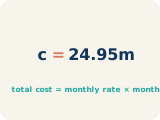
Ecuación
Ecuación
A math sentence with an equals sign showing two amounts are the same.
ES Un enunciado matemático con un signo igual que muestra que dos cantidades son iguales.
Operación inversa
Operación inversa
The operation that undoes another one.
ES La operación que deshace otra.
Trabajar hacia atrás
Trabajar hacia atrás
Start from the output and undo each step to find the input.
ES Empezar desde el resultado y deshacer cada paso para encontrar la entrada.
Student: explain. Partner: ask “How do you know?” Then switch. Working solo? Say or write your explanation; bring a question to a trusted adult at school.Estudiante: explica. Acompañante: pregunta «¿Cómo lo sabes?» Luego cambien. ¿Trabajas a solas? Di o escribe tu explicación; lleva una pregunta a un adulto de confianza en la escuela.
A printer prints 15 pages per minute. How long to print 300 pages?
Una impresora imprime 15 páginas por minuto. ¿Cuánto tarda en imprimir 300 páginas?
Work side by side. You ask questions; your student does the thinking. Trabajen juntos. Tú haces preguntas; tu estudiante piensa.
Write the equation using letters you define.
Escriban la ecuación con letras que ustedes definan.
Substitute what you know.
Sustituyan lo que saben.
Solve and explain the answer.
Resuelvan y expliquen la respuesta.
Do these together. Start at ★ and climb to ★★★ when ready. Háganlos juntos. Empiecen en ★ y suban a ★★★ cuando estén listos.
Last year the student council washed 34 cars and raised $408. How much did they charge per car?El año pasado el consejo estudiantil lavó 34 carros y recaudó $408. ¿Cuánto cobraron por carro?
B. $12
At $12 per car, how much does the student council raise by washing 20 cars?A $12 por carro, ¿cuánto recauda el consejo estudiantil lavando 20 carros?
D. $240
The order requires 1,000 cars. Using 2.5h = 1,000, how many hours will the plant need?El pedido requiere 1,000 carros. Usando 2.5h = 1,000, ¿cuántas horas necesitará la planta?
B. 400 hours
How could the council CHECK that charging $14.30 for 35 cars meets the goal?¿Cómo podría el consejo REVISAR que cobrar $14.30 por 35 carros cumple la meta?
B. Multiply 35 × 14.30 = 500.50 and confirm it is at least $500
If the plant runs 24 hours a day, 7 days a week for the full 3 weeks, how many hours is that — and can it fill the 1,000-car order?Si la planta trabaja 24 horas al día, 7 días a la semana durante las 3 semanas completas, ¿cuántas horas son — y puede cumplir el pedido de 1,000 carros?
C. 504 hours — yes, because 504 hours is more than the 400 hours needed
Point and name → finish the sentence → explain in your own words.Señala y nombra → completa la oración → explica con tus propias palabras.
In my rule, ___ is the rate and ___ is the starting amount.En mi regla, ___ es la tasa y ___ es la cantidad inicial.
Check: I answered the question, showed my thinking, labeled units, and explained why.Reviso: respondí la pregunta, mostré mi razonamiento, indiqué las unidades y expliqué por qué.
"Can you show me how you see that in your work or a quick sketch?" "¿Puedes mostrarme cómo ves eso en tu trabajo o en un dibujo rápido?"
Follow-up: Point to where each number from the problem shows up. Seguimiento: Señala dónde aparece cada número del problema.
Try the recommended mission. Student: explain; partner: ask one question, then switch. Paper drawings work for every object. Prueba la misión recomendada. Estudiante: explica; acompañante: haz una pregunta, luego cambien. Puedes dibujar los objetos en papel.
One mission is enough. You can also work solo and explain in writing.Una misión es suficiente. También puedes trabajar a solas y explicar por escrito.
Imagine renting a bike for $4 to start and $2 per hour. Write a rule, make a table for 0, 1, 2, and 3 hours, and plot the pairs. Explain where the starting fee appears in all three.
Imagina alquilar una bicicleta por $4 iniciales y $2 por hora. Escribe una regla, haz una tabla para 0, 1, 2 y 3 horas y representa los pares. Explica dónde aparece el costo inicial en las tres representaciones.
Show a labeled drawing, table, or equation. Your partner asks one question; working alone, write your explanation.
Muestra un dibujo con etiquetas, una tabla o una ecuación. Tu acompañante hace una pregunta; a solas, escribe tu explicación.
⏱️ About 8 minutes for the 6 problems below. The extra practice at the bottom is optional. ⏱️ Unos 8 minutos para los 6 problemas de abajo. La práctica extra al final es opcional.
A few problems to practice together. Each one has a step-by-step guide, a picture to draw on, and a space to show your work. Use Check This Problem for instant feedback — no need to finish everything at once. Unos problemas para practicar juntos. Cada uno tiene una guía paso a paso, un dibujo para trabajar y un espacio para mostrar el trabajo. Usen Revisar esta pregunta para retroalimentación al instante — no tienen que terminar todo de una vez.
Easier problems to practice the idea. Do these first together. Problemas más fáciles para practicar la idea. Hagan estos primero juntos.
Say the question in your own words. Circle what you know and underline what you need to find.
Explica la pregunta con tus propias palabras. Encierra lo que sabes y subraya lo que debes hallar.
The input is what you feed the equation — here, hours.
La entrada es lo que le das a la ecuación: aquí, las horas.
Start here: Test the number claims by substituting into c = 2.5h.
Empieza aquí: Prueba las afirmaciones numéricas sustituyendo en c = 2.5h.
Sort each statement about c = 2.5h.Clasifica cada afirmación sobre c = 2.5h.
👪 On a phone, use Move to. On a computer, drag cards or tap a card then tap a column.👪 En el teléfono usen Mover a. En la computadora arrastren o toquen tarjeta y columna.
💡 Test the number claims by substituting into c = 2.5h.Prueba las afirmaciones numéricas sustituyendo en c = 2.5h.
💡 The input is what you feed the equation — here, hours.La entrada es lo que le das a la ecuación: aquí, las horas.
Answer key for families — compare, then talk about why.Clave de respuestas para la familia — comparen y hablen del porqué.
Not tried yet? Close this and give it one try first. A wrong first try still helps.¿Todavía no lo intentaron? Ciérrenla y hagan un intento primero. Un primer intento equivocado también ayuda.
Why:Por qué: Substitution settles each claim: 2.5 × 4 = 10 ✓, but 2.5 × 2 = 5 (not 4) and 2.5 × 5 = 12.5 (not 25). Hours are chosen, so h is independent and is the input; c is the output that responds at 2.5 cars per hour.La sustitución resuelve cada afirmación: 2.5 × 4 = 10 ✓, pero 2.5 × 2 = 5 (no 4) y 2.5 × 5 = 12.5 (no 25). Las horas se eligen, así que h es independiente y es la entrada; c es la salida que responde a 2.5 autos por hora.
Say the question in your own words. Circle what you know and underline what you need to find.
Explica la pregunta con tus propias palabras. Encierra lo que sabes y subraya lo que debes hallar.
Test your choice against the table row (8, 20).
Prueba tu opción con la fila (8, 20) de la tabla.
Start here: Say it in words: the cars produced equal 2.5 ___ the hours.
Empieza aquí: Dilo en palabras: los carros producidos son iguales a 2.5 ___ las horas.
Let h = hours of operation and c = cars produced. Which equation represents the assembly line?Sea h = horas de operación y c = carros producidos. ¿Cuál ecuación representa la línea de ensamblaje?
👪 Read the question together, then let your student pick an answer before you discuss why.👪 Lean la pregunta juntos; dejen que su estudiante elija antes de hablar del porqué.
Answer key for families — compare, then talk about why.Clave de respuestas para la familia — comparen y hablen del porqué.
Not tried yet? Close this and give it one try first. A wrong first try still helps.¿Todavía no lo intentaron? Ciérrenla y hagan un intento primero. Un primer intento equivocado también ayuda.
Why:Por qué: Every hour the plant produces 2.5 cars, so the total is 2.5 times the hours: c = 2.5h. Check with the table: 8 hours gives 20 cars.Cada hora la planta produce 2.5 carros, así que el total es 2.5 por las horas: c = 2.5h. Comprueba con la tabla: 8 horas dan 20 carros.
Say the question in your own words. Circle what you know and underline what you need to find.
Explica la pregunta con tus propias palabras. Encierra lo que sabes y subraya lo que debes hallar.
More cars washed causes more money.
Más carros lavados producen más dinero.
Start here: Which quantity responds to the other?
Empieza aquí: ¿Cuál cantidad responde a la otra?
The price is set at $12 per car. Which is the DEPENDENT variable at the car wash?El precio se fija en $12 por carro. ¿Cuál es la variable DEPENDIENTE en el lavado de carros?
Answer key for families — compare, then talk about why.Clave de respuestas para la familia — comparen y hablen del porqué.
Not tried yet? Close this and give it one try first. A wrong first try still helps.¿Todavía no lo intentaron? Ciérrenla y hagan un intento primero. Un primer intento equivocado también ayuda.
Why:Por qué: The total raised responds to how many cars get washed — money raised depends on cars washed.Lo recaudado responde a cuántos carros se lavan — el dinero recaudado depende de los carros lavados.
Try these once the warm-up feels easy. It's okay to use the steps and pictures. Intenten estos cuando el calentamiento sea fácil. Está bien usar los pasos y los dibujos.
Say the question in your own words. Circle what you know and underline what you need to find.
Explica la pregunta con tus propias palabras. Encierra lo que sabes y subraya lo que debes hallar.
The count must be whole — which direction keeps the goal met?
La cantidad debe ser entera — ¿en qué dirección se cumple la meta?
Start here: Can you hand back seven-tenths of a washed car?
Empieza aquí: ¿Puedes entregar siete décimos de un carro lavado?
The solution to one problem was 41.7 cars. Would producing or washing a PARTIAL car make sense?La solución de un problema fue 41.7 carros. ¿Tendría sentido producir o lavar un carro PARCIAL?
Answer key for families — compare, then talk about why.Clave de respuestas para la familia — comparen y hablen del porqué.
Not tried yet? Close this and give it one try first. A wrong first try still helps.¿Todavía no lo intentaron? Ciérrenla y hagan un intento primero. Un primer intento equivocado también ayuda.
Why:Por qué: You cannot wash seven-tenths of a car, so the model's decimal answer must be interpreted: round up so the goal is still met.No puedes lavar siete décimos de un carro, así que hay que interpretar la respuesta decimal del modelo: redondea hacia arriba para que la meta se cumpla.
Say the question in your own words. Circle what you know and underline what you need to find.
Explica la pregunta con tus propias palabras. Encierra lo que sabes y subraya lo que debes hallar.
To interpret a point, read it as a sentence: 'after ___ hours, ___ cars.'
Para interpretar un punto, léelo como oración: 'después de ___ horas, ___ autos.'
Start here: A table row (h, c) and a graph point (x, y) carry identical information.
Empieza aquí: Una fila de tabla (h, c) y un punto de gráfica (x, y) llevan información idéntica.
Connect the four representations of the assembly line: scenario, equation, table, and graph.Conecta las cuatro representaciones de la línea de ensamblaje: situación, ecuación, tabla y gráfica.
👪 Say each term out loud, then talk through which match makes sense before choosing.👪 Digan cada término en voz alta y hablen de cuál pareja tiene sentido antes de elegir.
Answer key for families — compare, then talk about why.Clave de respuestas para la familia — comparen y hablen del porqué.
Not tried yet? Close this and give it one try first. A wrong first try still helps.¿Todavía no lo intentaron? Ciérrenla y hagan un intento primero. Un primer intento equivocado también ayuda.
Why:Por qué: The four representations tell one story: the 2.5-cars-per-hour scenario is compressed into c = 2.5h; the table row (8, 20) and the graph point (8, 20) are the same fact in two costumes; the point (400, 1000) answers the order question; and c = 20s re-counts the same production in shifts. Moving fluently between them is the 'apply' skill of this lesson.Las cuatro representaciones cuentan una sola historia: la situación de 2.5 autos por hora se comprime en c = 2.5h; la fila (8, 20) y el punto (8, 20) son el mismo hecho con dos disfraces; el punto (400, 1000) responde la pregunta del pedido; y c = 20s recuenta la misma producción en turnos. Moverse con fluidez entre ellas es la habilidad de 'aplicar' de esta lección.
Say the question in your own words. Circle what you know and underline what you need to find.
Explica la pregunta con tus propias palabras. Encierra lo que sabes y subraya lo que debes hallar.
42 cars at $12, or about 35 at $14.30.
42 carros a $12, o unos 35 a $14.30.
Start here: How many cars does each price require to hit $500?
Empieza aquí: ¿Cuántos carros requiere cada precio para llegar a $500?
Would you recommend the student council charge $12 or $14.30 per car? Which reasoning is strongest?¿Recomendarías que el consejo estudiantil cobre $12 o $14.30 por carro? ¿Cuál razonamiento es más fuerte?
Answer key for families — compare, then talk about why.Clave de respuestas para la familia — comparen y hablen del porqué.
Not tried yet? Close this and give it one try first. A wrong first try still helps.¿Todavía no lo intentaron? Ciérrenla y hagan un intento primero. Un primer intento equivocado también ayuda.
Why:Por qué: Both plans reach $500 — 42 × 12 = $504 and 35 × 14.30 = $500.50 — so the real question is whether they can attract 42 cars at the lower price, or whether the higher price might turn customers away.Los dos planes llegan a $500 — 42 × 12 = $504 y 35 × 14.30 = $500.50 — así que la verdadera pregunta es si pueden atraer 42 carros al precio más bajo, o si el precio más alto podría alejar a los clientes.
Optional. Only if your student wants more — these are bonus problems. Opcional. Solo si tu estudiante quiere más — son problemas adicionales.
Say the question in your own words. Circle what you know and underline what you need to find.
Explica la pregunta con tus propias palabras. Encierra lo que sabes y subraya lo que debes hallar.
Divide 500 by 35.
Divide 500 entre 35.
Start here: The price is the unknown this time: 35 × p = 500.
Empieza aquí: Esta vez el precio es la incógnita: 35 × p = 500.
The council expects 35 cars and wants to raise at least $500. What is the minimum price per car, in whole cents, that reaches the goal? Use 35p ≥ 500.El consejo espera 35 carros y quiere recaudar al menos $500. ¿Cuál es el precio mínimo por carro, en centavos enteros, que alcanza la meta? Usa 35p ≥ 500.
Answer key for families — compare, then talk about why.Clave de respuestas para la familia — comparen y hablen del porqué.
Not tried yet? Close this and give it one try first. A wrong first try still helps.¿Todavía no lo intentaron? Ciérrenla y hagan un intento primero. Un primer intento equivocado también ayuda.
Why:Por qué: 500 ÷ 35 = 14.285714… . The least whole-cent price that reaches the goal is $14.29: 35 × $14.29 = $500.15. One cent less gives 35 × $14.28 = $499.80, below the goal.500 ÷ 35 = 14.285714… . El menor precio en centavos enteros que alcanza la meta es $14.29: 35 × $14.29 = $500.15. Un centavo menos da 35 × $14.28 = $499.80, por debajo de la meta.
Say the question in your own words. Circle what you know and underline what you need to find.
Explica la pregunta con tus propias palabras. Encierra lo que sabes y subraya lo que debes hallar.
The 8-hour row is one shift — the same 20 cars the lesson's shift equation builds on.
La fila de 8 horas es un turno: los mismos 20 autos en los que se basa la ecuación de turnos de la lección.
Start here: Multiplying by 2.5 is multiplying by 2, plus half of the number.
Empieza aquí: Multiplicar por 2.5 es multiplicar por 2 y sumar la mitad del número.
The assembly line produces 2.5 cars per hour. Complete the production table.La línea de ensamblaje produce 2.5 autos por hora. Completa la tabla de producción.
👪 Encourage your student to show work on paper if a box feels tricky.👪 Animen a mostrar el trabajo en papel si una casilla se siente difícil.
| Hours (h)Horas (h) | Substitute c = 2.5hSustituye c = 2.5h | Cars produced (c)Carros producidos (c) |
|---|---|---|
| 4 | 2.5 × 4 |
|
| 8 (one shift)8 (un turno) | 2.5 × 8 |
|
| 100 | 2.5 × 100 |
|
Answer key for families — compare, then talk about why.Clave de respuestas para la familia — comparen y hablen del porqué.
Not tried yet? Close this and give it one try first. A wrong first try still helps.¿Todavía no lo intentaron? Ciérrenla y hagan un intento primero. Un primer intento equivocado también ayuda.
Why:Por qué: c = 2.5h gives 10 cars in 4 hours, 20 cars in an 8-hour shift, and 250 cars in 100 hours. The shift row explains the alternate equation c = 20s: one 8-hour shift bundles 2.5 × 8 into a single rate of 20 cars per shift.c = 2.5h da 10 autos en 4 horas, 20 autos en un turno de 8 horas y 250 autos en 100 horas. La fila del turno explica la ecuación alternativa c = 20s: un turno de 8 horas agrupa 2.5 × 8 en una sola tasa de 20 autos por turno.
Say the question in your own words. Circle what you know and underline what you need to find.
Explica la pregunta con tus propias palabras. Encierra lo que sabes y subraya lo que debes hallar.
A shift is 8 hours at 2.5 cars per hour.
Un turno son 8 horas a 2.5 carros por hora.
Start here: How many cars come out of ONE full shift?
Empieza aquí: ¿Cuántos carros salen de UN turno completo?
Suppose the variable s counts 8-hour SHIFTS instead of hours. Which equation gives the cars produced?Supón que la variable s cuenta TURNOS de 8 horas en vez de horas. ¿Cuál ecuación da los carros producidos?
Answer key for families — compare, then talk about why.Clave de respuestas para la familia — comparen y hablen del porqué.
Not tried yet? Close this and give it one try first. A wrong first try still helps.¿Todavía no lo intentaron? Ciérrenla y hagan un intento primero. Un primer intento equivocado también ayuda.
Why:Por qué: One shift is 8 hours at 2.5 cars per hour, so each shift produces 2.5 × 8 = 20 cars — the rate per shift is 20.Un turno son 8 horas a 2.5 carros por hora, así que cada turno produce 2.5 × 8 = 20 carros — la tasa por turno es 20.
Say the question in your own words. Circle what you know and underline what you need to find.
Explica la pregunta con tus propias palabras. Encierra lo que sabes y subraya lo que debes hallar.
Each of the 8 hours adds another 2.5 cars.
Cada una de las 8 horas suma otros 2.5 carros.
Start here: How many cars come off the line in ONE hour?
Empieza aquí: ¿Cuántos carros salen de la línea en UNA hora?
The assembly line produces 2.5 cars per hour. How many cars does it produce in one 8-hour shift?La línea de ensamblaje produce 2.5 carros por hora. ¿Cuántos carros produce en un turno de 8 horas?
Answer key for families — compare, then talk about why.Clave de respuestas para la familia — comparen y hablen del porqué.
Not tried yet? Close this and give it one try first. A wrong first try still helps.¿Todavía no lo intentaron? Ciérrenla y hagan un intento primero. Un primer intento equivocado también ayuda.
Why:Por qué: Substitute 8 hours: 2.5 × 8 = 20 cars per shift.Sustituye 8 horas: 2.5 × 8 = 20 carros por turno.
Say the question in your own words. Circle what you know and underline what you need to find.
Explica la pregunta con tus propias palabras. Encierra lo que sabes y subraya lo que debes hallar.
Each shift produces 20 cars.
Cada turno produce 20 carros.
Start here: How many 8-hour shifts fit in 24 hours?
Empieza aquí: ¿Cuántos turnos de 8 horas caben en 24 horas?
Using the table (1 hour, 2.5 cars; 8 hours, 20 cars; 16 hours, 40 cars), how many cars are produced in 24 hours?Usando la tabla (1 hora, 2.5 carros; 8 horas, 20 carros; 16 horas, 40 carros), ¿cuántos carros se producen en 24 horas?
Answer key for families — compare, then talk about why.Clave de respuestas para la familia — comparen y hablen del porqué.
Not tried yet? Close this and give it one try first. A wrong first try still helps.¿Todavía no lo intentaron? Ciérrenla y hagan un intento primero. Un primer intento equivocado también ayuda.
Why:Por qué: 24 hours at 2.5 cars per hour is 2.5 × 24 = 60 cars — three full shifts of 20.24 horas a 2.5 carros por hora es 2.5 × 24 = 60 carros — tres turnos completos de 20.
Say the question in your own words. Circle what you know and underline what you need to find.
Explica la pregunta con tus propias palabras. Encierra lo que sabes y subraya lo que debes hallar.
Divide 400 by 24.
Divide 400 entre 24.
Start here: How many hours are in one full day?
Empieza aquí: ¿Cuántas horas tiene un día completo?
The plant needs 400 hours to fill the order. Running 24 hours a day, about how many days is that?La planta necesita 400 horas para cumplir el pedido. Trabajando 24 horas al día, ¿aproximadamente cuántos días son?
Answer key for families — compare, then talk about why.Clave de respuestas para la familia — comparen y hablen del porqué.
Not tried yet? Close this and give it one try first. A wrong first try still helps.¿Todavía no lo intentaron? Ciérrenla y hagan un intento primero. Un primer intento equivocado también ayuda.
Why:Por qué: Divide the hours by the hours in a day: 400 ÷ 24 ≈ 16.7, which is about 17 days — about 2.5 weeks.Divide las horas entre las horas de un día: 400 ÷ 24 ≈ 16.7, que son unos 17 días — aproximadamente 2.5 semanas.
Say the question in your own words. Circle what you know and underline what you need to find.
Explica la pregunta con tus propias palabras. Encierra lo que sabes y subraya lo que debes hallar.
The result is not a whole number — should you round up or down to still reach $500?
El resultado no es un número entero — ¿debes redondear hacia arriba o hacia abajo para seguir llegando a $500?
Start here: Divide 500 by 12 first.
Empieza aquí: Divide primero 500 entre 12.
The goal is $500 at $12 per car. Using 12n = 500, at least how many cars must be washed?La meta es $500 a $12 por carro. Usando 12n = 500, ¿cuántos carros como mínimo deben lavarse?
Answer key for families — compare, then talk about why.Clave de respuestas para la familia — comparen y hablen del porqué.
Not tried yet? Close this and give it one try first. A wrong first try still helps.¿Todavía no lo intentaron? Ciérrenla y hagan un intento primero. Un primer intento equivocado también ayuda.
Why:Por qué: 500 ÷ 12 is about 41.7, and you cannot wash a fraction of a car, so round UP: 42 cars raise 42 × 12 = $504, which meets the goal.500 ÷ 12 es aproximadamente 41.7, y no puedes lavar una fracción de carro, así que redondea HACIA ARRIBA: 42 carros recaudan 42 × 12 = $504, que cumple la meta.
Say the question in your own words. Circle what you know and underline what you need to find.
Explica la pregunta con tus propias palabras. Encierra lo que sabes y subraya lo que debes hallar.
Compare the product to 500.
Compara el producto con 500.
Start here: Multiply 41 by 12.
Empieza aquí: Multiplica 41 por 12.
Can the student council wash 41 cars at $12 each and meet the $500 goal?¿Puede el consejo estudiantil lavar 41 carros a $12 cada uno y alcanzar la meta de $500?
Answer key for families — compare, then talk about why.Clave de respuestas para la familia — comparen y hablen del porqué.
Not tried yet? Close this and give it one try first. A wrong first try still helps.¿Todavía no lo intentaron? Ciérrenla y hagan un intento primero. Un primer intento equivocado también ayuda.
Why:Por qué: 41 × 12 = 492, and $492 < $500, so 41 cars fall $8 short.41 × 12 = 492, y $492 < $500, así que a 41 carros les faltan $8.
Pick a game and play as a team. Nothing here is timed, and every game can be replayed as many times as you like. Escojan un juego y jueguen en equipo. Nada aquí tiene cronómetro, y pueden repetir cada juego cuantas veces quieran.
Choose ONE game. Quick Quiz practices this lesson; the other games review related skills. Play together or solo, without a timer. Elige UN juego. Reto rápido practica esta lección; los demás repasan temas relacionados. Juega acompañado o a solas, sin cronómetro.
Flip two cards to find each problem's twin answer. Fewer flips = sharper memory! Volteen dos tarjetas para encontrar la pareja de cada problema. ¡Menos vueltas = mejor memoria!
Matches: 0 / 4 · Flips: 0 Parejas: 0 / 4 · Vueltas: 0
🎉 All twins found! Can you beat your flip count on a rematch?¡Encontraron todas las parejas! ¿Pueden lograrlo con menos vueltas en la revancha?
Take turns — student answers one, then a family member answers the next. Watch for the trick statements! Por turnos: el estudiante responde una y luego un familiar responde la siguiente. ¡Cuidado con las trampas!
Tap a card, then tap the bin it belongs in. Talk it through before you tap! Toquen una tarjeta y luego el cesto al que pertenece. ¡Conversen antes de tocar!
Everyone votes and says WHY. Then tap to see what the math says — sometimes it is a tie! Todos votan y dicen POR QUÉ. Luego toquen para ver qué dicen las matemáticas: ¡a veces es empate!
🔎 What the math saysLo que dicen las matemáticas
Reinforce tonight's topic with a quick family game. You ask; your student decides! Refuercen el tema de hoy con un juego rápido en familia. ¡Ustedes preguntan; su estudiante decide!
🎮 Play together! Name the input x and the output y. Check each ordered pair against the same rule. 🎮 ¡Jueguen juntos! Nombra la entrada x y la salida y. Comprueba cada par ordenado con la misma regla.
The bigger review game for tonight's lesson — sort, match and choose. A wrong answer gives a hint and lets your student try again. No timer. El juego de repaso más grande para la lección de hoy — clasificar, emparejar y elegir. Si se equivocan, reciben una pista y lo intentan otra vez. Sin cronómetro.
Explain one answer aloud or on paper: “I got ___ because ___. I checked by ___.” Include your strategy and units. Then you are done.Explica una respuesta en voz alta o en papel: “Obtuve ___ porque ___. Comprobé usando ___.” Incluye tu estrategia y las unidades. Después termina.
Name one strategy that helped, or one question to ask next time. You can stop here; no adult signature is needed.
Di una estrategia que te ayudó o una pregunta para la próxima vez. Puedes terminar aquí; no necesitas la firma de un adulto.
Answers save automatically on this device. Tap Check This Problem anytime. Las respuestas se guardan solas en este dispositivo. Toquen Revisar esta pregunta cuando quieran.
These extras are not required. Photos, recordings and reflections stay on this device. To send anything to Mr. Neft, use ClassDojo.Estos extras no son obligatorios. Las fotos, grabaciones y reflexiones quedan en este dispositivo. Para enviar algo al Sr. Neft, usa ClassDojo.
Saved on:Guardado el:
🔥 1-Night StreakRacha de 1 noche
Question draft (not sent):Borrador de pregunta (no enviado):
Family reflection:Reflexión familiar:
Student Work Photo:Foto del trabajo:
Student Voice Memo:Nota de voz del estudiante:
A personal record of practice for . Saved on this device; not submitted to the teacher.
Practice partner (optional)
Date
Use this as a photobooth for the work itself: point the camera at tonight's notebook page, the scratchpad or the whiteboard and take the picture — or pose holding it up. Choose a frame, add stickers, then download it, print it, or add it to your optional reflection. The photo is never uploaded; it stays on this device. Úsenla como cabina de fotos del trabajo: apunten la cámara a la página del cuaderno, al borrador o a la pizarra y tomen la foto, o posen sosteniéndola. Elijan un marco, agreguen calcomanías y luego descárguenla, imprímanla o agréguenla a la reflexión opcional. La foto nunca se sube a internet; se queda en este dispositivo.
Camera Ready!¡Cámara lista!
Tap “Start Camera” to photograph tonight’s work, or use “Upload Work” below. The photo stays on this device.Toca “Iniciar Cámara” para fotografiar el trabajo de hoy, o usa “Subir Foto”. La foto se queda en este dispositivo.
Holding your open notebook or paper up next to your smile makes the best shot! You can also snap a photo of just your written work. ¡Sostener el cuaderno abierto junto a su sonrisa crea la mejor foto! También pueden tomar la foto solo de su trabajo escrito.
x is the chosen input; y is the resulting output. A table, graph, and equation describe the same relationship.
x es la entrada elegida; y es la salida resultante. La tabla, gráfica y ecuación describen la misma relación.
Imagine each notebook costs $3. Let x be notebooks and y be total dollars.
Imagina que cada cuaderno cuesta $3. Sea x el número de cuadernos e y el total de dólares.
Make a table: x = 0, 1, 2, 3 and y = 0, 3, 6, 9. Write y = 3x.
Haz una tabla: x = 0, 1, 2, 3 e y = 0, 3, 6, 9. Escribe y = 3x.
Use a rule before checking what this question asks.
Usa una regla sin revisar qué pide esta pregunta.
These links go to specific videos and lessons about tonight's topic — not general math pages. Estos enlaces van a videos y lecciones específicas sobre el tema de hoy — no páginas generales.