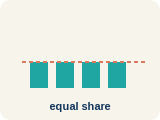
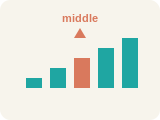
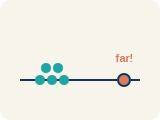
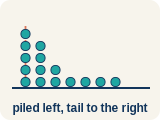
Background knowledgeConocimientos previos2 skills you need for today: Find the mean of a data set · Find the median of a data setLas 2 destrezas que necesitas hoy: Hallar la media de un conjunto de datos · Hallar la mediana de un conjunto de datos
Appropriate Measures of CenterMedidas de centro apropiadas:A mean, median, or mode chosen because it describes a data set fairly.Una media, mediana o moda elegida porque describe un conjunto de datos de manera justa.
Read the words below.Lee las palabras de abajo.
Open the model and change one number at a time.Abre el modelo y cambia un número a la vez.
Answer the questions beside the model, one at a time.Responde las preguntas junto al modelo, una a la vez.
Words to knowPalabras clave
MeanMedia
The average. Add all the numbers, then divide by how many there are.El promedio. Suma todos los números y divide entre cuántos hay.
Mean of 10, 20, 30 = (10+20+30) ÷ 3 = 20
MedianMediana
The middle number when you put them in order.El número del medio cuando los pones en orden.
Data: 5, 8, 12, 15, 20 → median is 12 (the 3rd of 5 values)
OutlierValor atípico
A number that is much bigger or smaller than the rest.Un número mucho mayor o menor que los demás.
Data: 12, 14, 13, 15, 45 → 45 is far from the cluster, so it is an outlier
SkewedSesgado
When most data sits on one side with a tail on the other.Cuando la mayoría de los datos está de un lado con una cola del otro.
Scores: 5, 6, 7, 8, 8, 35 → most scores are low, but 35 creates a tail to the right (skewed right)
Loading the model…
1. Try this1. Prueba esto
Compare the mean and median. Which one is closer to most values?
Replace 40 with 10. Describe how each measure changes.
Explain when keeping an unusual value is important even if it changes the summary.
3. Check yourself3. Compruébalo
Answer a question about your model, then one new problem without it.Responde una pregunta sobre tu modelo y luego un problema nuevo sin él.
Read the idea, follow the worked examples, and connect the picture to the numbers.Lee la idea, sigue los ejemplos resueltos y conecta el dibujo con los números.
1Step 1 of 9:Paso 1 de 9:Words to knowPalabras clave
Say what each word means, then tap the card to check.Di qué significa cada palabra y luego toca la tarjeta para comprobar.
2Step 2 of 9:Paso 2 de 9:Check the wordsComprueba las palabras
3Step 3 of 9:Paso 3 de 9:Should I use the mean or the median?¿Debo usar la media o la mediana?
The mean and the median both describe the center of a data set, but one fits better depending on the shape. When the data has an outlier (a value far from the rest), the median is usually the better choice.La media y la mediana describen el centro de un conjunto de datos, pero una encaja mejor según la forma. Cuando los datos tienen un valor atípico (un valor muy lejano al resto), la mediana suele ser la mejor opción.
The students want to describe the data they collected about the years of teaching experience of the teachers in their school. One teacher's number sits far away from all the others.Los estudiantes quieren describir los datos que recogieron sobre los años de experiencia dando clases de los maestros de su escuela. El número de un maestro queda muy lejos de todos los demás.
4Step 4 of 9:Paso 4 de 9:Watch meMírame
Watch me
My data, the top scorer's points: 22, 24, 20, 25, 23, 21, 58. I notice 58 is much bigger than the rest, so it is an outlier.Mis datos, los puntos del máximo anotador: 22, 24, 20, 25, 23, 21, 58. Noto que 58 es mucho mayor que el resto, así que es un valor atípico.
Median: in order they are 20, 21, 22, 23, 24, 25, 58. The middle (4th) value is 23.Mediana: en orden quedan 20, 21, 22, 23, 24, 25, 58. El valor del medio (el 4.º) es 23.
The mean (27.6) is higher than 6 of the 7 games because 58 pulled it up. So the median (23) better shows a typical game.La media (27.6) es mayor que 6 de los 7 partidos porque 58 la jaló hacia arriba. Así que la mediana (23) muestra mejor un partido típico.
5Step 5 of 9:Paso 5 de 9:Let’s do one togetherHagamos uno juntos
Before each step, say what you think comes next. Then show it.Antes de cada paso, di qué crees que sigue. Luego muéstralo.
Let's try together
Data set A: 4, 5, 6, 7, 8. Are there any outliers? If not, which measure should we use, mean or median?Conjunto de datos A: 4, 5, 6, 7, 8. ¿Hay valores atípicos? Si no, ¿qué medida deberíamos usar, la media o la mediana?
Data set B: 4, 5, 6, 7, 40. Which value is an outlier here?Conjunto de datos B: 4, 5, 6, 7, 40. ¿Cuál valor es el atípico aquí?
For data set B, would the outlier pull the mean up or down? So which measure best shows a typical value?En el conjunto B, ¿el valor atípico jalaría la media hacia arriba o hacia abajo? Entonces, ¿qué medida muestra mejor un valor típico?
6Step 6 of 9:Paso 6 de 9:Your turnTu turno
Now it's your turn
Next, you will sort sports scenarios into "Use Mean" or "Use Median."Luego vas a clasificar situaciones deportivas en «Usa la media» o «Usa la mediana».
For each one, look for an outlier or a skewed shape to decide.En cada una, busca un valor atípico o una forma sesgada para decidir.
7Step 7 of 9:Paso 7 de 9:Check yourself: a first questionCompruébalo: una primera pregunta
8Step 8 of 9:Paso 8 de 9:Check yourself: a harder questionCompruébalo: una pregunta más difícil
9Step 9 of 9:Paso 9 de 9:Put it togetherJúntalo todo
Watch out for a common mistakeCuidado con un error común
A common mistake in Appropriate Measures is defaulting to the mean just because "it uses all the data," without first checking whether an outlier or skewed shape is present. For example, given a player's points per game 14, 16, 15, 17, 16, 58, a student calculates the mean (136 ÷ 6 ≈ 22.7) and reports that as the typical game — but 58 is far from the cluster of 14–17, so it pulls the mean above 5 of the 6 games. The median (16) actually represents a typical game here. Before choosing a measure, always scan the data for an outlier or a long tail first: only use the mean once you've confirmed the data has neither.
Sentence frameMarco de oración
The median is better when the data has ___ because the mean gets pulled toward ___. The mean is better when the data is ___ because ___.La mediana es mejor cuando los datos tienen ___ porque la media queda jalada hacia ___. La media es mejor cuando los datos son ___ porque ___.
Stage 3 of 5Etapa 3 de 5
PracticePractica
Choose Regular or Challenge. Hints come one step at a time; you get a new question after a worked example.Elige Regular o Reto. Las pistas llegan paso a paso; después de un ejemplo resuelto recibes una pregunta nueva.
Loading practice…
Stage 4 of 5Etapa 4 de 5
ApplyAplica
Use the idea in a real situation. Write your reasoning, then compare it with a sample.Usa la idea en una situación real. Escribe tu razonamiento y compáralo con un ejemplo.
Apply in context: The big collectorAplica en contexto: El gran coleccionista
Five students counted the books on their shelves: 6, 7, 8, 9, and 35. One student collects books. By how many books is the mean greater than the median?Cinco estudiantes contaron los libros de sus estantes: 6, 7, 8, 9 y 35. Un estudiante colecciona libros. ¿Por cuántos libros es mayor la media que la mediana?
Step 1 · Guide mePaso 1 · Guíame
What is the total number of books?¿Cuál es el número total de libros?
bookslibros
Step 2 · Final answerPaso 2 · Respuesta final
bookslibros
Real-world connectionConexión con el mundo real
A sports reporter writes: 'The average ticket price for the playoffs is $85.' The actual prices are: $45, $50, $48, $52, $55, $260. The $260 ticket is a courtside seat.Un reportero deportivo escribe: «El precio promedio de boleto para las eliminatorias es $85.» Los precios reales son: $45, $50, $48, $52, $55, $260. El boleto de $260 es un asiento a pie de cancha.
The Six Playoff Ticket PricesLos seis precios de boleto de las eliminatorias
One courtside outlier towers over the rest — it drags the mean up to $85 even though the median ticket costs about $51.Un valor atípico de pie de cancha se eleva por encima del resto — jala la media hasta $85 aunque el boleto de la mediana cueste como $51.
Question:Pregunta:Is $85 a fair way to describe a 'typical' ticket price? What measure should the reporter use?¿$85 es una manera justa de describir un precio de boleto «típico»? ¿Qué medida debería usar el reportero?
The reporter used the , which is . A better measure would be the (about ) because . The courtside seat at $260 is an that pulls the mean .El reportero usó , que es . Una mejor medida sería (como ) porque . El asiento de pie de cancha de $260 es un que jala la media .
Reasoning challengeReto de razonamiento
A local newspaper reports that the average home price in a neighborhood is $450,000. The actual prices are: $180K, $200K, $190K, $210K, $195K, $1,725K. Is the reporter's claim misleading? Calculate the mean and median and explain which better represents a 'typical' home price.Un periódico local informa que el precio promedio de una casa en un vecindario es de $450,000. Los precios reales son: $180K, $200K, $190K, $210K, $195K, $1,725K. ¿Es engañosa la afirmación del reportero? Calcula la media y la mediana y explica cuál representa mejor el precio de una casa 'típica'.
Mean = ___. Median = ___. The reporter's claim is ___ because the outlier ($1,725K) pulls the mean ___. The ___ (about $___) better represents a typical home price because ___.
Create & verify: Choose Appropriate MeasuresCrea y verifica
Create a 6-number data set with one extreme outlier. Compute both the mean and median, and explain which measure of center best represents a typical value.Crea un conjunto de 6 datos con un valor atípico extremo. Calcula la media y la mediana, y explica qué medida de centro representa mejor un valor típico.
Quick test bench (try numbers or expressions)Banco de prueba rápido (prueba números o expresiones)
Stage 5 of 5Etapa 5 de 5
ReflectReflexiona
Answer on your own. Your first try counts as independent evidence; you can still revise.Responde por tu cuenta. Tu primer intento cuenta como evidencia independiente; todavía puedes revisar.