Background knowledgeConocimientos previos2 skills you need for today: Multiply two-digit whole numbers · Estimate a product by roundingLas 2 destrezas que necesitas hoy: Multiplicar números enteros de dos dígitos · Estimar un producto redondeando
Multiply DecimalsMultiplicar decimales:Find the product of decimals, then use place value to place the decimal point.Hallar el producto de decimales y luego usar el valor posicional para colocar el punto decimal.
Read the words below.Lee las palabras de abajo.
Open the model and change one number at a time.Abre el modelo y cambia un número a la vez.
Answer the questions beside the model, one at a time.Responde las preguntas junto al modelo, una a la vez.
Words to knowPalabras clave
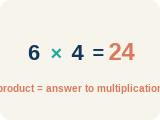
ProductProducto
The answer when you multiply.La respuesta cuando multiplicas.
4 × 7 = 28, so the product is 28
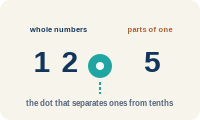
Decimal pointPunto decimal
The dot that splits the whole number from the part after it.El punto que separa el número entero de la parte que sigue.
In 3.25, the decimal point separates 3 (ones) from 25 (tenths and hundredths)
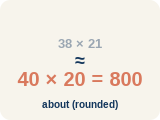
EstimateEstimar
A close answer you get by rounding first.Una respuesta cercana que obtienes al redondear primero.
3.7 × 4.2: round to 4 × 4 = 16, so the exact answer should be near 16
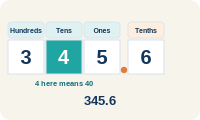
Place valueValor posicional
What a digit is worth based on where it sits in a number.Lo que vale un dígito según el lugar que ocupa en el número.
In 0.36: the 3 is in the tenths place (0.3) and the 6 is in the hundredths place (0.06)
Loading the model…
1. Try this1. Prueba esto
Estimate a six-item order first. Use the estimate to check the exact product.
On paper, compare 2.75 × 6 with 27.5 × 6. Explain the factor-of-ten change.
Design two orders whose totals differ by exactly $1.50.
3. Check yourself3. Compruébalo
Answer a question about your model, then one new problem without it.Responde una pregunta sobre tu modelo y luego un problema nuevo sin él.
Read the idea, follow the worked examples, and connect the picture to the numbers.Lee la idea, sigue los ejemplos resueltos y conecta el dibujo con los números.
1Step 1 of 9:Paso 1 de 9:Words to knowPalabras clave
Say what each word means, then tap the card to check.Di qué significa cada palabra y luego toca la tarjeta para comprobar.
2Step 2 of 9:Paso 2 de 9:Check the wordsComprueba las palabras
3Step 3 of 9:Paso 3 de 9:How do you multiply decimals?¿Cómo se multiplican los decimales?
To multiply decimals, you multiply the numbers as if there were no decimal points. Then you count the decimal places and put the point back in the answer.Para multiplicar decimales, multiplicas los números como si no tuvieran puntos decimales. Luego cuentas los lugares decimales y vuelves a poner el punto en la respuesta.
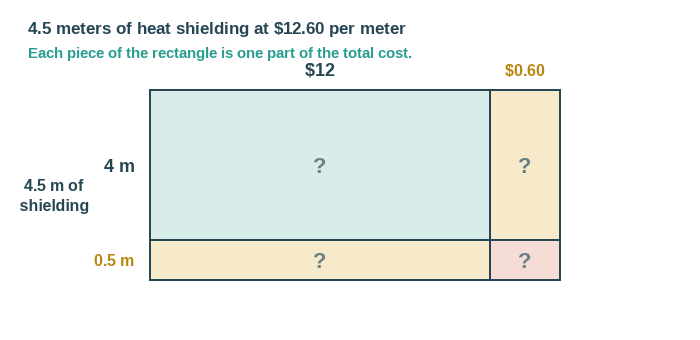
The station needs 4.5 meters of heat shielding. The shielding costs $12.60 per meter.La estación necesita 4.5 metros de blindaje térmico. El blindaje cuesta $12.60 por metro.
4Step 4 of 9:Paso 4 de 9:Watch meMírame
Watch me
I want 4.5 × 12.60, the cost of 4.5 meters at $12.60 each.Quiero 4.5 × 12.60, el costo de 4.5 metros a $12.60 cada uno.
First I multiply without points, like whole numbers: 45 × 1260 = 56,700.Primero multiplico sin puntos, como enteros: 45 × 1260 = 56,700.
Now I count decimal places: 4.5 has 1, and 12.60 has 2, so 1 + 2 = 3 decimal places.Ahora cuento los lugares decimales: 4.5 tiene 1 y 12.60 tiene 2, así que 1 + 2 = 3 lugares decimales.
I put the point 3 places from the right in 56,700: that gives 56.700, or $56.70.Pongo el punto 3 lugares desde la derecha en 56,700: eso da 56.700, o sea $56.70.
I check with an estimate: 5 × $13 = $65, and $56.70 is close, so my answer is reasonable.Lo compruebo con una estimación: 5 × $13 = $65, y $56.70 está cerca, así que mi respuesta es razonable.
5Step 5 of 9:Paso 5 de 9:Let’s do one togetherHagamos uno juntos
Before each step, say what you think comes next. Then show it.Antes de cada paso, di qué crees que sigue. Luego muéstralo.
Let's try together
Let's multiply 0.4 × 0.7. First multiply like whole numbers: what is 4 × 7? (28.)Multipliquemos 0.4 × 0.7. Primero multiplica como enteros: ¿cuánto es 4 × 7? (28.)
Now count decimal places: 0.4 has 1 and 0.7 has 1, so that is 2 places total.Ahora cuenta los lugares decimales: 0.4 tiene 1 y 0.7 tiene 1, así que son 2 lugares en total.
Put the point 2 places from the right in 28: 0.28. So 0.4 × 0.7 = 0.28.Pon el punto 2 lugares desde la derecha en 28: 0.28. Entonces 0.4 × 0.7 = 0.28.
6Step 6 of 9:Paso 6 de 9:Your turnTu turno
Now it's your turn
Next, you will estimate and sort decimal products on your own.Luego vas a estimar y clasificar productos decimales por tu cuenta.
Remember: count the decimal places in both factors and add them to place the point.Recuerda: cuenta los lugares decimales de los dos factores y súmalos para colocar el punto.
7Step 7 of 9:Paso 7 de 9:Check yourself: a first questionCompruébalo: una primera pregunta
8Step 8 of 9:Paso 8 de 9:Check yourself: a harder questionCompruébalo: una pregunta más difícil
9Step 9 of 9:Paso 9 de 9:Put it togetherJúntalo todo
Watch out for a common mistakeCuidado con un error común
A common mistake in Multiply Decimals is counting decimal places from only one factor instead of adding the decimal places from BOTH factors. For example, in 0.4 × 0.06, a student multiplies 4 × 6 = 24, then places the decimal point using just one factor's place count (1 place), writing 0.24 instead of the correct answer: 0.4 has 1 decimal place and 0.06 has 2 decimal places, for a total of 3, so 24 becomes 0.024. Before you submit, count the decimal places in EACH factor separately and add them together — that total is how many decimal places belong in your final answer.
Sentence frameMarco de oración
I estimated ___ x ___ by rounding to ___ x ___ = ___, which told me the product is ___ than 20.Estimé ___ x ___ redondeando a ___ x ___ = ___, lo que me dijo que el producto es ___ que 20.
Stage 3 of 5Etapa 3 de 5
PracticePractica
Choose Regular or Challenge. Hints come one step at a time; you get a new question after a worked example.Elige Regular o Reto. Las pistas llegan paso a paso; después de un ejemplo resuelto recibes una pregunta nueva.
Loading practice…
Stage 4 of 5Etapa 4 de 5
ApplyAplica
Use the idea in a real situation. Write your reasoning, then compare it with a sample.Usa la idea en una situación real. Escribe tu razonamiento y compáralo con un ejemplo.
Apply in context: Ribbon and changeAplica en contexto: Cinta y cambio
Ribbon costs $0.85 per meter. Kai buys 6.4 meters and pays with a $10 bill. How much change does he get?La cinta cuesta $0.85 por metro. Kai compra 6.4 metros y paga con un billete de $10. ¿Cuánto cambio recibe?
Step 1 · Guide mePaso 1 · Guíame
What is 85 times 64?¿Cuánto es 85 por 64?
Step 2 · Final answerPaso 2 · Respuesta final
dollarsdólares
Real-world connectionConexión con el mundo real
A family is buying 3.5 pounds of deli meat that costs $6.80 per pound at the grocery store.Una familia está comprando 3.5 libras de carne fría que cuesta $6.80 por libra en el supermercado.
3.5 × 6.8
Question:Pregunta:How do you multiply decimals to find the total cost? How can estimation help you check?¿Cómo multiplicas decimales para hallar el costo total? ¿Cómo te puede ayudar estimar a comprobarlo?
The total cost is $ because 3.5 × $6.80 = $, and I can estimate by rounding to × = .El costo total es $ porque 3.5 × $6.80 = $, y puedo estimar redondeando a × = .
Reasoning challengeReto de razonamiento
A driver buys 9.5 gallons of gas at $3.40 per gallon. Show how to find the total cost. Use estimation to check if your answer is reasonable.Un conductor compra 9.5 galones de gasolina a $3.40 por galón. Muestra cómo encontrar el costo total. Usa la estimación para comprobar si tu respuesta es razonable.
The total cost is $___ because 9.5 × $3.40 = ___. I can estimate: ___ × ___ = ___, which is close to my exact answer, so it is reasonable.
Create & verify: Multiply DecimalsCrea y verifica
Create a real-world decimal multiplication problem (like 2.4 × 1.5). Estimate first, solve by multiplying whole numbers and placing the decimal point, and check against your estimate.Crea un problema real de multiplicación decimal (como 2.4 × 1.5). Estima primero, resuelve y compara tu producto con tu estimación.
Quick test bench (try numbers or expressions)Banco de prueba rápido (prueba números o expresiones)
Stage 5 of 5Etapa 5 de 5
ReflectReflexiona
Answer on your own. Your first try counts as independent evidence; you can still revise.Responde por tu cuenta. Tu primer intento cuenta como evidencia independiente; todavía puedes revisar.