Background knowledgeConocimientos previos2 skills you need for today: Put numbers in order, least to greatest · Find the number halfway between two numbersLas 2 destrezas que necesitas hoy: Ordenar números de menor a mayor · Hallar el número a la mitad entre dos números
Describe the Data Using the MedianDescribir los datos con la mediana:Using the middle value of the ordered data to say what is typical for the whole set.Usar el valor del medio de los datos ordenados para decir qué es típico en todo el conjunto.
Read the words below.Lee las palabras de abajo.
Open the model and change one number at a time.Abre el modelo y cambia un número a la vez.
Answer the questions beside the model, one at a time.Responde las preguntas junto al modelo, una a la vez.
Words to knowPalabras clave
MedianMediana
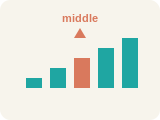
The middle number when you put them in order.El número del medio cuando los pones en orden.
Data: 1, 3, 5, 7, 9 → the middle (3rd) value is 5, so median = 5
ModeModa
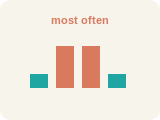
The number that shows up most often.El número que aparece más veces.
Read the idea, follow the worked examples, and connect the picture to the numbers.Lee la idea, sigue los ejemplos resueltos y conecta el dibujo con los números.
1Step 1 of 9:Paso 1 de 9:Words to knowPalabras clave
Say what each word means, then tap the card to check.Di qué significa cada palabra y luego toca la tarjeta para comprobar.
2Step 2 of 9:Paso 2 de 9:Check the wordsComprueba las palabras
3Step 3 of 9:Paso 3 de 9:What are mean, median, and mode?¿Qué son la media, la mediana y la moda?
Mean, median, and mode are three ways to find the center, or "typical" value, of a data set. The mean is the average, the median is the middle, and the mode is the most common value.La media, la mediana y la moda son tres maneras de hallar el centro, o valor «típico», de un conjunto de datos. La media es el promedio, la mediana es el valor del medio y la moda es el valor más común.
Some students surveyed the teachers at their school about their years of teaching experience. The data they collected is shown.Unos estudiantes encuestaron a los maestros de su escuela sobre sus años de experiencia dando clases. Se muestran los datos que recogieron.
4Step 4 of 9:Paso 4 de 9:Watch meMírame
Watch me find the median
My data set: 2, 4, 4, 6, 9 — five values, already in order. Ordering first is what makes a middle exist at all.Mi conjunto de datos: 2, 4, 4, 6, 9 — cinco valores, ya ordenados. Ordenar primero es lo que hace que exista un medio.
With 5 values, the middle is the 3rd one. Counting in from both ends: 2 and 9 pair off, 4 and 6 pair off, and 4 is left alone.Con 5 valores, el del medio es el 3.º. Contando desde ambos extremos: 2 y 9 se emparejan, 4 y 6 se emparejan, y el 4 queda solo.
So the median is 4. Half the values sit at or below it and half at or above it.Entonces la mediana es 4. La mitad de los valores queda en él o por debajo, y la mitad en él o por encima.
Now an even set: 2, 4, 6, 9. There is no single middle, so I take the mean of the two middle values: (4 + 6) ÷ 2 = 5. The median is 5, even though 5 is not in the data.Ahora un conjunto par: 2, 4, 6, 9. No hay un solo valor del medio, así que tomo la media de los dos centrales: (4 + 6) ÷ 2 = 5. La mediana es 5, aunque el 5 no esté en los datos.
5Step 5 of 9:Paso 5 de 9:Let’s do one togetherHagamos uno juntos
Before each step, say what you think comes next. Then show it.Antes de cada paso, di qué crees que sigue. Luego muéstralo.
Let's do one together
New data set, out of order: 13, 3, 7, 10, 7. Put it in order first.Conjunto de datos nuevo, desordenado: 13, 3, 7, 10, 7. Ordénalo primero.
In order: 3, 7, 7, 10, 13. Five values, so the middle is the 3rd.En orden: 3, 7, 7, 10, 13. Cinco valores, así que el del medio es el 3.º.
The median is 7. Say what it means: a typical value in this set is about 7.La mediana es 7. Di lo que significa: un valor típico de este conjunto es aproximadamente 7.
Now change the 13 to 130. Does the median move? It does not — still 7. That resistance is exactly why the median is used.Ahora cambia el 13 por 130. ¿Se mueve la mediana? No se mueve — sigue siendo 7. Esa resistencia es exactamente por lo que se usa la mediana.
6Step 6 of 9:Paso 6 de 9:Your turnTu turno
Your turn
Order the team's game scores from least to greatest.Ordena de menor a mayor los puntajes de los partidos del equipo.
Find the median, and say whether the count is odd or even.Halla la mediana y di si la cantidad de valores es impar o par.
Decide what the median tells you about a typical game.Decide qué te dice la mediana sobre un partido típico.
7Step 7 of 9:Paso 7 de 9:Check yourself: a first questionCompruébalo: una primera pregunta
8Step 8 of 9:Paso 8 de 9:Check yourself: a harder questionCompruébalo: una pregunta más difícil
9Step 9 of 9:Paso 9 de 9:Put it togetherJúntalo todo
Watch out for a common mistakeCuidado con un error común
A common mistake in Mean, Median, and Mode is finding the median without ordering the data first — students pick the middle number straight from the list as given (for 9, 4, 7, 2, 6 they say the median is 7, the middle position in that original order) instead of sorting least to greatest (2, 4, 6, 7, 9) and finding the true middle value, 6. Before finalizing a median, always reorder the data smallest to largest, then count to the middle position — and if there is an even number of values, average the two middle numbers.
Sentence frameMarco de oración
The mean is higher than the median because the high score of ___ pulls the mean ___. The ___ better represents a typical game because ___.La media es mayor que la mediana porque el puntaje alto de ___ jala la media ___. ___ representa mejor un partido típico porque ___.
Stage 3 of 5Etapa 3 de 5
PracticePractica
Choose Regular or Challenge. Hints come one step at a time; you get a new question after a worked example.Elige Regular o Reto. Las pistas llegan paso a paso; después de un ejemplo resuelto recibes una pregunta nueva.
Loading practice…
Stage 4 of 5Etapa 4 de 5
ApplyAplica
Use the idea in a real situation. Write your reasoning, then compare it with a sample.Usa la idea en una situación real. Escribe tu razonamiento y compáralo con un ejemplo.
Apply in context: Bike tripsAplica en contexto: Paseos en bicicleta
Amir tracked the length of his bike trips for a week. His seven trips, in miles, were 12, 5, 9, 14, 7, 20, and 10. What is the median trip length?Amir anotó la longitud de sus paseos en bicicleta durante una semana. Sus siete paseos, en millas, fueron 12, 5, 9, 14, 7, 20 y 10. ¿Cuál es la mediana de la longitud de los paseos?
Step 1 · Guide mePaso 1 · Guíame
How many trips are there?¿Cuántos viajes hay?
tripsviajes
Step 2 · Final answerPaso 2 · Respuesta final
milesmillas
Real-world connectionConexión con el mundo real
Your class took a math quiz. The scores were: 85, 92, 78, 88, 92, 95, 72, 88, 92, 84. The teacher says 'most students scored around 87.' A student disagrees and says 'the most common score was 92.'Tu clase hizo una prueba de matemáticas. Los puntajes fueron: 85, 92, 78, 88, 92, 95, 72, 88, 92, 84. La maestra dice «la mayoría de los estudiantes sacaron alrededor de 87». Un estudiante no está de acuerdo y dice «el puntaje más común fue 92».
Class Quiz Scores — Dot PlotPuntajes de la prueba de la clase — diagrama de puntos
The tallest stack sits at 92 — the mode. The balance point (mean) is 86.6. Both describe the center, but they land in different places.La torre más alta está en 92 — la moda. El punto de equilibrio (la media) es 86.6. Las dos describen el centro, pero caen en lugares distintos.
Question:Pregunta:Who is using the mean, and who is using the mode? Which is more useful here?¿Quién está usando la media y quién la moda? ¿Cuál es más útil aquí?
The teacher used the (about 86.6). The student used the (92). The is more useful here because .La maestra usó (como 86.6). El estudiante usó (92). es más útil aquí porque .
Reasoning challengeReto de razonamiento
A basketball player scored 15, 18, 16, 42, and 14 points in 5 games. Find the mean and median. Which better represents the player's typical game? Explain how the outlier affects each measure.Un jugador de baloncesto anotó 15, 18, 16, 42 y 14 puntos en 5 partidos. Encuentra la media y la mediana. ¿Cuál representa mejor un partido típico del jugador? Explica cómo afecta el valor atípico a cada medida.
Mean = ___. Median = ___. The ___ better represents a typical game because the outlier (___) pulls the ___ toward it, making it ___ than most scores. The median is not affected because ___.
Create & verify: Describe the Data Using the MedianCrea y verifica
Make up a data set of 6 numbers whose median is 15, even though 15 is not in your list. Show the ordered list and how you found the median.Inventa un conjunto de 6 números cuya mediana sea 15, aunque el 15 no esté en tu lista. Muestra la lista ordenada y cómo hallaste la mediana.
Quick test bench (try numbers or expressions)Banco de prueba rápido (prueba números o expresiones)
Stage 5 of 5Etapa 5 de 5
ReflectReflexiona
Answer on your own. Your first try counts as independent evidence; you can still revise.Responde por tu cuenta. Tu primer intento cuenta como evidencia independiente; todavía puedes revisar.