Background knowledgeConocimientos previos2 skills you need for today: Multiply a decimal by 10 or 100 · Divide a decimal by a whole numberLas 2 destrezas que necesitas hoy: Multiplicar un decimal por 10 o por 100 · Dividir un decimal entre un número entero
Divide DecimalsDividir decimales:Find a quotient with decimals by sliding both decimal points right until the divisor is a whole number.Hallar un cociente con decimales deslizando ambos puntos decimales a la derecha hasta que el divisor sea un número entero.
Read the words below.Lee las palabras de abajo.
Open the model and change one number at a time.Abre el modelo y cambia un número a la vez.
Answer the questions beside the model, one at a time.Responde las preguntas junto al modelo, una a la vez.
Words to knowPalabras clave
DividendDividendo
The total number being divided into equal groups (the number inside the division bracket).El número total que se divide en grupos iguales (el número dentro de la galera de división).
In 8.4 ÷ 2.1 = 4, the dividend is 8.4 — the total amount being divided
Divisor
The number of equal groups you are dividing into (the number outside the division bracket).El número de grupos iguales en que divides (el número fuera de la galera de división).
In 8.4 ÷ 2.1 = 4, the divisor is 2.1 — the number of equal groups
QuotientCociente
The answer when you divide.La respuesta cuando divides.
In 8.4 ÷ 2.1 = 4, the quotient is 4 — there are 4 groups
Decimal Division AlgorithmAlgoritmo de división decimal
The steps for dividing decimals: slide the divisor's decimal point right until the divisor is a whole number, slide the dividend's point right the same number of places, then divide.Los pasos para dividir decimales: desliza el punto decimal del divisor a la derecha hasta que sea un número entero, desliza el punto del dividendo a la derecha el mismo número de lugares y luego divide.
8.4 ÷ 2.1 → move the point in both → 84 ÷ 21 → divide, multiply, subtract, bring down → 4
Loading the model…
1. Try this1. Prueba esto
Predict how many equal groups fit before calculating.
Try 14.4 ÷ 1.2. Why does it have the same quotient as 144 ÷ 12?
Make a division problem whose quotient is 15. Show a multiplication check.
3. Check yourself3. Compruébalo
Answer a question about your model, then one new problem without it.Responde una pregunta sobre tu modelo y luego un problema nuevo sin él.
Read the idea, follow the worked examples, and connect the picture to the numbers.Lee la idea, sigue los ejemplos resueltos y conecta el dibujo con los números.
1Step 1 of 9:Paso 1 de 9:Words to knowPalabras clave
Say what each word means, then tap the card to check.Di qué significa cada palabra y luego toca la tarjeta para comprobar.
2Step 2 of 9:Paso 2 de 9:Check the wordsComprueba las palabras
3Step 3 of 9:Paso 3 de 9:How do you divide with decimals?¿Cómo se divide con decimales?
Dividing splits a total into equal groups. When you divide by a decimal, first move the point to make the divisor a whole number — then run the same long-division cycle: divide, multiply, subtract, bring down.Dividir reparte un total en grupos iguales. Cuando divides entre un decimal, primero mueve el punto para que el divisor sea un número entero — y luego corre el mismo ciclo de división larga: divide, multiplica, resta, baja.
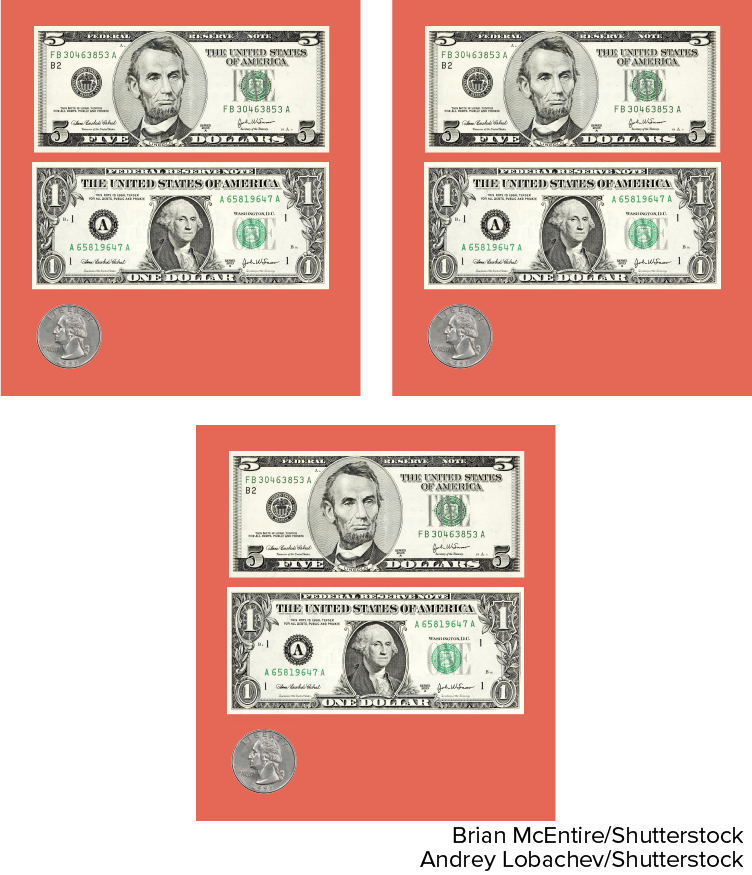
A school paid for math workbooks with the money shown. There are three identical stacks, and each stack holds one $5 bill, one $1 bill, and a single quarter.Una escuela pagó unos cuadernos de matemáticas con el dinero que se muestra. Hay tres montones idénticos, y cada montón tiene un billete de $5, un billete de $1 y una moneda de veinticinco centavos.
4Step 4 of 9:Paso 4 de 9:Watch meMírame
Watch me
I want 18.9 ÷ 6.3. The divisor is 6.3, and long division needs a whole-number divisor.Quiero 18.9 ÷ 6.3. El divisor es 6.3, y la división larga necesita un divisor entero.
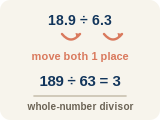
STEP 0 — MOVE THE POINT: I move the decimal point 1 place right in the divisor, so 6.3 becomes 63.Paso 0 — mueve el punto: muevo el punto decimal 1 lugar a la derecha en el divisor, así que 6.3 se convierte en 63.
I slide the decimal point 1 place to the right in the dividend too, so 18.9 becomes 189. Both points slid the same 1 place, so the answer does not change. The problem is now 189 ÷ 63.Deslizo el punto decimal 1 lugar a la derecha en el dividendo también, así que 18.9 se convierte en 189. Los dos puntos se deslizaron el mismo lugar, así que la respuesta no cambia. El problema ahora es 189 ÷ 63.
Now I write it the tall way — 63 into 189 — with the answer going on top of the bar and the answer's decimal point in the column directly above the dividend's point. Then I repeat the same four steps I always use: DIVIDE, MULTIPLY, SUBTRACT, BRING DOWN.Ahora lo escribo en vertical — 189 entre 63 — con la respuesta arriba de la línea y el punto decimal de la respuesta en la columna justo arriba del punto del dividendo. Luego repito los mismos cuatro pasos de siempre: divide, multiplica, resta, baja.
DIVIDE: 63 does not fit into 1 or 18, so my first working number is 189. How many 63s fit into 189? Three. I write 3 above the 9.Divide: el 63 no cabe en 1 ni en 18, así que mi primer número de trabajo es 189. ¿Cuántos 63 caben en 189? Tres. Escribo 3 arriba del 9.
MULTIPLY: 3 × 63 = 189. I write it underneath.Multiplica: 3 × 63 = 189. Lo escribo debajo.
SUBTRACT: 189 − 189 = 0.Resta: 189 − 189 = 0.
BRING DOWN: there are no digits left to bring down, so the cycle is finished and the remainder is 0. 18.9 ÷ 6.3 = 3.Baja: no quedan dígitos por bajar, así que el ciclo termina y el residuo es 0. 18.9 ÷ 6.3 = 3.
I check by multiplying: 6.3 × 3 = 18.9. Correct — 18.9 ÷ 6.3 = 3.Lo compruebo multiplicando: 6.3 × 3 = 18.9. Correcto — se pueden llenar 3 cápsulas.
5Step 5 of 9:Paso 5 de 9:Let’s do one togetherHagamos uno juntos
Before each step, say what you think comes next. Then show it.Antes de cada paso, di qué crees que sigue. Luego muéstralo.
Let's try together
Let's do 8.4 ÷ 2.1. STEP 0 — MOVE THE POINT: how many places make 2.1 a whole number? (1 place, so 2.1 becomes 21.)Hagamos 8.4 ÷ 2.1. Paso 0 — mueve el punto: ¿cuántos lugares hacen que 2.1 sea un número entero? (1 lugar, así que 2.1 se convierte en 21.)
Now slide the decimal point 1 place to the right in the dividend too. What does 8.4 become? (84, so the new problem is 84 ÷ 21.)Ahora desliza el punto decimal 1 lugar a la derecha en el dividendo también. ¿En qué se convierte 8.4? (En 84, así que el nuevo problema es 84 ÷ 21.)
DIVIDE: how many 21s fit into 84? (Four. I write 4 on top, above the 4 in 84.)Divide: ¿cuántos 21 caben en 84? (Cuatro. Escribo 4 arriba, sobre el 4 de 84.)
MULTIPLY: what is 4 × 21? (84. I write it underneath the 84.)Multiplica: ¿cuánto es 4 × 21? (84. Lo escribo debajo del 84.)
SUBTRACT: what is 84 − 84? (0.)Resta: ¿cuánto es 84 − 84? (0.)
BRING DOWN: is there another digit left to bring down? (No — nothing is left, so 8.4 ÷ 2.1 = 4. Check: 2.1 × 4 = 8.4.)Baja: ¿queda otro dígito para bajar? (No, no queda nada, así que 8.4 ÷ 2.1 = 4. Comprueba: 2.1 × 4 = 8.4.)
6Step 6 of 9:Paso 6 de 9:Your turnTu turno
Now it's your turn
Next, you will move the point so the divisor is a whole number, then run the divide, multiply, subtract, bring down cycle on your own.Luego vas a mover el punto para que el divisor sea un número entero y después correr el ciclo de divide, multiplica, resta y baja por tu cuenta.
Remember: move the point in both numbers, put the point in the quotient, then divide, multiply, subtract, bring down.Recuerda: mueve el punto en los dos números, pon el punto en el cociente y luego divide, multiplica, resta y baja.
7Step 7 of 9:Paso 7 de 9:Check yourself: a first questionCompruébalo: una primera pregunta
8Step 8 of 9:Paso 8 de 9:Check yourself: a harder questionCompruébalo: una pregunta más difícil
9Step 9 of 9:Paso 9 de 9:Put it togetherJúntalo todo
Watch out for a common mistakeCuidado con un error común
A common mistake in Divide Decimals is moving the decimal point in the divisor but forgetting to move it the same number of places in the dividend. For example, in 6.4 ÷ 0.8 a student changes 0.8 to 8 but leaves the dividend as 6.4, then divides 6.4 ÷ 8 = 0.8 instead of moving both points to get 64 ÷ 8 = 8. A second version of this mistake happens when the divisor has two decimal places, like 0.12: students move both points only 1 place instead of 2, turning 9.6 ÷ 0.12 into 96 ÷ 1.2 instead of the correct 960 ÷ 12. Count the divisor's decimal places first, then move BOTH points that same number of places.
Sentence frameMarco de oración
Multiplying both numbers by ___ doesn't change the quotient because ___.Multiplicar los dos números por ___ no cambia el cociente porque ___.
Stage 3 of 5Etapa 3 de 5
PracticePractica
Choose Regular or Challenge. Hints come one step at a time; you get a new question after a worked example.Elige Regular o Reto. Las pistas llegan paso a paso; después de un ejemplo resuelto recibes una pregunta nueva.
Loading practice…
Stage 4 of 5Etapa 4 de 5
ApplyAplica
Use the idea in a real situation. Write your reasoning, then compare it with a sample.Usa la idea en una situación real. Escribe tu razonamiento y compáralo con un ejemplo.
Apply in context: Apple pricesAplica en contexto: Precio de las manzanas
Lena buys 2.5 kilograms of apples for $8.75. At that price, how much would 4 kilograms of apples cost?Lena compra 2.5 kilogramos de manzanas por $8.75. Con ese precio, ¿cuánto costarían 4 kilogramos de manzanas?
Step 1 · Guide mePaso 1 · Guíame
What does 0.5 kilogram of apples cost?¿Cuánto cuesta 0.5 kilogramo de manzanas?
dollarsdólares
Step 2 · Final answerPaso 2 · Respuesta final
dollarsdólares
Real-world connectionConexión con el mundo real
A ribbon is 16.8 feet long. You need to cut it into pieces that are each 2.4 feet long for a craft project.Un listón mide 16.8 pies de largo. Necesitas cortarlo en piezas de 2.4 pies cada una para un proyecto de manualidades.
16.8 ÷ 2.4
Question:Pregunta:How does decimal division help you figure out how many pieces you can cut?¿Cómo te ayuda la división de decimales a averiguar cuántas piezas puedes cortar?
I can cut pieces because 16.8 ÷ 2.4 = .Puedo cortar piezas porque 16.8 ÷ 2.4 = .
Reasoning challengeReto de razonamiento
A gas station sells fuel at $3.45 per gallon. A customer pays $27.60 total. How many gallons did the customer buy? Set up the decimal division, show how to convert it to whole-number division, and solve.Una gasolinera vende combustible a $3.45 por galón. Un cliente paga $27.60 en total. ¿Cuántos galones compró? Plantea la división de decimales, muestra cómo convertirla en una división de números enteros y resuelve.
The equation is $27.60 ÷ $3.45 = ___. I multiply both by ___ to get ___ ÷ ___ = ___ gallons.
Create & verify: Divide Decimals Using an AlgorithmCrea y verifica
Create a real-world problem where you divide a decimal by a decimal (like $10.50 ÷ $1.75). Show how you shift the decimal point to make a whole-number divisor and solve.Crea un problema real donde dividas un decimal entre un decimal (como $10.50 ÷ $1.75). Muestra cómo recorres el punto decimal para tener un divisor entero y resuelve.
Quick test bench (try numbers or expressions)Banco de prueba rápido (prueba números o expresiones)
Stage 5 of 5Etapa 5 de 5
ReflectReflexiona
Answer on your own. Your first try counts as independent evidence; you can still revise.Responde por tu cuenta. Tu primer intento cuenta como evidencia independiente; todavía puedes revisar.