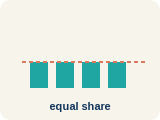
I can determine the mean of a data set, use a target mean to find a missing value, and explain the mean as the fair share and the balance point of the data.
Your work saves on this device.Tu trabajo se guarda en este dispositivo.
Background knowledgeConocimientos previos2 skills you need for today: Add a list of numbers · Share a total equallyLas 2 destrezas que necesitas hoy: Sumar una lista de números · Repartir un total en partes iguales
Read the words below.Lee las palabras de abajo.
Open the model and change one number at a time.Abre el modelo y cambia un número a la vez.
Answer the questions beside the model, one at a time.Responde las preguntas junto al modelo, una a la vez.
Words to knowPalabras clave
MeanMedia
The average of a data set. Add all the values, then divide by how many values there are.El promedio de un conjunto de datos. Suma todos los valores y divide entre cuántos valores hay.
Miguel earned $60 in 4 days: 60 ÷ 4 = 15, so the mean is $15 per day.
AveragePromedio
Another word for the mean — the amount each value would be if the total were shared equally.Otra palabra para la media: la cantidad que tendría cada valor si el total se repartiera en partes iguales.
A player averages 15 points per game, so over 10 games she scores 15 × 10 = 150 points in all.
Measure of centerMedida de centro
A single number used to describe the middle, or typical value, of a whole data set.Un solo número que se usa para describir el centro, o valor típico, de todo un conjunto de datos.
The mean, $15, is one measure of center that describes all four of Miguel's days at once.
Balance pointPunto de equilibrio
The value where the total distance of the data above it equals the total distance below it. The mean is the balance point.El valor donde la distancia total de los datos por encima es igual a la distancia total por debajo. La media es el punto de equilibrio.
With a target mean of 15, points totaling 13 below must be matched by points totaling 13 above.
Loading the model…
1. Try this1. Prueba esto
Before you press Even it out: what will each bar hold?
Change one value up by 4. How much does the mean change? Why?
Find a different set of four values with the same mean.
Miguel wants a mean of $16 after a fifth day. What must he earn that day?
3. Check yourself3. Compruébalo
Answer a question about your model, then one new problem without it.Responde una pregunta sobre tu modelo y luego un problema nuevo sin él.
Stage 2 of 5Etapa 2 de 5
UnderstandComprende
Read the idea, follow the worked examples, and connect the picture to the numbers.Lee la idea, sigue los ejemplos resueltos y conecta el dibujo con los números.
1Step 1 of 9:Paso 1 de 9:Words to knowPalabras clave
Say what each word means, then tap the card to check.Di qué significa cada palabra y luego toca la tarjeta para comprobar.
2Step 2 of 9:Paso 2 de 9:Check the wordsComprueba las palabras
3Step 3 of 9:Paso 3 de 9:What is the mean?¿Qué es la media?
The mean, or average, is a measure of center that describes a whole data set with one number. It is what every value would be if the total were leveled out and shared equally.La media, o promedio, es una medida de centro que describe todo un conjunto de datos con un solo número. Es lo que sería cada valor si el total se nivelara y se repartiera por igual.
Every week, Miguel walks dogs after school to earn some money. He keeps track of his earnings in his notebook. Over 4 days he earned $60 in all. How can Miguel describe his earnings on a typical day?Cada semana, Miguel pasea perros después de la escuela para ganar algo de dinero. Lleva la cuenta de sus ganancias en su cuaderno. En 4 días ganó $60 en total. ¿Cómo puede describir Miguel sus ganancias en un día típico?
4Step 4 of 9:Paso 4 de 9:Watch meMírame
Watch me
Miguel's 4 days of earnings are shown with counters. When I combine all of the counters, there are 60 of them, which means Miguel earned $60 in all.Las ganancias de Miguel en 4 días se muestran con fichas. Cuando junto todas las fichas, hay 60, lo que significa que Miguel ganó $60 en total.
Now I redistribute the 60 counters equally among the 4 days. Each of the 4 groups ends up with 15 counters.Ahora redistribuyo las 60 fichas por igual entre los 4 días. Cada uno de los 4 grupos termina con 15 fichas.
The arithmetic does exactly the same thing: I find the total, 60, and divide it by the number of days, 4. So 60 ÷ 4 = 15.La aritmética hace exactamente lo mismo: hallo el total, 60, y lo divido entre la cantidad de días, 4. Así que 60 ÷ 4 = 15.
We can use $15 to describe Miguel's typical daily earnings. That leveled value is the mean.Podemos usar $15 para describir las ganancias diarias típicas de Miguel. Ese valor nivelado es la media.
5Step 5 of 9:Paso 5 de 9:Let’s do one togetherHagamos uno juntos
Before each step, say what you think comes next. Then show it.Antes de cada paso, di qué crees que sigue. Luego muéstralo.
Let's try together
New data set: a dog walker earns $9, $11, $16, and $12 over 4 days. First, what is the total?Conjunto de datos nuevo: un paseador de perros gana $9, $11, $16 y $12 en 4 días. Primero, ¿cuál es el total?
Next, how many values are in the data set? That number is what we divide by.Luego, ¿cuántos valores hay en el conjunto de datos? Ese número es entre el que dividimos.
Last, divide the total by 4. Is your answer bigger than the smallest day and smaller than the biggest day? It should be.Por último, divide el total entre 4. ¿Es tu respuesta mayor que el día más bajo y menor que el más alto? Debería serlo.
6Step 6 of 9:Paso 6 de 9:Your turnTu turno
Now it's your turn
Next, you will sort Sofia's game scores against her target mean of 15 to see the mean as a balance point.Luego vas a clasificar los puntajes de Sofía frente a su media objetivo de 15 para ver la media como punto de equilibrio.
Then you will use that target mean to figure out what she must score in her last game.Después vas a usar esa media objetivo para averiguar cuánto debe anotar en su último partido.
7Step 7 of 9:Paso 7 de 9:Check yourself: a first questionCompruébalo: una primera pregunta
8Step 8 of 9:Paso 8 de 9:Check yourself: a harder questionCompruébalo: una pregunta más difícil
9Step 9 of 9:Paso 9 de 9:Put it togetherJúntalo todo
Watch out for a common mistakeCuidado con un error común
The most common mistake with the mean is adding correctly and then dividing by the wrong number — or not dividing at all. Students report the total (for 8, 10, 6, 12 they say the mean is 36) or they divide by a count that does not match the data, such as dividing a 4-value total by 5, or skipping a zero when counting the values. Before you finish, do two things: count the values in the data set out loud, and check that your mean lands between the smallest and largest value. A mean of 36 for data that never goes above 12 is impossible.
Sentence frameMarco de oración
Counting games is not enough because ___. To balance, I have to measure how ___ each score is from ___, and then compare the total ___ to the total ___.Contar los partidos no basta porque ___. Para equilibrar, tengo que medir qué tan ___ está cada puntaje de ___, y luego comparar el total ___ con el total ___.
Stage 3 of 5Etapa 3 de 5
PracticePractica
Choose Regular or Challenge. Hints come one step at a time; you get a new question after a worked example.Elige Regular o Reto. Las pistas llegan paso a paso; después de un ejemplo resuelto recibes una pregunta nueva.
Loading practice…
Stage 4 of 5Etapa 4 de 5
ApplyAplica
Use the idea in a real situation. Write your reasoning, then compare it with a sample.Usa la idea en una situación real. Escribe tu razonamiento y compáralo con un ejemplo.
Apply in context: Game pointsAplica en contexto: Puntos por juego
A basketball player scored 14, 9, 21, 12, and 9 points in five games. What is the mean number of points per game?Un jugador de baloncesto anotó 14, 9, 21, 12 y 9 puntos en cinco juegos. ¿Cuál es la media de puntos por juego?
Step 1 · Guide mePaso 1 · Guíame
What is the total of all five scores?¿Cuál es el total de las cinco puntuaciones?
pointspuntos
Step 2 · Final answerPaso 2 · Respuesta final
pointspuntos
Real-world connectionConexión con el mundo real
Sofia tracks the number of points she scores in each basketball game. In games 1 through 9 she scored 12, 20, 16, 11, 17, 14, 15, 10, and 18 points. She wants to end the season with a mean of 15 points per game across all 10 games. Compared with that target of 15, her nine games came in 3 below, 5 above, 1 above, 4 below, 2 above, 1 below, even, 5 below, and 3 above.Sofía lleva la cuenta de los puntos que anota en cada partido de básquetbol. En los partidos 1 al 9 anotó 12, 20, 16, 11, 17, 14, 15, 10 y 18 puntos. Quiere terminar la temporada con una media de 15 puntos por partido en los 10 partidos. Comparados con esa meta de 15, sus nueve partidos quedaron 3 abajo, 5 arriba, 1 arriba, 4 abajo, 2 arriba, 1 abajo, parejo, 5 abajo y 3 arriba.
Question:Pregunta:How many points does Sofia need to score in the last game to hit her goal, and how does the balance-point view give the same answer as adding and dividing?¿Cuántos puntos necesita anotar Sofía en el último partido para llegar a su meta, y cómo da la vista del punto de equilibrio la misma respuesta que sumar y dividir?
After 9 games Sofia has scored points. To average 15 across 10 games she needs points in all, so game 10 must be points. Using the balance point instead, her games total points below the target mean and points above it, so game 10 has to land the target mean.Después de 9 partidos Sofía ha anotado puntos. Para promediar 15 en 10 partidos necesita puntos en total, así que el partido 10 debe ser de puntos. Usando el punto de equilibrio, sus partidos suman puntos por debajo de la media meta y puntos por encima, así que el partido 10 tiene que caer la media meta.
Reasoning challengeReto de razonamiento
Sofia realized she made an error: she actually scored 12 points in Game 8, not 10. Her other games are unchanged (12, 20, 16, 11, 17, 14, 15, and 18). How does this change the number of points she needs in Game 10 to average 15 points per game? Show how you know.Sofía se dio cuenta de un error: en realidad anotó 12 puntos en el Juego 8, no 10. Sus otros juegos no cambian (12, 20, 16, 11, 17, 14, 15 y 18). ¿Cómo cambia esto los puntos que necesita en el Juego 10 para promediar 15 puntos por juego? Muestra cómo lo sabes.
Her new total after 9 games is ___ points. To average 15 over 10 games she still needs ___ points in all, so Game 10 must now be ___ points. That is ___ points fewer than before, because ___.
Create & verify: Describe Data Using the MeanCrea y verifica
Create a data set of 5 numbers with a mean of 12 where none of the numbers is 12. Show how the total sum proves the mean is 12.Crea un conjunto de 5 datos con una media de 12 donde ninguno de los números sea 12. Muestra cómo la suma total demuestra que la media es 12.
Quick test bench (try numbers or expressions)Banco de prueba rápido (prueba números o expresiones)
Stage 5 of 5Etapa 5 de 5
ReflectReflexiona
Answer on your own. Your first try counts as independent evidence; you can still revise.Responde por tu cuenta. Tu primer intento cuenta como evidencia independiente; todavía puedes revisar.