Background knowledgeConocimientos previos2 skills you need for today: Find a missing part of a group · Compare with times as manyLas 2 destrezas que necesitas hoy: Hallar la parte que falta de un grupo · Comparar con veces más
Understand RatiosComprender razones:Use a ratio to compare two quantities by division.Usar una razón para comparar dos cantidades mediante la división.
Read the words below.Lee las palabras de abajo.
Open the model and change one number at a time.Abre el modelo y cambia un número a la vez.
Answer the questions beside the model, one at a time.Responde las preguntas junto al modelo, una a la vez.
Words to knowPalabras clave
RatioRazón
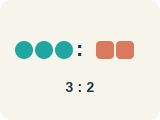
A way to compare two amounts, like 3 to 2.Una manera de comparar dos cantidades, como 3 a 2.
3 cups flour to 2 cups sugar → 3:2
ComparisonComparación
Looking at two or more amounts to see how they are related.Mirar dos o más cantidades para ver cómo se relacionan.
5 eggs vs. 3 eggs — which recipe uses more?
Part-to-partParte a parte
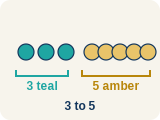
A ratio comparing one part of a group to another part.Una razón que compara una parte de un grupo con otra parte.
3 teal counters to 5 amber counters → 3:5
Part-to-wholeParte a todo
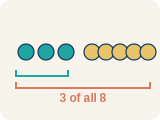
A ratio comparing one part to the whole group.Una razón que compara una parte con todo el grupo.
3 teal counters out of 8 counters in all → 3:8
Loading the model…
1. Try this1. Prueba esto
Compare juice to water and juice to the whole drink. Why are their second numbers different?
Double both ingredients. Explain why the recipe tastes the same.
Use 6 cups of juice and 4 cups of water at a total cost of $5. What is the cost per cup of drink?
3. Check yourself3. Compruébalo
Answer a question about your model, then one new problem without it.Responde una pregunta sobre tu modelo y luego un problema nuevo sin él.
Read the idea, follow the worked examples, and connect the picture to the numbers.Lee la idea, sigue los ejemplos resueltos y conecta el dibujo con los números.
1Step 1 of 9:Paso 1 de 9:Words to knowPalabras clave
Say what each word means, then tap the card to check.Di qué significa cada palabra y luego toca la tarjeta para comprobar.
2Step 2 of 9:Paso 2 de 9:Check the wordsComprueba las palabras
3Step 3 of 9:Paso 3 de 9:What is a ratio?¿Qué es una razón?
A ratio compares two amounts. It tells how much of one thing there is for another thing.Una razón compara dos cantidades. Dice cuánto hay de una cosa por cada cantidad de otra.
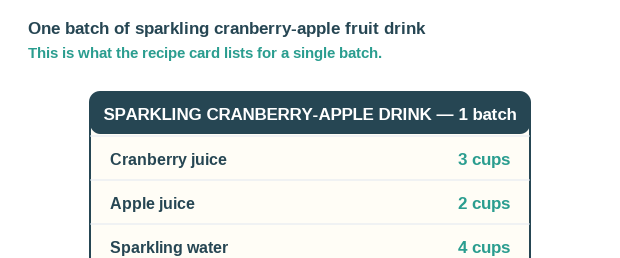
The recipe card shows the ingredients needed to make one batch of sparkling cranberry-apple fruit drink.La tarjeta de receta muestra los ingredientes que se necesitan para hacer una tanda de bebida burbujeante de arándano y manzana.
4Step 4 of 9:Paso 4 de 9:Watch meMírame
Watch me
Chef Reyes uses 3 cups of apple juice for every 2 cups of sparkling water.El chef Reyes usa 3 tazas de jugo de manzana por cada 2 tazas de agua mineral.
I am comparing two amounts: apple juice and sparkling water.Estoy comparando dos cantidades: jugo de manzana y agua mineral.
I write apple juice to sparkling water, in that order, as 3 to 2, or 3:2.Escribo jugo de manzana a agua mineral, en ese orden, como 3 a 2, o 3:2.
I can also draw the ratio. On a tape diagram I give apple juice 3 equal parts and sparkling water 2 equal parts, so one batch is 5 parts in all.También puedo dibujar la razón. En un diagrama de barras le doy al jugo de manzana 3 partes iguales y al agua mineral 2 partes iguales, así que una tanda son 5 partes en total.
Those same 5 parts show a second ratio: apple juice to the whole fruit drink is 3 to 5.Esas mismas 5 partes muestran una segunda razón: jugo de manzana al total de la bebida es 3 a 5.
On a double number line I line the two amounts up: 5 cups of fruit drink pairs with 3 cups of apple juice, and 10 cups of fruit drink pairs with 6 cups of apple juice.En una recta numérica doble alineo las dos cantidades: 5 tazas de bebida se emparejan con 3 tazas de jugo de manzana, y 10 tazas de bebida se emparejan con 6 tazas de jugo de manzana.
5Step 5 of 9:Paso 5 de 9:Let’s do one togetherHagamos uno juntos
Before each step, say what you think comes next. Then show it.Antes de cada paso, di qué crees que sigue. Luego muéstralo.
Let's try together
A bowl has 4 apples and 1 orange. What two amounts are we comparing?Un tazón tiene 4 manzanas y 1 naranja. ¿Qué dos cantidades estamos comparando?
We write apples to oranges in order: 4 to 1, or 4:1.Escribimos manzanas a naranjas en orden: 4 a 1, o 4:1.
Now draw it: 4 equal parts for apples beside 1 part for oranges, 5 parts of fruit in all.Ahora dibújalo: 4 partes iguales para las manzanas junto a 1 parte para la naranja, 5 partes de fruta en total.
So apples to total fruit is 4 to 5.Entonces manzanas al total de fruta es 4 a 5.
6Step 6 of 9:Paso 6 de 9:Your turnTu turno
Now it's your turn
Next you will sort the chef's statements into ratios and not-ratios.Luego vas a clasificar las afirmaciones del chef en razones y no razones.
Then you will use a tape diagram and a double number line to scale the fruit-drink recipe.Después vas a usar un diagrama de barras y una recta numérica doble para escalar la receta de la bebida.
Remember: a real ratio compares two amounts, and the order matters.Recuerda: una razón de verdad compara dos cantidades, y el orden importa.
7Step 7 of 9:Paso 7 de 9:Check yourself: a first questionCompruébalo: una primera pregunta
8Step 8 of 9:Paso 8 de 9:Check yourself: a harder questionCompruébalo: una pregunta más difícil
9Step 9 of 9:Paso 9 de 9:Put it togetherJúntalo todo
Watch out for a common mistakeCuidado con un error común
A common mistake in Understand Ratios is writing the ratio in the wrong order: when asked for the ratio of apple juice to sparkling water in a recipe that uses 3 cups of apple juice for every 2 cups of sparkling water, some students write 2:3 (sparkling water to apple juice) because they list the ingredients in whatever order comes to mind rather than the order the question asks for. The two ratios describe different drinks — 3:2 means 3 cups of juice for every 2 cups of water, while 2:3 would mean only 2 cups of juice for every 3 cups of water. Always match the order of your ratio to the order named in the question: "apple juice to sparkling water" means the apple juice number comes first, giving 3:2.
Sentence frameMarco de oración
A ratio compares ___ to ___ using words like ___ or symbols like ___.Una razón compara ___ con ___ usando palabras como ___ o símbolos como ___.
Stage 3 of 5Etapa 3 de 5
PracticePractica
Choose Regular or Challenge. Hints come one step at a time; you get a new question after a worked example.Elige Regular o Reto. Las pistas llegan paso a paso; después de un ejemplo resuelto recibes una pregunta nueva.
Loading practice…
Stage 4 of 5Etapa 4 de 5
ApplyAplica
Use the idea in a real situation. Write your reasoning, then compare it with a sample.Usa la idea en una situación real. Escribe tu razonamiento y compáralo con un ejemplo.
Apply in context: Car washAplica en contexto: Lavado de autos
At a car wash, the ratio of cars to trucks is 3 to 2. The crew washed 15 cars. How many trucks did they wash?En un lavado de autos, la razón de autos a camionetas es 3 a 2. El equipo lavó 15 autos. ¿Cuántas camionetas lavó?
Step 1 · Guide mePaso 1 · Guíame
How many groups of 3 cars are in 15 cars?¿Cuántos grupos de 3 autos hay en 15 autos?
groupsgrupos
Step 2 · Final answerPaso 2 · Respuesta final
truckscamionetas
Real-world connectionConexión con el mundo real
The school cafeteria is planning a new lunch menu. They want to offer 3 main dishes for every 2 side dishes. If they have 10 side dishes, the cafeteria manager needs to figure out how many main dishes to prepare.La cafetería de la escuela está planeando un menú de almuerzo nuevo. Quieren ofrecer 3 platos fuertes por cada 2 guarniciones. Si tienen 10 guarniciones, el gerente de la cafetería necesita averiguar cuántos platos fuertes preparar.
Main-to-Side Dish RatioRazón de platos fuertes a guarniciones
Each group keeps the 3:2 ratio; five groups reach 10 side dishes, so the cafeteria needs 15 main dishes.Cada grupo mantiene la razón 3:2; cinco grupos llegan a 10 guarniciones, así que la cafetería necesita 15 platos fuertes.
Question:Pregunta:Complete the mathematical reasoning and explain how the numbers fit the situation.Completa el razonamiento matemático y explica cómo encajan los números en la situación.
For every main dishes the cafeteria serves side dishes, so with 10 side dishes they need main dishes.Por cada platos fuertes la cafetería sirve guarniciones, así que con 10 guarniciones necesitan platos fuertes.
Reasoning challengeReto de razonamiento
A bag of marbles has 8 red, 6 blue, and 4 green marbles. Write three different ratios using these quantities: one part-to-part ratio, one part-to-whole ratio, and explain the difference.Una bolsa de canicas tiene 8 canicas rojas, 6 azules y 4 verdes. Escribe tres razones distintas usando estas cantidades: una razón parte a parte, una razón parte a todo, y explica la diferencia.
Create & verify: Understand RatiosCrea y verifica
Write a ratio story about two quantities in your classroom or kitchen. State one part-to-part ratio and one part-to-whole ratio, and explain why order matters.Escribe una historia de razón sobre dos cantidades en tu salón o cocina. Escribe una razón parte a parte y una razón parte a todo, y explica por qué importa el orden.
Quick test bench (try numbers or expressions)Banco de prueba rápido (prueba números o expresiones)
Stage 5 of 5Etapa 5 de 5
ReflectReflexiona
Answer on your own. Your first try counts as independent evidence; you can still revise.Responde por tu cuenta. Tu primer intento cuenta como evidencia independiente; todavía puedes revisar.