I can describe a rate using its two different units and use a model to find a travel time, and I can find a unit rate to compare prices and decide the better buy.
Your work saves on this device.Tu trabajo se guarda en este dispositivo.
Background knowledgeConocimientos previos2 skills you need for today: Divide to find the amount for one · Divide with a decimal answerLas 2 destrezas que necesitas hoy: Dividir para hallar la cantidad para uno · Dividir con una respuesta decimal
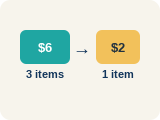
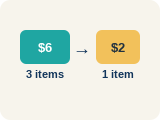
Rates and Unit RatesTasas y tasas unitarias:A rate compares different units; a unit rate compares a quantity to 1 unit.Una tasa compara unidades diferentes; una tasa unitaria compara una cantidad con 1 unidad.
Read the words below.Lee las palabras de abajo.
Open the model and change one number at a time.Abre el modelo y cambia un número a la vez.
Answer the questions beside the model, one at a time.Responde las preguntas junto al modelo, una a la vez.
Words to knowPalabras clave
RateTasa
A ratio comparing two amounts with different units, like miles per hour.Una razón que compara dos cantidades con unidades distintas, como millas por hora.
$12 for 4 games is a rate
Unit RateTasa unitaria
A rate for just 1 of something, like cost for 1 item.Una tasa para solo 1 de algo, como el precio de 1 artículo.
$3 per 1 game
PerPor
For each one. Example: 5 dollars per book.Por cada uno. Ejemplo: 5 dólares por libro.
60 miles per hour means 60 miles for every 1 hour
RatioRazón
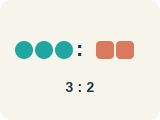
A way to compare two amounts, like 3 to 2.Una manera de comparar dos cantidades, como 3 a 2.
5 to 3 or 5:3
Loading the model…
1. Try this1. Prueba esto
Booth A charges $3 for 5 games. Before you look: is one game more or less than $1?
Keep the price at $3 and double the games to 10. What happens to the cost of one game?
Find a pack size and price that cost exactly $0.50 per item.
A rate compares two different units. Name both units in “$3 for 5 games”.
3. Check yourself3. Compruébalo
Answer a question about your model, then one new problem without it.Responde una pregunta sobre tu modelo y luego un problema nuevo sin él.
Stage 2 of 5Etapa 2 de 5
UnderstandComprende
Read the idea, follow the worked examples, and connect the picture to the numbers.Lee la idea, sigue los ejemplos resueltos y conecta el dibujo con los números.
1Step 1 of 9:Paso 1 de 9:Words to knowPalabras clave
Say what each word means, then tap the card to check.Di qué significa cada palabra y luego toca la tarjeta para comprobar.
2Step 2 of 9:Paso 2 de 9:Check the wordsComprueba las palabras
3Step 3 of 9:Paso 3 de 9:What is a unit rate, and how does it help me find the better buy?¿Qué es una tasa unitaria y cómo me ayuda a hallar la mejor compra?
A rate compares two amounts with different units. A unit rate tells you the amount for just 1 of something, like the cost for 1 game.Una tasa compara dos cantidades con unidades distintas. Una tasa unitaria te dice la cantidad por solo 1 de algo, como el costo de 1 partida.
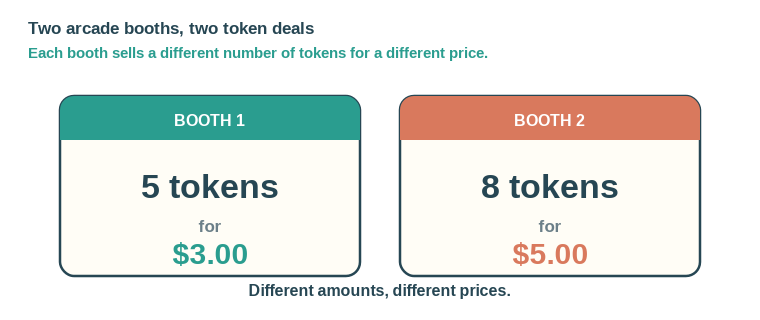
Two arcade booths sell game tokens. One booth advertises 5 tokens for $3.00, and the booth next to it advertises 8 tokens for $5.00. The signs are big and colorful, and each lists a different number of tokens for a different price.Dos taquillas de arcade venden fichas de juego. Una taquilla anuncia 5 fichas por $3.00, y la taquilla de al lado anuncia 8 fichas por $5.00. Los letreros son grandes y coloridos, y cada uno enlista un número distinto de fichas por un precio distinto.
4Step 4 of 9:Paso 4 de 9:Watch meMírame
Watch me
Booth A charges $3 for 5 games. I want the cost for just 1 game.El puesto A cobra $3 por 5 partidas. Quiero el costo de solo 1 partida.
I divide the cost by the games: $3 ÷ 5 = $0.60.Divido el costo entre las partidas: $3 ÷ 5 = $0.60.
So Booth A costs $0.60 per game. That is the unit rate.Entonces el puesto A cuesta $0.60 por partida. Esa es la tasa unitaria.
Because this unit rate is money for one item, it has its own name: it is the unit price.Como esta tasa unitaria es dinero por un artículo, tiene su propio nombre: es el precio unitario.
Now I can compare this booth's unit price fairly with any other booth's.Ahora puedo comparar de forma justa el precio unitario de este puesto con el de cualquier otro.
5Step 5 of 9:Paso 5 de 9:Let’s do one togetherHagamos uno juntos
Before each step, say what you think comes next. Then show it.Antes de cada paso, di qué crees que sigue. Luego muéstralo.
Let's try together
A booth charges $4 for 8 games. What do we divide?Un puesto cobra $4 por 8 partidas. ¿Qué dividimos?
We divide cost by games: $4 ÷ 8 = ?Dividimos el costo entre las partidas: $4 ÷ 8 = ?
What is the unit price, the cost for just 1 game? ($0.50 per game.)¿Cuál es el precio unitario, el costo de solo 1 partida? ($0.50 por partida.)
6Step 6 of 9:Paso 6 de 9:Your turnTu turno
Now it's your turn
In the table, find the cost per game for each booth by dividing.En la tabla, halla el costo por partida de cada puesto dividiendo.
Then decide which booth has the lowest unit rate — that is the better buy.Luego decide qué puesto tiene la tasa unitaria más baja — esa es la mejor compra.
7Step 7 of 9:Paso 7 de 9:Check yourself: a first questionCompruébalo: una primera pregunta
8Step 8 of 9:Paso 8 de 9:Check yourself: a harder questionCompruébalo: una pregunta más difícil
9Step 9 of 9:Paso 9 de 9:Put it togetherJúntalo todo
Watch out for a common mistakeCuidado con un error común
A common mistake in Rates and Unit Rates is comparing total costs instead of unit rates: a student sees Pack X at $4.00 for 10 tokens and Pack Y at $6.00 for 16 tokens and picks Pack X just because $4.00 is the smaller number, without dividing to find the cost per token ($0.40 for Pack X vs. $0.375 for Pack Y — Pack Y is actually the better buy). A second common mistake is dividing backwards — finding tokens ÷ cost instead of cost ÷ tokens — which turns 'dollars per token' into 'tokens per dollar' and gives an answer that looks reasonable but answers the wrong question. Always divide the total cost by the number of items, and check that your unit rate answers 'the cost for ONE item,' not the reverse.
Sentence frameMarco de oración
The best deal is Booth ___ because its unit rate of ___ per game is the ___.La mejor oferta es la taquilla ___ porque su tasa unitaria de ___ por juego es la ___.
Stage 3 of 5Etapa 3 de 5
PracticePractica
Choose Regular or Challenge. Hints come one step at a time; you get a new question after a worked example.Elige Regular o Reto. Las pistas llegan paso a paso; después de un ejemplo resuelto recibes una pregunta nueva.
Loading practice…
Stage 4 of 5Etapa 4 de 5
ApplyAplica
Use the idea in a real situation. Write your reasoning, then compare it with a sample.Usa la idea en una situación real. Escribe tu razonamiento y compáralo con un ejemplo.
Apply in context: Bike rideAplica en contexto: Paseo en bicicleta
Leo rides his bike 3 miles every 12 minutes at a steady rate. At that rate, how many minutes will it take him to ride 15 miles?Leo anda en bicicleta 3 millas cada 12 minutos a un ritmo constante. A ese ritmo, ¿cuántos minutos le tomará recorrer 15 millas?
Step 1 · Guide mePaso 1 · Guíame
How many groups of 3 miles are in 15 miles?¿Cuántos grupos de 3 millas hay en 15 millas?
groupsgrupos
Step 2 · Final answerPaso 2 · Respuesta final
minutesminutos
Real-world connectionConexión con el mundo real
The arcade snack bar sells popcorn in two sizes: a small bag with 3 cups for $2.25 and a large bag with 8 cups for $5.60. You want the most popcorn for your money.La cafetería del arcade vende palomitas en dos tamaños: una bolsa pequeña con 3 tazas por $2.25 y una bolsa grande con 8 tazas por $5.60. Quieres la mayor cantidad de palomitas por tu dinero.
Popcorn Cost Per CupCosto de las palomitas por taza
Each bar is the price for 1 cup ($2.25 divided by 3 vs $5.60 divided by 8); the shorter bar is the better deal, so the large bag wins at $0.70 per cup.Cada barra es el precio de 1 taza ($2.25 dividido entre 3 contra $5.60 dividido entre 8); la barra más corta es la mejor oferta, así que gana la bolsa grande con $0.70 por taza.
Question:Pregunta:Which size is the better deal, and how do you know?¿Qué tamaño es la mejor oferta y cómo lo sabes?
The bag is the better deal because its unit rate is $ per cup, which is than $ per cup for the other size.La bolsa es la mejor oferta porque su tasa unitaria es $ por taza, que es que $ por taza del otro tamaño.
Reasoning challengeReto de razonamiento
An arcade sells tokens in three packs: 25 tokens for $5, 60 tokens for $10.80, and 100 tokens for $19. A student says the 100-token pack is always the best deal because you get the most tokens. Is the student correct? Find all three unit rates and explain.Un arcade vende fichas en tres paquetes: 25 fichas por $5, 60 fichas por $10.80 y 100 fichas por $19. Un estudiante dice que el paquete de 100 fichas siempre es la mejor oferta porque recibes más fichas. ¿Tiene razón? Encuentra las tres tasas unitarias y explica.
The student is ___ because the best deal is the ___ pack with a unit rate of $___ per token.
Create & verify: Understand Rates and Unit RatesCrea y verifica
Invent a shopping or travel rate (e.g., $18 for 4 notebooks). Find the unit rate, explain what 'per 1' means, and use it to find the cost or distance for 7 units.Inventa una tasa de compras o viaje (ej. $18 por 4 cuadernos). Halla la tasa unitaria, explica qué significa 'por 1' y úsala para calcular 7 unidades.
Quick test bench (try numbers or expressions)Banco de prueba rápido (prueba números o expresiones)
Stage 5 of 5Etapa 5 de 5
ReflectReflexiona
Answer on your own. Your first try counts as independent evidence; you can still revise.Responde por tu cuenta. Tu primer intento cuenta como evidencia independiente; todavía puedes revisar.