Background knowledgeConocimientos previos2 skills you need for today: Know common unit facts · Scale both numbers of a ratioLas 2 destrezas que necesitas hoy: Conocer equivalencias comunes de unidades · Ampliar los dos números de una razón
Convert Measurements within the Same SystemConvertir medidas dentro del mismo sistema:Rewriting a measurement in a different unit of the SAME system, such as feet into inches or liters into milliliters.Reescribir una medida en otra unidad del MISMO sistema, como pies a pulgadas o litros a mililitros.
Read the words below.Lee las palabras de abajo.
Open the model and change one number at a time.Abre el modelo y cambia un número a la vez.
Answer the questions beside the model, one at a time.Responde las preguntas junto al modelo, una a la vez.
Words to knowPalabras clave
Conversion factorFactor de conversión
The ratio that links two units in the same measurement system, such as 12 inches to 1 foot. Within one system it is exact.La razón que relaciona dos unidades del mismo sistema de medición, como 12 pulgadas a 1 pie. Dentro de un mismo sistema es exacta.
1 ft = 12 in. · 1 L = 1,000 mL · 1 lb = 16 oz
Unit ratioRazón unitaria
A ratio that compares an amount to exactly 1 unit of another quantity, like 12 inches to 1 foot.Una razón que compara una cantidad con exactamente 1 unidad de otra cantidad, como 12 pulgadas por 1 pie.
12 : 1 — twelve inches for every one foot
ConvertConvertir
To change a measurement from one unit to another without changing how much it is.Cambiar una medida de una unidad a otra sin cambiar la cantidad que representa.
4 ft and 48 in are the same height, written two ways
Measurement systemSistema de medidas
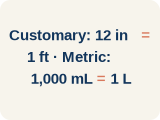
A family of units that go together — customary units like inches and feet, or metric units like milliliters and liters.Una familia de unidades que van juntas: unidades usuales como pulgadas y pies, o métricas como mililitros y litros.
Customary: 12 in = 1 ft · Metric: 1,000 mL = 1 L
Loading the model…
1. Try this1. Prueba esto
Use 1 inch = 2.54 centimeters to convert five inches.
Reverse the calculation to return to inches. Explain why the numbers change but the length does not.
Compare that conversion with 1 foot = 12 inches. Name the starting and ending units every time.
3. Check yourself3. Compruébalo
Answer a question about your model, then one new problem without it.Responde una pregunta sobre tu modelo y luego un problema nuevo sin él.
Read the idea, follow the worked examples, and connect the picture to the numbers.Lee la idea, sigue los ejemplos resueltos y conecta el dibujo con los números.
1Step 1 of 9:Paso 1 de 9:Words to knowPalabras clave
Say what each word means, then tap the card to check.Di qué significa cada palabra y luego toca la tarjeta para comprobar.
2Step 2 of 9:Paso 2 de 9:Check the wordsComprueba las palabras
3Step 3 of 9:Paso 3 de 9:Converting inside one measurement systemConvertir dentro de un mismo sistema de medida
Two measurements can only be compared when they are written in the same unit. Converting uses a special ratio — a unit ratio — that says how much of the smaller unit fits into exactly 1 of the larger unit.Dos medidas solo se pueden comparar cuando están escritas en la misma unidad. Convertir usa una razón especial — una razón unitaria — que dice cuánto de la unidad más pequeña cabe en exactamente 1 de la unidad más grande.
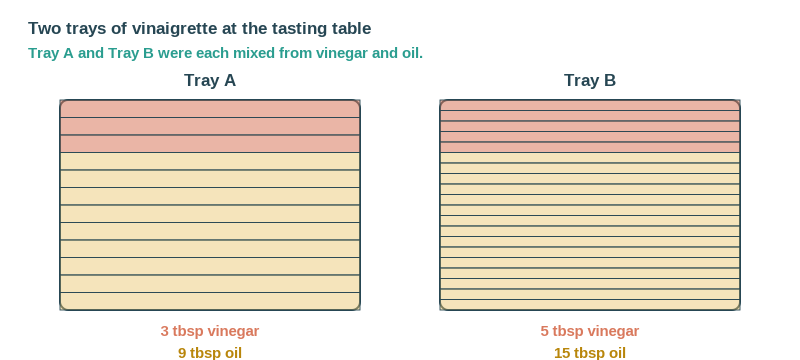
Chef Reyes lines up two trays of vinaigrette at the tasting table. Tray A mixes 3 tablespoons of vinegar with 9 tablespoons of oil. Tray B mixes 5 tablespoons of vinegar with 15 tablespoons of oil.La chef Reyes pone dos charolas de vinagreta en la mesa de degustación. La charola A mezcla 3 cucharadas de vinagre con 9 cucharadas de aceite. La charola B mezcla 5 cucharadas de vinagre con 15 cucharadas de aceite.
4Step 4 of 9:Paso 4 de 9:Watch meMírame
Watch me check the ride height rule
A ride requires riders to be at or above 44 inches tall. A child is 4 feet tall. The two measurements use different units, so I cannot compare them yet.Un juego mecánico exige que quienes suban midan 44 pulgadas o más. Un niño mide 4 pies. Las dos medidas usan unidades distintas, así que todavía no puedo compararlas.
Both units belong to the customary system, and there are 12 inches in one foot. That relationship is the conversion factor. As a ratio it is 12 : 1 — a unit ratio, because it compares an amount to exactly 1 foot.Las dos unidades pertenecen al sistema usual, y hay 12 pulgadas en un pie. Esa relación es el factor de conversión. Como razón es 12 : 1 — una razón unitaria, porque compara una cantidad con exactamente 1 pie.
Inches are smaller than feet, so there will be MORE of them: I multiply. 4 × 12 = 48.Las pulgadas son más pequeñas que los pies, así que habrá más: multiplico. 4 × 12 = 48.
The child is 48 inches tall. Now the comparison is fair: 48 inches is greater than 44 inches, so the child can go on the ride.El niño mide 48 pulgadas. Ahora la comparación es justa: 48 pulgadas es más que 44 pulgadas, así que el niño sí puede subir al juego.
5Step 5 of 9:Paso 5 de 9:Let’s do one togetherHagamos uno juntos
Before each step, say what you think comes next. Then show it.Antes de cada paso, di qué crees que sigue. Luego muéstralo.
Let's do one together
Diamond wants to drink 4 liters of water. Her bottle is marked in milliliters.Diamond quiere tomar 4 litros de agua. Su botella está marcada en mililitros.
The conversion factor is 1,000 mL : 1 L. On a double number line, every 1 liter above matches 1,000 milliliters below.El factor de conversión es 1,000 mL : 1 L. En una recta numérica doble, cada 1 litro de arriba corresponde a 1,000 mililitros abajo.
Milliliters are smaller, so multiply: 4 × 1,000 = 4,000. So 4 liters = 4,000 milliliters.Los mililitros son más pequeños, así que multiplica: 4 × 1,000 = 4,000. Entonces 4 litros = 4,000 mililitros.
Her bottle holds 500 milliliters. How many fills? Solve ? × 500 = 4,000. Since 8 × 500 = 4,000, she fills the bottle 8 times.Su botella tiene capacidad de 500 mililitros. ¿Cuántas veces la llena? Resuelve ? × 500 = 4,000. Como 8 × 500 = 4,000, llena la botella 8 veces.
6Step 6 of 9:Paso 6 de 9:Your turnTu turno
Your turn
A stockpot recipe calls for 3 quarts of broth, but the pot is marked only in cups.Una receta para una olla pide 3 cuartos de caldo, pero la olla solo está marcada en tazas.
Write the unit ratio: there are 4 cups in 1 quart, so 4 : 1.Escribe la razón unitaria: hay 4 tazas en 1 cuarto, así que 4 : 1.
Are cups smaller or larger than quarts? Decide whether to multiply or divide.¿Las tazas son más pequeñas o más grandes que los cuartos? Decide si multiplicas o divides.
Convert 3 quarts to cups, then say the answer as a full sentence with its unit.Convierte 3 cuartos a tazas y luego di la respuesta en una oración completa con su unidad.
7Step 7 of 9:Paso 7 de 9:Check yourself: a first questionCompruébalo: una primera pregunta
8Step 8 of 9:Paso 8 de 9:Check yourself: a harder questionCompruébalo: una pregunta más difícil
9Step 9 of 9:Paso 9 de 9:Put it togetherJúntalo todo
Watch out for a common mistakeCuidado con un error común
A common mistake when converting within a measurement system is choosing the operation by habit instead of by unit size — multiplying every time. Converting 36 inches to feet by multiplying gives 36 × 12 = 432 feet, taller than a 40-story building. Ask first which unit is smaller: it takes MORE small units to make the same amount, so going to a smaller unit multiplies, and going to a larger unit divides.
Sentence frameMarco de oración
When the unit gets ___, it takes ___ of them to make the same amount, so I ___.Cuando la unidad se hace ___, se necesitan ___ de ellas para formar la misma cantidad, así que ___.
Stage 3 of 5Etapa 3 de 5
PracticePractica
Choose Regular or Challenge. Hints come one step at a time; you get a new question after a worked example.Elige Regular o Reto. Las pistas llegan paso a paso; después de un ejemplo resuelto recibes una pregunta nueva.
Loading practice…
Stage 4 of 5Etapa 4 de 5
ApplyAplica
Use the idea in a real situation. Write your reasoning, then compare it with a sample.Usa la idea en una situación real. Escribe tu razonamiento y compáralo con un ejemplo.
Apply in context: Water jugAplica en contexto: Garrafón de agua
A coach fills a 3-liter jug with water. Each paper cup holds 250 milliliters. There are 1,000 milliliters in 1 liter. How many cups can be filled from the jug?Un entrenador llena un garrafón de 3 litros con agua. Cada vaso de papel contiene 250 mililitros. Hay 1,000 mililitros en 1 litro. ¿Cuántos vasos se pueden llenar con el garrafón?
Step 1 · Guide mePaso 1 · Guíame
How many milliliters are in the 3-liter jug?¿Cuántos mililitros hay en la jarra de 3 litros?
millilitersmililitros
Step 2 · Final answerPaso 2 · Respuesta final
cupsvasos
Real-world connectionConexión con el mundo real
Chef Reyes is making stock. The recipe calls for 3 quarts of broth, but the only measuring tool on the line is a 1-cup scoop. There are 4 cups in 1 quart.La chef Reyes está haciendo caldo. La receta pide 3 cuartos de caldo, pero la única herramienta de medida en la línea es una taza medidora de 1 taza. Hay 4 tazas en 1 cuarto.
Quarts
Cups
1
4
2
8
3
12
4
16
Question:Pregunta:How many cup-scoops of broth does the recipe need, and how do you know?¿Cuántas tazas de caldo necesita la receta y cómo lo sabes?
The unit ratio is cups to 1 quart. Cups are than quarts, so I to convert. 3 × 4 = cups. The amount of broth did not change — only the did.La razón unitaria es tazas a 1 cuarto. Las tazas son que los cuartos, así que para convertir. 3 × 4 = tazas. La cantidad de caldo no cambió — solo la .
Reasoning challengeReto de razonamiento
Michael's mother is setting four fence posts. Each post needs 250 ounces of concrete mix, one bag holds 80 ounces, and each bag needs 1 quart of water. How many bags and how many cups of water does she need? Show your conversions.La mamá de Michael está colocando cuatro postes de cerca. Cada poste necesita 250 onzas de mezcla de concreto, una bolsa contiene 80 onzas, y cada bolsa necesita 1 cuarto de galón de agua. ¿Cuántas bolsas y cuántas tazas de agua necesita? Muestra tus conversiones.
Create & verify: Ratio Reasoning: Convert Measurements within the Same SystemCrea y verifica
Write a measurement conversion problem within the same system (e.g., feet to inches or liters to milliliters). Solve it using a ratio table or unit rate and explain whether you multiply or divide.Escribe un problema de conversión dentro del mismo sistema (ej. pies a pulgadas o litros a mililitros). Resuélvelo con una razón y explica si multiplicas o divides.
Quick test bench (try numbers or expressions)Banco de prueba rápido (prueba números o expresiones)
Stage 5 of 5Etapa 5 de 5
ReflectReflexiona
Answer on your own. Your first try counts as independent evidence; you can still revise.Responde por tu cuenta. Tu primer intento cuenta como evidencia independiente; todavía puedes revisar.