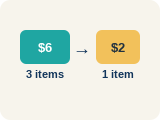
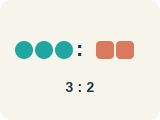
Background knowledgeConocimientos previos2 skills you need for today: Find a unit rate by dividing · Compare decimals to find the lower priceLas 2 destrezas que necesitas hoy: Hallar una tasa unitaria al dividir · Comparar decimales para hallar el precio menor
Unit Rate Problem SolvingResolución de problemas con tasas unitarias:Find an amount per 1 unit and use it to compare choices or solve a problem.Hallar una cantidad por 1 unidad y usarla para comparar opciones o resolver un problema.
Read the words below.Lee las palabras de abajo.
Open the model and change one number at a time.Abre el modelo y cambia un número a la vez.
Answer the questions beside the model, one at a time.Responde las preguntas junto al modelo, una a la vez.
Words to knowPalabras clave
Unit RateTasa unitaria
A rate for just 1 of something, like cost for 1 item.Una tasa para solo 1 de algo, como el precio de 1 artículo.
$2.50 per pound means $2.50 for every 1 pound
Better BuyMejor compra
The choice that costs less for each item.La opción que cuesta menos por cada artículo.
$0.10 each vs $0.15 each — the $0.10 option is the better buy
ComparisonComparación
Looking at two or more amounts to see how they are related.Mirar dos o más cantidades para ver cómo se relacionan.
$3 per game < $4 per game
Per UnitPor unidad
For each single item.Por cada artículo.
$0.50 per token means each token costs $0.50
Loading the model…
1. Try this1. Prueba esto
Compare your price per item with a reference pack of 6 items for $10.
Build a larger pack with exactly the same unit price.
If you need only three items, what else should you consider besides unit price?
3. Check yourself3. Compruébalo
Answer a question about your model, then one new problem without it.Responde una pregunta sobre tu modelo y luego un problema nuevo sin él.
Read the idea, follow the worked examples, and connect the picture to the numbers.Lee la idea, sigue los ejemplos resueltos y conecta el dibujo con los números.
1Step 1 of 9:Paso 1 de 9:Words to knowPalabras clave
Say what each word means, then tap the card to check.Di qué significa cada palabra y luego toca la tarjeta para comprobar.
2Step 2 of 9:Paso 2 de 9:Check the wordsComprueba las palabras
3Step 3 of 9:Paso 3 de 9:How do I use unit rates to find the better buy?¿Cómo uso las tasas unitarias para hallar la mejor compra?
A unit rate is the cost for just 1 item, like the price per token. When packages have different sizes, the unit rate lets you compare them fairly.Una tasa unitaria es el costo de solo 1 artículo, como el precio por ficha. Cuando los paquetes tienen tamaños distintos, la tasa unitaria te deja compararlos de forma justa.
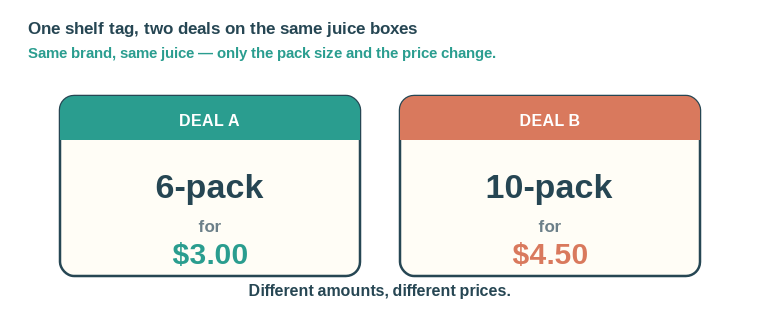
A supermarket shelf tag shows two deals side by side for the same brand of juice boxes: a 6-pack for $3.00 and a 10-pack for $4.50.La etiqueta de un estante de supermercado muestra dos ofertas lado a lado de la misma marca de jugos en caja: un paquete de 6 por $3.00 y un paquete de 10 por $4.50.
4Step 4 of 9:Paso 4 de 9:Watch meMírame
Watch me
Fun Supply Co. sells 500 tokens for $60. I want the cost for 1 token.Fun Supply Co. vende 500 fichas por $60. Quiero el costo de 1 ficha.
I divide the price by the tokens: $60 ÷ 500 = $0.12.Divido el precio entre las fichas: $60 ÷ 500 = $0.12.
So this deal is $0.12 per token. That is the unit rate.Entonces esta oferta es de $0.12 por ficha. Esa es la tasa unitaria.
Now I can compare it fairly to a deal with a different number of tokens.Ahora puedo compararla de forma justa con una oferta que tenga otra cantidad de fichas.
5Step 5 of 9:Paso 5 de 9:Let’s do one togetherHagamos uno juntos
Before each step, say what you think comes next. Then show it.Antes de cada paso, di qué crees que sigue. Luego muéstralo.
Let's try together
Arcade Depot sells 350 tokens for $38.50. What do we divide?Arcade Depot vende 350 fichas por $38.50. ¿Qué dividimos?
We divide price by tokens: $38.50 ÷ 350 = ?Dividimos el precio entre las fichas: $38.50 ÷ 350 = ?
What is the cost per token, and is it lower than $0.12? ($0.11 — yes, the better buy.)¿Cuál es el costo por ficha, y es menor que $0.12? ($0.11 — sí, es la mejor compra.)
6Step 6 of 9:Paso 6 de 9:Your turnTu turno
Now it's your turn
In the table, find the unit rate for each supplier by dividing price by quantity.En la tabla, halla la tasa unitaria de cada proveedor dividiendo el precio entre la cantidad.
Mark the option with the lower unit rate as the better buy.Marca la opción con la tasa unitaria más baja como la mejor compra.
7Step 7 of 9:Paso 7 de 9:Check yourself: a first questionCompruébalo: una primera pregunta
8Step 8 of 9:Paso 8 de 9:Check yourself: a harder questionCompruébalo: una pregunta más difícil
9Step 9 of 9:Paso 9 de 9:Put it togetherJúntalo todo
Watch out for a common mistakeCuidado con un error común
A common mistake in Solve Problems with Unit Rates is comparing the total prices instead of the cost per item — the deal with the smaller total can still cost more per unit. Always reduce each option to its unit rate before you decide, then pick the lower one.
Sentence frameMarco de oración
I find the better buy by comparing the ___ for each option. The option with the ___ unit rate is the better buy because ___.Hallo la mejor compra comparando ___ de cada opción. La opción con la tasa unitaria ___ es la mejor compra porque ___.
Stage 3 of 5Etapa 3 de 5
PracticePractica
Choose Regular or Challenge. Hints come one step at a time; you get a new question after a worked example.Elige Regular o Reto. Las pistas llegan paso a paso; después de un ejemplo resuelto recibes una pregunta nueva.
Loading practice…
Stage 4 of 5Etapa 4 de 5
ApplyAplica
Use the idea in a real situation. Write your reasoning, then compare it with a sample.Usa la idea en una situación real. Escribe tu razonamiento y compáralo con un ejemplo.
Apply in context: Notebook saleAplica en contexto: Oferta de cuadernos
Store A sells 5 notebooks for $12.50. Store B sells 8 notebooks for $18. A teacher needs 20 notebooks. How much money does she save by buying all 20 at the cheaper store?La tienda A vende 5 cuadernos por $12.50. La tienda B vende 8 cuadernos por $18. Una maestra necesita 20 cuadernos. ¿Cuánto dinero ahorra si compra los 20 en la tienda más barata?
Step 1 · Guide mePaso 1 · Guíame
How much would 20 notebooks cost at Store A?¿Cuánto costarían 20 cuadernos en la tienda A?
dollarsdólares
Step 2 · Final answerPaso 2 · Respuesta final
dollarsdólares
Real-world connectionConexión con el mundo real
The arcade needs 600 prize tickets printed. Printer A prints 150 tickets in 5 minutes. Printer B prints 200 tickets in 8 minutes. The manager wants to use the faster printer.El arcade necesita imprimir 600 boletos de premio. La impresora A imprime 150 boletos en 5 minutos. La impresora B imprime 200 boletos en 8 minutos. El gerente quiere usar la impresora más rápida.
Printer Speed: Tickets Per MinuteVelocidad de la impresora: boletos por minuto
Each bar shows one printer's unit rate (tickets in 1 minute); the taller bar, Printer A at 30, is the faster choice for the 600 tickets.Cada barra muestra la tasa unitaria de una impresora (boletos en 1 minuto); la barra más alta, la impresora A con 30, es la opción más rápida para los 600 boletos.
Question:Pregunta:Which printer should the manager choose, and how long will it take to print all 600 tickets?¿Qué impresora debe escoger el gerente, y cuánto tiempo tomará imprimir los 600 boletos?
Printer A prints tickets per minute. Printer B prints tickets per minute. The manager should use Printer because it is faster. It will take minutes to print 600 tickets.La impresora A imprime boletos por minuto. La impresora B imprime boletos por minuto. El gerente debe usar la impresora porque es más rápida. Tomará minutos imprimir 600 boletos.
Reasoning challengeReto de razonamiento
Two arcade supply companies offer token deals. Company X: 300 tokens for $36. Company Y: 500 tokens for $55. The arcade needs 1,000 tokens. Find the unit rate for each company, determine which is cheaper per token, and calculate the total cost of buying 1,000 tokens from the better deal.Dos compañías de suministros para arcades ofrecen paquetes de fichas. Compañía X: 300 fichas por $36. Compañía Y: 500 fichas por $55. El arcade necesita 1,000 fichas. Encuentra la tasa unitaria de cada compañía, determina cuál es más barata por ficha y calcula el costo total de comprar 1,000 fichas en la mejor oferta.
Company X charges $___ per token and Company Y charges $___ per token. The better deal is Company ___ because ___. Buying 1,000 tokens would cost $___.
Create & verify: Solve Problems with Unit RatesCrea y verifica
Write a two-step problem solved with a unit rate (e.g., earning money per hour or driving at constant speed). Find the unit rate first, then answer a question about a new amount.Escribe un problema de dos pasos resuelto con una tasa unitaria. Halla primero la tasa unitaria y luego responde una pregunta sobre una nueva cantidad.
Quick test bench (try numbers or expressions)Banco de prueba rápido (prueba números o expresiones)
Stage 5 of 5Etapa 5 de 5
ReflectReflexiona
Answer on your own. Your first try counts as independent evidence; you can still revise.Responde por tu cuenta. Tu primer intento cuenta como evidencia independiente; todavía puedes revisar.