Background knowledgeConocimientos previos2 skills you need for today: Read tenths and hundredths · Write a fraction with denominator 100Las 2 destrezas que necesitas hoy: Leer décimos y centésimos · Escribir una fracción con denominador 100
Fractions, Decimals, and PercentsFracciones, decimales y porcentajes:Three equivalent ways to name the same part of a whole.Tres maneras equivalentes de nombrar la misma parte de un todo.
Read the words below.Lee las palabras de abajo.
Open the model and change one number at a time.Abre el modelo y cambia un número a la vez.
Answer the questions beside the model, one at a time.Responde las preguntas junto al modelo, una a la vez.
Words to knowPalabras clave
PercentPorcentaje
A way to compare a number to 100, shown with the % sign.Una manera de comparar un número con 100, con el signo %.
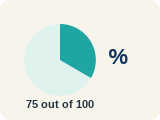
25% means 25 out of 100
Decimal
A number with a dot, like 0.5, that shows a part less than one.Un número con un punto, como 0.5, que muestra una parte menor que uno.
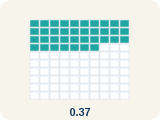
0.75 means seventy-five hundredths
EquivalentEquivalente
Having the same value, just written a different way.Tener el mismo valor, escrito de otra forma.
1/2 = 0.5 = 50%
BenchmarkReferencia
A familiar number you use to guess, like 50% or 1/2.Un número conocido que usas para estimar, como 50% o 1/2.
Common benchmarks: 25%, 50%, 75%
Loading the model…
1. Try this1. Prueba esto
Shade 35 out of 100 squares. Name the fraction, decimal, and percent.
On paper, compare 0.4 and 4%. How many of 100 squares would each fill?
Make a design representing three quarters. Explain all three notations.
3. Check yourself3. Compruébalo
Answer a question about your model, then one new problem without it.Responde una pregunta sobre tu modelo y luego un problema nuevo sin él.
Read the idea, follow the worked examples, and connect the picture to the numbers.Lee la idea, sigue los ejemplos resueltos y conecta el dibujo con los números.
1Step 1 of 9:Paso 1 de 9:Words to knowPalabras clave
Say what each word means, then tap the card to check.Di qué significa cada palabra y luego toca la tarjeta para comprobar.
2Step 2 of 9:Paso 2 de 9:Check the wordsComprueba las palabras
3Step 3 of 9:Paso 3 de 9:How can one value be written as a fraction, a decimal, AND a percent?¿Cómo se puede escribir un mismo valor como fracción, decimal y porcentaje?
Equivalent forms name the same value in different ways. Percent means "out of 100," so a fraction is already a percent once its denominator is 100.Las formas equivalentes nombran el mismo valor de maneras distintas. Porcentaje significa «de cada 100», así que una fracción ya es un porcentaje en cuanto su denominador es 100.
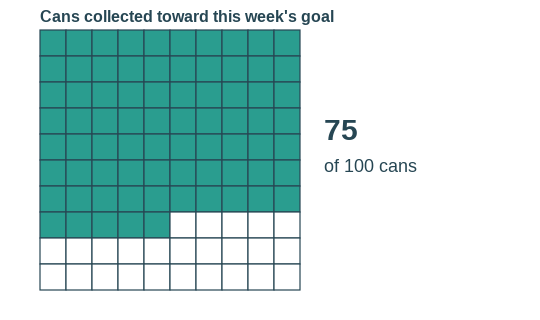
Some middle school students are running a canned food drive. Their goal is to collect 100 cans each week for the local food pantry. So far this week, students have brought in 75 cans.Unos estudiantes de secundaria están organizando una colecta de alimentos enlatados. Su meta es juntar 100 latas cada semana para el banco de alimentos local. En lo que va de esta semana, los estudiantes han traído 75 latas.
4Step 4 of 9:Paso 4 de 9:Watch meMírame
Watch me
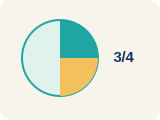
A player scored 3/4 of the points. Percent means out of 100, so I want an equivalent fraction with 100 on the bottom.Un jugador anotó 3/4 de los puntos. Porcentaje significa de cada 100, así que quiero una fracción equivalente con 100 abajo.
What do I multiply the denominator 4 by to get 100? 4 × 25 = 100, so my scale factor is 25.¿Por cuánto multiplico el denominador 4 para llegar a 100? 4 × 25 = 100, así que mi factor de escala es 25.
I have to multiply the top by that same 25: 3 × 25 = 75. So 3/4 = 75/100.Tengo que multiplicar el numerador por ese mismo 25: 3 × 25 = 75. Entonces 3/4 = 75/100.
75 out of 100 is 75%. And 75/100 as a decimal is 0.75, because hundredths sit two places after the point.75 de cada 100 es 75%. Y 75/100 como decimal es 0.75, porque las centésimas están dos lugares después del punto.
So 3/4 = 75/100 = 0.75 = 75%. All three name the same score.Entonces 3/4 = 75/100 = 0.75 = 75%. Las tres formas nombran el mismo puntaje.
5Step 5 of 9:Paso 5 de 9:Let’s do one togetherHagamos uno juntos
Before each step, say what you think comes next. Then show it.Antes de cada paso, di qué crees que sigue. Luego muéstralo.
Let's try together
Let's change 1/5 into a fraction out of 100, then a decimal and a percent.Convirtamos 1/5 en una fracción de cada 100, y luego en decimal y porcentaje.
What do we multiply the denominator 5 by to get 100? (20)¿Por cuánto multiplicamos el denominador 5 para llegar a 100? (20)
Now multiply the numerator by that same 20: 1 × 20 = ? (20) So 1/5 = 20/100.Ahora multiplica el numerador por ese mismo 20: 1 × 20 = ? (20) Entonces 1/5 = 20/100.
20 out of 100 is what percent? (20%) And as a decimal? (0.2)¿20 de cada 100 es qué porcentaje? (20%) ¿Y como decimal? (0.2)
6Step 6 of 9:Paso 6 de 9:Your turnTu turno
Now it's your turn
In the table, first build the equivalent fraction out of 100 — you find the number that turns the denominator into 100.En la tabla, primero forma la fracción equivalente de cada 100 — halla el número que convierte el denominador en 100.
Then read the percent straight off the new numerator, and write the same value as a decimal.Luego lee el porcentaje directamente del nuevo numerador y escribe el mismo valor como decimal.
If the denominator will not scale to 100 evenly (like 8 or 3), divide the numerator by the denominator instead, then multiply by 100.Si el denominador no se escala a 100 de forma exacta (como 8 o 3), divide el numerador entre el denominador y luego multiplica por 100.
7Step 7 of 9:Paso 7 de 9:Check yourself: a first questionCompruébalo: una primera pregunta
8Step 8 of 9:Paso 8 de 9:Check yourself: a harder questionCompruébalo: una pregunta más difícil
9Step 9 of 9:Paso 9 de 9:Put it togetherJúntalo todo
Watch out for a common mistakeCuidado con un error común
A common mistake in Relate Fractions, Decimals, and Percents is treating the numerator and denominator as the percent's digits — turning 3/5 into "35%" by just reading the 3 and the 5. Percent means out of 100, so the fix is to build an equivalent fraction with denominator 100: 5 × 20 = 100, so multiply the top by 20 too — 3/5 = 60/100 = 60%. A second version of this mistake is scaling only ONE part of the fraction (writing 3/5 = 3/100 or 60/5). Whatever you multiply the denominator by, you must multiply the numerator by the same number. When a denominator will not reach 100 evenly (8, 3, 7), divide the numerator by the denominator instead and then multiply by 100.
Sentence frameMarco de oración
I multiplied the top and bottom of ___ by ___ to get ___/100, so the percent is ___%.Multipliqué el numerador y el denominador de ___ por ___ para obtener ___/100, así que el porcentaje es ___%.
Stage 3 of 5Etapa 3 de 5
PracticePractica
Choose Regular or Challenge. Hints come one step at a time; you get a new question after a worked example.Elige Regular o Reto. Las pistas llegan paso a paso; después de un ejemplo resuelto recibes una pregunta nueva.
Loading practice…
Stage 4 of 5Etapa 4 de 5
ApplyAplica
Use the idea in a real situation. Write your reasoning, then compare it with a sample.Usa la idea en una situación real. Escribe tu razonamiento y compáralo con un ejemplo.
Apply in context: Win percentsAplica en contexto: Porcentajes de victorias
Team A won 17 of its 20 games. Team B won 82% of its games. How many percentage points higher is Team A's win percent than Team B's?El equipo A ganó 17 de sus 20 partidos. El equipo B ganó 82% de sus partidos. ¿Cuántos puntos porcentuales más alto es el porcentaje de victorias del equipo A que el del equipo B?
Step 1 · Guide mePaso 1 · Guíame
What number do you multiply 20 by to get 100?¿Por qué número multiplicas 20 para obtener 100?
Step 2 · Final answerPaso 2 · Respuesta final
percentage pointspuntos porcentuales
Real-world connectionConexión con el mundo real
A store has a clearance sale: 'Everything 3/5 off!' Your friend says that means 35% off. Another friend says it's 60% off. The original price of a game is $40.Una tienda tiene una liquidación: «¡Todo a 3/5 de descuento!» Tu amigo dice que eso significa 35% de descuento. Otro amigo dice que es 60% de descuento. El precio original de un juego es $40.
3/5 Off a $40 Game3/5 de descuento en un juego de $40
Split $40 into 5 equal $8 parts: 3 of the 5 parts are taken off, so 3/5 = 60% = $24 off, leaving 2 parts = $16 to pay.Reparte $40 en 5 partes iguales de $8: 3 de las 5 partes se le quitan, así que 3/5 = 60% = $24 de descuento, dejando 2 partes = $16 por pagar.
Question:Pregunta:Who is correct, and how much would the game cost on sale?¿Quién tiene razón, y cuánto costaría el juego en oferta?
The friend who said % is correct because 3/5 = = %. The sale price is $.El amigo que dijo % tiene razón porque 3/5 = = %. El precio de oferta es $.
Reasoning challengeReto de razonamiento
A student says 3/8 is greater than 40% because 3 and 8 are bigger numbers than 4 and 0. Is the student correct? Convert both values to the same form and explain.Un estudiante dice que 3/8 es mayor que 40% porque 3 y 8 son números más grandes que 4 y 0. ¿Tiene razón? Convierte los dos valores a la misma forma y explica.
The student is ___ because 3/8 = ___ = ___%, which is ___ than 40%.
Create & verify: Relate Fractions, Decimals, and PercentagesCrea y verifica
Pick a real-world percent (not a multiple of 10) and write it in all three equivalent forms: simplified fraction, decimal, and percent. Show how to convert between them.Elige un porcentaje real (que no sea múltiplo de 10) y escríbelo en sus tres formas equivalentes: fracción simplificada, decimal y porcentaje. Muestra cómo convertir entre ellas.
Quick test bench (try numbers or expressions)Banco de prueba rápido (prueba números o expresiones)
Stage 5 of 5Etapa 5 de 5
ReflectReflexiona
Answer on your own. Your first try counts as independent evidence; you can still revise.Responde por tu cuenta. Tu primer intento cuenta como evidencia independiente; todavía puedes revisar.