Background knowledgeConocimientos previos2 skills you need for today: Find 10% by dividing by 10 · Find a fraction of a numberLas 2 destrezas que necesitas hoy: Hallar 10% al dividir entre 10 · Hallar una fracción de un número
Percent of a NumberPorcentaje de un número:A part of a number found by multiplying the number by the percent written as a decimal.Una parte de un número que se halla multiplicando el número por el porcentaje escrito como decimal.
Read the words below.Lee las palabras de abajo.
Open the model and change one number at a time.Abre el modelo y cambia un número a la vez.
Answer the questions beside the model, one at a time.Responde las preguntas junto al modelo, una a la vez.
Words to knowPalabras clave
PercentPorcentaje
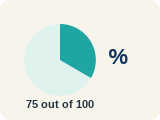
A way to compare a number to 100, shown with the % sign.Una manera de comparar un número con 100, con el signo %.
30% means 30 out of 100
Base
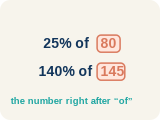
The whole amount you start with — the number right after the word “of.”La cantidad total con la que empiezas: el número que va después de la palabra “de”.
25% of 80 → the whole is 80.
PartParte
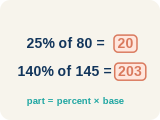
How much of the base (the whole) you get. It is your answer.Cuánto obtienes de la base (el total). Es tu respuesta.
25% of 80 = 20 → the part is 20 (20 out of the 80).
EquationEcuación
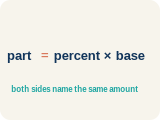
A number sentence with an equal sign. The percent one is: part = percent × base.Una oración numérica con signo de igual. La de porcentaje es: parte = porcentaje × base.
part = percent × base — like 20 = 0.25 × 80.
Loading the model…
1. Try this1. Prueba esto
Find 10%, 25%, and 50% of the same price using benchmarks.
Compare your estimate with the exact discount. Then find the remaining price.
Explain why a 25% discount is not the same as subtracting $25 from every price.
3. Check yourself3. Compruébalo
Answer a question about your model, then one new problem without it.Responde una pregunta sobre tu modelo y luego un problema nuevo sin él.
Read the idea, follow the worked examples, and connect the picture to the numbers.Lee la idea, sigue los ejemplos resueltos y conecta el dibujo con los números.
1Step 1 of 9:Paso 1 de 9:Words to knowPalabras clave
Say what each word means, then tap the card to check.Di qué significa cada palabra y luego toca la tarjeta para comprobar.
2Step 2 of 9:Paso 2 de 9:Check the wordsComprueba las palabras
3Step 3 of 9:Paso 3 de 9:How do I find the percent of a number?¿Cómo hallo el porcentaje de un número?
A percent is a piece of a whole. The whole is called the base — it is the number right after the word “of,” and “of” means multiply. Your answer is the piece you get, called the part.Un porcentaje es una parte de un entero. Al entero se le llama la base — es el número que va justo después de la palabra «de», y «de» significa multiplicar. Tu respuesta es la parte que obtienes.
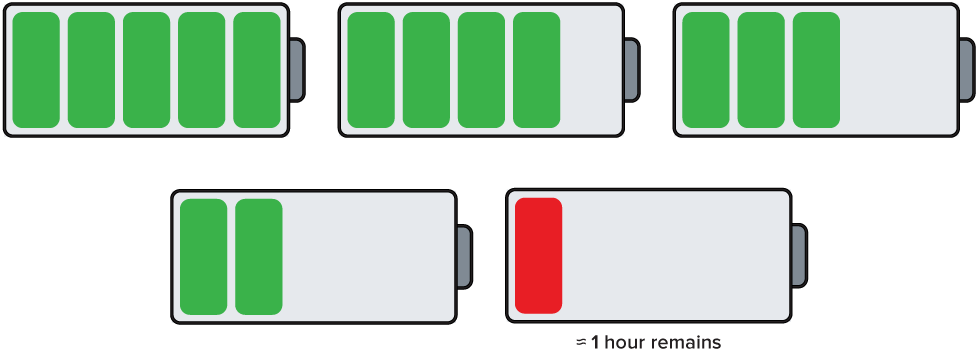
Five phone battery icons are lined up in order. The first is full at 5 bars out of 5, and each one after it has one fewer bar. The last icon has 1 bar left, and the caption says about 1 hour remains.Cinco íconos de batería de teléfono están alineados en orden. El primero está lleno con 5 barras de 5, y cada uno después tiene una barra menos. El último ícono tiene 1 barra, y el pie de foto dice que queda como 1 hora.
4Step 4 of 9:Paso 4 de 9:Watch meMírame
Watch me
The claw machine costs 60 tickets, and it is 25% off. I need 25% of 60.La máquina de garra cuesta 60 boletos, y tiene 25% de descuento. Necesito el 25% de 60.
Step 1 — find the base (the whole): the number after “of” is 60.Paso 1 — halla la base (el entero): el número después de «de» es 60.
Step 2 — the percent as a decimal: 25% means 25 out of 100, so 25 ÷ 100 = 0.25.Paso 2 — el porcentaje como decimal: 25% significa 25 de cada 100, así que 25 ÷ 100 = 0.25.
The discount is 15 tickets. Check: 15 is about a quarter of 60, so that makes sense.El descuento es de 15 boletos. Comprueba: 15 es como la cuarta parte de 60, así que tiene sentido.
5Step 5 of 9:Paso 5 de 9:Let’s do one togetherHagamos uno juntos
Before each step, say what you think comes next. Then show it.Antes de cada paso, di qué crees que sigue. Luego muéstralo.
Let's try together
Find 40% of 80. Step 1 — what is the base? (80, the number after “of”)Halla el 40% de 80. Paso 1 — ¿cuál es la base? (80, el número después de «de»)
Step 2 — 40% as a decimal? (40 ÷ 100 = 0.40)Paso 2 — ¿40% como decimal? (40 ÷ 100 = 0.40)
Does 32 make sense? 40% is a little less than half, and half of 80 is 40. ✓¿Tiene sentido 32? El 40% es un poco menos de la mitad, y la mitad de 80 es 40. ✓
6Step 6 of 9:Paso 6 de 9:Your turnTu turno
Now it's your turn
For each row: circle the base (the number after “of”), write the percent as a decimal, then multiply.En cada fila: encierra la base (el número después de «de»), escribe el porcentaje como decimal y luego multiplica.
That answer is the discount — how many tickets you save.Esa respuesta es el descuento — cuántos boletos te ahorras.
7Step 7 of 9:Paso 7 de 9:Check yourself: a first questionCompruébalo: una primera pregunta
8Step 8 of 9:Paso 8 de 9:Check yourself: a harder questionCompruébalo: una pregunta más difícil
9Step 9 of 9:Paso 9 de 9:Put it togetherJúntalo todo
Watch out for a common mistakeCuidado con un error común
A common mistake in Find the Percent of a Number is multiplying by the percent number itself instead of its decimal form — for example, finding 30% of 80 by computing 30 × 80 = 2,400 instead of 0.30 × 80 = 24. Always divide the percent by 100 to get the decimal, then multiply that decimal by the base.
Sentence frameMarco de oración
To find ___% of ___, I first convert the percent to ___, then I multiply ___ × ___ = ___.Para hallar el ___% de ___, primero convierto el porcentaje a ___, y luego multiplico ___ × ___ = ___.
Stage 3 of 5Etapa 3 de 5
PracticePractica
Choose Regular or Challenge. Hints come one step at a time; you get a new question after a worked example.Elige Regular o Reto. Las pistas llegan paso a paso; después de un ejemplo resuelto recibes una pregunta nueva.
Loading practice…
Stage 4 of 5Etapa 4 de 5
ApplyAplica
Use the idea in a real situation. Write your reasoning, then compare it with a sample.Usa la idea en una situación real. Escribe tu razonamiento y compáralo con un ejemplo.
Apply in context: Dinner billAplica en contexto: Cuenta de la cena
A dinner bill is $48. The group adds a 20% tip. The 4 friends split the bill and the tip equally. How much does each friend pay?La cuenta de una cena es $48. El grupo agrega 20% de propina. Los 4 amigos se dividen la cuenta y la propina en partes iguales. ¿Cuánto paga cada amigo?
Step 1 · Guide mePaso 1 · Guíame
How many dollars is the 20% tip on the $48 bill?¿Cuántos dólares es la propina de 20% sobre la cuenta de $48?
dollarsdólares
Step 2 · Final answerPaso 2 · Respuesta final
dollarsdólares
Real-world connectionConexión con el mundo real
The arcade is donating 12% of Saturday's ticket sales to charity. They sold 1,500 tickets on Saturday. The manager says they will donate 180 tickets. A student says it should be 18 tickets.El arcade va a donar el 12% de las ventas de boletos del sábado a una organización benéfica. Vendieron 1,500 boletos el sábado. El gerente dice que van a donar 180 boletos. Un estudiante dice que deberían ser 18 boletos.
12% of 1,500 Tickets Donated12% de 1,500 boletos donados
Each bar is a percent of the 1,500 tickets; 10% is 150, so 12% must be a bit more — 180 tickets, not 18.Cada barra es un porcentaje de los 1,500 boletos; el 10% son 150, así que el 12% debe ser un poco más — 180 boletos, no 18.
Question:Pregunta:Who is correct, and how do you know?¿Quién tiene razón y cómo lo sabes?
The is correct because 12% of 1,500 = × 1,500 = . The mistake was .El tiene razón porque el 12% de 1,500 = × 1,500 = . El error fue .
Reasoning challengeReto de razonamiento
A class has 32 students. 25% join the math club and 50% join the reading club. How many students are in each club? How many more are in reading?Un grupo tiene 32 estudiantes. El 25 % participa en el club de matemáticas y el 50 % en el club de lectura. ¿Cuántos estudiantes hay en cada club? ¿Cuántos más hay en lectura?
Math club: ___ because ___. Reading club: ___. There are ___ more in reading because ___.
Create & verify: Find and Compare with PercentagesCrea y verifica
Write a problem finding the percent of a number (including a percent under 10% or over 100%). Solve it by multiplying the decimal or fraction form by the whole.Escribe un problema para hallar el porcentaje de un número (puede ser menor a 10% o mayor a 100%). Resuélvelo multiplicando la forma decimal o fraccionaria por el total.
Quick test bench (try numbers or expressions)Banco de prueba rápido (prueba números o expresiones)
Stage 5 of 5Etapa 5 de 5
ReflectReflexiona
Answer on your own. Your first try counts as independent evidence; you can still revise.Responde por tu cuenta. Tu primer intento cuenta como evidencia independiente; todavía puedes revisar.