Background knowledgeConocimientos previos2 skills you need for today: Area of a rectangle: length × width · Find the height: straight up, not slantedLas 2 destrezas que necesitas hoy: Área de un rectángulo: largo × ancho · Hallar la altura: recta, no inclinada
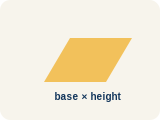
Area of ParallelogramsÁrea de paralelogramos:The space inside a parallelogram. Formula: A = b × h, using the perpendicular height.El espacio dentro de un paralelogramo. Fórmula: A = b × h, usando la altura perpendicular.
Read the words below.Lee las palabras de abajo.
Open the model and change one number at a time.Abre el modelo y cambia un número a la vez.
Answer the questions beside the model, one at a time.Responde las preguntas junto al modelo, una a la vez.
Words to knowPalabras clave
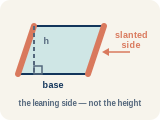
Slanted sideLado inclinado
A side that leans instead of going straight up and down. It is not the perpendicular height.Un lado que está inclinado en vez de subir y bajar verticalmente. No es la altura perpendicular.
In a leaning parallelogram, use the dashed 90° height—not the slanted side—in A = b × h.
ParallelogramParalelogramo
A four-sided shape with two pairs of parallel sides.Una figura de cuatro lados con dos pares de lados paralelos.
Think of a leaning door — the top and bottom are parallel, and the two sides are parallel, like a slanted rectangle
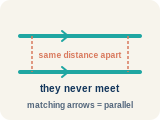
ParallelParalelas
Two lines or sides that stay the same distance apart and never meet.Dos líneas o lados que se mantienen a la misma distancia y nunca se cruzan.
The top and bottom of a parallelogram never get closer together — matching arrowheads (›) mark one parallel pair, double arrowheads (››) mark the other.
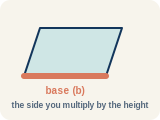
Base
Any side of a parallelogram can be the base. Once you pick a base, the height must be measured perpendicular (at a 90° angle) to it.Cualquier lado de un paralelogramo puede ser la base. Una vez que eliges la base, la altura debe medirse perpendicular (en un ángulo de 90°) a ella.
Any side can be the base: choose the 10 cm side and b = 10 cm, then draw the height at 90° to that side in A = b × h
Loading the model…
1. Try this1. Prueba esto
The lesson's parallelogram has base 14 and height 9. Predict its area before you build it (the model's base goes to 12).
Change only the horizontal shift. Does the area change? Why not?
Which length does the formula use: the slanted side or the dashed height?
Find two different parallelograms with an area of 48 square units.
3. Check yourself3. Compruébalo
Answer a question about your model, then one new problem without it.Responde una pregunta sobre tu modelo y luego un problema nuevo sin él.
Stage 2 of 5Etapa 2 de 5
UnderstandComprende
Read the idea, follow the worked examples, and connect the picture to the numbers.Lee la idea, sigue los ejemplos resueltos y conecta el dibujo con los números.
1Step 1 of 9:Paso 1 de 9:Words to knowPalabras clave
Say what each word means, then tap the card to check.Di qué significa cada palabra y luego toca la tarjeta para comprobar.
2Step 2 of 9:Paso 2 de 9:Check the wordsComprueba las palabras
3Step 3 of 9:Paso 3 de 9:How do we find the area of a parallelogram?¿Cómo hallamos el área de un paralelogramo?
A parallelogram is a four-sided shape with two pairs of parallel sides, like a leaning rectangle. Its area is how much flat space is inside it.Un paralelogramo es una figura de cuatro lados con dos pares de lados paralelos, como un rectángulo inclinado. Su área es cuánto espacio plano hay adentro.
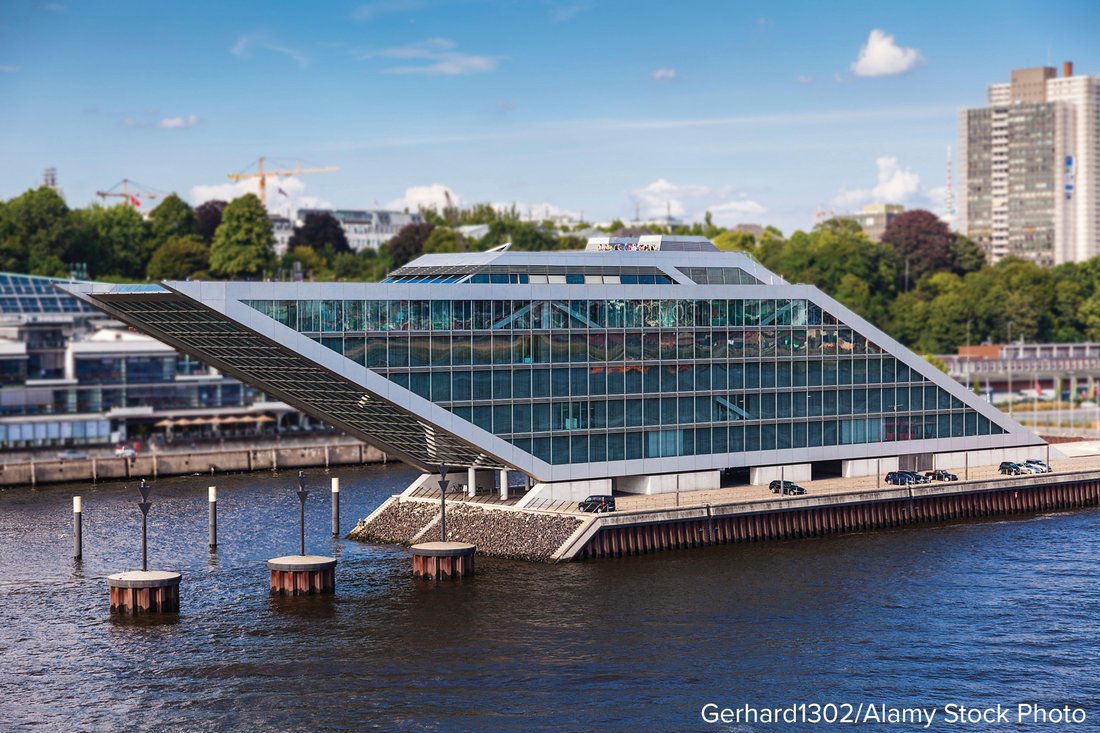
The Dockland building in Hamburg, Germany, is built in the shape of a parallelogram leaning over the water.El edificio Dockland de Hamburgo, Alemania, está construido en forma de paralelogramo inclinado sobre el agua.
4Step 4 of 9:Paso 4 de 9:Watch meMírame
Watch me
I have a parallelogram with a base of 14 feet and a height of 9 feet.Tengo un paralelogramo con base de 14 pies y altura de 9 pies.
I write the formula: A = base × height.Escribo la fórmula: A = base × altura.
I put in the numbers: A = 14 × 9.Sustituyo los números: A = 14 × 9.
So the area is 126 square feet. I used the height of 9, not the slanted side.Entonces el área es 126 pies cuadrados. Usé la altura de 9, no el lado inclinado.
5Step 5 of 9:Paso 5 de 9:Let’s do one togetherHagamos uno juntos
Before each step, say what you think comes next. Then show it.Antes de cada paso, di qué crees que sigue. Luego muéstralo.
Let's try together
Now a smaller parallelogram: base = 5 cm, height = 4 cm.Ahora un paralelogramo más pequeño: base = 5 cm, altura = 4 cm.
What is the formula? A = base × height.¿Cuál es la fórmula? A = base × altura.
What do we put in? A = 5 × 4.¿Qué sustituimos? A = 5 × 4.
What is 5 × 4? Yes, 20, so the area is 20 square centimeters.¿Cuánto es 5 × 4? Sí, 20, así que el área es 20 centímetros cuadrados.
6Step 6 of 9:Paso 6 de 9:Your turnTu turno
Now it's your turn
Next you will plot the patio on a grid and find its area yourself.Luego vas a marcar el patio en una cuadrícula y hallar su área por tu cuenta.
Remember: multiply the base by the height, and always use the perpendicular height.Recuerda: multiplica la base por la altura, y usa siempre la altura perpendicular.
7Step 7 of 9:Paso 7 de 9:Check yourself: a first questionCompruébalo: una primera pregunta
8Step 8 of 9:Paso 8 de 9:Check yourself: a harder questionCompruébalo: una pregunta más difícil
9Step 9 of 9:Paso 9 de 9:Put it togetherJúntalo todo
Watch out for a common mistakeCuidado con un error común
The most common mistake in Area of Parallelograms is multiplying the base by the slanted side instead of the perpendicular height. For a parallelogram with a base of 16 ft, a perpendicular height of 9 ft, and a slanted side of 11 ft, students compute 16 × 11 = 176 square feet instead of the correct 16 × 9 = 144 square feet. The height must be the straight-up (perpendicular) distance between the base and its opposite side, not the length of the slanted side, even though the slanted side is often the number that 'looks' like it belongs in the formula.
Sentence frameMarco de oración
The area of the parallelogram equals base x height = ___ x ___ = ___ square feet, which is the same as a ___ with the same base and height.El área del paralelogramo es igual a base x altura = ___ x ___ = ___ pies cuadrados, que es lo mismo que un ___ con la misma base y altura.
Stage 3 of 5Etapa 3 de 5
PracticePractica
Choose Regular or Challenge. Hints come one step at a time; you get a new question after a worked example.Elige Regular o Reto. Las pistas llegan paso a paso; después de un ejemplo resuelto recibes una pregunta nueva.
Loading practice…
Stage 4 of 5Etapa 4 de 5
ApplyAplica
Use the idea in a real situation. Write your reasoning, then compare it with a sample.Usa la idea en una situación real. Escribe tu razonamiento y compáralo con un ejemplo.
Apply in context: Band bannerAplica en contexto: Pancarta de la banda
A band makes a parallelogram-shaped banner with a base of 9 feet and a height of 4 feet. Fabric costs $2 for each square foot. How much does the fabric for the banner cost?Una banda hace una pancarta con forma de paralelogramo, con una base de 9 pies y una altura de 4 pies. La tela cuesta $2 por cada pie cuadrado. ¿Cuánto cuesta la tela de la pancarta?
Step 1 · Guide mePaso 1 · Guíame
What is the area of the banner?¿Cuál es el área de la pancarta?
square feetpies cuadrados
Step 2 · Final answerPaso 2 · Respuesta final
dollarsdólares
Real-world connectionConexión con el mundo real
A landscape architect is tiling a parallelogram-shaped courtyard. The courtyard has a base of 18 feet and a height of 10 feet. Each tile covers 2 square feet.Una arquitecta paisajista está poniendo azulejos en un patio con forma de paralelogramo. El patio tiene una base de 18 pies y una altura de 10 pies. Cada azulejo cubre 2 pies cuadrados.
Courtyard on the GridEl patio en la cuadrícula
The base runs 18 ft from A to B and the perpendicular height rises 10 ft, so area = 18 x 10 = 180 sq ft, then 180 / 2 = 90 tiles.La base va 18 pies de A a B y la altura perpendicular sube 10 pies, así que el área = 18 x 10 = 180 pies cuadrados, y luego 180 / 2 = 90 azulejos.
Question:Pregunta:How many tiles does the architect need?¿Cuántos azulejos necesita el arquitecto?
The courtyard's area is sq ft because A = x . She needs tiles because / 2 = .El área del patio es pies cuadrados porque A = x . Ella necesita azulejos porque / 2 = .
Reasoning challengeReto de razonamiento
A parallelogram has a base of 12 cm. If you double the height, the area doubles too. Explain why this happens using the formula, and give a specific example with numbers.Un paralelogramo tiene una base de 12 cm. Si duplicas la altura, el área también se duplica. Explica por qué pasa esto usando la fórmula y da un ejemplo específico con números.
When the height doubles from ___ to ___, the area changes from ___ to ___ because in the formula A = b × h, the base stays at ___ and ___.
Create & verify: Determine the Area of Parallelograms and RhombusesCrea y verifica
Design a parallelogram-shaped patio or banner. Give its base, slanted side, and perpendicular height, then find its area and explain why the slanted side is NOT used in A = bh.Diseña un patio o cartel en forma de paralelogramo. Da su base, lado inclinado y altura perpendicular, halla su área y explica por qué el lado inclinado NO se usa en A = bh.
Quick test bench (try numbers or expressions)Banco de prueba rápido (prueba números o expresiones)
Stage 5 of 5Etapa 5 de 5
ReflectReflexiona
Answer on your own. Your first try counts as independent evidence; you can still revise.Responde por tu cuenta. Tu primer intento cuenta como evidencia independiente; todavía puedes revisar.