Background knowledgeConocimientos previos2 skills you need for today: Do the parentheses first · Area of a triangle: half of base × heightLas 2 destrezas que necesitas hoy: Resolver primero los paréntesis · Área de un triángulo: la mitad de base × altura
Area of TrapezoidsÁrea de trapecios:The space inside a trapezoid. Formula: A = 1/2(b₁ + b₂)h.El espacio dentro de un trapecio. Fórmula: A = 1/2(b₁ + b₂)h.
Read the words below.Lee las palabras de abajo.
Open the model and change one number at a time.Abre el modelo y cambia un número a la vez.
Answer the questions beside the model, one at a time.Responde las preguntas junto al modelo, una a la vez.
Words to knowPalabras clave
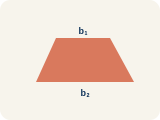
TrapezoidTrapecio
A four-sided shape with just one pair of parallel sides.Una figura de cuatro lados con solo un par de lados paralelos.
A table top wider than the bottom shelf — the top and bottom edges are parallel, the two sides slant inward
ParallelParalelas
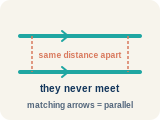
Two lines or sides that stay the same distance apart and never meet.Dos líneas o lados que se mantienen a la misma distancia y nunca se cruzan.
The top and bottom of a parallelogram never get closer together — matching arrowheads (›) mark one parallel pair, double arrowheads (››) mark the other.
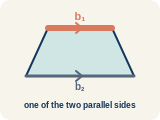
Base 1 (b1)
One of the two parallel sides of a trapezoid.Uno de los dos lados paralelos de un trapecio.
If the bottom of the trapezoid is 10 ft, then b₁ = 10 ft in the formula A = ½(b₁ + b₂) × h
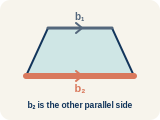
Base 2 (b2)
The other parallel side of a trapezoid.El otro lado paralelo de un trapecio.
If the top of the trapezoid is 6 ft, then b₂ = 6 ft; both bases are parallel to each other
Loading the model…
1. Try this1. Prueba esto
Interpret the two parallel bases and the perpendicular height.
Compare the trapezoid to a rectangle with the average base length.
Split a composite floor plan into familiar shapes and explain how the areas combine.
3. Check yourself3. Compruébalo
Answer a question about your model, then one new problem without it.Responde una pregunta sobre tu modelo y luego un problema nuevo sin él.
Read the idea, follow the worked examples, and connect the picture to the numbers.Lee la idea, sigue los ejemplos resueltos y conecta el dibujo con los números.
1Step 1 of 9:Paso 1 de 9:Words to knowPalabras clave
Say what each word means, then tap the card to check.Di qué significa cada palabra y luego toca la tarjeta para comprobar.
2Step 2 of 9:Paso 2 de 9:Check the wordsComprueba las palabras
3Step 3 of 9:Paso 3 de 9:How do we find the area of a trapezoid?¿Cómo hallamos el área de un trapecio?
A trapezoid is a four-sided shape with one pair of parallel sides. The two parallel sides are called the bases, and they have different lengths.Un trapecio es una figura de cuatro lados con un par de lados paralelos. Los dos lados paralelos se llaman bases y tienen longitudes distintas.
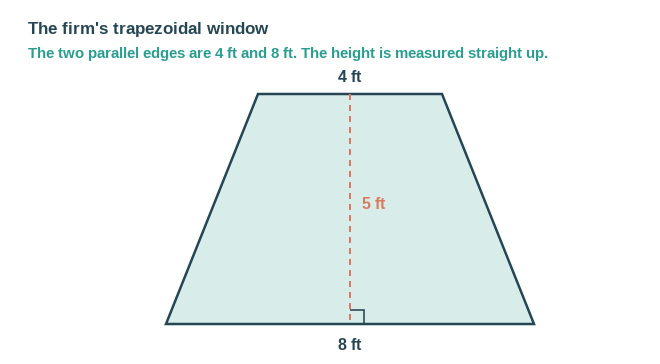
The architecture firm's trapezoidal window has a top edge of 4 feet, a bottom edge of 8 feet, and a height of 5 feet.La ventana en forma de trapecio de la firma de arquitectura tiene un borde de arriba de 4 pies, un borde de abajo de 8 pies y una altura de 5 pies.
4Step 4 of 9:Paso 4 de 9:Watch meMírame
Watch me
My trapezoid window has a top base of 4 feet, a bottom base of 8 feet, and a height of 5 feet.Mi ventana trapezoidal tiene una base superior de 4 pies, una base inferior de 8 pies y una altura de 5 pies.
I write the formula: A = ½ × (b1 + b2) × h.Escribo la fórmula: A = ½ × (b1 + b2) × h.
I add the bases first: 4 + 8 = 12.Sumo primero las bases: 4 + 8 = 12.
I multiply by the height: 12 × 5 = 60.Multiplico por la altura: 12 × 5 = 60.
I take half: ½ × 60 = 30. So the area is 30 square feet.Tomo la mitad: ½ × 60 = 30. Entonces el área es 30 pies cuadrados.
5Step 5 of 9:Paso 5 de 9:Let’s do one togetherHagamos uno juntos
Before each step, say what you think comes next. Then show it.Antes de cada paso, di qué crees que sigue. Luego muéstralo.
Let's try together
Now a smaller trapezoid: bases 3 cm and 5 cm, height 2 cm.Ahora un trapecio más pequeño: bases de 3 cm y 5 cm, altura de 2 cm.
First, what is 3 + 5? Yes, 8.Primero, ¿cuánto es 3 + 5? Sí, 8.
Next, what is 8 × 2? Yes, 16.Luego, ¿cuánto es 8 × 2? Sí, 16.
Now take half: ½ × 16 = 8, so the area is 8 square centimeters.Ahora toma la mitad: ½ × 16 = 8, así que el área es 8 centímetros cuadrados.
6Step 6 of 9:Paso 6 de 9:Your turnTu turno
Now it's your turn
Next you will plot the window on a grid and find its area using the formula.Luego vas a marcar la ventana en una cuadrícula y hallar su área con la fórmula.
Remember the order: add the bases, multiply by the height, then take half.Recuerda el orden: suma las bases, multiplica por la altura y luego toma la mitad.
7Step 7 of 9:Paso 7 de 9:Check yourself: a first questionCompruébalo: una primera pregunta
8Step 8 of 9:Paso 8 de 9:Check yourself: a harder questionCompruébalo: una pregunta más difícil
9Step 9 of 9:Paso 9 de 9:Put it togetherJúntalo todo
Watch out for a common mistakeCuidado con un error común
A common mistake in Area of Trapezoids is forgetting the ½ in A = ½ × (b1 + b2) × h. After adding the bases and multiplying by the height, students stop there instead of taking half — for example, with bases 6 ft and 10 ft and a height of 4 ft, they compute (6 + 10) × 4 = 64 sq ft instead of taking half to get the correct 32 sq ft. That unhalved number is really the area of the parallelogram made from two trapezoids, not the area of one trapezoid. Before you submit, always ask: "Did I take half of my last answer?"
Sentence frameMarco de oración
The area of the trapezoid is 1/2 x (___ + ___) x ___ = 1/2 x ___ x ___ = ___ square feet.El área del trapecio es 1/2 x (___ + ___) x ___ = 1/2 x ___ x ___ = ___ pies cuadrados.
Stage 3 of 5Etapa 3 de 5
PracticePractica
Choose Regular or Challenge. Hints come one step at a time; you get a new question after a worked example.Elige Regular o Reto. Las pistas llegan paso a paso; después de un ejemplo resuelto recibes una pregunta nueva.
Loading practice…
Stage 4 of 5Etapa 4 de 5
ApplyAplica
Use the idea in a real situation. Write your reasoning, then compare it with a sample.Usa la idea en una situación real. Escribe tu razonamiento y compáralo con un ejemplo.
Apply in context: Tiled patioAplica en contexto: Patio con baldosas
A patio is a trapezoid with parallel sides of 14 feet and 10 feet. The height of the patio is 6 feet. Tile costs $4 for each square foot. How much will it cost to tile the whole patio?Un patio es un trapecio con lados paralelos de 14 pies y 10 pies. La altura del patio es de 6 pies. Las baldosas cuestan $4 por cada pie cuadrado. ¿Cuánto costará cubrir todo el patio con baldosas?
Step 1 · Guide mePaso 1 · Guíame
What is the sum of the two parallel sides?¿Cuál es la suma de los dos lados paralelos?
feetpies
Step 2 · Final answerPaso 2 · Respuesta final
dollarsdólares
Real-world connectionConexión con el mundo real
A builder is pouring concrete for a trapezoidal driveway. The driveway has parallel edges of 20 feet and 12 feet with a height of 15 feet. One bag of concrete covers 6 square feet.Un constructor está vaciando concreto para una entrada de auto en forma de trapecio. La entrada tiene bordes paralelos de 20 pies y 12 pies con una altura de 15 pies. Una bolsa de concreto cubre 6 pies cuadrados.
Trapezoidal Driveway FootprintHuella de la entrada de auto en forma de trapecio
Plot the driveway's corners: the bottom edge is 20 ft, the top edge is 12 ft, and the height between them is 15 ft, so area = 1/2 x (20 + 12) x 15 = 240 sq ft.Marca las esquinas de la entrada: el borde de abajo mide 20 pies, el de arriba 12 pies, y la altura entre ellos 15 pies, así que el área = 1/2 x (20 + 12) x 15 = 240 pies cuadrados.
Question:Pregunta:How many bags of concrete does the builder need?¿Cuántas bolsas de concreto necesita el constructor?
The driveway's area is sq ft because A = 1/2 x ( + ) x . He needs bags because / 6 = .El área de la entrada es pies cuadrados porque A = 1/2 x ( + ) x . Él necesita bolsas porque / 6 = .
Reasoning challengeReto de razonamiento
A trapezoid and a parallelogram both have a height of 8 ft. The trapezoid has bases of 5 ft and 11 ft. The parallelogram has a base of 7 ft. Which shape has the greater area? Explain your reasoning using the formulas.Un trapecio y un paralelogramo tienen los dos una altura de 8 pies. El trapecio tiene bases de 5 pies y 11 pies. El paralelogramo tiene una base de 7 pies. ¿Cuál figura tiene mayor área? Explica tu razonamiento usando las fórmulas.
The trapezoid's area is ___ because ½ × (___ + ___) × ___ = ___. The parallelogram's area is ___ because ___ × ___ = ___. The ___ has a greater area by ___ sq ft.
Create & verify: Determine the Area of TrapezoidsCrea y verifica
Design a trapezoid garden bed with two parallel bases and a perpendicular height. Find its area using A = ½(b₁ + b₂)h and check it by splitting into a rectangle and triangles.Diseña un jardín en forma de trapecio con dos bases paralelas y una altura perpendicular. Halla su área con A = ½(b₁ + b₂)h y compruébala dividiéndolo en rectángulo y triángulos.
Quick test bench (try numbers or expressions)Banco de prueba rápido (prueba números o expresiones)
Stage 5 of 5Etapa 5 de 5
ReflectReflexiona
Answer on your own. Your first try counts as independent evidence; you can still revise.Responde por tu cuenta. Tu primer intento cuenta como evidencia independiente; todavía puedes revisar.