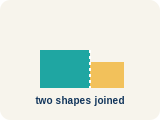
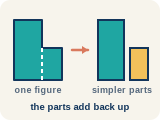
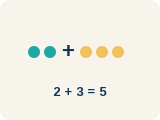
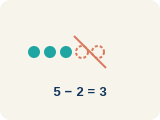
I can find the area of a composite figure by decomposing it into basic shapes, including a regular polygon split into triangles, and adding or subtracting the areas.
Your work saves on this device.Tu trabajo se guarda en este dispositivo.
Background knowledgeConocimientos previos2 skills you need for today: Find a missing side length · Add or subtract areasLas 2 destrezas que necesitas hoy: Hallar la longitud de un lado que falta · Sumar o restar áreas
Area of Composite FiguresÁrea de figuras compuestas:The total space inside a figure made of basic shapes. Formula: A = A₁ + A₂ — add the parts (or subtract a missing piece).El espacio total dentro de una figura formada por figuras básicas. Fórmula: A = A₁ + A₂ — suma las partes (o resta la pieza que falta).
Read the words below.Lee las palabras de abajo.
Open the model and change one number at a time.Abre el modelo y cambia un número a la vez.
Answer the questions beside the model, one at a time.Responde las preguntas junto al modelo, una a la vez.
Words to knowPalabras clave
Composite FigureFigura compuesta
A shape made by putting two or more simple shapes together.Una figura formada al juntar dos o más figuras simples.
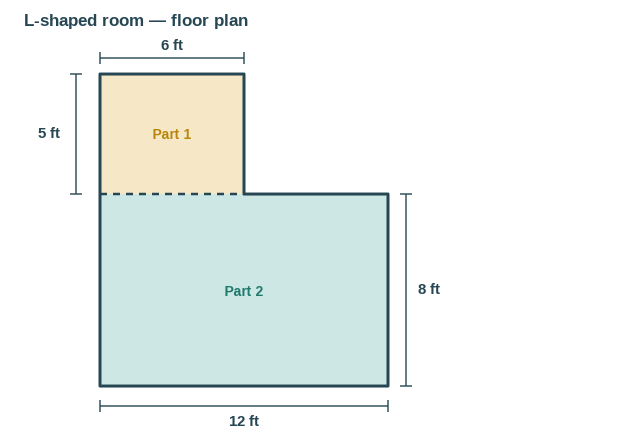
An L-shaped room = a 12×8 rectangle joined to a 6×5 rectangle; total area = 96 + 30 = 126 sq ft
DecomposeDescomponer
To break a shape into smaller, simpler shapes.Separar una figura en figuras más pequeñas y simples.
Draw a dashed line across the L-shape to split it into two rectangles — now you can find each area separately
AddSumar
Add up the areas of the smaller shapes to get the total.Sumar las áreas de las figuras pequeñas para obtener el total.
T-shaped hallway: top rectangle = 30 sq ft, bottom rectangle = 28 sq ft → total = 30 + 28 = 58 sq ft
SubtractRestar
Take away the area of a missing piece from a bigger shape.Quitar el área de una parte que falta de una figura más grande.
A 14×10 pool with a 6×4 cutout: 140 − 24 = 116 sq ft of water surface
Loading the model…
1. Try this1. Prueba esto
Predict the area of the room before you use either method.
Split the room into two rectangles. Which lengths did you need?
Switch to “whole minus the missing corner.” Do you get the same area?
Make the missing corner bigger. Which method is quicker now, and why?
3. Check yourself3. Compruébalo
Answer a question about your model, then one new problem without it.Responde una pregunta sobre tu modelo y luego un problema nuevo sin él.
Stage 2 of 5Etapa 2 de 5
UnderstandComprende
Read the idea, follow the worked examples, and connect the picture to the numbers.Lee la idea, sigue los ejemplos resueltos y conecta el dibujo con los números.
1Step 1 of 9:Paso 1 de 9:Words to knowPalabras clave
Say what each word means, then tap the card to check.Di qué significa cada palabra y luego toca la tarjeta para comprobar.
2Step 2 of 9:Paso 2 de 9:Check the wordsComprueba las palabras
3Step 3 of 9:Paso 3 de 9:How do we find the area of a composite figure?¿Cómo hallamos el área de una figura compuesta?
A composite figure is a shape made of two or more simple shapes joined together. We decompose it into basic shapes, find each area, then add or subtract.Una figura compuesta es una figura formada por dos o más figuras simples unidas. La descomponemos en figuras básicas, hallamos cada área y luego sumamos o restamos.
This is an L-shaped room from a floor plan. A dashed line splits it into two rectangles, and each part is labeled with its length and width.Este es un cuarto en forma de L de un plano. Una línea punteada lo parte en dos rectángulos, y cada parte está rotulada con su largo y su ancho.
4Step 4 of 9:Paso 4 de 9:Watch meMírame
Watch me
My L-shaped room splits into two rectangles: one is 12 ft by 8 ft, the other is 6 ft by 5 ft.Mi cuarto en forma de L se divide en dos rectángulos: uno de 12 pies por 8 pies, el otro de 6 pies por 5 pies.
First rectangle: A = length × width = 12 × 8 = 96 square feet.Primer rectángulo: A = largo × ancho = 12 × 8 = 96 pies cuadrados.
Second rectangle: A = 6 × 5 = 30 square feet.Segundo rectángulo: A = 6 × 5 = 30 pies cuadrados.
The pieces are joined, so I add: 96 + 30 = 126.Las partes están unidas, así que sumo: 96 + 30 = 126.
So the total area is 126 square feet.Entonces el área total es 126 pies cuadrados.
A regular polygon splits the same way: a stop sign is a regular octagon, so I cut it into 8 congruent triangles that meet at the centre.Un polígono regular se divide igual: una señal de alto es un octágono regular, así que la corto en 8 triángulos congruentes que se unen en el centro.
One triangle has a base of 14 9/10 inches and a height of 18 inches, so A = 1/2 × 14.9 × 18 = 134.1 square inches.Un triángulo tiene una base de 14 9/10 pulgadas y una altura de 18 pulgadas, así que A = 1/2 × 14.9 × 18 = 134.1 pulgadas cuadradas.
There are 8 congruent triangles, so I multiply instead of adding eight times: 134.1 × 8 = 1,072.8 square inches.Hay 8 triángulos congruentes, así que multiplico en vez de sumar ocho veces: 134.1 × 8 = 1,072.8 pulgadas cuadradas.
5Step 5 of 9:Paso 5 de 9:Let’s do one togetherHagamos uno juntos
Before each step, say what you think comes next. Then show it.Antes de cada paso, di qué crees que sigue. Luego muéstralo.
Let's try together
Now an L-shape made of a 5 ft by 4 ft rectangle and a 3 ft by 2 ft rectangle.Ahora una figura en L formada por un rectángulo de 5 pies por 4 pies y otro de 3 pies por 2 pies.
Are they joined or cut out? Joined, so we add: 20 + 6 = 26 square feet.¿Están unidos o recortados? Unidos, así que sumamos: 20 + 6 = 26 pies cuadrados.
6Step 6 of 9:Paso 6 de 9:Your turnTu turno
Now it's your turn
Next you will find areas for an L-shape, a T-shape, and a U-shaped pool with a cutout.Luego vas a hallar áreas de una figura en L, una en T y una alberca en U con un recorte.
Remember: add joined pieces, but subtract a piece that is cut out.Recuerda: suma las partes unidas, pero resta la parte que está recortada.
7Step 7 of 9:Paso 7 de 9:Check yourself: a first questionCompruébalo: una primera pregunta
8Step 8 of 9:Paso 8 de 9:Check yourself: a harder questionCompruébalo: una pregunta más difícil
9Step 9 of 9:Paso 9 de 9:Put it togetherJúntalo todo
Watch out for a common mistakeCuidado con un error común
A common mistake in Area of Composite Figures is adding every piece even when a piece has been cut out of the figure. For a 10 ft by 8 ft rectangle with a 3 ft by 2 ft rectangular notch cut from one corner, students compute the full rectangle 10 × 8 = 80 sq ft and stop, or they add the notch instead of removing it (80 + 6 = 86 sq ft) instead of subtracting it: 80 − (3 × 2) = 80 − 6 = 74 sq ft. Before submitting, check whether each piece is part of the figure (add it) or missing from the figure (subtract it).
Sentence frameMarco de oración
I ___ the areas because the composite figure is made by ___ a piece from a larger shape, so the total area is ___ - ___ = ___ square feet.Yo ___ las áreas porque la figura compuesta se hace ___ una pieza de una figura más grande, así que el área total es ___ - ___ = ___ pies cuadrados.
Stage 3 of 5Etapa 3 de 5
PracticePractica
Choose Regular or Challenge. Hints come one step at a time; you get a new question after a worked example.Elige Regular o Reto. Las pistas llegan paso a paso; después de un ejemplo resuelto recibes una pregunta nueva.
Loading practice…
Stage 4 of 5Etapa 4 de 5
ApplyAplica
Use the idea in a real situation. Write your reasoning, then compare it with a sample.Usa la idea en una situación real. Escribe tu razonamiento y compáralo con un ejemplo.
Apply in context: Felt with a corner cut outAplica en contexto: Fieltro con una esquina recortada
A craft club has a 10-foot by 8-foot rectangle of felt. It cuts a 4-foot by 3-foot rectangle out of one corner. What is the area of the felt that is left?Un club de manualidades tiene un rectángulo de fieltro de 10 pies por 8 pies. Recorta un rectángulo de 4 pies por 3 pies de una esquina. ¿Cuál es el área del fieltro que queda?
Step 1 · Guide mePaso 1 · Guíame
What is the area of the whole rectangle of felt?¿Cuál es el área de todo el rectángulo de fieltro?
square feetpies cuadrados
Step 2 · Final answerPaso 2 · Respuesta final
square feetpies cuadrados
Real-world connectionConexión con el mundo real
An architect is ordering carpet for a T-shaped conference room. The top of the T is 14 feet by 4 feet and the stem is 6 feet by 10 feet. Carpet costs $5 per square foot.Un arquitecto está pidiendo alfombra para una sala de juntas en forma de T. La parte de arriba de la T mide 14 pies por 4 pies y el tronco mide 6 pies por 10 pies. La alfombra cuesta $5 por pie cuadrado.
T-Room Areas Add UpLas áreas del cuarto en T se suman
Each bar is one part's area in square feet; the two rectangle parts (56 + 60) add up to the 116 sq ft total.Cada barra es el área de una parte en pies cuadrados; las dos partes rectangulares (56 + 60) suman el total de 116 pies cuadrados.
Question:Pregunta:How much will the carpet cost?¿Cuánto costará la alfombra?
The top area is sq ft and the stem area is sq ft. Total = + = sq ft. Cost = x $5 = $.El área de arriba es pies cuadrados y el área del tronco es pies cuadrados. Total = + = pies cuadrados. Costo = x $5 = $.
Reasoning challengeReto de razonamiento
A T-shaped room can be decomposed in two different ways. Show both ways and prove they give the same total area. Use a T-shape where the top is 14 ft × 4 ft and the stem is 6 ft × 10 ft.Un cuarto en forma de T se puede descomponer de dos maneras diferentes. Muestra las dos maneras y demuestra que dan la misma área total. Usa una forma de T donde la parte de arriba mida 14 pies × 4 pies y el tronco mida 6 pies × 10 pies.
Way 1: I split it into ___ and ___. Areas: ___ + ___ = ___. Way 2: I used a ___ rectangle and subtracted ___. Areas: ___ − ___ = ___. Both give ___ sq ft.
Create & verify: Apply Area Concepts to Solve ProblemsCrea y verifica
Design an L-shaped or house-shaped composite figure with labeled side lengths. Find its total area two ways: by decomposing (adding parts) and by enclosing (subtracting a cutout).Diseña una figura compuesta en forma de L o casa con medidas etiquetadas. Halla su área total de dos maneras: descomponiendo (sumando) y encerrando (restando un hueco).
Quick test bench (try numbers or expressions)Banco de prueba rápido (prueba números o expresiones)
Stage 5 of 5Etapa 5 de 5
ReflectReflexiona
Answer on your own. Your first try counts as independent evidence; you can still revise.Responde por tu cuenta. Tu primer intento cuenta como evidencia independiente; todavía puedes revisar.