Background knowledgeConocimientos previos2 skills you need for today: Multiply three numbers, two at a time · Count unit cubes by layersLas 2 destrezas que necesitas hoy: Multiplicar tres números de dos en dos · Contar cubos unitarios por capas
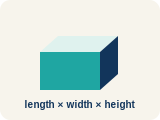
Volume with Whole-Number EdgesVolumen con aristas de números enteros:The number of unit cubes inside a rectangular prism. Formula: V = l × w × h.La cantidad de cubos unitarios dentro de un prisma rectangular. Fórmula: V = l × w × h.
Read the words below.Lee las palabras de abajo.
Open the model and change one number at a time.Abre el modelo y cambia un número a la vez.
Answer the questions beside the model, one at a time.Responde las preguntas junto al modelo, una a la vez.
Words to knowPalabras clave
VolumeVolumen
How much space is inside a solid shape.Cuánto espacio hay dentro de una figura sólida.
A box 3 × 2 × 4 holds 24 unit cubes, so V = 24 cubic units
Rectangular prismPrisma rectangular
A solid box shape with six flat rectangle sides.Una figura sólida en forma de caja con seis lados rectangulares.
A cereal box or shoe box — it has length, width, and height
Cubic unitsUnidades cúbicas
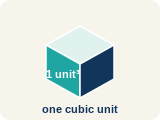
The units used to measure space inside, like cubic inches.Las unidades para medir el espacio interior, como pulgadas cúbicas.
A tiny cube that is 1 in × 1 in × 1 in = 1 in³ (one cubic inch)
Length, width, heightLargo, ancho, altura
How long, how wide, and how tall a box is.Qué tan largo, ancho y alto es una caja.
V = l × w × h: for a box 5 × 3 × 2, volume = 30 cubic units
Loading the model…
1. Try this1. Prueba esto
Count one layer of cubes, then multiply by the number of layers.
Match each pair of faces in the net. Which lengths meet when it folds?
Make two boxes with the same volume but different dimensions.
3. Check yourself3. Compruébalo
Answer a question about your model, then one new problem without it.Responde una pregunta sobre tu modelo y luego un problema nuevo sin él.
Read the idea, follow the worked examples, and connect the picture to the numbers.Lee la idea, sigue los ejemplos resueltos y conecta el dibujo con los números.
1Step 1 of 9:Paso 1 de 9:Words to knowPalabras clave
Say what each word means, then tap the card to check.Di qué significa cada palabra y luego toca la tarjeta para comprobar.
2Step 2 of 9:Paso 2 de 9:Check the wordsComprueba las palabras
3Step 3 of 9:Paso 3 de 9:How do we find the volume of a box?¿Cómo hallamos el volumen de una caja?
Volume is how much space is inside a 3D shape. For a rectangular prism (a box), volume = length × width × height, measured in cubic units.El volumen es cuánto espacio hay dentro de una figura en 3D. Para un prisma rectangular (una caja), volumen = largo × ancho × alto, medido en unidades cúbicas.
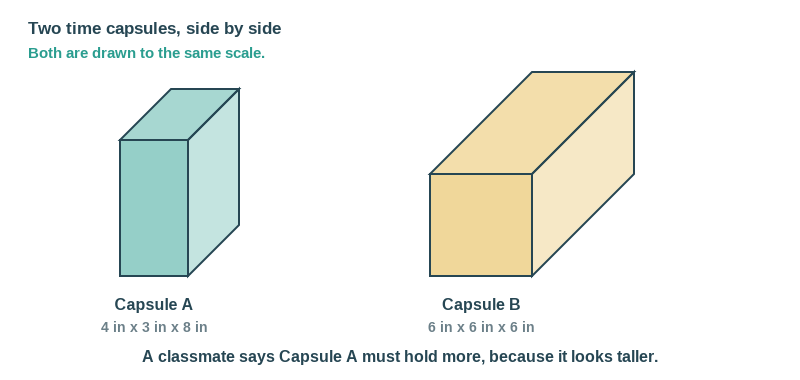
Two time capsule containers sit side by side. Capsule A is 4 in long, 3 in wide, and 8 in tall. Capsule B is 6 in long, 6 in wide, and 6 in tall. A classmate says Capsule A must hold more because it looks taller.Dos recipientes de cápsula del tiempo están uno al lado del otro. La cápsula A mide 4 pulg de largo, 3 pulg de ancho y 8 pulg de alto. La cápsula B mide 6 pulg de largo, 6 pulg de ancho y 6 pulg de alto. Un compañero dice que la cápsula A debe tener más porque se ve más alta.
4Step 4 of 9:Paso 4 de 9:Watch meMírame
Watch me
My time capsule box is 6 long, 4 wide, and 3 tall. I write the formula: V = length × width × height.Mi caja de cápsula del tiempo mide 6 de largo, 4 de ancho y 3 de alto. Escribo la fórmula: V = largo × ancho × alto.
I put in the numbers: V = 6 × 4 × 3.Sustituyo los números: V = 6 × 4 × 3.
First I multiply two of them: 6 × 4 = 24.Primero multiplico dos de ellos: 6 × 4 = 24.
Then I multiply by the last one: 24 × 3 = 72.Luego multiplico por el último: 24 × 3 = 72.
So the volume is 72 cubic units. I use cubic units because volume fills space in 3 directions.Entonces el volumen es 72 unidades cúbicas. Uso unidades cúbicas porque el volumen llena el espacio en 3 direcciones.
5Step 5 of 9:Paso 5 de 9:Let’s do one togetherHagamos uno juntos
Before each step, say what you think comes next. Then show it.Antes de cada paso, di qué crees que sigue. Luego muéstralo.
Let's try together
Now a smaller box: 5 long, 2 wide, 2 tall. What formula do we use?Ahora una caja más pequeña: 5 de largo, 2 de ancho, 2 de alto. ¿Qué fórmula usamos?
Let's put in the numbers: V = 5 × 2 × 2. What is 5 × 2?Sustituyamos los números: V = 5 × 2 × 2. ¿Cuánto es 5 × 2?
We got 10. Now multiply 10 × 2. What is the volume?Nos dio 10. Ahora multiplica 10 × 2. ¿Cuál es el volumen?
Yes, V = 20 cubic units. Don't forget the cubic units!Sí, V = 20 unidades cúbicas. ¡No olvides las unidades cúbicas!
6Step 6 of 9:Paso 6 de 9:Your turnTu turno
Now it's your turn
In the table below, find the volume of each container using V = length × width × height.En la tabla de abajo, halla el volumen de cada recipiente usando V = largo × ancho × alto.
Write your answer in cubic inches (in³).Escribe tu respuesta en pulgadas cúbicas (pulg³).
7Step 7 of 9:Paso 7 de 9:Check yourself: a first questionCompruébalo: una primera pregunta
8Step 8 of 9:Paso 8 de 9:Check yourself: a harder questionCompruébalo: una pregunta más difícil
9Step 9 of 9:Paso 9 de 9:Put it togetherJúntalo todo
Watch out for a common mistakeCuidado con un error común
A common mistake in Volume with Whole Number Edges is multiplying only two of the three edges and stopping there — for example, seeing a box that is 6 in long, 4 in wide, and 3 in tall, multiplying just 6 × 4 = 24, and calling that the volume, when 24 is only the area of the bottom face (in square inches), not the volume of the whole box. The height must also be multiplied in: V = 6 × 4 × 3 = 72 cubic inches. A second common mistake is adding the three edges instead of multiplying them (6 + 4 + 3 = 13 instead of 6 × 4 × 3 = 72 cubic inches). Volume always MULTIPLIES all three edges, and the answer is always labeled in cubic units (in³), never square units (in²) or plain units (in).
Sentence frameMarco de oración
Container C has the largest volume because ___ × ___ × ___ = ___. Compared to Container B, the dimensions ___ produce a ___ volume because ___.El recipiente C tiene el mayor volumen porque ___ × ___ × ___ = ___. Comparado con el recipiente B, las dimensiones ___ producen un volumen ___ porque ___.
Stage 3 of 5Etapa 3 de 5
PracticePractica
Choose Regular or Challenge. Hints come one step at a time; you get a new question after a worked example.Elige Regular o Reto. Las pistas llegan paso a paso; después de un ejemplo resuelto recibes una pregunta nueva.
Loading practice…
Stage 4 of 5Etapa 4 de 5
ApplyAplica
Use the idea in a real situation. Write your reasoning, then compare it with a sample.Usa la idea en una situación real. Escribe tu razonamiento y compáralo con un ejemplo.
Apply in context: Cubes in a craft boxAplica en contexto: Cubos en una caja de manualidades
A craft box is 10 cm long, 6 cm wide, and 5 cm tall. It is filled with 1-centimeter cubes. A student takes out 20 cubes. How many cubes are left in the box?Una caja de manualidades mide 10 cm de largo, 6 cm de ancho y 5 cm de alto. Está llena de cubos de 1 centímetro. Un estudiante saca 20 cubos. ¿Cuántos cubos quedan en la caja?
Step 1 · Guide mePaso 1 · Guíame
How many cubes fit in the bottom layer?¿Cuántos cubos caben en la capa de abajo?
cubescubos
Step 2 · Final answerPaso 2 · Respuesta final
cubescubos
Real-world connectionConexión con el mundo real
A moving company uses rectangular boxes. A large box is 24 inches long, 18 inches wide, and 18 inches tall. A medium box is 18 inches long, 14 inches wide, and 12 inches tall.Una empresa de mudanzas usa cajas rectangulares. Una caja grande mide 24 pulgadas de largo, 18 pulgadas de ancho y 18 pulgadas de alto. Una caja mediana mide 18 pulgadas de largo, 14 pulgadas de ancho y 12 pulgadas de alto.
Comparing Box VolumesComparando volúmenes de cajas
Each bar's height is that box's volume (l×w×h in in³); the gap between the bars shows the large box holds 4752 in³ more.La altura de cada barra es el volumen de esa caja (l×a×h en pulg³); la diferencia entre las barras muestra que la caja grande tiene 4752 pulg³ más.
Question:Pregunta:How many more cubic inches does the large box hold than the medium box?¿Cuántas pulgadas cúbicas más tiene la caja grande que la caja mediana?
The large box volume is in³ because V = × × . The medium box volume is in³. The large box holds more cubic inches.El volumen de la caja grande es pulg³ porque V = × × . El volumen de la caja mediana es pulg³. La caja grande tiene pulgadas cúbicas más.
Reasoning challengeReto de razonamiento
A box needs to hold exactly 60 cubic inches. Give three different sets of whole-number dimensions that work. Which set would make the box closest to a cube shape? Why might that matter?Una caja debe contener exactamente 60 pulgadas cúbicas. Da tres conjuntos distintos de dimensiones con números enteros que funcionen. ¿Cuál conjunto haría la caja más parecida a un cubo? ¿Por qué podría importar eso?
Option 1: ___ × ___ × ___. Option 2: ___ × ___ × ___. Option 3: ___ × ___ × ___. The ___ option is closest to a cube because ___. This matters because ___.
Create & verify: Determine the Volume of Rectangular PrismsCrea y verifica
Design a shipping box (rectangular prism) with at least one fractional edge length (like 4½ in. × 2 in. × 3 in.). Calculate its volume and explain what packing it with ½-inch cubes would look like.Diseña una caja (prisma rectangular) con al menos una arista fraccionaria. Calcula su volumen y explica cómo sería llenarla con cubos unitarios.
Quick test bench (try numbers or expressions)Banco de prueba rápido (prueba números o expresiones)
Stage 5 of 5Etapa 5 de 5
ReflectReflexiona
Answer on your own. Your first try counts as independent evidence; you can still revise.Responde por tu cuenta. Tu primer intento cuenta como evidencia independiente; todavía puedes revisar.