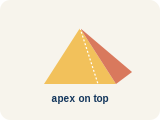
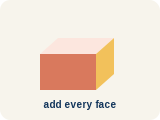
Background knowledgeConocimientos previos2 skills you need for today: Area of a square: side × side · Area of a triangle: half of base × heightLas 2 destrezas que necesitas hoy: Área de un cuadrado: lado × lado · Área de un triángulo: la mitad de base × altura
Surface Area of PyramidsÁrea de superficie de pirámides:The total area of a pyramid's base and triangular faces. Formula: SA = B + lateral area.El área total de la base y las caras triangulares de una pirámide. Fórmula: SA = B + área lateral.
Read the words below.Lee las palabras de abajo.
Open the model and change one number at a time.Abre el modelo y cambia un número a la vez.
Answer the questions beside the model, one at a time.Responde las preguntas junto al modelo, una a la vez.
Words to knowPalabras clave
PyramidPirámide
A solid with a flat bottom and triangle sides that meet at one point on top.Un sólido con un fondo plano y lados triangulares que se unen en un punto arriba.
Like the Great Pyramid of Giza — a square on the bottom, 4 triangles slanting up to a point
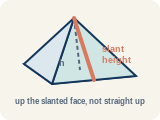
Slant heightAltura inclinada (apotema)
The height of a side triangle, measured along its slanted face.La altura de un triángulo lateral, medida por su cara inclinada.
If you slide your finger from the bottom edge up the triangle face to the top point — that distance is the slant height
Lateral faceCara lateral
A triangle side of a pyramid, not the bottom.Un lado triangular de una pirámide, no el fondo.
A square pyramid has 4 lateral faces — one triangle for each side of the square base
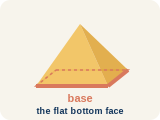
Base
The flat bottom of a pyramid.El fondo plano de una pirámide.
A square pyramid sits on a square base; base area = side × side
Loading the model…
1. Try this1. Prueba esto
Find the areas of the three different face pairs on the prism.
Switch to the square pyramid. Its third control is slant height; find each triangular face.
Explain why volume would not tell you how much wrapping material is needed.
3. Check yourself3. Compruébalo
Answer a question about your model, then one new problem without it.Responde una pregunta sobre tu modelo y luego un problema nuevo sin él.
Read the idea, follow the worked examples, and connect the picture to the numbers.Lee la idea, sigue los ejemplos resueltos y conecta el dibujo con los números.
1Step 1 of 9:Paso 1 de 9:Words to knowPalabras clave
Say what each word means, then tap the card to check.Di qué significa cada palabra y luego toca la tarjeta para comprobar.
2Step 2 of 9:Paso 2 de 9:Check the wordsComprueba las palabras
3Step 3 of 9:Paso 3 de 9:How do we find the surface area of a pyramid?¿Cómo hallamos el área de superficie de una pirámide?
Surface area of a pyramid is the base area plus all the triangular side faces. A square pyramid has 1 square base and 4 triangular faces. Each triangle uses the slant height: ½ × base × slant height.El área de superficie de una pirámide es el área de la base más todas las caras triangulares de los lados. Una pirámide cuadrada tiene 1 base cuadrada y 4 caras triangulares. Cada triángulo usa la altura inclinada: ½ × base × altura inclinada.
The blueprint shows a right square pyramid with the measurements of its base and its slant height labeled.El plano muestra una pirámide recta de base cuadrada con las medidas de su base y de su altura inclinada rotuladas.
4Step 4 of 9:Paso 4 de 9:Watch meMírame
Watch me
My square pyramid has a 6 in. × 6 in. base and a slant height of 8 in.Mi pirámide cuadrada tiene una base de 6 pulg × 6 pulg y una altura inclinada de 8 pulg.
First the base area: 6 × 6 = 36.Primero el área de la base: 6 × 6 = 36.
Now one triangular face: ½ × 6 × 8 = 24. A square pyramid has 4 of them, so 4 × 24 = 96.Ahora una cara triangular: ½ × 6 × 8 = 24. Una pirámide cuadrada tiene 4, así que 4 × 24 = 96.
I add the base and the side faces: 36 + 96 = 132.Sumo la base y las caras laterales: 36 + 96 = 132.
So the total surface area is 132 in². I used the slant height (8) for the triangles, not the pyramid's height.Entonces el área de superficie total es 132 pulg². Usé la altura inclinada (8) para los triángulos, no la altura de la pirámide.
5Step 5 of 9:Paso 5 de 9:Let’s do one togetherHagamos uno juntos
Before each step, say what you think comes next. Then show it.Antes de cada paso, di qué crees que sigue. Luego muéstralo.
Let's try together
Now a smaller square pyramid: base 4 × 4, slant height 5. What is the base area?Ahora una pirámide cuadrada más pequeña: base 4 × 4, altura inclinada 5. ¿Cuál es el área de la base?
Right, 4 × 4 = 16. Now one triangular face: ½ × 4 × 5. What do you get?Correcto, 4 × 4 = 16. Ahora una cara triangular: ½ × 4 × 5. ¿Qué obtienes?
Yes, 10. Four faces is 4 × 10 = 40. Now add the base: 16 + 40. What is the surface area?Sí, 10. Cuatro caras son 4 × 10 = 40. Ahora suma la base: 16 + 40. ¿Cuál es el área de superficie?
Yes, SA = 56 in². Don't forget to add the base area!Sí, 56 pulg². ¡No olvides sumar el área de la base!
6Step 6 of 9:Paso 6 de 9:Your turnTu turno
Now it's your turn
In the table below, find the area of one lateral face, then the total surface area of each pyramid display.En la tabla de abajo, halla el área de una cara lateral y luego el área de superficie total de cada exhibición piramidal.
Remember: total SA = base area + all the triangular faces.Recuerda: área de superficie total = área de la base + todas las caras triangulares.
7Step 7 of 9:Paso 7 de 9:Check yourself: a first questionCompruébalo: una primera pregunta
8Step 8 of 9:Paso 8 de 9:Check yourself: a harder questionCompruébalo: una pregunta más difícil
9Step 9 of 9:Paso 9 de 9:Put it togetherJúntalo todo
Watch out for a common mistakeCuidado con un error común
A common mistake in Surface Area of Pyramids is finding the four triangular lateral faces correctly (½ × base edge × slant height, times 4) and then stopping — forgetting to add the base area at the end. This leaves the total surface area too small by exactly the base's area. Before you submit, ask: 'Did I add the base area to the four lateral faces, or did I stop after the sides?'
Sentence frameMarco de oración
For Display B, the base area is ___ in² and the total lateral area is 4 × ___ = ___ in². The ___ contribute(s) more because ___.Para el exhibidor B, el área de la base es ___ pulg² y el área lateral total es 4 × ___ = ___ pulg². ___ aporta(n) más porque ___.
Stage 3 of 5Etapa 3 de 5
PracticePractica
Choose Regular or Challenge. Hints come one step at a time; you get a new question after a worked example.Elige Regular o Reto. Las pistas llegan paso a paso; después de un ejemplo resuelto recibes una pregunta nueva.
Loading practice…
Stage 4 of 5Etapa 4 de 5
ApplyAplica
Use the idea in a real situation. Write your reasoning, then compare it with a sample.Usa la idea en una situación real. Escribe tu razonamiento y compáralo con un ejemplo.
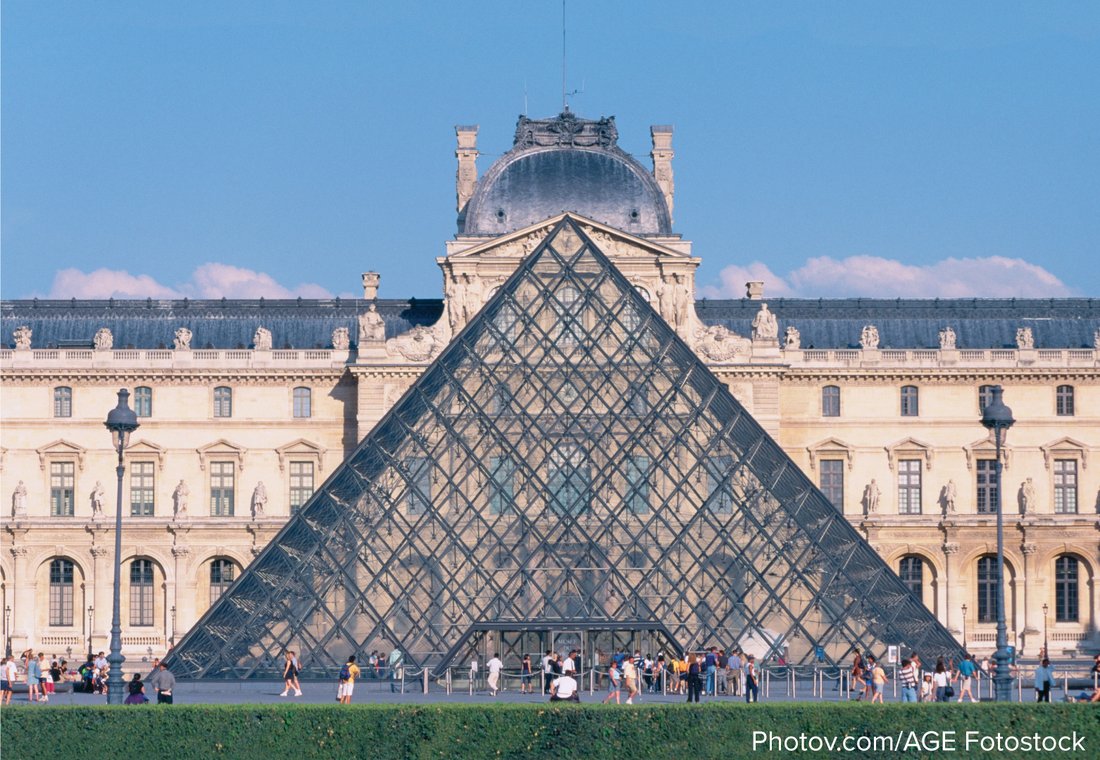
Apply in context: Glass pyramidAplica en contexto: Pirámide de vidrio
A museum builds a glass square pyramid. The base is 6 meters on each side. Each of the 4 triangular faces has a base of 6 meters and a slant height of 5 meters. What is the surface area, including the base?Un museo construye una pirámide cuadrada de vidrio. La base mide 6 metros por lado. Cada una de las 4 caras triangulares tiene una base de 6 metros y una altura inclinada de 5 metros. ¿Cuál es el área de la superficie, incluida la base?
Step 1 · Guide mePaso 1 · Guíame
What is the area of the square base?¿Cuál es el área de la base cuadrada?
square metersmetros cuadrados
Step 2 · Final answerPaso 2 · Respuesta final
square metersmetros cuadrados
Real-world connectionConexión con el mundo real
A museum is building a square pyramid display case. The base edge is 3 feet and the slant height is 4 feet. The glass costs $12 per square foot.Un museo está construyendo una vitrina en forma de pirámide cuadrada. La arista de la base mide 3 pies y la altura inclinada 4 pies. El vidrio cuesta $12 por pie cuadrado.
Glass Faces of the Display CaseCaras de vidrio de la vitrina
Each bar is one face's area in ft²; the open base adds 0 and the four triangular faces (½×3×4 = 6 ft² each) add up to 24 ft² of glass.Cada barra es el área de una cara en pies²; la base abierta suma 0 y las cuatro caras triangulares (½×3×4 = 6 pies² cada una) suman 24 pies² de vidrio.
Question:Pregunta:How much will the glass for all 4 triangular sides cost? (The base is open — no glass needed.)¿Cuánto costará el vidrio de los 4 lados triangulares? (La base está abierta — no necesita vidrio.)
Each triangular face has area = ½ × × = ft². Four faces: 4 × = ft². Cost: × $12 = $.Cada cara triangular tiene un área de ½ × × = pies². Cuatro caras: 4 × = pies². Costo: × $12 = $.
Reasoning challengeReto de razonamiento
Two pyramids have the same base area (64 in²) but different slant heights. Pyramid A has slant height 6 in and Pyramid B has slant height 10 in. How much more surface area does Pyramid B have? Why does slant height affect surface area but NOT base area?Dos pirámides tienen la misma área de base (64 in²) pero alturas inclinadas diferentes. La pirámide A tiene una altura inclinada de 6 in y la pirámide B de 10 in. ¿Cuánta área superficial más tiene la pirámide B? ¿Por qué la altura inclinada afecta el área superficial pero NO el área de la base?
Pyramid A: SA = 64 + 4(½ × 8 × 6) = 64 + ___ = ___ in². Pyramid B: SA = 64 + 4(½ × 8 × 10) = 64 + ___ = ___ in². Pyramid B has ___ more in² because ___. Slant height only affects ___ because ___.
Create & verify: Determine Surface Area of PyramidsCrea y verifica
Create a square pyramid tent or monument with a given base edge and triangular slant height. Find its surface area by adding the square base plus the 4 congruent triangles.Crea una tienda o monumento en forma de pirámide cuadrada con un lado de base y altura inclinada. Halla su área superficial sumando la base cuadrada y los 4 triángulos.
Quick test bench (try numbers or expressions)Banco de prueba rápido (prueba números o expresiones)
Stage 5 of 5Etapa 5 de 5
ReflectReflexiona
Answer on your own. Your first try counts as independent evidence; you can still revise.Responde por tu cuenta. Tu primer intento cuenta como evidencia independiente; todavía puedes revisar.