Division Expressions with Fractions and Whole Numbers
I can explain what dividing with a whole number and a unit fraction means — how many groups fit, or how much is in one group — find the quotient with a model, and check it by multiplying.
Your work saves on this device.Tu trabajo se guarda en este dispositivo.
Background knowledgeConocimientos previos2 skills you need for today: Division asks how many groups fit · How many unit fractions make one wholeLas 2 destrezas que necesitas hoy: La división pregunta cuántos grupos caben · Cuántas fracciones unitarias forman 1 entero
Division of FractionsDivisión de fracciones:Finding how many groups of one fraction fit inside another amount.Hallar cuántos grupos de una fracción caben dentro de otra cantidad.
Read the words below.Lee las palabras de abajo.
Open the model and change one number at a time.Abre el modelo y cambia un número a la vez.
Answer the questions beside the model, one at a time.Responde las preguntas junto al modelo, una a la vez.
Words to knowPalabras clave
ReciprocalRecíproco
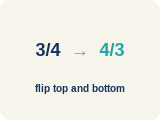
A fraction turned upside down.Una fracción volteada de arriba abajo.
The reciprocal of 1/4 is 4/1 = 4. A whole number like 3 is 3/1, so its reciprocal is 1/3.
QuotientCociente
The answer when you divide.La respuesta cuando divides.
In 3 ÷ 1/4 = 12, the quotient is 12 — there are 12 quarter-size pieces in 3
DividendDividendo
The total number being divided into equal groups (the number inside the division bracket).El número total que se divide en partes iguales (el número dentro de la casilla de división).
In 3 ÷ 1/4 = 12, the dividend is 3 — it is the total being split
Divisor
The number of equal groups you are dividing into (the number outside the division bracket).El número de partes iguales en las que divides (el número fuera de la casilla de división).
In 3 ÷ 1/4 = 12, the divisor is 1/4 — it is the size of each piece
Loading the model…
1. Try this1. Prueba esto
Predict how many half-cup servings fit into three cups.
Change the serving size to three quarters of a cup. Does the number of servings increase or decrease?
Explain why dividing by a number smaller than one can increase the result.
3. Check yourself3. Compruébalo
Answer a question about your model, then one new problem without it.Responde una pregunta sobre tu modelo y luego un problema nuevo sin él.
Read the idea, follow the worked examples, and connect the picture to the numbers.Lee la idea, sigue los ejemplos resueltos y conecta el dibujo con los números.
1Step 1 of 9:Paso 1 de 9:Words to knowPalabras clave
Say what each word means, then tap the card to check.Di qué significa cada palabra y luego toca la tarjeta para comprobar.
2Step 2 of 9:Paso 2 de 9:Check the wordsComprueba las palabras
3Step 3 of 9:Paso 3 de 9:What does it mean to divide by a fraction?¿Qué significa dividir entre una fracción?
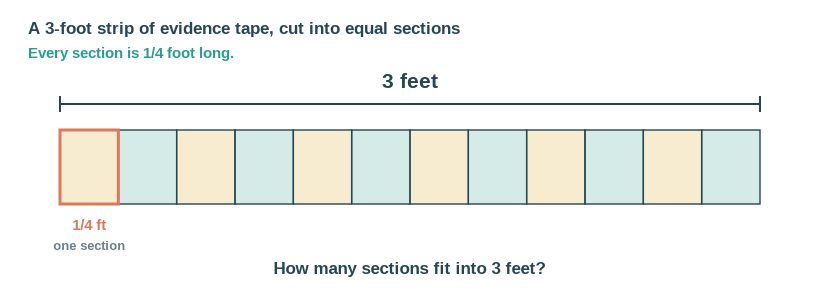
Dividing by a fraction asks one question: how many of that small piece fit inside the whole amount? For 3 ÷ 1/4, we ask how many 1/4-foot pieces fit into 3 feet.Dividir entre una fracción hace una sola pregunta: ¿cuántas de esas piezas pequeñas caben dentro de la cantidad entera? Para 3 ÷ 1/4, preguntamos cuántas piezas de 1/4 de pie caben en 3 pies.
Agent Reyes has a 3-foot strip of evidence tape. For the lab she needs to cut it into sections that are each 1/4 foot long.El agente Reyes tiene una tira de 3 pies de cinta de evidencia. Para el laboratorio necesita cortarla en secciones de 1/4 de pie cada una.
4Step 4 of 9:Paso 4 de 9:Watch meMírame
Watch me
I want to cut a 3-foot strip of tape into 1/4-foot pieces, so I write 3 ÷ 1/4. It asks: how many 1/4-foot pieces fit in 3 feet?Quiero cortar una tira de cinta de 3 pies en piezas de 1/4 de pie, así que escribo 3 ÷ 1/4. Pregunta: ¿cuántas piezas de 1/4 de pie caben en 3 pies?
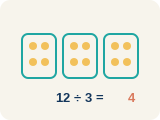
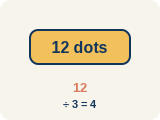
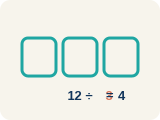
Each foot holds 4 quarter-foot pieces, so 3 feet hold 3 × 4 = 12 pieces.Cada pie tiene 4 piezas de un cuarto de pie, así que 3 pies tienen 3 × 4 = 12 piezas.
That is why the shortcut works: dividing by 1/4 gives the same answer as multiplying by its reciprocal, 4/1. So 3 ÷ 1/4 = 3/1 × 4/1 = 12. (Some people call this Keep, Change, Flip.)Por eso funciona el atajo: dividir entre 1/4 da lo mismo que multiplicar por su recíproco, 4/1. Así que 3 ÷ 1/4 = 3/1 × 4/1 = 12. (Hay quien lo llama Conserva, Cambia, Voltea.)
Check by multiplying: 12 pieces × 1/4 foot = 12/4 = 3 feet. So 3 ÷ 1/4 = 12 pieces.Comprueba multiplicando: 12 piezas × 1/4 de pie = 12/4 = 3 pies. Así que 3 ÷ 1/4 = 12 piezas.
One more move to know: mixed number → improper fraction: multiply the bottom by the whole number, add the top, keep the same bottom. 3 1/2 → (2 × 3) + 1 = 7 → 7/2.Un movimiento más que debes saber: número mixto → fracción impropia: multiplica el denominador por el entero, suma el numerador y conserva el mismo denominador. 3 1/2 → (2 × 3) + 1 = 7 → 7/2.
5Step 5 of 9:Paso 5 de 9:Let’s do one togetherHagamos uno juntos
Before each step, say what you think comes next. Then show it.Antes de cada paso, di qué crees que sigue. Luego muéstralo.
Let's do one together — the same problem the bar model showed
Let's try 2 ÷ 1/3. The bar model counted 6 thirds inside 2 wholes — now let's see why.Probemos 2 ÷ 1/3. El modelo de barras contó 6 tercios dentro de 2 enteros; ahora veamos por qué.
Each whole holds 3 thirds, so 2 wholes hold 2 × 3 = 6 thirds. That is 2/1 × 3/1, multiplying by the reciprocal of 1/3.Cada entero tiene 3 tercios, así que 2 enteros tienen 2 × 3 = 6 tercios. Eso es 2/1 × 3/1, multiplicar por el recíproco de 1/3.
Another way to see it: write 2 as 6/3. Six thirds ÷ one third = 6, just like 6 apples ÷ 1 apple = 6.Otra forma de verlo: escribe 2 como 6/3. Seis tercios ÷ un tercio = 6, igual que 6 manzanas ÷ 1 manzana = 6.
Check by multiplying: 6 × 1/3 = 6/3 = 2. So 2 ÷ 1/3 = 6 — exactly what we counted on the bars.Comprueba multiplicando: 6 × 1/3 = 6/3 = 2. Así que 2 ÷ 1/3 = 6, exactamente lo que contamos en las barras.
6Step 6 of 9:Paso 6 de 9:Your turnTu turno
Your turn — how much is in one group?
Now try 1/2 ÷ 4. This one asks how much is in ONE group: half a pan of brownies is shared equally by 4 people.Ahora prueba 1/2 ÷ 4. Esta pregunta es cuánto hay en UN grupo: medio molde de brownies se reparte en partes iguales entre 4 personas.
Cut the half into 4 equal parts. Each part is 1/8 of the whole pan, because 8 of those parts would fill the whole pan.Corta la mitad en 4 partes iguales. Cada parte es 1/8 del molde entero, porque 8 de esas partes llenarían el molde entero.
The shortcut agrees: dividing by 4 is the same as multiplying by its reciprocal, 1/4, so 1/2 × 1/4 = 1/8.El atajo coincide: dividir entre 4 es lo mismo que multiplicar por su recíproco, 1/4, así que 1/2 × 1/4 = 1/8.
One more: the top number does not have to be a 1. For 3/4 ÷ 2, share 3/4 into 2 equal parts: 3/4 × 1/2 = 3/8, and 2 × 3/8 = 6/8 = 3/4 checks it.Una más: el número de arriba no tiene que ser 1. Para 3/4 ÷ 2, reparte 3/4 en 2 partes iguales: 3/4 × 1/2 = 3/8, y 2 × 3/8 = 6/8 = 3/4 lo comprueba.
7Step 7 of 9:Paso 7 de 9:Check yourself: a first questionCompruébalo: una primera pregunta
8Step 8 of 9:Paso 8 de 9:Check yourself: a harder questionCompruébalo: una pregunta más difícil
9Step 9 of 9:Paso 9 de 9:Put it togetherJúntalo todo
Watch out for a common mistakeCuidado con un error común
A common mistake in Interpret Division of Fractions is assuming that dividing always makes the answer smaller. For 4 ÷ 1/3, students reason 'dividing shrinks the number' and compute 4 ÷ 3 ≈ 1.3 instead of asking how many 1/3-foot pieces fit into 4 feet (each whole foot holds 3 thirds, so 4 × 3 = 12). Before you submit, check: if the divisor is a fraction smaller than 1, the quotient must be BIGGER than the dividend, not smaller.
Sentence frameMarco de oración
Dividing by 1/3 means finding how many ___ fit into ___, so the quotient is ___ than the dividend.Dividir entre 1/3 significa hallar cuántos ___ caben en ___, así que el cociente es ___ que el dividendo.
Stage 3 of 5Etapa 3 de 5
PracticePractica
Choose Regular or Challenge. Hints come one step at a time; you get a new question after a worked example.Elige Regular o Reto. Las pistas llegan paso a paso; después de un ejemplo resuelto recibes una pregunta nueva.
Loading practice…
Stage 4 of 5Etapa 4 de 5
ApplyAplica
Use the idea in a real situation. Write your reasoning, then compare it with a sample.Usa la idea en una situación real. Escribe tu razonamiento y compáralo con un ejemplo.
Apply in context: Juice standAplica en contexto: Puesto de jugo
Dev has 4 cups of juice. He pours it into small cups that each hold 1/5 cup. He sells each small cup for $2. If he sells every small cup, how much money does he make?Dev tiene 4 tazas de jugo. Lo sirve en vasitos que caben 1/5 de taza cada uno. Vende cada vasito en $2. Si vende todos los vasitos, ¿cuánto dinero gana?
Step 1 · Guide mePaso 1 · Guíame
How many small cups can Dev fill from 1 cup of juice?¿Cuántos vasitos puede llenar Dev con 1 taza de jugo?
small cupsvasitos
Step 2 · Final answerPaso 2 · Respuesta final
dollarsdólares
Real-world connectionConexión con el mundo real
A detective has 6 yards of crime scene tape. She needs to mark off sections that are each 1/3 of a yard. She wants to know how many sections she can mark.Una detective tiene 6 yardas de cinta de escena del crimen. Necesita marcar secciones de 1/3 de yarda cada una. Quiere saber cuántas secciones puede marcar.
6 Yards of Tape in Thirds6 yardas de cinta en tercios
Each yard splits into three 1/3-yard sections; count all the parts to see that 6 ÷ 1/3 = 18 sections fit into the 6-yard tape.Cada yarda se parte en tres secciones de 1/3 de yarda; cuenta todas las partes para ver que 6 ÷ 1/3 = 18 secciones caben en la cinta de 6 yardas.
Question:Pregunta:How does interpreting fraction division help the detective?¿Cómo ayuda interpretar la división de fracciones al detective?
The detective can mark sections because 6 ÷ 1/3 = .La detective puede marcar secciones porque 6 ÷ 1/3 = .
Reasoning challengeReto de razonamiento
Dividing 6 by 1/2 gives 12, but dividing 6 by 2 gives 3. How can dividing by a smaller number (1/2) give a bigger answer than dividing by a larger number (2)? Explain using a real-world example.Dividir 6 entre 1/2 da 12, pero dividir 6 entre 2 da 3. ¿Cómo puede dividir entre un número más pequeño (1/2) dar una respuesta más grande que dividir entre un número más grande (2)? Explica con un ejemplo de la vida real.
When I divide 6 by 2, I am ___. When I divide 6 by 1/2, I am ___. The answer is bigger because ___.
Create & verify: Division Expressions with Fractions and Whole NumbersCrea y verifica
Write a division story involving a fraction and a whole number (like 3/4 ÷ 3 or 4 ÷ 1/2). Solve it and explain what the quotient means in your story.Escribe una historia de división con una fracción y un número entero (como 3/4 ÷ 3 o 4 ÷ 1/2). Resuélvela y explica qué significa el cociente en tu historia.
Quick test bench (try numbers or expressions)Banco de prueba rápido (prueba números o expresiones)
Stage 5 of 5Etapa 5 de 5
ReflectReflexiona
Answer on your own. Your first try counts as independent evidence; you can still revise.Responde por tu cuenta. Tu primer intento cuenta como evidencia independiente; todavía puedes revisar.