I can solve real-world problems by deciding whether the question asks how many groups fit or how much is in one group, writing a fraction division equation, and checking the solution by multiplying.
Your work saves on this device.Tu trabajo se guarda en este dispositivo.
Background knowledgeConocimientos previos2 skills you need for today: Divide by a fraction: multiply by the reciprocal · Check a division by multiplyingLas 2 destrezas que necesitas hoy: Dividir entre una fracción: multiplicar por el recíproco · Comprobar una división con una multiplicación
Fraction Division Problem SolvingResolución de problemas de división de fracciones:Use fraction division to find an unknown number of groups or the size of each group.Usar la división de fracciones para hallar una cantidad desconocida de grupos o el tamaño de cada grupo.
Read the words below.Lee las palabras de abajo.
Open the model and change one number at a time.Abre el modelo y cambia un número a la vez.
Answer the questions beside the model, one at a time.Responde las preguntas junto al modelo, una a la vez.
Words to knowPalabras clave
ModelModelo
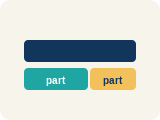
A picture or math way to show a problem so you can solve it.Un dibujo o forma matemática de mostrar un problema para resolverlo.
A bar model showing 3/4 split into 1/8-size pieces, or the equation 3/4 ÷ 1/8 = 6
EquationEcuación
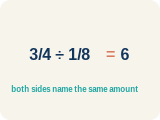
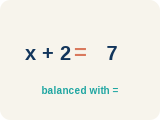
A math sentence with an equal sign showing both sides are the same.Una oración matemática con un signo igual que muestra que ambos lados son iguales.
3/4 ÷ 1/8 = 6 — the left side (division) equals the right side (answer)
SolutionSolución
A number that makes the equation or inequality true.Un número que hace verdadera la ecuación o desigualdad.
In 3/4 ÷ 1/8 = 6, the solution is 6 portions
ReasonablenessRazonabilidad
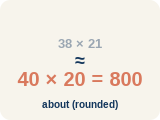
Checking if your answer makes sense.Revisar si tu respuesta tiene sentido.
3 ÷ 1/4 = 12. Is 12 reasonable? Yes, because 1/4 is small so many pieces fit into 3.
Loading the model…
1. Try this1. Prueba esto
Find how many 2/3-liter portions fit into 4 1/2 liters.
Explain the difference between the exact number of portions and full bottles you can fill.
Create a problem where a quotient smaller than one makes sense.
3. Check yourself3. Compruébalo
Answer a question about your model, then one new problem without it.Responde una pregunta sobre tu modelo y luego un problema nuevo sin él.
Read the idea, follow the worked examples, and connect the picture to the numbers.Lee la idea, sigue los ejemplos resueltos y conecta el dibujo con los números.
1Step 1 of 9:Paso 1 de 9:Words to knowPalabras clave
Say what each word means, then tap the card to check.Di qué significa cada palabra y luego toca la tarjeta para comprobar.
2Step 2 of 9:Paso 2 de 9:Check the wordsComprueba las palabras
3Step 3 of 9:Paso 3 de 9:How do I solve a fraction division word problem?¿Cómo resuelvo un problema verbal de división de fracciones?
In a word problem, first decide what the question asks: how many groups fit (total ÷ size of each group) or how much is in one group (total ÷ number of groups). The total amount is the dividend and the other number is the divisor. Write the equation, solve it with a model, common denominators, or by multiplying by the reciprocal, then check by multiplying the quotient by the divisor.En un problema verbal, primero decide qué pregunta: cuántos grupos caben (total ÷ tamaño de cada grupo) o cuánto hay en un grupo (total ÷ número de grupos). La cantidad total es el dividendo y el otro número es el divisor. Escribe la ecuación, resuélvela con un modelo, con denominadores comunes o multiplicando por el recíproco, y luego comprueba multiplicando el cociente por el divisor.
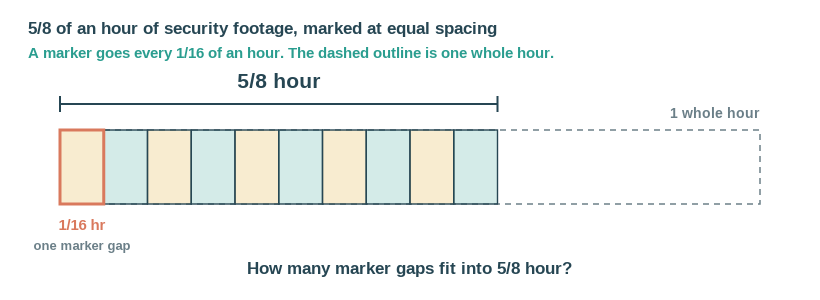
Agent Diaz is reviewing 5/8 of an hour of security footage. She wants to place a time-stamp marker every 1/16 of an hour along the footage.El agente Díaz está revisando 5/8 de hora de video de seguridad. Quiere poner un marcador de tiempo cada 1/16 de hora a lo largo del video.
4Step 4 of 9:Paso 4 de 9:Watch meMírame
Watch me
Agent Torres has 2/3 gallon of dust and each test uses 1/6 gallon. I ask: how many tests fit?La agente Torres tiene 2/3 de galón de polvo y cada prueba usa 1/6 de galón. Me pregunto: ¿cuántas pruebas caben?
The total 2/3 is the dividend. The size of each test 1/6 is the divisor. My equation is 2/3 ÷ 1/6.El total 2/3 es el dividendo. El tamaño de cada prueba, 1/6, es el divisor. Mi ecuación es 2/3 ÷ 1/6.
In sixths, 2/3 = 4/6, and 4 sixths ÷ 1 sixth = 4. Multiplying by the reciprocal gives the same answer: 2/3 × 6/1 = 12/3 = 4.En sextos, 2/3 = 4/6, y 4 sextos ÷ 1 sexto = 4. Multiplicar por el recíproco da la misma respuesta: 2/3 × 6/1 = 12/3 = 4.
So she can run 4 tests. I check by multiplying back: 4 × 1/6 = 4/6 = 2/3. It matches the total, so the answer is reasonable.Entonces puede hacer 4 pruebas. Lo compruebo multiplicando de vuelta: 4 × 1/6 = 4/6 = 2/3. Coincide con el total, así que la respuesta es razonable.
5Step 5 of 9:Paso 5 de 9:Let’s do one togetherHagamos uno juntos
Before each step, say what you think comes next. Then show it.Antes de cada paso, di qué crees que sigue. Luego muéstralo.
Let's try together
A ribbon is 3/4 yard and each bow uses 1/4 yard. The total 3/4 is the dividend; 1/4 is the divisor.Un listón mide 3/4 de yarda y cada moño usa 1/4 de yarda. El total 3/4 es el dividendo; 1/4 es el divisor.
Equation: 3/4 ÷ 1/4. Three fourths hold 3 fourths, so the quotient is 3 — the same as 3/4 × 4/1 = 12/4 = 3.Ecuación: 3/4 ÷ 1/4. Tres cuartos contienen 3 cuartos, así que el cociente es 3, lo mismo que 3/4 × 4/1 = 12/4 = 3.
So we can make 3 bows. Check: 3 × 1/4 = 3/4. It matches, so it is reasonable.Entonces podemos hacer 3 moños. Comprueba: 3 × 1/4 = 3/4. Coincide, así que es razonable.
6Step 6 of 9:Paso 6 de 9:Your turnTu turno
Now it's your turn
Now read each word problem and decide: does it ask how many groups fit (total ÷ group size) or how much is in one group (total ÷ number of groups)? Write the equation, solve it, and check by multiplying.Ahora lee cada problema verbal y decide: ¿pregunta cuántos grupos caben (total ÷ tamaño del grupo) o cuánto hay en un grupo (total ÷ número de grupos)? Escribe la ecuación, resuélvela y comprueba multiplicando.
7Step 7 of 9:Paso 7 de 9:Check yourself: a first questionCompruébalo: una primera pregunta
8Step 8 of 9:Paso 8 de 9:Check yourself: a harder questionCompruébalo: una pregunta más difícil
9Step 9 of 9:Paso 9 de 9:Put it togetherJúntalo todo
Watch out for a common mistakeCuidado con un error común
A common mistake in Fraction Division Problem Solving is reversing which fraction is the dividend and which is the divisor when setting up the equation from a word problem. For example: a pitcher holds 3/4 cup of punch, and each serving is 1/8 cup — how many servings? The correct setup is total ÷ group size = 3/4 ÷ 1/8 = 3/4 × 8/1 = 24/4 = 6 servings. A student who reverses the setup calculates 1/8 ÷ 3/4 = 1/8 × 4/3 = 4/24 = 1/6, an answer smaller than 1 that can't possibly be a serving count. Before you submit, check: does my answer make sense as a NUMBER OF GROUPS? If the setup gives a fraction less than 1 for a 'how many' question, you likely swapped the dividend and divisor.
Sentence frameMarco de oración
The total amount is the ___ because it is being split into groups. The size of each group is the ___ because we are dividing by that amount.La cantidad total es el ___ porque se está repartiendo en grupos. El tamaño de cada grupo es el ___ porque estamos dividiendo entre esa cantidad.
Stage 3 of 5Etapa 3 de 5
PracticePractica
Choose Regular or Challenge. Hints come one step at a time; you get a new question after a worked example.Elige Regular o Reto. Las pistas llegan paso a paso; después de un ejemplo resuelto recibes una pregunta nueva.
Loading practice…
Stage 4 of 5Etapa 4 de 5
ApplyAplica
Use the idea in a real situation. Write your reasoning, then compare it with a sample.Usa la idea en una situación real. Escribe tu razonamiento y compáralo con un ejemplo.
Apply in context: Lemonade pitcherAplica en contexto: Jarra de limonada
Tara pours 6 cups of lemonade, and that fills 3/4 of a pitcher. She will serve a full pitcher in glasses that each hold 1/2 cup. How many glasses can she fill from a full pitcher?Tara sirve 6 tazas de limonada, y eso llena 3/4 de una jarra. Va a servir una jarra llena en vasos que caben 1/2 taza cada uno. ¿Cuántos vasos puede llenar con una jarra llena?
Step 1 · Guide mePaso 1 · Guíame
How many cups does 1/4 of the pitcher hold?¿Cuántas tazas caben en 1/4 de la jarra?
cupstazas
Step 2 · Final answerPaso 2 · Respuesta final
glassesvasos
Real-world connectionConexión con el mundo real
A forensic chemist has 5/6 of a liter of testing solution. Each DNA test requires 1/12 of a liter. She needs to figure out how many tests she can run before the solution runs out.Una química forense tiene 5/6 de litro de solución de prueba. Cada prueba de ADN requiere 1/12 de litro. Necesita averiguar cuántas pruebas puede hacer antes de que se acabe la solución.
How Many DNA Tests FitCuántas pruebas de ADN caben
The top bar is the 5/6 L of solution (10 twelfths); the bottom bar is one 1/12 L test, so count how many bottom bars fit in the top: 5/6 ÷ 1/12 = 10 tests.La barra de arriba son los 5/6 de L de solución (10 doceavos); la barra de abajo es una prueba de 1/12 de L, así que cuenta cuántas barras de abajo caben en la de arriba: 5/6 ÷ 1/12 = 10 pruebas.
Question:Pregunta:How does setting up a fraction division equation help solve this real-world problem?¿Cómo ayuda armar una ecuación de división de fracciones a resolver este problema del mundo real?
The chemist can run tests because 5/6 ÷ 1/12 = .La química puede hacer pruebas porque 5/6 ÷ 1/12 = .
Reasoning challengeReto de razonamiento
Write your own fraction division word problem where the answer is 8. Then show the equation, solve it step by step, and explain how you know your answer is reasonable.Escribe tu propio problema de división de fracciones cuya respuesta sea 8. Después muestra la ecuación, resuélvela paso a paso y explica cómo sabes que tu respuesta es razonable.
My word problem: ___. The equation is ___ ÷ ___ = ___. I solved it using KCF: ___ × ___ = ___. The answer 8 is reasonable because ___.
Create & verify: Fraction Division Problem SolvingCrea y verifica
Write a multi-step fraction division problem (for example, finding how many full servings fit AND how much is left over, or finding a missing rectangle side from fractional area). Solve and check.Escribe un problema de varios pasos con división de fracciones (ej. hallar un lado faltante de un rectángulo con área fraccionaria). Resuelve y comprueba.
Quick test bench (try numbers or expressions)Banco de prueba rápido (prueba números o expresiones)
Stage 5 of 5Etapa 5 de 5
ReflectReflexiona
Answer on your own. Your first try counts as independent evidence; you can still revise.Responde por tu cuenta. Tu primer intento cuenta como evidencia independiente; todavía puedes revisar.