Background knowledgeConocimientos previos2 skills you need for today: Skip-count to list multiples · Tell a multiple from a factorLas 2 destrezas que necesitas hoy: Contar de tanto en tanto para hacer la lista de múltiplos · Distinguir un múltiplo de un factor
Least Common MultipleMínimo común múltiplo:The least positive number that is a multiple of two or more numbers.El menor número positivo que es múltiplo de dos o más números.
Read the words below.Lee las palabras de abajo.
Open the model and change one number at a time.Abre el modelo y cambia un número a la vez.
Answer the questions beside the model, one at a time.Responde las preguntas junto al modelo, una a la vez.
Words to knowPalabras clave
MultipleMúltiplo
What you get when you multiply a number by 1, 2, 3, and so on.Lo que obtienes al multiplicar un número por 1, 2, 3, y así.
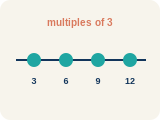
Multiples of 4: 4, 8, 12, 16, 20 — found by multiplying 4 × 1, 4 × 2, 4 × 3, ...
Common multipleMúltiplo común
A number that two or more numbers both go into.Un número al que llegan dos o más números al multiplicar.
12, 24, and 36 are all common multiples of both 3 and 4
Skip countingConteo salteado
Counting by a number, like 2, 4, 6, to list its multiples.Contar de un número en un número, como 2, 4, 6, para listar sus múltiplos.
Skip count by 6: 6, 12, 18, 24, 30 — each jump adds 6
Prime factorizationFactorización prima
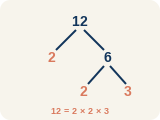
Writing a number as prime numbers multiplied together. It helps you find the LCM.Escribir un número como números primos multiplicados. Ayuda a encontrar el mcm.
4 = 2 × 2, 6 = 2 × 3. LCM uses the highest power of each prime: 2² × 3 = 12
Loading the model…
1. Try this1. Prueba esto
List the first few multiples of each signal period.
Use prime factors to explain the first shared positive multiple.
Why is multiplying the two periods sometimes too large for the first meeting?
3. Check yourself3. Compruébalo
Answer a question about your model, then one new problem without it.Responde una pregunta sobre tu modelo y luego un problema nuevo sin él.
Read the idea, follow the worked examples, and connect the picture to the numbers.Lee la idea, sigue los ejemplos resueltos y conecta el dibujo con los números.
1Step 1 of 9:Paso 1 de 9:Words to knowPalabras clave
Say what each word means, then tap the card to check.Di qué significa cada palabra y luego toca la tarjeta para comprobar.
2Step 2 of 9:Paso 2 de 9:Check the wordsComprueba las palabras
3Step 3 of 9:Paso 3 de 9:What is the least common multiple (LCM)?¿Qué es el mínimo común múltiplo?
A multiple is what you get when you count by a number: 4, 8, 12, 16. The least common multiple is the smallest multiple that two numbers share.Un múltiplo es lo que obtienes al contar de un número en un número: 4, 8, 12, 16. El mínimo común múltiplo es el múltiplo más pequeño que comparten dos números.
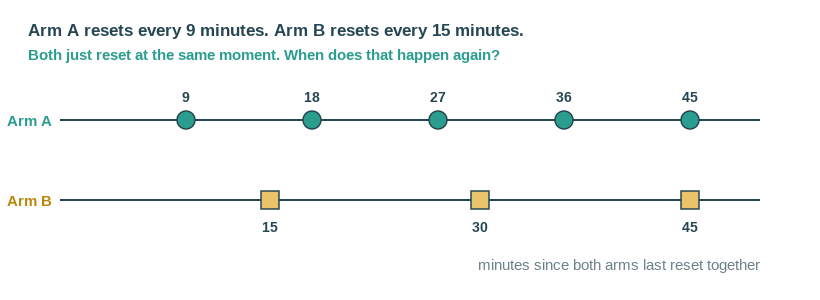
Two robotic arms on Station Helios run on repeating cycles. Arm A resets every 9 minutes and Arm B resets every 15 minutes. Right now both arms just reset at the same moment.Dos brazos robóticos de la estación Helios trabajan en ciclos que se repiten. El brazo A se reinicia cada 9 minutos y el brazo B se reinicia cada 15 minutos. Justo ahora los dos brazos acaban de reiniciarse al mismo tiempo.
4Step 4 of 9:Paso 4 de 9:Watch meMírame
Watch me
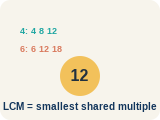
I want the LCM of 4 and 6. I skip count the multiples of 4: 4, 8, 12, 16, 20, 24.Quiero el mínimo común múltiplo de 4 y 6. Cuento de salto los múltiplos de 4: 4, 8, 12, 16, 20, 24.
Then I skip count the multiples of 6: 6, 12, 18, 24.Luego cuento de salto los múltiplos de 6: 6, 12, 18, 24.
I look for the first number in BOTH lists. 12 is in both lists, and it comes before 24.Busco el primer número que esté en las dos listas. El 12 está en las dos, y viene antes que el 24.
So the LCM of 4 and 6 is 12. I check: 12 ÷ 4 = 3 and 12 ÷ 6 = 2, so both go into 12 evenly.Entonces el mínimo común múltiplo de 4 y 6 es 12. Lo compruebo: 12 ÷ 4 = 3 y 12 ÷ 6 = 2, así que los dos caben exactamente en 12.
5Step 5 of 9:Paso 5 de 9:Let’s do one togetherHagamos uno juntos
Before each step, say what you think comes next. Then show it.Antes de cada paso, di qué crees que sigue. Luego muéstralo.
Let's try together
Let's find the LCM of 3 and 5. What are the multiples of 3? (3, 6, 9, 12, 15.)Hallemos el mínimo común múltiplo de 3 y 5. ¿Cuáles son los múltiplos de 3? (3, 6, 9, 12, 15.)
What are the multiples of 5? (5, 10, 15.) What is the first number in both lists? (15.)¿Cuáles son los múltiplos de 5? (5, 10, 15.) ¿Cuál es el primer número que está en las dos listas? (15.)
So the LCM of 3 and 5 is 15.Entonces el mínimo común múltiplo de 3 y 5 es 15.
6Step 6 of 9:Paso 6 de 9:Your turnTu turno
Now it's your turn
Next, you will sort multiples to find the common multiples of two numbers and pick the smallest one.Luego vas a clasificar múltiplos para hallar los múltiplos comunes de dos números y escoger el más pequeño.
Remember: the LCM is the SMALLEST multiple the two numbers share.Recuerda: el mínimo común múltiplo es el múltiplo más pequeño que comparten los dos números.
7Step 7 of 9:Paso 7 de 9:Check yourself: a first questionCompruébalo: una primera pregunta
8Step 8 of 9:Paso 8 de 9:Check yourself: a harder questionCompruébalo: una pregunta más difícil
9Step 9 of 9:Paso 9 de 9:Put it togetherJúntalo todo
Watch out for a common mistakeCuidado con un error común
A common mistake in Least Common Multiple is multiplying the two numbers together instead of listing multiples to find the smallest shared one. For example, for 4 and 6, a student calculates 4 × 6 = 24 and calls that the LCM, but the actual least common multiple is 12 (multiples of 4: 4, 8, 12; multiples of 6: 6, 12 — 12 is the first number that appears in both lists). This shortcut only works when the two numbers share no common factors (like 4 and 9, where the LCM really is 36 = 4 × 9); for numbers like 4 and 6 that share a factor of 2, multiplying overshoots the true LCM. Always list multiples of both numbers and pick the first one that appears in both lists.
Sentence frameMarco de oración
The LCM of 4 and 6 is ___ because it is the smallest number in the ___ group.El mínimo común múltiplo de 4 y 6 es ___ porque es el número más pequeño del grupo ___.
Stage 3 of 5Etapa 3 de 5
PracticePractica
Choose Regular or Challenge. Hints come one step at a time; you get a new question after a worked example.Elige Regular o Reto. Las pistas llegan paso a paso; después de un ejemplo resuelto recibes una pregunta nueva.
Loading practice…
Stage 4 of 5Etapa 4 de 5
ApplyAplica
Use the idea in a real situation. Write your reasoning, then compare it with a sample.Usa la idea en una situación real. Escribe tu razonamiento y compáralo con un ejemplo.
Apply in context: Field day prizesAplica en contexto: Premios del día de campo
At field day, 36 students stand in a line, numbered 1 to 36. Every 4th student gets a sticker, and every 6th student gets a pin. How many students get both a sticker and a pin?En el día de campo, 36 estudiantes están en fila, numerados del 1 al 36. Cada 4.º estudiante recibe una calcomanía y cada 6.º estudiante recibe un botón. ¿Cuántos estudiantes reciben una calcomanía y un botón?
Step 1 · Guide mePaso 1 · Guíame
What is the smallest number that is a multiple of both 4 and 6?¿Cuál es el número más pequeño que es múltiplo de 4 y de 6?
Step 2 · Final answerPaso 2 · Respuesta final
studentsestudiantes
Real-world connectionConexión con el mundo real
Hot dogs come in packs of 8 and buns come in packs of 6. You want to buy the exact same number of hot dogs and buns with none left over.Las salchichas vienen en paquetes de 8 y los panes en paquetes de 6. Quieres comprar exactamente el mismo número de salchichas y de panes sin que sobre nada.
LCM: 8 & 6
Question:Pregunta:How does the LCM help you figure out the fewest hot dogs and buns to buy so they come out even?¿Cómo te ayuda el mínimo común múltiplo a averiguar la menor cantidad de salchichas y panes que hay que comprar para que salgan parejos?
I need to buy hot dogs and buns because the LCM of 8 and 6 is .Necesito comprar salchichas y panes porque el mínimo común múltiplo de 8 y 6 es .
Reasoning challengeReto de razonamiento
You are making party favors. Glow sticks come in packs of 10 and bracelets come in packs of 4. What is the fewest of each you can buy so every favor has exactly one glow stick and one bracelet with none left over? Explain how the LCM solves this problem.Estás armando recuerdos para una fiesta. Las barras luminosas vienen en paquetes de 10 y las pulseras en paquetes de 4. ¿Cuál es la menor cantidad de cada una que puedes comprar para que cada recuerdo tenga exactamente una barra luminosa y una pulsera, sin que sobre nada? Explica cómo el mcm resuelve este problema.
The LCM of 10 and 4 is ___. I need to buy ___ packs of glow sticks and ___ packs of bracelets to get ___ of each. This works because ___.
Create & verify: Least Common MultipleCrea y verifica
Invent a scheduling or packaging problem solved by Least Common Multiple (LCM) using two numbers between 4 and 15. List multiples of both to prove when they first align.Inventa un problema de horarios o paquetes que se resuelva con el Mínimo Común Múltiplo (MCM) usando dos números entre 4 y 15. Lista múltiplos de ambos para demostrar cuándo coinciden.
Quick test bench (try numbers or expressions)Banco de prueba rápido (prueba números o expresiones)
Stage 5 of 5Etapa 5 de 5
ReflectReflexiona
Answer on your own. Your first try counts as independent evidence; you can still revise.Responde por tu cuenta. Tu primer intento cuenta como evidencia independiente; todavía puedes revisar.