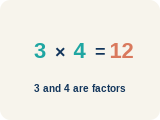
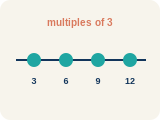
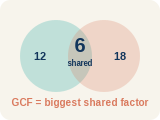
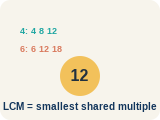
Background knowledgeConocimientos previos2 skills you need for today: Find factor pairs of a number · List multiples by skip-countingLas 2 destrezas que necesitas hoy: Hallar los pares de factores de un número · Hacer la lista de múltiplos contando de tanto en tanto
Find Factors and MultiplesHallar factores y múltiplos:Listing what divides a number evenly (its factors) and what it divides into evenly (its multiples), then finding what two numbers share.Listar lo que divide un número exactamente (sus factores) y lo que el número forma al contar de esa cantidad (sus múltiplos), y luego hallar lo que dos números comparten.
Read the words below.Lee las palabras de abajo.
Open the model and change one number at a time.Abre el modelo y cambia un número a la vez.
Answer the questions beside the model, one at a time.Responde las preguntas junto al modelo, una a la vez.
Words to knowPalabras clave
Factor
A whole number that divides another number evenly, with no remainder.Un número entero que divide a otro exactamente, sin residuo.
Factors of 36: 1, 2, 3, 4, 6, 9, 12, 18, 36
MultipleMúltiplo
The result of multiplying a number by 1, 2, 3, and so on — where you land when you skip-count by it.El resultado de multiplicar un número por 1, 2, 3, y así sucesivamente: donde caes al contar de esa cantidad.
Multiples of 8: 8, 16, 24, 32, 40 …
Greatest common factor (GCF)Máximo común divisor (MCD)
The largest number that is a factor of two or more numbers. It answers “how many equal groups can I make?”El número más grande que es factor de dos o más números. Responde “¿cuántos grupos iguales puedo formar?”
48 and 36 share 1, 2, 3, 4, 6, 12 → GCF = 12
Least common multiple (LCM)Mínimo común múltiplo (mcm)
The smallest number that is a multiple of two or more numbers. It answers “when will these line up again?”El número más pequeño que es múltiplo de dos o más números. Responde “¿cuándo volverán a coincidir?”
6, 12, 18, 24 and 8, 16, 24 → LCM = 24
Loading the model…
1. Try this1. Prueba esto
List every factor of each number. Which factors are shared?
Use the greatest common factor to write 18 + 24 as a product.
Explain why a common multiple and a common factor play different roles.
3. Check yourself3. Compruébalo
Answer a question about your model, then one new problem without it.Responde una pregunta sobre tu modelo y luego un problema nuevo sin él.
Read the idea, follow the worked examples, and connect the picture to the numbers.Lee la idea, sigue los ejemplos resueltos y conecta el dibujo con los números.
1Step 1 of 9:Paso 1 de 9:Words to knowPalabras clave
Say what each word means, then tap the card to check.Di qué significa cada palabra y luego toca la tarjeta para comprobar.
2Step 2 of 9:Paso 2 de 9:Check the wordsComprueba las palabras
3Step 3 of 9:Paso 3 de 9:Factors split things up; multiples count forwardLos factores reparten; los múltiplos cuentan hacia adelante
A factor divides a number evenly, so factors answer questions about splitting a stock into equal groups. A multiple is where you land when you skip-count, so multiples answer questions about when repeating events line up.Un factor divide un número exactamente, así que los factores responden preguntas sobre repartir existencias en grupos iguales. Un múltiplo es donde caes al contar de salto, así que los múltiplos responden preguntas sobre cuándo coinciden eventos que se repiten.
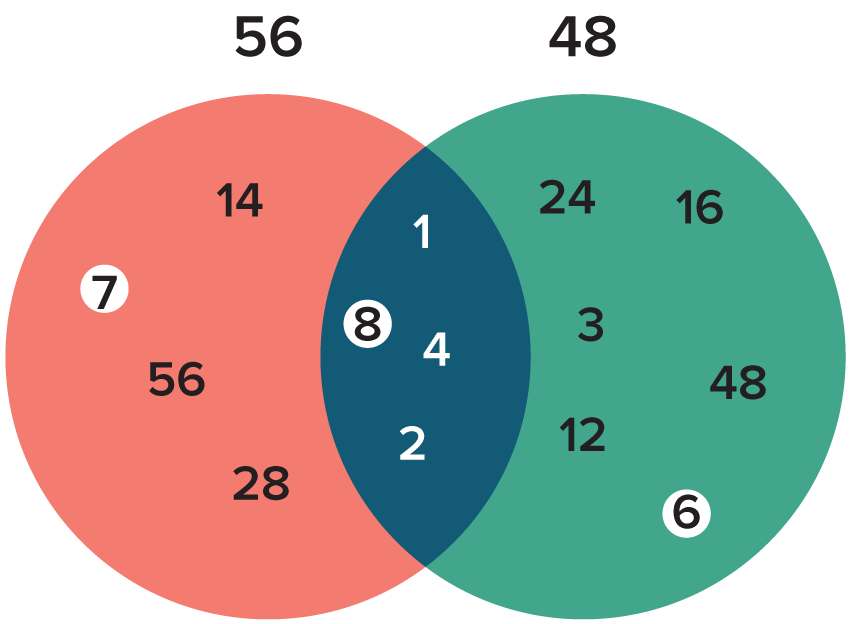
Mission Control sorted the factors of 56 and the factors of 48 into two overlapping rings. The numbers that divide BOTH 56 and 48 sit in the middle, where the rings cross.El control de la misión clasificó los factores de 56 y los factores de 48 en dos anillos que se traslapan. Los números que dividen tanto a 56 como a 48 quedan en el medio, donde los anillos se cruzan.
4Step 4 of 9:Paso 4 de 9:Watch meMírame
Watch me build the combo packs
The store has 48 pencils and 36 notebooks. Every combo pack must hold the same number of each, with nothing left over — so the number of packs has to be a factor of BOTH quantities.La tienda tiene 48 lápices y 36 cuadernos. Cada paquete combinado debe llevar la misma cantidad de cada uno, sin que sobre nada — así que el número de paquetes tiene que ser un factor de las dos cantidades.
Factors of 48: 1, 2, 3, 4, 6, 8, 12, 16, 24, 48. Factors of 36: 1, 2, 3, 4, 6, 9, 12, 18, 36. Listing them in order is what makes the comparison easy.Factores de 48: 1, 2, 3, 4, 6, 8, 12, 16, 24, 48. Factores de 36: 1, 2, 3, 4, 6, 9, 12, 18, 36. Enumerarlos en orden es lo que hace fácil la comparación.
The numbers in both lists are the common factors: 1, 2, 3, 4, 6, and 12.Los números que están en las dos listas son los factores comunes: 1, 2, 3, 4, 6 y 12.
The greatest of those is 12, so the GCF of 48 and 36 is 12. The manager can make 12 combo packs — each holding 48 ÷ 12 = 4 pencils and 36 ÷ 12 = 3 notebooks.El mayor de esos es 12, así que el máximo común divisor de 48 y 36 es 12. El gerente puede armar 12 paquetes combinados — cada uno con 48 ÷ 12 = 4 lápices y 36 ÷ 12 = 3 cuadernos.
5Step 5 of 9:Paso 5 de 9:Let’s do one togetherHagamos uno juntos
Before each step, say what you think comes next. Then show it.Antes de cada paso, di qué crees que sigue. Luego muéstralo.
Let's do one together — the same GCF, using prime factors
A factor tree breaks each number into primes. 48 = 2 × 2 × 2 × 2 × 3, and 36 = 2 × 2 × 3 × 3.Un árbol de factores separa cada número en primos. 48 = 2 × 2 × 2 × 2 × 3, y 36 = 2 × 2 × 3 × 3.
Now look at what the two share: two 2s and one 3.Ahora mira lo que comparten los dos: dos veces el 2 y una vez el 3.
Same answer as the lists, 12 — which is the check. For big numbers, the factor tree is usually the faster road.La misma respuesta que con las listas, 12 — y esa es la comprobación. Para números grandes, el árbol de factores suele ser el camino más rápido.
6Step 6 of 9:Paso 6 de 9:Your turnTu turno
Your turn — now a multiples question
Ayasha has painting class every 8 weeks and pottery class every 6 weeks. Both are this week. When will both fall in the same week again?Ayasha tiene clase de pintura cada 8 semanas y clase de cerámica cada 6 semanas. Las dos son esta semana. ¿Cuándo volverán a caer en la misma semana?
List multiples of 8: 8, 16, 24, 32 … and multiples of 6: 6, 12, 18, 24 …Enumera los múltiplos de 8: 8, 16, 24, 32… y los múltiplos de 6: 6, 12, 18, 24…
Find the smallest number in both lists — that is the LCM.Halla el número más pequeño que esté en las dos listas — ese es el mínimo común múltiplo.
Say what the LCM means for Ayasha, and explain why 48 is a common multiple but not the answer.Di qué significa el mínimo común múltiplo para Ayasha y explica por qué 48 es un múltiplo común pero no es la respuesta.
7Step 7 of 9:Paso 7 de 9:Check yourself: a first questionCompruébalo: una primera pregunta
8Step 8 of 9:Paso 8 de 9:Check yourself: a harder questionCompruébalo: una pregunta más difícil
9Step 9 of 9:Paso 9 de 9:Put it togetherJúntalo todo
Watch out for a common mistakeCuidado con un error común
A common mistake is reaching for the wrong tool: listing FACTORS for a problem about repeating cycles. Ayasha's classes repeat every 6 and 8 weeks, so the weeks they land on are multiples — answering with the GCF of 2 claims a class that meets every 8 weeks happens in week 2. Use the size of the answer as a check: a GCF is never larger than the smaller number, and an LCM is never smaller than the larger one.
Sentence frameMarco de oración
If the problem ___ something into equal groups, I use the ___. If it asks when things ___ again, I use the ___.Si el problema ___ algo en grupos iguales, uso el ___. Si pregunta cuándo las cosas ___ otra vez, uso el ___.
Stage 3 of 5Etapa 3 de 5
PracticePractica
Choose Regular or Challenge. Hints come one step at a time; you get a new question after a worked example.Elige Regular o Reto. Las pistas llegan paso a paso; después de un ejemplo resuelto recibes una pregunta nueva.
Loading practice…
Stage 4 of 5Etapa 4 de 5
ApplyAplica
Use the idea in a real situation. Write your reasoning, then compare it with a sample.Usa la idea en una situación real. Escribe tu razonamiento y compáralo con un ejemplo.
Apply in context: Garden choresAplica en contexto: Tareas del jardín
Lena waters her garden every 4 days and fertilizes it every 6 days. She does both chores today, which is day 0. On how many of the next 60 days, counting day 60, does she do both chores?Lena riega su jardín cada 4 días y lo abona cada 6 días. Hoy hace las dos tareas, que es el día 0. ¿En cuántos de los próximos 60 días, contando el día 60, hace las dos tareas?
Step 1 · Guide mePaso 1 · Guíame
What is the least common multiple of 4 and 6?¿Cuál es el mínimo común múltiplo de 4 y 6?
Step 2 · Final answerPaso 2 · Respuesta final
daysdías
Real-world connectionConexión con el mundo real
The school store has 48 pencils and 36 notebooks. Every combo pack must hold the same number of pencils and the same number of notebooks, using all the stock with nothing left over.La tienda escolar tiene 48 lápices y 36 cuadernos. Cada paquete combo debe tener el mismo número de lápices y el mismo número de cuadernos, usando todas las existencias sin que sobre nada.
GCF: 48 & 36
Question:Pregunta:What is the greatest number of combo packs the manager can make, and what goes in each one?¿Cuál es el mayor número de paquetes combo que puede hacer el gerente, y qué lleva cada uno?
The number of packs must be a of both 48 and 36. Their common factors are 1, 2, 3, 4, 6, and . The greatest of these is the , so the manager makes packs, each holding pencils and 3 notebooks.El número de paquetes debe ser un de 48 y de 36. Sus factores comunes son 1, 2, 3, 4, 6 y . El mayor de estos es el , así que el gerente hace paquetes, cada uno con lápices y 3 cuadernos.
Reasoning challengeReto de razonamiento
Reginald is having hot dogs for 24 guests and wants the same number of hot dogs and buns, with none left over. Hot dogs come in packs of 10 and buns in packs of 8. How many packs of each should he buy, and how many will he have? Explain which tool you used and why.Reginald va a servir hot dogs para 24 invitados y quiere el mismo número de salchichas y panes, sin que sobre ninguno. Las salchichas vienen en paquetes de 10 y los panes en paquetes de 8. ¿Cuántos paquetes de cada uno debe comprar, y cuántos tendrá? Explica qué herramienta usaste y por qué.
Create & verify: Find Factors and MultiplesCrea y verifica
Choose two composite numbers (like 24 and 36) for a packing or party problem. Find their Greatest Common Factor (GCF) and show how to rewrite their sum using the GCF and Distributive Property.Elige dos números compuestos (como 24 y 36) para un problema de paquetes. Halla su Máximo Común Divisor (MCD) y reescribe su suma usando el MCD y la propiedad distributiva.
Quick test bench (try numbers or expressions)Banco de prueba rápido (prueba números o expresiones)
Stage 5 of 5Etapa 5 de 5
ReflectReflexiona
Answer on your own. Your first try counts as independent evidence; you can still revise.Responde por tu cuenta. Tu primer intento cuenta como evidencia independiente; todavía puedes revisar.