I can explain what dividing a whole number by a fraction means — how many pieces fit, or how much is in one whole — find the quotient with a model or by multiplying by the reciprocal, and check it by multiplying.
Your work saves on this device.Tu trabajo se guarda en este dispositivo.
Background knowledgeConocimientos previos2 skills you need for today: Count unit fractions in several wholes · Find the reciprocal of a fractionLas 2 destrezas que necesitas hoy: Contar fracciones unitarias en varios enteros · Hallar el recíproco de una fracción
Divide Whole Numbers by FractionsDividir números enteros entre fracciones:Find how many fractional groups fit in a whole number by multiplying by the reciprocal.Hallar cuántos grupos fraccionarios caben en un número entero multiplicando por el recíproco.
Read the words below.Lee las palabras de abajo.
Open the model and change one number at a time.Abre el modelo y cambia un número a la vez.
Answer the questions beside the model, one at a time.Responde las preguntas junto al modelo, una a la vez.
Words to knowPalabras clave
Whole NumberNúmero entero
A counting number with no fraction or decimal, like 0, 1, 2, 3.Un número de contar sin fracción ni decimal, como 0, 1, 2, 3.
4 is a whole number; as a fraction it is 4/1
FractionFracción
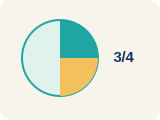
A number that shows part of a whole, like 3/4.Un número que muestra una parte de un todo, como 3/4.
1/2 means 1 out of 2 equal parts — like cutting a sandwich in half and taking one piece
ReciprocalRecíproco
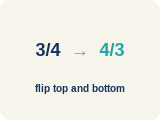
A fraction turned upside down.Una fracción volteada de arriba abajo.
The reciprocal of 2/3 is 3/2. Flip the fraction to divide: 6 ÷ 2/3 = 6 × 3/2
Keep, Change, FlipMantener, cambiar, invertir
A shortcut for dividing fractions: keep the first number, change ÷ to ×, flip the second. It works because dividing by a fraction gives the same answer as multiplying by its reciprocal.Un atajo para dividir fracciones: deja el primer número, cambia ÷ por × y voltea el segundo. Funciona porque dividir entre una fracción da lo mismo que multiplicar por su recíproco.
6 ÷ 1/3 → Keep 6, Change ÷ to ×, Flip 1/3 to 3/1 → 6 × 3 = 18
Loading the model…
1. Try this1. Prueba esto
How many 3/4-unit pieces fit into 5 1/2 units? Predict before checking.
Separate the exact quotient from the number of complete pieces.
Check the used length and remaining ribbon with multiplication and subtraction.
3. Check yourself3. Compruébalo
Answer a question about your model, then one new problem without it.Responde una pregunta sobre tu modelo y luego un problema nuevo sin él.
Read the idea, follow the worked examples, and connect the picture to the numbers.Lee la idea, sigue los ejemplos resueltos y conecta el dibujo con los números.
1Step 1 of 9:Paso 1 de 9:Words to knowPalabras clave
Say what each word means, then tap the card to check.Di qué significa cada palabra y luego toca la tarjeta para comprobar.
2Step 2 of 9:Paso 2 de 9:Check the wordsComprueba las palabras
3Step 3 of 9:Paso 3 de 9:How do I divide a whole number by a fraction?¿Cómo divido un número entero entre una fracción?
Dividing a whole number by a fraction asks how many of those pieces fit, or how much is in one whole. 4 ÷ 1/2 counts halves: every whole holds 2 halves, so the answer is 4 × 2 = 8. That is why the shortcut called Keep, Change, Flip works — dividing by a fraction gives the same answer as multiplying by its reciprocal. Check by multiplying: 8 × 1/2 = 4.Dividir un número entero entre una fracción pregunta cuántas de esas piezas caben, o cuánto hay en un entero. 4 ÷ 1/2 cuenta medios: cada entero tiene 2 medios, así que la respuesta es 4 × 2 = 8. Por eso funciona el atajo llamado Conserva, Cambia, Voltea: dividir entre una fracción da lo mismo que multiplicar por su recíproco. Comprueba multiplicando: 8 × 1/2 = 4.
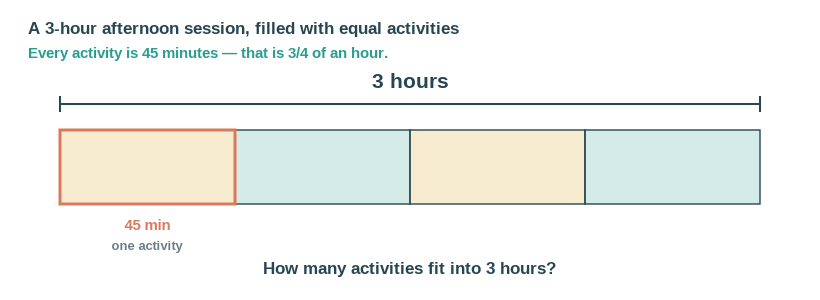
A STEM summer camp has a 3-hour afternoon session. Campers choose from afternoon activities that are each 45 minutes long.Un campamento de verano de ciencias tiene una sesión de 3 horas por la tarde. Los campistas escogen entre actividades de la tarde que duran 45 minutos cada una.
4Step 4 of 9:Paso 4 de 9:Watch meMírame
Watch me
Agent Park has 4 pounds of powder and each bag holds 1/2 pound. I want 4 ÷ 1/2.El agente Park tiene 4 libras de polvo y cada bolsa guarda 1/2 libra. Quiero 4 ÷ 1/2.
Each pound fills 2 half-pound bags, so 4 pounds fill 4 × 2 = 8 bags.Cada libra llena 2 bolsas de media libra, así que 4 libras llenan 4 × 2 = 8 bolsas.
That is the same as multiplying by the reciprocal of 1/2: 4 × 2/1 = 8. Dividing by 1/2 doubles the count, because every whole holds 2 halves.Eso es lo mismo que multiplicar por el recíproco de 1/2: 4 × 2/1 = 8. Dividir entre 1/2 duplica la cuenta, porque cada entero tiene 2 medios.
Check by multiplying: 8 bags × 1/2 pound = 4 pounds. So 4 ÷ 1/2 = 8. He can fill 8 bags.Compruebo multiplicando: 8 bolsas × 1/2 libra = 4 libras. Entonces 4 ÷ 1/2 = 8. Puede llenar 8 bolsas.
5Step 5 of 9:Paso 5 de 9:Let’s do one togetherHagamos uno juntos
Before each step, say what you think comes next. Then show it.Antes de cada paso, di qué crees que sigue. Luego muéstralo.
Let's try together
Let's try 3 ÷ 1/4 together. How many 1/4s fit in 3? Each whole holds 4 fourths.Probemos 3 ÷ 1/4 juntos. ¿Cuántos 1/4 caben en 3? Cada entero tiene 4 cuartos.
So 3 wholes hold 3 × 4 = 12 fourths — the same as 3 × 4/1, multiplying by the reciprocal.Así que 3 enteros tienen 3 × 4 = 12 cuartos, lo mismo que 3 × 4/1, multiplicar por el recíproco.
Check by multiplying: 12 × 1/4 = 12/4 = 3. So 3 ÷ 1/4 = 12.Comprueba multiplicando: 12 × 1/4 = 12/4 = 3. Entonces 3 ÷ 1/4 = 12.
6Step 6 of 9:Paso 6 de 9:Your turnTu turno
Now it's your turn
Now use the number line to show how many 1/4-jumps fit into 3 — a new problem, not the 4 ÷ 1/2 we just watched.Ahora usa la recta numérica para mostrar cuántos saltos de 1/4 caben en 3 — un problema nuevo, no el 4 ÷ 1/2 que acabamos de ver.
Then try one that asks how much is in ONE whole: 6 cups of rice fill 3/4 of a pot. 6 ÷ 3/4 = 6 × 4/3 = 8 cups fill the whole pot, and 3/4 × 8 = 6 checks it.Luego prueba uno que pregunta cuánto hay en UN entero: 6 tazas de arroz llenan 3/4 de una olla. 6 ÷ 3/4 = 6 × 4/3 = 8 tazas llenan la olla entera, y 3/4 × 8 = 6 lo comprueba.
7Step 7 of 9:Paso 7 de 9:Check yourself: a first questionCompruébalo: una primera pregunta
8Step 8 of 9:Paso 8 de 9:Check yourself: a harder questionCompruébalo: una pregunta más difícil
9Step 9 of 9:Paso 9 de 9:Put it togetherJúntalo todo
Watch out for a common mistakeCuidado con un error común
A common mistake in Divide Whole Numbers by Fractions is doing 'Keep, Change' but skipping the 'Flip' — students multiply by the divisor as it is instead of by its reciprocal. For example, for 6 ÷ 3/4, a student might write 6 × 3/4 = 4 1/2 and stop there, but the divisor 3/4 must be flipped to 4/3 first: 6 × 4/3 = 24/3 = 8. Before you submit, check: did I flip the second fraction (the divisor) upside down before multiplying?
Sentence frameMarco de oración
3 ÷ 1/4 = 12 because it takes ___ jumps of ___ to get from 0 to ___.3 ÷ 1/4 = 12 porque se necesitan ___ saltos de ___ para ir de 0 a ___.
Stage 3 of 5Etapa 3 de 5
PracticePractica
Choose Regular or Challenge. Hints come one step at a time; you get a new question after a worked example.Elige Regular o Reto. Las pistas llegan paso a paso; después de un ejemplo resuelto recibes una pregunta nueva.
Loading practice…
Stage 4 of 5Etapa 4 de 5
ApplyAplica
Use the idea in a real situation. Write your reasoning, then compare it with a sample.Usa la idea en una situación real. Escribe tu razonamiento y compáralo con un ejemplo.
Apply in context: Team waterAplica en contexto: Agua para los equipos
A coach has 10 gallons of water. She fills bottles that each hold 2/5 gallon. Then she shares the filled bottles equally among 5 teams. How many bottles does each team get?Una entrenadora tiene 10 galones de agua. Llena botellas que caben 2/5 de galón cada una. Luego reparte las botellas llenas en partes iguales entre 5 equipos. ¿Cuántas botellas recibe cada equipo?
Step 1 · Guide mePaso 1 · Guíame
How many 2/5-gallon bottles can she fill from 1 gallon?¿Cuántas botellas de 2/5 de galón puede llenar con 1 galón?
bottlesbotellas
Step 2 · Final answerPaso 2 · Respuesta final
bottlesbotellas
Real-world connectionConexión con el mundo real
A detective has 10 feet of rope to section off a crime scene. Each section needs to be 1/4 of a foot long for detailed evidence markers. How many markers can the detective set up?Un detective tiene 10 pies de cuerda para acordonar una escena del crimen. Cada sección debe medir 1/4 de pie para poner marcadores detallados de evidencia. ¿Cuántos marcadores puede poner el detective?
Marker Sections in One FootSecciones de marcador en un pie
One foot of rope splits into four 1/4-foot markers, so each whole foot makes 4 markers and all 10 feet make 10 x 4 = 40 (10 divided by 1/4 = 40).Un pie de cuerda se parte en cuatro marcadores de 1/4 de pie, así que cada pie entero hace 4 marcadores y los 10 pies hacen 10 x 4 = 40 (10 dividido entre 1/4 = 40).
Question:Pregunta:How does dividing a whole number by a fraction help the detective?¿Cómo ayuda dividir un número entero entre una fracción al detective?
The detective can set up markers because 10 ÷ 1/4 = .El detective puede poner marcadores porque 10 ÷ 1/4 = .
Reasoning challengeReto de razonamiento
A pizza shop has 8 whole pizzas. Each serving is 2/3 of a pizza. How many servings can they make? Write and solve an equation, then explain why the answer is greater than 8.Una pizzería tiene 8 pizzas enteras. Cada porción es 2/3 de una pizza. ¿Cuántas porciones pueden hacer? Escribe y resuelve una ecuación y después explica por qué la respuesta es mayor que 8.
The equation is 8 ÷ 2/3 = ___. Using the reciprocal shortcut: 8 × 3/2 = ___. The answer is greater than 8 because ___.
Create & verify: Divide Whole Numbers by FractionsCrea y verifica
Write a story problem where a whole number of pounds, feet, or hours is divided by a unit or non-unit fraction (like 6 ÷ 2/3). Solve it and explain why the quotient is larger than the whole number.Escribe un problema donde un número entero de libras, pies u horas se divida entre una fracción (como 6 ÷ 2/3). Resuélvelo y explica por qué el cociente es mayor que el entero.
Quick test bench (try numbers or expressions)Banco de prueba rápido (prueba números o expresiones)
Stage 5 of 5Etapa 5 de 5
ReflectReflexiona
Answer on your own. Your first try counts as independent evidence; you can still revise.Responde por tu cuenta. Tu primer intento cuenta como evidencia independiente; todavía puedes revisar.