Background knowledgeConocimientos previos2 skills you need for today: Read an ordered pair: across, then up · Place negatives and decimals on a number lineLas 2 destrezas que necesitas hoy: Leer un par ordenado: primero de lado, luego arriba · Ubicar negativos y decimales en la recta numérica
Graph on the Coordinate PlaneRepresentar en el plano de coordenadas:Plot a point by moving horizontally to its x-coordinate and vertically to its y-coordinate.Ubicar un punto moviéndose horizontalmente hasta su coordenada x y verticalmente hasta su coordenada y.
Read the words below.Lee las palabras de abajo.
Open the model and change one number at a time.Abre el modelo y cambia un número a la vez.
Answer the questions beside the model, one at a time.Responde las preguntas junto al modelo, una a la vez.
Words to knowPalabras clave
Coordinate planePlano cartesiano
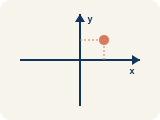
A grid with a line going across and a line going up to plot points.Una cuadrícula con una línea horizontal y una vertical para marcar puntos.
A grid with a horizontal line (x-axis) crossing a vertical line (y-axis), making four sections
Ordered pairPar ordenado
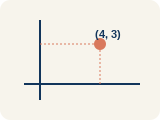
Two numbers (x, y) that tell where a point is on a grid.Dos números (x, y) que dicen dónde está un punto en una cuadrícula.
(3, 5) means move right 3 from the origin, then up 5
OriginOrigen
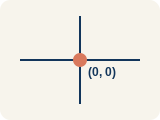
The point (0, 0) where the two grid lines cross.El punto (0, 0) donde se cruzan las dos líneas de la cuadrícula.
The starting point at the center where both axes cross — (0, 0)
QuadrantCuadrante
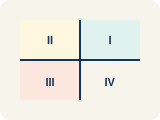
One of the four parts of a coordinate grid, numbered I to IV.Una de las cuatro partes de una cuadrícula de coordenadas, numeradas I a IV.
I (+,+) top-right, II (-,+) top-left, III (-,-) bottom-left, IV (+,-) bottom-right
Loading the model…
1. Try this1. Prueba esto
Move from A to B along their shared horizontal street. Find the distance.
Put points on opposite sides of an axis with one coordinate shared.
Explain why |x₂ − x₁| measures a horizontal distance and not every possible route.
3. Check yourself3. Compruébalo
Answer a question about your model, then one new problem without it.Responde una pregunta sobre tu modelo y luego un problema nuevo sin él.
Read the idea, follow the worked examples, and connect the picture to the numbers.Lee la idea, sigue los ejemplos resueltos y conecta el dibujo con los números.
1Step 1 of 9:Paso 1 de 9:Words to knowPalabras clave
Say what each word means, then tap the card to check.Di qué significa cada palabra y luego toca la tarjeta para comprobar.
2Step 2 of 9:Paso 2 de 9:Check the wordsComprueba las palabras
3Step 3 of 9:Paso 3 de 9:How do you plot a point on the coordinate plane?¿Cómo marcas un punto en el plano de coordenadas?
An ordered pair (x, y) is two numbers that tell you exactly where a point goes. The first number moves you right or left. The second number moves you up or down.Un par ordenado (x, y) son dos números que dicen exactamente dónde va un punto. El primer número te mueve a la derecha o a la izquierda. El segundo te mueve hacia arriba o hacia abajo.
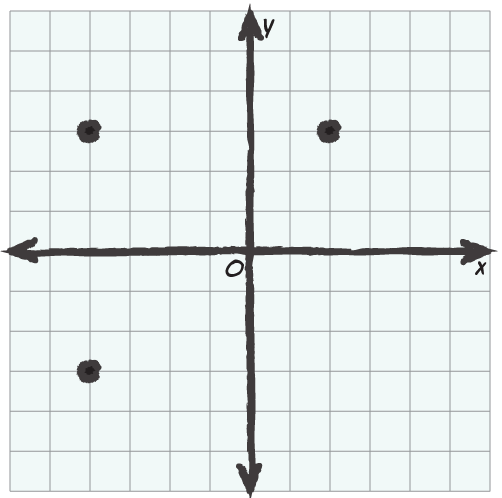
Three points are plotted on this coordinate grid. Only one of them sits to the right of and above the origin O, where the two number lines cross — the other two are on the far side of one of those lines.Se marcan tres puntos en esta cuadrícula de coordenadas. Solo uno de ellos queda a la derecha y arriba del origen O, donde se cruzan las dos rectas numéricas — los otros dos están del otro lado de una de esas rectas.
4Step 4 of 9:Paso 4 de 9:Watch meMírame
Watch me
I will plot the point (5, 4). The 5 is the x-coordinate, and the 4 is the y-coordinate.Voy a marcar el punto (5, 4). El 5 es la coordenada x, y el 4 es la coordenada y.
I start at the origin, which is (0, 0).Empiezo en el origen, que es (0, 0).
First I move 5 units to the right along the x-axis.Primero me muevo 5 unidades a la derecha por el eje x.
Then I move 4 units up. I place my dot. That is the point (5, 4).Luego me muevo 4 unidades hacia arriba. Coloco mi punto. Ese es el punto (5, 4).
5Step 5 of 9:Paso 5 de 9:Let’s do one togetherHagamos uno juntos
Before each step, say what you think comes next. Then show it.Antes de cada paso, di qué crees que sigue. Luego muéstralo.
Let's try together
Now let's plot (2, 1). Where do we start? At the origin (0, 0).Ahora marquemos (2, 1). ¿Dónde empezamos? En el origen (0, 0).
How far do we move right? The first number is 2, so we move 2 right.¿Cuánto nos movemos a la derecha? El primer número es 2, así que nos movemos 2 a la derecha.
How far do we move up? The second number is 1, so we move 1 up and place the dot.¿Cuánto nos movemos hacia arriba? El segundo número es 1, así que subimos 1 y colocamos el punto.
6Step 6 of 9:Paso 6 de 9:Your turnTu turno
Now it's your turn
In the explore, plot Captain Vega's waypoints (2, 1), (5, 4), and (8, 1) to trace the treasure route.En la exploración, marca los puntos de referencia de la capitana Vega (2, 1), (5, 4) y (8, 1) para trazar la ruta del tesoro.
7Step 7 of 9:Paso 7 de 9:Check yourself: a first questionCompruébalo: una primera pregunta
8Step 8 of 9:Paso 8 de 9:Check yourself: a harder questionCompruébalo: una pregunta más difícil
9Step 9 of 9:Paso 9 de 9:Put it togetherJúntalo todo
Watch out for a common mistakeCuidado con un error común
A common mistake in Graph on the Coordinate Plane is swapping the order of the coordinates — moving up/down first instead of right/left first. For example, when plotting (5, 2), students often move up 5 and right 2, landing on the wrong point (2, 5) instead of (5, 2). Remember: the x-coordinate (first number) always tells you how far to move right or left along the x-axis; the y-coordinate (second number) tells you how far up or down along the y-axis.
Sentence frameMarco de oración
The first number in the ordered pair tells me ___ and the second number tells me ___. The point (5, 4) means ___.El primer número del par ordenado me dice ___ y el segundo número me dice ___. El punto (5, 4) significa ___.
Stage 3 of 5Etapa 3 de 5
PracticePractica
Choose Regular or Challenge. Hints come one step at a time; you get a new question after a worked example.Elige Regular o Reto. Las pistas llegan paso a paso; después de un ejemplo resuelto recibes una pregunta nueva.
Loading practice…
Stage 4 of 5Etapa 4 de 5
ApplyAplica
Use the idea in a real situation. Write your reasoning, then compare it with a sample.Usa la idea en una situación real. Escribe tu razonamiento y compáralo con un ejemplo.
Apply in context: Robot movesAplica en contexto: Movimientos del robot
A robot starts at the origin (0, 0). It moves 7 units right and 3 units up to point P. Then it moves 2 units right and 5 units up to point Q. What is the y-coordinate of Q?Un robot empieza en el origen (0, 0). Se mueve 7 unidades a la derecha y 3 unidades hacia arriba hasta el punto P. Luego se mueve 2 unidades a la derecha y 5 unidades hacia arriba hasta el punto Q. ¿Cuál es la coordenada y de Q?
Step 1 · Guide mePaso 1 · Guíame
What is the y-coordinate of P?¿Cuál es la coordenada y de P?
Step 2 · Final answerPaso 2 · Respuesta final
Real-world connectionConexión con el mundo real
A drone delivery company programs flight paths using coordinate pairs. A drone starts at the warehouse (0, 0), flies to pickup at (3, 6), then delivers to (8, 2), then returns to base (0, 0).Una empresa de entregas con drones programa rutas de vuelo usando pares de coordenadas. Un dron sale de la bodega (0, 0), vuela a recoger en (3, 6), luego entrega en (8, 2) y luego regresa a la base (0, 0).
Drone Flight Path TriangleTriángulo de la ruta de vuelo del dron
Each ordered pair (x, y) places a stop: read x for the sideways move, y for the up move — connect Base to Pickup to Delivery and back to see the triangle.Cada par ordenado (x, y) ubica una parada: lee la x para el movimiento de lado, la y para el movimiento hacia arriba — conecta base con recogida, con entrega y de regreso para ver el triángulo.
Question:Pregunta:How do ordered pairs help the drone navigate? What shape does the flight path make?¿Cómo ayudan los pares ordenados a que el dron navegue? ¿Qué forma hace la ruta de vuelo?
The drone uses ordered pairs because the first number controls movement and the second controls . The path makes a shape.El dron usa pares ordenados porque el primer número controla el movimiento y el segundo controla el . La ruta hace una forma de .
Reasoning challengeReto de razonamiento
A student says that (3, 5) and (5, 3) are the same point because they use the same numbers. Is the student correct? Explain why or why not, and describe where each point is located on the coordinate plane.Un estudiante dice que (3, 5) y (5, 3) son el mismo punto porque usan los mismos números. ¿Tiene razón? Explica por qué sí o por qué no y describe dónde se ubica cada punto en el plano de coordenadas.
The student is ___ because (3, 5) means ___ while (5, 3) means ___. The ORDER matters because ___.
Create & verify: Represent Rational Numbers on the Coordinate PlaneCrea y verifica
Invent a treasure map with 4 landmarks placed in all four quadrants using fractional or decimal coordinates (like (−2.5, 3)). Name the quadrant for each point and explain what the signs tell you.Inventa un mapa del tesoro con 4 puntos en los cuatro cuadrantes usando coordenadas decimales o fraccionarias. Nombra el cuadrante de cada punto y explica qué indican los signos.
Quick test bench (try numbers or expressions)Banco de prueba rápido (prueba números o expresiones)
Stage 5 of 5Etapa 5 de 5
ReflectReflexiona
Answer on your own. Your first try counts as independent evidence; you can still revise.Responde por tu cuenta. Tu primer intento cuenta como evidencia independiente; todavía puedes revisar.