I can draw polygons from their vertex coordinates on the coordinate plane, and use coordinates to find side lengths and solve perimeter and area problems.
Your work saves on this device.Tu trabajo se guarda en este dispositivo.
Background knowledgeConocimientos previos2 skills you need for today: Side length from two corner points · Perimeter and area of a rectangleLas 2 destrezas que necesitas hoy: Longitud de un lado con dos vértices · Perímetro y área de un rectángulo
Read the words below.Lee las palabras de abajo.
Open the model and change one number at a time.Abre el modelo y cambia un número a la vez.
Answer the questions beside the model, one at a time.Responde las preguntas junto al modelo, una a la vez.
Words to knowPalabras clave
vertexvértice
A corner point of a polygon, named by an ordered pair on the coordinate plane.Un punto de esquina de un polígono, nombrado por un par ordenado en el plano de coordenadas.
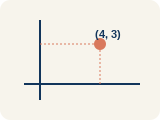
The park's corner at (2, 4) — one corner, named by an ordered pair.
polygonpolígono
A closed figure made of line segments; on the plane you draw it by plotting the vertices and connecting them in order.Una figura cerrada hecha de segmentos; en el plano se dibuja marcando los vértices y conectándolos en orden.
Plot (2, 4), (5, 4), (5, −4), (2, −4) and join them — a rectangle appears.
perimeterperímetro
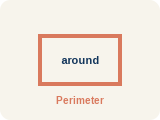
The total distance around a polygon — the sum of all its side lengths.La distancia total alrededor de un polígono: la suma de todos sus lados.
2(9.5) + 2(6.75) = 32.5 units around the deck.
distance between verticesdistancia entre vértices
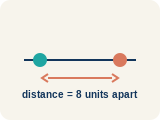
When two vertices share an x- or y-coordinate, the distance between them is the absolute difference of the other coordinates.Cuando dos vértices comparten una coordenada x o y, la distancia es la diferencia absoluta de las otras coordenadas.
(2, 4) and (5, 4) share y, so the side is |5 − 2| = 3 units.
Loading the model…
1. Try this1. Prueba esto
Use the two control points as opposite corners. Name the other corners.
Find width and height from coordinate differences.
Move the whole rectangle across an axis without changing its dimensions. What stays fixed?
3. Check yourself3. Compruébalo
Answer a question about your model, then one new problem without it.Responde una pregunta sobre tu modelo y luego un problema nuevo sin él.
Read the idea, follow the worked examples, and connect the picture to the numbers.Lee la idea, sigue los ejemplos resueltos y conecta el dibujo con los números.
1Step 1 of 9:Paso 1 de 9:Words to knowPalabras clave
Say what each word means, then tap the card to check.Di qué significa cada palabra y luego toca la tarjeta para comprobar.
2Step 2 of 9:Paso 2 de 9:Check the wordsComprueba las palabras
3Step 3 of 9:Paso 3 de 9:The coordinates already know the side lengthsLas coordenadas ya saben las longitudes de los lados
Graph the points, connect them in order, and the polygon appears. Then the same coordinates that placed the corners tell you exactly how long each side is.Grafica los puntos, únelos en orden y aparece el polígono. Luego las mismas coordenadas que colocaron los vértices te dicen exactamente qué tan largo es cada lado.
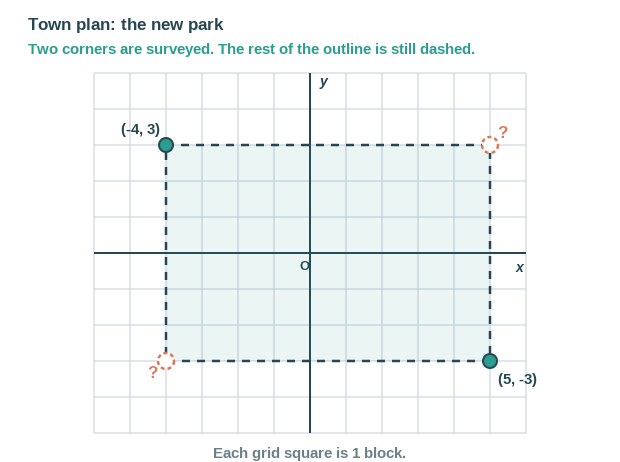
A town-planning map shows a grid with two corner points of a future rectangular park already marked. The rest of the park is drawn only as a dashed outline waiting for its other two corners.Un mapa de planeación urbana muestra una cuadrícula con dos puntos de esquina de un futuro parque rectangular ya marcados. El resto del parque está dibujado solo como un contorno punteado esperando sus otras dos esquinas.
4Step 4 of 9:Paso 4 de 9:Watch meMírame
Watch me find one side
(-4.5, 3) and (5, 3) share y = 3, so the side between them is horizontal.(-4.5, 3) y (5, 3) comparten y = 3, así que el lado entre ellos es horizontal.
Its length is the distance between the x-coordinates: |5 − (−4.5)| = 9.5 units.Su longitud es la distancia entre las coordenadas x: |5 − (−4.5)| = 9.5 unidades.
(5, 3) and (5, -3.75) share x = 5, so that side is vertical: |3 − (−3.75)| = 6.75 units.(5, 3) y (5, -3.75) comparten x = 5, así que ese lado es vertical: |3 − (−3.75)| = 6.75 unidades.
5Step 5 of 9:Paso 5 de 9:Let’s do one togetherHagamos uno juntos
Before each step, say what you think comes next. Then show it.Antes de cada paso, di qué crees que sigue. Luego muéstralo.
Let's finish the perimeter together
The shape is a rectangle, so the opposite sides match: two sides of 9.5 and two of 6.75.La figura es un rectángulo, así que los lados opuestos coinciden: dos lados de 9.5 y dos de 6.75.
That is why two of the terms are multiplied by 2 — each length appears on two sides.Por eso dos de los términos se multiplican por 2 — cada longitud aparece en dos lados.
6Step 6 of 9:Paso 6 de 9:Your turnTu turno
Now you try
A square has vertices (1, 2), (6, 2), (6, -3), (1, -3). Find one side length from the coordinates, then the perimeter.Un cuadrado tiene vértices (1, 2), (6, 2), (6, -3), (1, -3). Halla la longitud de un lado con las coordenadas y luego el perímetro.
Say which pair of vertices you used and why their shared coordinate mattered.Di qué par de vértices usaste y por qué importó la coordenada que comparten.
7Step 7 of 9:Paso 7 de 9:Check yourself: a first questionCompruébalo: una primera pregunta
8Step 8 of 9:Paso 8 de 9:Check yourself: a harder questionCompruébalo: una pregunta más difícil
9Step 9 of 9:Paso 9 de 9:Put it togetherJúntalo todo
Watch out for a common mistakeCuidado con un error común
Subtracting coordinates without the absolute value — from y = 3 down to y = −3.75 the distance is 3 + 3.75 = 6.75 units, not 3.75 − 3 = 0.75. Distances that cross zero are the whole reason the absolute value is there.
Sentence frameMarco de oración
Subtracting works when the two vertices share ___, so for ___ I cannot ___.Restar funciona cuando los dos vértices comparten ___, así que para ___ no puedo ___.
Stage 3 of 5Etapa 3 de 5
PracticePractica
Choose Regular or Challenge. Hints come one step at a time; you get a new question after a worked example.Elige Regular o Reto. Las pistas llegan paso a paso; después de un ejemplo resuelto recibes una pregunta nueva.
Loading practice…
Stage 4 of 5Etapa 4 de 5
ApplyAplica
Use the idea in a real situation. Write your reasoning, then compare it with a sample.Usa la idea en una situación real. Escribe tu razonamiento y compáralo con un ejemplo.
Apply in context: Playground fenceAplica en contexto: Cerca del patio de recreo
A rectangular playground has vertices at (1, 2), (8, 2), (8, 5), and (1, 5). Each unit on the map is 1 meter. How many meters of fence go around the playground?Un patio de recreo rectangular tiene vértices en (1, 2), (8, 2), (8, 5) y (1, 5). Cada unidad del mapa es 1 metro. ¿Cuántos metros de cerca rodean el patio?
Step 1 · Guide mePaso 1 · Guíame
How many meters is the length, from x = 1 to x = 8?¿Cuántos metros mide el largo, de x = 1 a x = 8?
metersmetros
Step 2 · Final answerPaso 2 · Respuesta final
metersmetros
Real-world connectionConexión con el mundo real
Designing the Town Square: a rectangular park will have an area of 240,000 square feet. Two vertices are already marked on the planning grid, 3 units apart, and each grid unit represents 100 feet.Diseñando la plaza del pueblo: un parque rectangular tendrá un área de 240,000 pies cuadrados. Dos vértices ya están marcados en la cuadrícula de planeación, a 3 unidades de distancia, y cada unidad de la cuadrícula representa 100 pies.
Question:Pregunta:Where do the other two vertices go — and how do the known coordinates, the scale, and the area work together to tell you?¿A dónde van los otros dos vértices — y cómo trabajan juntas las coordenadas conocidas, la escala y el área para decírtelo?
The park's width is feet. Using the area formula, its length is feet, which is units on the map — so the new vertices sit that many units below the known ones.El ancho del parque es pies. Usando la fórmula del área, su largo es pies, que son unidades en el mapa — así que los vértices nuevos quedan esa cantidad de unidades debajo de los conocidos.
Reasoning challengeReto de razonamiento
The park design used width from coordinates, then length from the area, then the scale to place the missing vertices. Design your own version: pick an area and a scale, mark two vertices, and show where the other two go.El diseño del parque usó el ancho de las coordenadas, luego el largo del área, y luego la escala para ubicar los vértices que faltaban. Diseña tu propia versión: escoge un área y una escala, marca dos vértices y muestra dónde van los otros dos.
Create & verify: Represent Polygons on the Coordinate PlaneCrea y verifica
Give the 4 vertices of a rectangle that crosses at least one axis on the coordinate plane. Calculate its side lengths, perimeter, and area from the coordinates.Da los 4 vértices de un rectángulo que cruce al menos un eje en el plano coordenado. Calcula sus lados, perímetro y área a partir de las coordenadas.
Quick test bench (try numbers or expressions)Banco de prueba rápido (prueba números o expresiones)
Stage 5 of 5Etapa 5 de 5
ReflectReflexiona
Answer on your own. Your first try counts as independent evidence; you can still revise.Responde por tu cuenta. Tu primer intento cuenta como evidencia independiente; todavía puedes revisar.