Background knowledgeConocimientos previos2 skills you need for today: Plot a point: x across, then y · Negative means the opposite directionLas 2 destrezas que necesitas hoy: Ubicar un punto: primero x, luego y · Negativo significa la dirección opuesta
Ordered Pairs in All Four QuadrantsPares ordenados en los cuatro cuadrantes:Points written as (x, y) whose positive or negative coordinates place them in one of four quadrants.Puntos escritos como (x, y) cuyas coordenadas positivas o negativas los ubican en uno de cuatro cuadrantes.
Read the words below.Lee las palabras de abajo.
Open the model and change one number at a time.Abre el modelo y cambia un número a la vez.
Answer the questions beside the model, one at a time.Responde las preguntas junto al modelo, una a la vez.
Words to knowPalabras clave
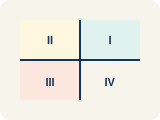
QuadrantCuadrante
One of the four parts of a coordinate grid, numbered I to IV.Una de las cuatro partes de una cuadrícula de coordenadas, numeradas I a IV.
I (+, +) top-right, II (-, +) top-left, III (-, -) bottom-left, IV (+, -) bottom-right
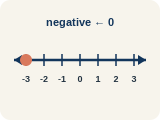
Negative coordinateCoordenada negativa
A coordinate less than zero. It means left or below the center point.Una coordenada menor que cero. Significa a la izquierda o debajo del centro.
(-3, 2) means 3 left and 2 up from the origin
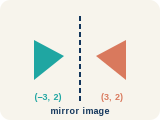
ReflectionReflexión
A flipped, mirror image across a line.Una imagen reflejada al otro lado de una línea.
(3, 2) reflected over the y-axis is (-3, 2) — same distance, opposite side
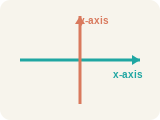
AxisEje
One of the two number lines that frame a graph: the x-axis runs across, the y-axis runs up and down.Una de las dos rectas numéricas que enmarcan una gráfica: el eje x va horizontal y el eje y va vertical.
The x-axis goes left-right; the y-axis goes up-down; they cross at (0, 0)
Loading the model…
1. Try this1. Prueba esto
Use the two control points as opposite corners. Name the other corners.
Find width and height from coordinate differences.
Move the whole rectangle across an axis without changing its dimensions. What stays fixed?
3. Check yourself3. Compruébalo
Answer a question about your model, then one new problem without it.Responde una pregunta sobre tu modelo y luego un problema nuevo sin él.
Read the idea, follow the worked examples, and connect the picture to the numbers.Lee la idea, sigue los ejemplos resueltos y conecta el dibujo con los números.
1Step 1 of 9:Paso 1 de 9:Words to knowPalabras clave
Say what each word means, then tap the card to check.Di qué significa cada palabra y luego toca la tarjeta para comprobar.
2Step 2 of 9:Paso 2 de 9:Check the wordsComprueba las palabras
3Step 3 of 9:Paso 3 de 9:How do you plot points in all four quadrants?¿Cómo marcas puntos en los cuatro cuadrantes?
The coordinate plane has four parts called quadrants. A negative coordinate means you move left (for x) or down (for y) from the origin instead of right or up.El plano de coordenadas tiene cuatro partes llamadas cuadrantes. Una coordenada negativa significa que te mueves a la izquierda (para x) o hacia abajo (para y) desde el origen, en lugar de a la derecha o hacia arriba.
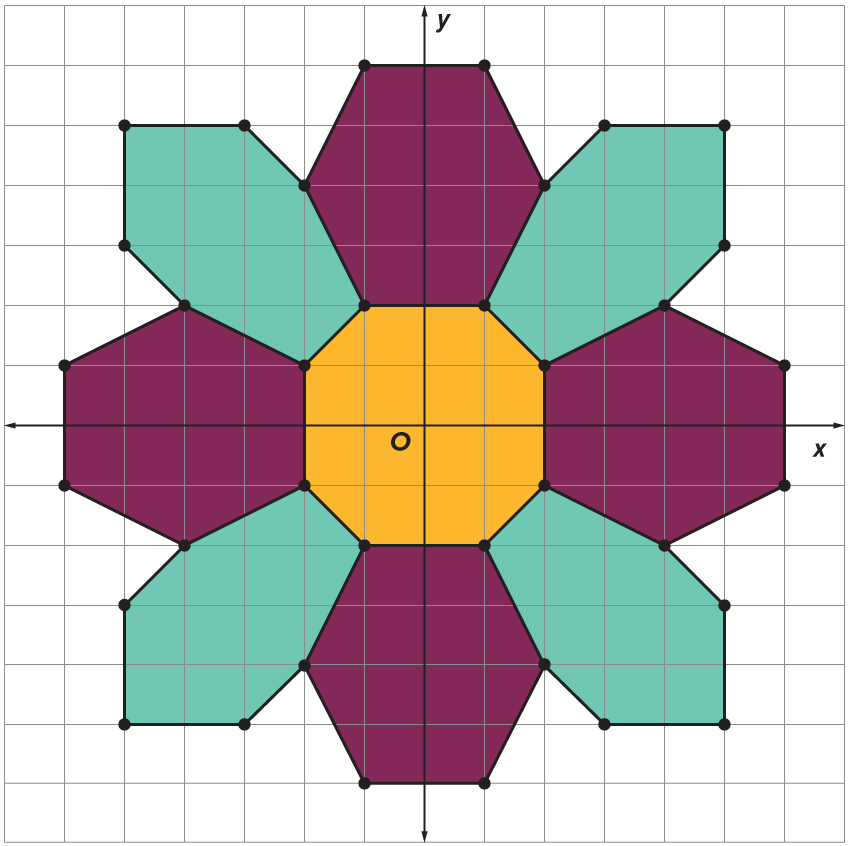
A colorful eight-petaled flower design sits on a coordinate grid. An orange octagon is centered on the origin O, four maroon hexagon petals point straight up, down, left, and right along the axes, and four teal petals fill the space between them.Un diseño colorido de flor de ocho pétalos sobre una cuadrícula de coordenadas. Un octágono anaranjado está centrado en el origen O, cuatro pétalos hexagonales color vino apuntan derecho hacia arriba, abajo, izquierda y derecha a lo largo de los ejes, y cuatro pétalos color verde azulado llenan el espacio entre ellos.
4Step 4 of 9:Paso 4 de 9:Watch meMírame
Watch me
I will plot (-3, -4). I start at the origin (0, 0).Voy a marcar (-3, -4). Empiezo en el origen (0, 0).
The x is -3, which is negative, so I move 3 units to the LEFT.La x es -3, que es negativa, así que me muevo 3 unidades a la izquierda.
The y is -4, which is negative, so I move 4 units DOWN. I place my dot.La y es -4, que es negativa, así que me muevo 4 unidades hacia abajo. Coloco mi punto.
Both coordinates are negative, so the point is in Quadrant III.Las dos coordenadas son negativas, así que el punto está en el cuadrante III.
5Step 5 of 9:Paso 5 de 9:Let’s do one togetherHagamos uno juntos
Before each step, say what you think comes next. Then show it.Antes de cada paso, di qué crees que sigue. Luego muéstralo.
Let's try together
Now let's plot (-5, 2). The x is -5, so which way do we move? Left 5 units.Ahora marquemos (-5, 2). La x es -5, entonces ¿hacia dónde nos movemos? 5 unidades a la izquierda.
The y is 2, which is positive, so which way? Up 2 units.La y es 2, que es positiva, entonces ¿hacia dónde? 2 unidades hacia arriba.
Left and up lands us in which quadrant? Quadrant II.A la izquierda y hacia arriba nos deja en ¿qué cuadrante? El cuadrante II.
6Step 6 of 9:Paso 6 de 9:Your turnTu turno
Now it's your turn
In the explore, plot each treasure clue like (4, 3) and (-5, 2) and name the quadrant it lands in.En la exploración, marca cada pista del tesoro como (4, 3) y (-5, 2) y nombra el cuadrante donde cae.
7Step 7 of 9:Paso 7 de 9:Check yourself: a first questionCompruébalo: una primera pregunta
8Step 8 of 9:Paso 8 de 9:Check yourself: a harder questionCompruébalo: una pregunta más difícil
9Step 9 of 9:Paso 9 de 9:Put it togetherJúntalo todo
Watch out for a common mistakeCuidado con un error común
A common mistake in Ordered Pairs in All Four Quadrants is matching each sign to the wrong axis — for example, seeing (-2, 5) and thinking "the x is negative so I move DOWN, and the y is positive so I move RIGHT," which lands the point in Quadrant IV. But the x-coordinate always controls left/right, never up/down: negative x means LEFT (not down), and positive y means UP (not right). So (-2, 5) is actually left 2, up 5 — Quadrant II. Before you submit, check that you used the x-coordinate for left/right and the y-coordinate for up/down, and never swapped them.
Sentence frameMarco de oración
In Quadrant ___, the x-coordinate is ___ and the y-coordinate is ___. I know (-3, -4) is in Quadrant ___ because both coordinates are ___.En el cuadrante ___, la coordenada x es ___ y la coordenada y es ___. Sé que (-3, -4) está en el cuadrante ___ porque las dos coordenadas son ___.
Stage 3 of 5Etapa 3 de 5
PracticePractica
Choose Regular or Challenge. Hints come one step at a time; you get a new question after a worked example.Elige Regular o Reto. Las pistas llegan paso a paso; después de un ejemplo resuelto recibes una pregunta nueva.
Loading practice…
Stage 4 of 5Etapa 4 de 5
ApplyAplica
Use the idea in a real situation. Write your reasoning, then compare it with a sample.Usa la idea en una situación real. Escribe tu razonamiento y compáralo con un ejemplo.
Apply in context: Drone pathAplica en contexto: Ruta del dron
A drone starts at (-5, 3). It flies 8 units right, then 7 units down, then 2 units left. What is the x-coordinate of its final position?Un dron empieza en (-5, 3). Vuela 8 unidades a la derecha, luego 7 unidades hacia abajo y luego 2 unidades a la izquierda. ¿Cuál es la coordenada x de su posición final?
Step 1 · Guide mePaso 1 · Guíame
How many units must the drone fly right to reach the y-axis?¿Cuántas unidades debe volar el dron a la derecha para llegar al eje y?
unitsunidades
Step 2 · Final answerPaso 2 · Respuesta final
Real-world connectionConexión con el mundo real
A city uses a coordinate grid to map locations. City Hall is at the origin (0, 0). The library is at (-3, 4), the park is at (5, -2), the school is at (2, 3), and the hospital is at (-4, -1).Una ciudad usa una cuadrícula de coordenadas para ubicar lugares. El ayuntamiento está en el origen (0, 0). La biblioteca está en (-3, 4), el parque en (5, -2), la escuela en (2, 3) y el hospital en (-4, -1).
City Map: Four-Quadrant LocationsMapa de la ciudad: ubicaciones en cuatro cuadrantes
City Hall sits at the origin; read each point's signs to see its quadrant — Library (-,+) is II, School (+,+) is I, Park (+,-) is IV, Hospital (-,-) is III.El ayuntamiento está en el origen; lee los signos de cada punto para ver su cuadrante — biblioteca (-,+) es II, escuela (+,+) es I, parque (+,-) es IV, hospital (-,-) es III.
Question:Pregunta:How do four-quadrant coordinates help a city map locations in every direction from the center?¿Cómo ayudan las coordenadas de cuatro cuadrantes a una ciudad a ubicar lugares en todas las direcciones desde el centro?
The library is in Quadrant because its x is and its y is . The park is in Quadrant because . Four-quadrant coordinates help because .La biblioteca está en el cuadrante porque su x es y su y es . El parque está en el cuadrante porque . Las coordenadas de cuatro cuadrantes ayudan porque .
Reasoning challengeReto de razonamiento
A point starts in Quadrant I at (4, 6). Describe a move that puts it in Quadrant III. What must happen to both coordinates? Can you give the exact new coordinates after your move?Un punto empieza en el cuadrante I en (4, 6). Describe un movimiento que lo lleve al cuadrante III. ¿Qué debe pasar con las dos coordenadas? ¿Puedes dar las coordenadas nuevas exactas después de tu movimiento?
To move from Quadrant I to Quadrant III, both coordinates must become ___. Starting at (4, 6), I could move ___ units left and ___ units down to reach (___,___), which is in Quadrant III because ___.
Create & verify: Ordered Pairs in All Four QuadrantsCrea y verifica
Write clues for a secret point in Quadrant II, III, or IV using distance from both axes (e.g., '3 units left of the y-axis and 4.5 units below the x-axis'). Give its ordered pair and explain how you know.Escribe pistas para un punto secreto en el Cuadrante II, III o IV usando distancias a ambos ejes. Da su par ordenado y explica cómo lo sabes.
Quick test bench (try numbers or expressions)Banco de prueba rápido (prueba números o expresiones)
Stage 5 of 5Etapa 5 de 5
ReflectReflexiona
Answer on your own. Your first try counts as independent evidence; you can still revise.Responde por tu cuenta. Tu primer intento cuenta como evidencia independiente; todavía puedes revisar.