Background knowledgeConocimientos previos2 skills you need for today: Opposites: same distance, other side of 0 · Distance from an axisLas 2 destrezas que necesitas hoy: Opuestos: misma distancia, otro lado del 0 · Distancia desde un eje
Reflect Points Across AxesReflejar puntos sobre los ejes:Flip a point across an axis so it stays the same perpendicular distance from that axis.Voltear un punto sobre un eje para que quede a la misma distancia perpendicular de ese eje.
Read the words below.Lee las palabras de abajo.
Open the model and change one number at a time.Abre el modelo y cambia un número a la vez.
Answer the questions beside the model, one at a time.Responde las preguntas junto al modelo, una a la vez.
Words to knowPalabras clave
ReflectionReflexión
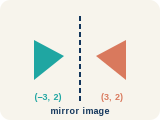
A flipped, mirror image across a line.Una imagen reflejada al otro lado de una línea.
(3, 2) reflected over the y-axis becomes (-3, 2) — x changes sign, y stays
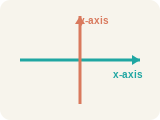
x-axisEje x
The line that goes across the grid. Flipping over it changes the y sign.La línea que va de lado en la cuadrícula. Voltear sobre ella cambia el signo de y.
(4, 3) → (4, -3): the y flips from +3 to -3, like folding the paper along the horizontal line
y-axisEje y
The line that goes up the grid. Flipping over it changes the x sign.La línea que va hacia arriba en la cuadrícula. Voltear sobre ella cambia el signo de x.
(4, 3) → (-4, 3): the x flips from +4 to -4, like folding the paper along the vertical line
SymmetrySimetría
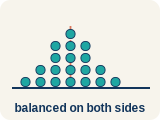
When a shape looks the same on both sides of a line.Cuando una figura se ve igual a ambos lados de una línea.
A butterfly's wings are symmetric — fold it down the middle and both sides match
Loading the model…
1. Try this1. Prueba esto
Reflect (−3, 4) across the y-axis, then across the x-axis.
Find a point that does not move when reflected across the x-axis.
Explain why negating both coordinates is not a single reflection across one axis.
3. Check yourself3. Compruébalo
Answer a question about your model, then one new problem without it.Responde una pregunta sobre tu modelo y luego un problema nuevo sin él.
Read the idea, follow the worked examples, and connect the picture to the numbers.Lee la idea, sigue los ejemplos resueltos y conecta el dibujo con los números.
1Step 1 of 9:Paso 1 de 9:Words to knowPalabras clave
Say what each word means, then tap the card to check.Di qué significa cada palabra y luego toca la tarjeta para comprobar.
2Step 2 of 9:Paso 2 de 9:Check the wordsComprueba las palabras
3Step 3 of 9:Paso 3 de 9:How do you reflect a point across an axis?¿Cómo reflejas un punto a través de un eje?
A reflection is a flip of a point over a line, like a mirror image. The axis you flip over decides which coordinate changes its sign.Una reflexión es voltear un punto sobre una línea, como una imagen en el espejo. El eje sobre el que volteas decide cuál coordenada cambia de signo.
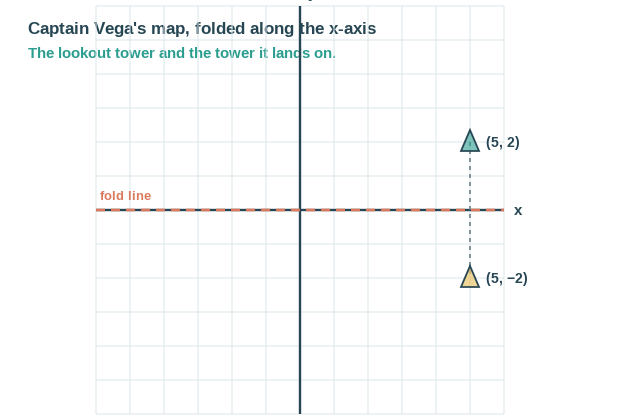
Captain Vega folds her treasure map along the x-axis. A lookout tower is marked at (5, 2), and after the fold, a matching tower symbol lines up at (5, -2) on the other side of the fold line.La capitana Vega dobla su mapa del tesoro a lo largo del eje x. Una torre de vigilancia está marcada en (5, 2), y después del doblez, un símbolo de torre igual queda alineado en (5, -2) del otro lado de la línea del doblez.
4Step 4 of 9:Paso 4 de 9:Watch meMírame
Watch me
I will reflect (3, 2) over the y-axis.Voy a reflejar (3, 2) sobre el eje y.
The y-axis is the vertical line, so the point flips left or right. That changes the x-coordinate.El eje y es la línea vertical, así que el punto se voltea a la izquierda o a la derecha. Eso cambia la coordenada x.
The x changes sign: 3 becomes -3. The y stays the same: 2 stays 2.La x cambia de signo: 3 se vuelve -3. La y queda igual: 2 sigue siendo 2.
So the reflection of (3, 2) over the y-axis is (-3, 2).Entonces la reflexión de (3, 2) sobre el eje y es (-3, 2).
5Step 5 of 9:Paso 5 de 9:Let’s do one togetherHagamos uno juntos
Before each step, say what you think comes next. Then show it.Antes de cada paso, di qué crees que sigue. Luego muéstralo.
Let's try together
Now let's reflect (4, -5) over the x-axis. Which coordinate changes over the x-axis? The y-coordinate.Ahora reflejemos (4, -5) sobre el eje x. ¿Qué coordenada cambia con el eje x? La coordenada y.
What does -5 become when it changes sign? It becomes 5.¿En qué se convierte -5 cuando cambia de signo? Se vuelve 5.
The x stays 4, so the reflection is what point? It is (4, 5).La x sigue siendo 4, entonces ¿cuál es el punto reflejado? Es (4, 5).
6Step 6 of 9:Paso 6 de 9:Your turnTu turno
Now it's your turn
In the explore, plot each point like (3, 5) and (-4, 2), then plot its reflection across the given axis.En la exploración, marca cada punto como (3, 5) y (-4, 2), y luego marca su reflexión a través del eje indicado.
7Step 7 of 9:Paso 7 de 9:Check yourself: a first questionCompruébalo: una primera pregunta
8Step 8 of 9:Paso 8 de 9:Check yourself: a harder questionCompruébalo: una pregunta más difícil
9Step 9 of 9:Paso 9 de 9:Put it togetherJúntalo todo
Watch out for a common mistakeCuidado con un error común
A common mistake in Reflect Points Across Axes is flipping the sign of the wrong coordinate — changing the x-coordinate when reflecting over the x-axis, instead of the y-coordinate (or vice versa for the y-axis). For example, to reflect (3, -5) over the x-axis, a student might flip the x-coordinate and write (-3, -5), but reflecting over the x-axis only changes the sign of the y-coordinate: (3, -5) becomes (3, 5). Before you submit, ask: 'Did I flip the sign of the coordinate that matches the axis I'm reflecting over — y for the x-axis, x for the y-axis?'
Sentence frameMarco de oración
When I reflect over the x-axis, the ___ -coordinate changes sign and the ___ -coordinate stays the same. When I reflect over the y-axis, the ___ -coordinate changes sign and the ___ -coordinate stays the same.Cuando reflejo a través del eje x, la coordenada ___ cambia de signo y la coordenada ___ se queda igual. Cuando reflejo a través del eje y, la coordenada ___ cambia de signo y la coordenada ___ se queda igual.
Stage 3 of 5Etapa 3 de 5
PracticePractica
Choose Regular or Challenge. Hints come one step at a time; you get a new question after a worked example.Elige Regular o Reto. Las pistas llegan paso a paso; después de un ejemplo resuelto recibes una pregunta nueva.
Loading practice…
Stage 4 of 5Etapa 4 de 5
ApplyAplica
Use the idea in a real situation. Write your reasoning, then compare it with a sample.Usa la idea en una situación real. Escribe tu razonamiento y compáralo con un ejemplo.
Apply in context: Two reflectionsAplica en contexto: Dos reflexiones
Point A is at (-7, 4). Reflect A across the x-axis to make point B. Then reflect B across the y-axis to make point C. What is the sum of C's x- and y-coordinates?El punto A está en (-7, 4). Refleja A sobre el eje x para formar el punto B. Luego refleja B sobre el eje y para formar el punto C. ¿Cuál es la suma de las coordenadas x y y de C?
Step 1 · Guide mePaso 1 · Guíame
What is the y-coordinate of B, the reflection of A across the x-axis?¿Cuál es la coordenada y de B, el reflejo de A sobre el eje x?
Step 2 · Final answerPaso 2 · Respuesta final
Real-world connectionConexión con el mundo real
A game designer creates a spaceship at (3, 2) and wants to place enemy ships as reflections to make the level symmetric. One enemy is reflected over the y-axis, and another is reflected over the x-axis.Una diseñadora de videojuegos crea una nave espacial en (3, 2) y quiere colocar naves enemigas como reflejos para que el nivel quede simétrico. Una enemiga se refleja a través del eje y, y otra a través del eje x.
Symmetric Enemy Ship PlacementColocación simétrica de las naves enemigas
The ship sits at (3, 2); reflecting over the y-axis flips x to (-3, 2) and reflecting over the x-axis flips y to (3, -2) — each enemy is the same distance across its axis.La nave está en (3, 2); reflejar a través del eje y voltea la x a (-3, 2) y reflejar a través del eje x voltea la y a (3, -2) — cada enemiga queda a la misma distancia a través de su eje.
Question:Pregunta:How do reflections help the game designer create a balanced, symmetric level?¿Cómo ayudan los reflejos a la diseñadora del juego a crear un nivel equilibrado y simétrico?
The enemy reflected over the y-axis is at because . The enemy reflected over the x-axis is at because . Reflections help game designers because .La enemiga reflejada a través del eje y está en porque . La enemiga reflejada a través del eje x está en porque . Los reflejos ayudan a los diseñadores de juegos porque .
Reasoning challengeReto de razonamiento
A triangle has vertices at A(1, 2), B(4, 2), and C(4, 6). If you reflect the entire triangle over the y-axis, what are the new vertices? What do you notice about the size and shape of the reflected triangle compared to the original?Un triángulo tiene vértices en A(1, 2), B(4, 2) y C(4, 6). Si reflejas todo el triángulo sobre el eje y, ¿cuáles son los vértices nuevos? ¿Qué observas sobre el tamaño y la forma del triángulo reflejado en comparación con el original?
The reflected vertices are A'(___), B'(___), C'(___). I found each by ___. The reflected triangle is ___ compared to the original because reflections ___.
Create & verify: Reflect Points Across AxesCrea y verifica
Pick a point with nonzero coordinates (like (3, −5)). Reflect it across the x-axis, then reflect the original point across the y-axis. Explain the sign rule for each reflection.Elige un punto con coordenadas distintas de cero (como (3, −5)). Refléjalo sobre el eje x, y luego refleja el original sobre el eje y. Explica la regla de signos para cada reflexión.
Quick test bench (try numbers or expressions)Banco de prueba rápido (prueba números o expresiones)
Stage 5 of 5Etapa 5 de 5
ReflectReflexiona
Answer on your own. Your first try counts as independent evidence; you can still revise.Responde por tu cuenta. Tu primer intento cuenta como evidencia independiente; todavía puedes revisar.