Background knowledgeConocimientos previos2 skills you need for today: Find the missing number · Substitute a number for a letterLas 2 destrezas que necesitas hoy: Hallar el número que falta · Sustituir una letra por un número
Write EquationsEscribir ecuaciones:Represent a relationship with expressions joined by an equal sign.Representar una relación con expresiones unidas por un signo igual.
Read the words below.Lee las palabras de abajo.
Open the model and change one number at a time.Abre el modelo y cambia un número a la vez.
Answer the questions beside the model, one at a time.Responde las preguntas junto al modelo, una a la vez.
Words to knowPalabras clave
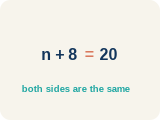
EquationEcuación
A math sentence with an equal sign showing both sides are the same.Una oración matemática con un signo igual que muestra que ambos lados son iguales.
n + 8 = 20 means 'some number plus 8 equals 20'
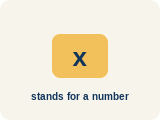
Variable
A letter that stands for a number that is unknown or can change.Una letra que representa un número desconocido o que puede cambiar.
In n + 3 = 10, the letter n stands for the unknown number (n = 7)
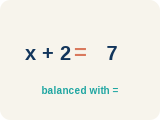
Equal signSigno igual
The = sign, showing both sides are the same.El signo =, que muestra que ambos lados son iguales.
7 + 3 = 10 — both sides equal 10
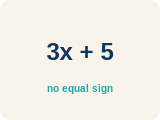
ExpressionExpresión
A math phrase with numbers and letters, but no equal sign.Una frase matemática con números y letras, pero sin signo igual.
2x + 5 is an expression; it becomes an equation when you write 2x + 5 = 15
Loading the model…
1. Try this1. Prueba esto
Test x = 12 in x + 7 = 19.
Try a different candidate. Read the two side values and decide whether they balance.
Explain how subtracting 7 from both sides preserves equality.
3. Check yourself3. Compruébalo
Answer a question about your model, then one new problem without it.Responde una pregunta sobre tu modelo y luego un problema nuevo sin él.
Read the idea, follow the worked examples, and connect the picture to the numbers.Lee la idea, sigue los ejemplos resueltos y conecta el dibujo con los números.
1Step 1 of 9:Paso 1 de 9:Words to knowPalabras clave
Say what each word means, then tap the card to check.Di qué significa cada palabra y luego toca la tarjeta para comprobar.
2Step 2 of 9:Paso 2 de 9:Check the wordsComprueba las palabras
3Step 3 of 9:Paso 3 de 9:How do I turn a word clue into an equation?¿Cómo convierto una pista escrita en una ecuación?
An equation is a math sentence with an equal sign (=). To write one, I pick a letter (a variable) for the unknown number and match the words to math symbols.Una ecuación es una oración matemática con un signo igual (=). Para escribir una, elijo una letra (una variable) para el número desconocido y hago corresponder las palabras con símbolos matemáticos.
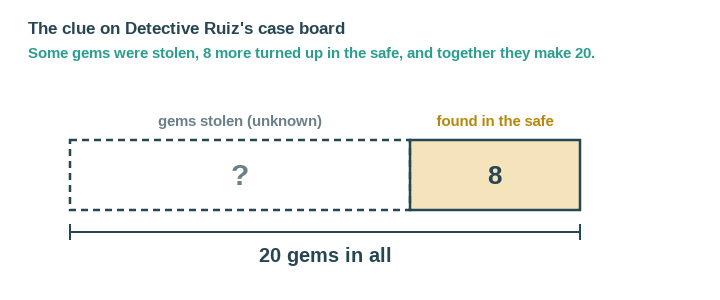
Detective Ruiz pins a clue to the case board: 'A number of stolen gems, plus 8 more found in the safe, equals 20 gems in all.'El detective Ruiz clava una pista en el pizarrón del caso: «Un número de gemas robadas, más 8 más encontradas en la caja fuerte, es igual a 20 gemas en total.»
4Step 4 of 9:Paso 4 de 9:Watch meMírame
Watch me
Clue: 'A number of stolen gems plus 8 more equals 20 total.'Pista: «Una cantidad de gemas robadas más 8 más es igual a 20 en total.»
The unknown is the number of gems. I let n stand for it.Lo desconocido es la cantidad de gemas. Dejo que n la represente.
'Plus 8 more' means + 8. 'Equals 20 total' means = 20.«Más 8 más» significa + 8. «Es igual a 20 en total» significa = 20.
So my equation is n + 8 = 20.Entonces mi ecuación es n + 8 = 20.
5Step 5 of 9:Paso 5 de 9:Let’s do one togetherHagamos uno juntos
Before each step, say what you think comes next. Then show it.Antes de cada paso, di qué crees que sigue. Luego muéstralo.
Let's try together
New clue: 'A number plus 5 equals 9.' What is the unknown?Nueva pista: «Un número más 5 es igual a 9.» ¿Cuál es lo desconocido?
We let n be the unknown. What does 'plus 5' tell us to write?Dejamos que n sea lo desconocido. ¿Qué nos dice que escribamos «más 5»?
What does 'equals 9' tell us? Put it together: n + 5 = 9.¿Qué nos dice «es igual a 9»? Júntalo: n + 5 = 9.
6Step 6 of 9:Paso 6 de 9:Your turnTu turno
Your turn — test a solution
Here is the equation from the clue: n + 5 = 9. A detective guesses n = 3.Aquí está la ecuación de la pista: n + 5 = 9. Un detective adivina que n = 3.
Substitute the guess: replace n with 3 to get 3 + 5 = 9.Sustituye la suposición: reemplaza n por 3 para obtener 3 + 5 = 9.
Is that statement true? 3 + 5 is 8, and 8 does not equal 9, so 3 is NOT a solution.¿Es verdadera esa afirmación? 3 + 5 es 8, y 8 no es igual a 9, así que 3 no es una solución.
Revise the guess and test again until the statement is true. Which value makes it true, and how do you know it is the solution?Corrige la suposición y vuelve a probar hasta que la afirmación sea verdadera. ¿Qué valor la hace verdadera y cómo sabes que es la solución?
7Step 7 of 9:Paso 7 de 9:Check yourself: a first questionCompruébalo: una primera pregunta
8Step 8 of 9:Paso 8 de 9:Check yourself: a harder questionCompruébalo: una pregunta más difícil
9Step 9 of 9:Paso 9 de 9:Put it togetherJúntalo todo
Watch out for a common mistakeCuidado con un error común
A common mistake in Write Equations is writing subtraction and division clues in the wrong order — putting the number from the clue first instead of the variable first. For 'a number decreased by 8 equals 5,' students often write 8 − n = 5 instead of the correct n − 8 = 5; for 'a number divided by 4 equals 6,' they write 4 ÷ n (or 4n) instead of n / 4 = 6. Always start with the variable, then attach the operation in the order the words describe it, and check by substituting your answer back in.
Sentence frameMarco de oración
I put ___ on the left side because ___, and ___ on the right side because ___. The equal sign means ___.Puse ___ del lado izquierdo porque ___, y ___ del lado derecho porque ___. El signo de igual significa ___.
Stage 3 of 5Etapa 3 de 5
PracticePractica
Choose Regular or Challenge. Hints come one step at a time; you get a new question after a worked example.Elige Regular o Reto. Las pistas llegan paso a paso; después de un ejemplo resuelto recibes una pregunta nueva.
Loading practice…
Stage 4 of 5Etapa 4 de 5
ApplyAplica
Use the idea in a real situation. Write your reasoning, then compare it with a sample.Usa la idea en una situación real. Escribe tu razonamiento y compáralo con un ejemplo.
Apply in context: Pencil packsAplica en contexto: Paquetes de lápices
A school store sells pencil packs for $3 each. Kim buys p packs and one $4 eraser. Her total is $19, so 3p + 4 = 19. Kim tests p = 6. Substitute 6 for p. Then find how many dollars greater than 19 the left side is.Una tienda escolar vende paquetes de lápices a $3 cada uno. Kim compra p paquetes y una goma de $4. Su total es $19, así que 3p + 4 = 19. Kim prueba p = 6. Sustituye p por 6. Luego halla cuántos dólares mayor que 19 es el lado izquierdo.
Step 1 · Guide mePaso 1 · Guíame
What is the cost of 6 pencil packs at $3 each?¿Cuánto cuestan 6 paquetes de lápices a $3 cada uno?
dollarsdólares
Step 2 · Final answerPaso 2 · Respuesta final
dollarsdólares
Real-world connectionConexión con el mundo real
A detective is tracking stolen paintings. She knows that the number of paintings recovered plus 14 paintings still missing equals the 37 total stolen. The equation p + 14 = 37 represents this situation.Una detective está rastreando pinturas robadas. Sabe que el número de pinturas recuperadas más 14 pinturas todavía perdidas es igual a las 37 robadas en total. La ecuación p + 14 = 37 representa esta situación.
Stolen Paintings Part-WholePinturas robadas: parte y entero
The whole bar is all 37 stolen paintings; it splits into recovered (p) and 14 still missing, so p + 14 = 37 gives p = 23.La barra entera son las 37 pinturas robadas; se parte en las recuperadas (p) y las 14 todavía perdidas, así que p + 14 = 37 da p = 23.
Question:Pregunta:How many paintings has the detective recovered? How did writing an equation help you understand the situation?¿Cuántas pinturas ha recuperado la detective? ¿Cómo te ayudó escribir una ecuación a entender la situación?
The detective recovered paintings because p + 14 = 37 means p = 37 − = .La detective recuperó pinturas porque p + 14 = 37 significa p = 37 − = .
Reasoning challengeReto de razonamiento
Write a real-world situation that can be modeled by the equation n / 5 = 9. Explain what n represents and verify your equation makes sense.Escribe una situación de la vida real que se pueda modelar con la ecuación n / 5 = 9. Explica qué representa n y comprueba que tu ecuación tiene sentido.
Situation: ___. In this problem, n represents ___. Check: n = ___ because ___ ÷ 5 = 9.
Create & verify: Understand Equations and Their SolutionsCrea y verifica
Write an equation with one variable and give two test values: one that IS a solution and one that is NOT. Show by substitution why one makes the equation true and the other makes it false.Escribe una ecuación con una variable y da dos valores de prueba: uno que SÍ sea solución y otro que NO lo sea. Muestra por sustitución por qué uno la hace verdadera y el otro falsa.
Quick test bench (try numbers or expressions)Banco de prueba rápido (prueba números o expresiones)
Stage 5 of 5Etapa 5 de 5
ReflectReflexiona
Answer on your own. Your first try counts as independent evidence; you can still revise.Responde por tu cuenta. Tu primer intento cuenta como evidencia independiente; todavía puedes revisar.