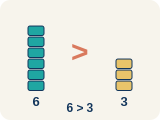
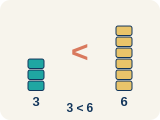
Background knowledgeConocimientos previos2 skills you need for today: Greater than and less than · At least and at mostLas 2 destrezas que necesitas hoy: Mayor que y menor que · Al menos y a lo más
Write InequalitiesEscribir desigualdades:Represent a range of possible values with <, >, ≤, or ≥.Representar un rango de valores posibles con <, >, ≤ o ≥.
Read the words below.Lee las palabras de abajo.
Open the model and change one number at a time.Abre el modelo y cambia un número a la vez.
Answer the questions beside the model, one at a time.Responde las preguntas junto al modelo, una a la vez.
Words to knowPalabras clave
InequalityDesigualdad
A math sentence that compares two sides with <, >, ≤, or ≥.Una oración matemática que compara dos lados con <, >, ≤ o ≥.
x > 5 means x can be 6, 7, 8, ... — any number greater than 5
Greater thanMayor que
The > sign, showing one number is bigger.El signo >, que muestra que un número es mayor.
8 > 3 — eight is larger than three
Less thanMenor que
The < sign, showing one number is smaller.El signo <, que muestra que un número es menor.
2 < 7 — two is smaller than seven
At least / At mostAl menos / A lo más
'At least' means ≥. 'At most' means ≤.'Al menos' significa ≥. 'Como máximo' significa ≤.
'At least 10 players' → p ≥ 10 (could be 10, 11, 12, ...); 'At most 5 tries' → t ≤ 5 (could be 5, 4, 3, ...)
Loading the model…
1. Try this1. Prueba esto
Compare x > 12 with x ≥ 12. Test the boundary value itself.
Show several different values that satisfy one rule.
Explain why an inequality usually has many solutions rather than one.
3. Check yourself3. Compruébalo
Answer a question about your model, then one new problem without it.Responde una pregunta sobre tu modelo y luego un problema nuevo sin él.
Read the idea, follow the worked examples, and connect the picture to the numbers.Lee la idea, sigue los ejemplos resueltos y conecta el dibujo con los números.
1Step 1 of 9:Paso 1 de 9:Words to knowPalabras clave
Say what each word means, then tap the card to check.Di qué significa cada palabra y luego toca la tarjeta para comprobar.
2Step 2 of 9:Paso 2 de 9:Check the wordsComprueba las palabras
3Step 3 of 9:Paso 3 de 9:How do I write an inequality from words?¿Cómo escribo una desigualdad a partir de palabras?
An inequality compares two amounts using <, >, ≤, or ≥. I use one when many values are allowed, not just one. I pick a variable and match the words to the right symbol.Una desigualdad compara dos cantidades usando <, >, ≤ o ≥. Uso una cuando se permiten muchos valores, no solo uno. Elijo una variable y hago corresponder las palabras con el símbolo correcto.
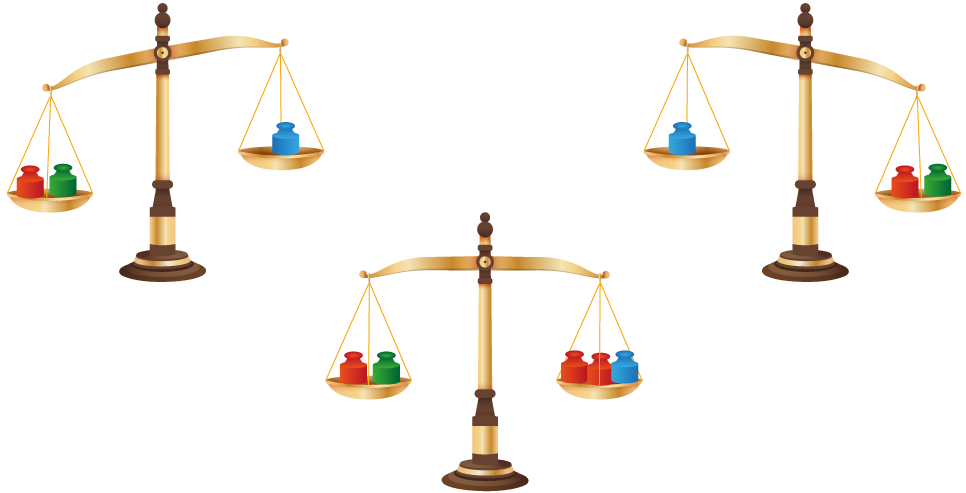
Three balance scales are shown. On two of them the pans hang at different heights, so one side is heavier. On the third the pans are level.Se muestran tres balanzas. En dos de ellas los platos cuelgan a distinta altura, así que un lado pesa más. En la tercera los platos están parejos.
4Step 4 of 9:Paso 4 de 9:Watch meMírame
Watch me
Clue: 'The suspect is at least 18 years old.'Pista: «El sospechoso tiene al menos 18 años.»
I let a stand for the age. 'At least 18' means 18 or more.Dejo que a represente la edad. «Al menos 18» significa 18 o más.
'At least' includes 18, so I use the symbol ≥.«Al menos» incluye el 18, así que uso el símbolo ≥.
My inequality is a ≥ 18. So a could be 18, 19, 20, and up.Mi desigualdad es a ≥ 18. Entonces a podría ser 18, 19, 20 y más.
5Step 5 of 9:Paso 5 de 9:Let’s do one togetherHagamos uno juntos
Before each step, say what you think comes next. Then show it.Antes de cada paso, di qué crees que sigue. Luego muéstralo.
Let's try together
Clue: 'A bag holds fewer than 10 items.' What does 'fewer than' mean?Pista: «Una bolsa lleva menos de 10 artículos.» ¿Qué significa «menos de»?
It means less than, and it does NOT include 10, so we use <.Significa menor que, y no incluye el 10, así que usamos <.
We let n be the number of items: n < 10.Dejamos que n sea el número de artículos: n < 10.
6Step 6 of 9:Paso 6 de 9:Your turnTu turno
Now it's your turn
Sort the phrase cards into the matching symbol: >, <, ≥, or ≤.Clasifica las tarjetas de frases con el símbolo que les corresponde: >, <, ≥ o ≤.
Then write inequalities for the practice situations.Luego escribe desigualdades para las situaciones de práctica.
7Step 7 of 9:Paso 7 de 9:Check yourself: a first questionCompruébalo: una primera pregunta
8Step 8 of 9:Paso 8 de 9:Check yourself: a harder questionCompruébalo: una pregunta más difícil
9Step 9 of 9:Paso 9 de 9:Put it togetherJúntalo todo
Watch out for a common mistakeCuidado con un error común
A common mistake in Write Inequalities is using a strict symbol (> or <) for a phrase that actually includes the boundary value. For 'the suspect is at least 18 years old,' students often write a > 18 instead of the correct a ≥ 18 — this wrongly excludes 18 itself, even though 'at least 18' means 18 counts as a match. The same error happens in reverse with 'at most': for 'the getaway bag holds at most 12 items,' students write n < 12 instead of n ≤ 12. Always ask: does the key phrase include the number ('at least,' 'at most,' 'no more than,' 'no fewer than' → use ≥ or ≤) or exclude it ('more than,' 'fewer than' → use > or <)?
Sentence frameMarco de oración
'At least' uses ≥ instead of > because it means the value ___ be equal to the number, while 'more than' means it must be ___.«Al menos» usa ≥ en vez de > porque significa que el valor ___ ser igual al número, mientras que «más que» significa que debe ser ___.
Stage 3 of 5Etapa 3 de 5
PracticePractica
Choose Regular or Challenge. Hints come one step at a time; you get a new question after a worked example.Elige Regular o Reto. Las pistas llegan paso a paso; después de un ejemplo resuelto recibes una pregunta nueva.
Loading practice…
Stage 4 of 5Etapa 4 de 5
ApplyAplica
Use the idea in a real situation. Write your reasoning, then compare it with a sample.Usa la idea en una situación real. Escribe tu razonamiento y compáralo con un ejemplo.
Apply in context: Fair budgetAplica en contexto: Presupuesto de la feria
Mia has $30 to spend at the fair. Parking costs $6, and each ride ticket costs $4. Let t be the number of tickets. Write an inequality that shows she cannot spend more than $30. What is the greatest whole number of tickets she can buy?Mia tiene $30 para gastar en la feria. El estacionamiento cuesta $6 y cada boleto para los juegos cuesta $4. Sea t el número de boletos. Escribe una desigualdad que muestre que no puede gastar más de $30. ¿Cuál es la mayor cantidad entera de boletos que puede comprar?
Step 1 · Guide mePaso 1 · Guíame
How many dollars are left for tickets after parking?¿Cuántos dólares quedan para los boletos después del estacionamiento?
dollarsdólares
Step 2 · Final answerPaso 2 · Respuesta final
ticketsboletos
Real-world connectionConexión con el mundo real
A detective knows the getaway car was traveling at most 65 miles per hour on the highway. The inequality s ≤ 65 represents the car's speed s.Una detective sabe que el carro de huida iba como máximo a 65 millas por hora en la carretera. La desigualdad s ≤ 65 representa la velocidad s del carro.
Getaway Car Speed: s ≤ 65Velocidad del carro de huida: s ≤ 65
The car's speed can be 65 or any speed below it — 65 is allowed (at most), but 70 is too fast.La velocidad del carro puede ser 65 o cualquier velocidad por debajo — 65 se permite (como máximo), pero 70 es demasiado rápido.
Question:Pregunta:What speeds are possible for the getaway car? How did the phrase 'at most' help you write the inequality?¿Qué velocidades son posibles para el carro de huida? ¿Cómo te ayudó la frase «como máximo» a escribir la desigualdad?
A speed of 65 mph is , a speed of 70 mph is , because 'at most 65' means the speed must be 65.Una velocidad de 65 mph es , una velocidad de 70 mph es , porque «como máximo 65» significa que la velocidad debe ser 65.
Reasoning challengeReto de razonamiento
Write two different real-world situations: one that uses > and one that uses ≥. Explain why the situations need different symbols even though both mean 'bigger.'Escribe dos situaciones diferentes de la vida real: una que use > y otra que use ≥. Explica por qué las situaciones necesitan símbolos distintos aunque las dos signifiquen 'más grande'.
Situation 1 (>): ___. This uses > because ___. Situation 2 (≥): ___. This uses ≥ because ___. The difference is that ≥ includes ___ while > does not.
Create & verify: Write and Represent InequalitiesCrea y verifica
Write a real-world rule using phrases like 'at least', 'no more than', or 'under' (e.g., height ≥ 48 in.). Write the inequality, explain why you chose <, >, ≤, or ≥, and describe its graph.Escribe una regla real usando frases como 'al menos', 'como máximo' o 'menos de'. Escribe la desigualdad, explica qué símbolo elegiste y describe su gráfica.
Quick test bench (try numbers or expressions)Banco de prueba rápido (prueba números o expresiones)
Stage 5 of 5Etapa 5 de 5
ReflectReflexiona
Answer on your own. Your first try counts as independent evidence; you can still revise.Responde por tu cuenta. Tu primer intento cuenta como evidencia independiente; todavía puedes revisar.