Background knowledgeConocimientos previos2 skills you need for today: Compare numbers on a number line · Is the boundary number included?Las 2 destrezas que necesitas hoy: Comparar números en la recta numérica · ¿Se incluye el número límite?
Graph InequalitiesRepresentar desigualdades en una recta numérica:Show every solution to an inequality on a number line with a boundary point and an arrow.Mostrar cada solución de una desigualdad en una recta numérica con un punto límite y una flecha.
Read the words below.Lee las palabras de abajo.
Open the model and change one number at a time.Abre el modelo y cambia un número a la vez.
Answer the questions beside the model, one at a time.Responde las preguntas junto al modelo, una a la vez.
Words to knowPalabras clave
Number lineRecta numérica
A straight line where numbers are placed in order; numbers get smaller to the left and larger to the right.Una recta donde los números se colocan en orden; los números son menores a la izquierda y mayores a la derecha.
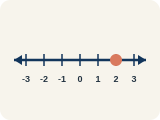
A horizontal line with marks at 0, 1, 2, 3, ... showing where values fall
Open circleCírculo abierto
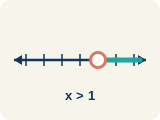
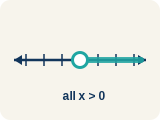
An empty circle showing a number is NOT included.Un círculo vacío que muestra que un número NO está incluido.
x > 5: open circle at 5 means 5 itself is NOT a solution, but 5.1, 6, 7, ... are
Closed circleCírculo cerrado
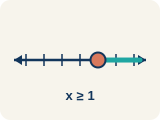
A filled-in circle showing a number IS included.Un círculo relleno que muestra que un número SÍ está incluido.
x ≥ 5: closed circle at 5 means 5 IS a solution, and so are 6, 7, 8, ...
Solution setConjunto solución
All the numbers that make the inequality true.Todos los números que hacen verdadera la desigualdad.
For x > 3, the solution set includes 3.1, 4, 5, 10, 100 — any number greater than 3
Loading the model…
1. Try this1. Prueba esto
Compare x > 12 with x ≥ 12. Test the boundary value itself.
Show several different values that satisfy one rule.
Explain why an inequality usually has many solutions rather than one.
3. Check yourself3. Compruébalo
Answer a question about your model, then one new problem without it.Responde una pregunta sobre tu modelo y luego un problema nuevo sin él.
Read the idea, follow the worked examples, and connect the picture to the numbers.Lee la idea, sigue los ejemplos resueltos y conecta el dibujo con los números.
1Step 1 of 9:Paso 1 de 9:Words to knowPalabras clave
Say what each word means, then tap the card to check.Di qué significa cada palabra y luego toca la tarjeta para comprobar.
2Step 2 of 9:Paso 2 de 9:Check the wordsComprueba las palabras
3Step 3 of 9:Paso 3 de 9:How do I graph an inequality on a number line?¿Cómo grafico una desigualdad en una recta numérica?
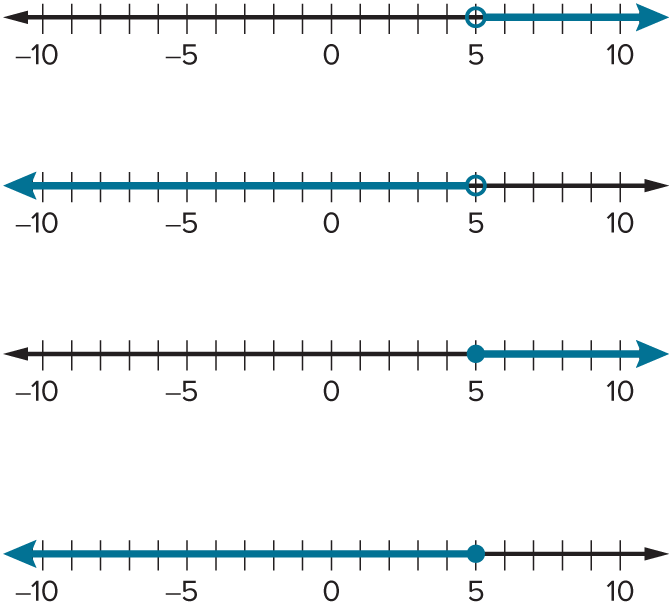
Graphing an inequality shows every value that makes it true. I draw a circle at the boundary number and shade the side that works. The circle tells me if the boundary is included.Graficar una desigualdad muestra todos los valores que la hacen verdadera. Dibujo un círculo en el número límite y sombreo el lado que funciona. El círculo me dice si el límite está incluido.
Four number lines are shown, and every one of them is marked at 5. Two use an open circle and two use a filled-in circle, and the shading runs a different direction on each line.Se muestran cuatro rectas numéricas, y todas están marcadas en el 5. Dos usan un círculo abierto y dos usan un círculo relleno, y el sombreado va en una dirección distinta en cada recta.
4Step 4 of 9:Paso 4 de 9:Watch meMírame
Watch me
Graph t ≥ 2. The boundary number is 2.Grafica t ≥ 2. El número límite es 2.
The symbol ≥ includes 2, so I draw a closed (filled) circle at 2.El símbolo ≥ incluye el 2, así que dibujo un círculo cerrado (relleno) en 2.
'Greater than or equal to' means larger values work, so I shade to the right.«Mayor o igual que» significa que sirven los valores más grandes, así que sombreo a la derecha.
Now the graph shows 2, 3, 4, and every value above 2.Ahora la gráfica muestra el 2, el 3, el 4 y todos los valores arriba de 2.
5Step 5 of 9:Paso 5 de 9:Let’s do one togetherHagamos uno juntos
Before each step, say what you think comes next. Then show it.Antes de cada paso, di qué crees que sigue. Luego muéstralo.
Let's try together
Graph x < 5. What number is the boundary?Grafica x < 5. ¿Cuál número es el límite?
The symbol < does NOT include 5, so we use an open (empty) circle at 5.El símbolo < no incluye el 5, así que usamos un círculo abierto (vacío) en 5.
Which way do we shade for 'less than'? To the left, toward smaller numbers.¿Hacia dónde sombreamos para «menor que»? A la izquierda, hacia los números más pequeños.
6Step 6 of 9:Paso 6 de 9:Your turnTu turno
Now it's your turn
Graph x > 4, x ≤ 7, and x ≥ 2 by choosing the right circle and shading.Grafica x > 4, x ≤ 7 y x ≥ 2 eligiendo el círculo correcto y el sombreado.
Then complete the practice graphs on your own.Luego completa las gráficas de práctica por tu cuenta.
7Step 7 of 9:Paso 7 de 9:Check yourself: a first questionCompruébalo: una primera pregunta
8Step 8 of 9:Paso 8 de 9:Check yourself: a harder questionCompruébalo: una pregunta más difícil
9Step 9 of 9:Paso 9 de 9:Put it togetherJúntalo todo
Watch out for a common mistakeCuidado con un error común
A common mistake in Graph Inequalities is treating ≥ and ≤ the same as > and < and drawing the wrong circle. For example, students often graph x ≥ 6 with an OPEN circle (as if it were x > 6), which wrongly excludes 6 even though 6 itself makes x ≥ 6 true. A second common mistake is choosing the right circle but shading the wrong direction — for x < 9 students sometimes shade right instead of left. Always check the symbol twice: once for the circle (does it have an 'or equal to' line?) and once for the shading direction (does the symbol point toward larger or smaller numbers?).
Sentence frameMarco de oración
I use a ___ circle when the symbol is ___ because the boundary value ___ part of the solution.Uso un círculo ___ cuando el símbolo es ___ porque el valor del límite ___ parte de la solución.
Stage 3 of 5Etapa 3 de 5
PracticePractica
Choose Regular or Challenge. Hints come one step at a time; you get a new question after a worked example.Elige Regular o Reto. Las pistas llegan paso a paso; después de un ejemplo resuelto recibes una pregunta nueva.
Loading practice…
Stage 4 of 5Etapa 4 de 5
ApplyAplica
Use the idea in a real situation. Write your reasoning, then compare it with a sample.Usa la idea en una situación real. Escribe tu razonamiento y compáralo con un ejemplo.
Apply in context: Zoo ride ruleAplica en contexto: Regla del juego del zoológico
A zoo ride allows kids taller than 40 inches, so h > 40. Four kids measure 38, 40, 43, and 47 inches. If the rule changes to h ≥ 40, how many more of these kids can ride?Un juego del zoológico permite a los niños más altos que 40 pulgadas, así que h > 40. Cuatro niños miden 38, 40, 43 y 47 pulgadas. Si la regla cambia a h ≥ 40, ¿cuántos niños más de estos pueden subir?
Step 1 · Guide mePaso 1 · Guíame
If the rule is h > 40, how many of the four kids can ride?Si la regla es h > 40, ¿cuántos de los cuatro niños pueden subir?
kidsniños
Step 2 · Final answerPaso 2 · Respuesta final
kidsniños
Real-world connectionConexión con el mundo real
A detective determines that fewer than 12 people were at the scene. The inequality p < 12 represents the number of people p. She graphs this with an open circle at 12 and shading to the left.Una detective determina que había menos de 12 personas en la escena. La desigualdad p < 12 representa el número de personas p. La grafica con un círculo abierto en 12 y sombreado hacia la izquierda.
Fewer Than 12 PeopleMenos de 12 personas
Open circle at 12 shows 12 is NOT a solution; every value shaded to the left (…9, 10, 11) makes p < 12 true.El círculo abierto en 12 muestra que el 12 no es una solución; todos los valores sombreados a la izquierda (…9, 10, 11) hacen verdadera p < 12.
Question:Pregunta:Why did the detective use an open circle instead of a closed circle? What values of p are possible?¿Por qué usó la detective un círculo abierto en vez de uno cerrado? ¿Qué valores de p son posibles?
The detective used an open circle because means 12 is included, so possible values are numbers than 12.La detective usó un círculo abierto porque significa que el 12 incluido, así que los valores posibles son números que 12.
Reasoning challengeReto de razonamiento
A theme park has two rides. Ride A requires height h > 48 inches. Ride B requires height h ≥ 48 inches. A child is exactly 48 inches tall. Which ride can they go on? Explain using number line graphs for both inequalities.Un parque de diversiones tiene dos juegos. El juego A requiere una estatura h > 48 pulgadas. El juego B requiere una estatura h ≥ 48 pulgadas. Un niño mide exactamente 48 pulgadas. ¿A cuál juego puede subirse? Explica usando gráficas en la recta numérica para las dos desigualdades.
For Ride A (h > 48), the graph has a ___ circle at 48. Since 48 > 48 is ___, the child ___ ride A. For Ride B (h ≥ 48), the graph has a ___ circle at 48. Since 48 ≥ 48 is ___, the child ___ ride B.
Create & verify: Understand Inequalities and Their SolutionsCrea y verifica
Write an inequality (like x < 5 or m ≥ −2) and list three values that ARE solutions and two values that are NOT. Explain why an inequality has infinitely many solutions.Escribe una desigualdad (como x < 5 o m ≥ −2) y lista tres valores que SÍ sean soluciones y dos que NO. Explica por qué una desigualdad tiene infinitas soluciones.
Quick test bench (try numbers or expressions)Banco de prueba rápido (prueba números o expresiones)
Stage 5 of 5Etapa 5 de 5
ReflectReflexiona
Answer on your own. Your first try counts as independent evidence; you can still revise.Responde por tu cuenta. Tu primer intento cuenta como evidencia independiente; todavía puedes revisar.