Background knowledgeConocimientos previos2 skills you need for today: Solve a one-step equation with the inverse · Test a number in an inequalityLas 2 destrezas que necesitas hoy: Resolver una ecuación de un paso con la operación inversa · Probar un número en una desigualdad
Solve and Graph InequalitiesResolver y representar desigualdades:Isolate the variable, then show the complete solution set on a number line.Aislar la variable y luego mostrar el conjunto completo de soluciones en una recta numérica.
Read the words below.Lee las palabras de abajo.
Open the model and change one number at a time.Abre el modelo y cambia un número a la vez.
Answer the questions beside the model, one at a time.Responde las preguntas junto al modelo, una a la vez.
Words to knowPalabras clave
SolveResolver
To find the number that makes it true.Encontrar el número que la hace verdadera.
x + 3 > 10 → subtract 3 → x > 7 — any number greater than 7 works
GraphGraficar
To show answers on a number line with circles and shading.Mostrar respuestas en una recta numérica con círculos y sombreado.
x > 7: open circle at 7, shade right — shows all solutions at a glance
SolutionSolución
A number that makes the equation or inequality true.Un número que hace verdadera la ecuación o desigualdad.
x = 8 is a solution to x > 7 because 8 > 7 is true; x = 5 is not because 5 > 7 is false
SubstituteSustituir
To put a number in place of a letter.Poner un número en lugar de una letra.
Substitute x = 5 into x + 3 > 10: 5 + 3 = 8, and 8 > 10 is false, so x = 5 is not a solution
Loading the model…
1. Try this1. Prueba esto
Interpret x ≤ 15 as a budget limit. Does spending exactly 15 qualify?
If each ticket costs $3 and you have $15, write and solve 3t ≤ 15.
Distinguish an equation asking for an exact cost from an inequality setting a maximum.
3. Check yourself3. Compruébalo
Answer a question about your model, then one new problem without it.Responde una pregunta sobre tu modelo y luego un problema nuevo sin él.
Read the idea, follow the worked examples, and connect the picture to the numbers.Lee la idea, sigue los ejemplos resueltos y conecta el dibujo con los números.
1Step 1 of 9:Paso 1 de 9:Words to knowPalabras clave
Say what each word means, then tap the card to check.Di qué significa cada palabra y luego toca la tarjeta para comprobar.
2Step 2 of 9:Paso 2 de 9:Check the wordsComprueba las palabras
3Step 3 of 9:Paso 3 de 9:How do I solve an inequality and then graph it?¿Cómo resuelvo una desigualdad y luego la grafico?
I solve an inequality the same way as an equation: use inverse operations to get the variable alone. But the answer is a range of values, so I show all of them on a number line.Resuelvo una desigualdad igual que una ecuación: uso operaciones inversas para dejar sola la variable. Pero la respuesta es un rango de valores, así que los muestro todos en una recta numérica.
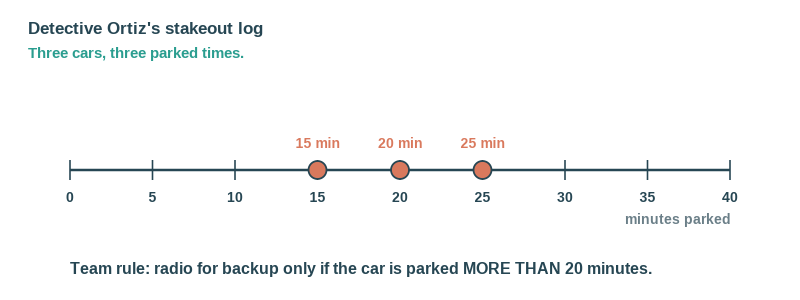
Detective Ortiz is reviewing a stakeout log. The team's rule is that a suspect's vehicle must be parked for more than 20 minutes before they radio for backup. The log lists parked times of 15, 20, and 25 minutes.El detective Ortiz revisa un registro de vigilancia. La regla del equipo es que el vehículo de un sospechoso debe estar estacionado más de 20 minutos antes de pedir refuerzos por radio. El registro enlista tiempos estacionados de 15, 20 y 25 minutos.
4Step 4 of 9:Paso 4 de 9:Watch meMírame
Watch me
Solve x + 3 > 53. The inverse of adding 3 is subtracting 3.Resuelve x + 3 > 53. La inversa de sumar 3 es restar 3.
I subtract 3 from both sides: x + 3 − 3 > 53 − 3, so x > 50.Resto 3 en los dos lados: x + 3 − 3 > 53 − 3, así que x > 50.
The symbol > does not include 50, so I use an open circle at 50.El símbolo > no incluye el 50, así que uso un círculo abierto en 50.
'Greater than' shades right. Check: x = 60 gives 60 + 3 = 63 > 53. True!«Mayor que» sombrea a la derecha. Comprueba: x = 60 da 60 + 3 = 63 > 53. ¡Verdadero!
5Step 5 of 9:Paso 5 de 9:Let’s do one togetherHagamos uno juntos
Before each step, say what you think comes next. Then show it.Antes de cada paso, di qué crees que sigue. Luego muéstralo.
Let's try together
Solve x − 5 ≤ 8. What is the inverse of subtracting 5?Resuelve x − 5 ≤ 8. ¿Cuál es la inversa de restar 5?
We add 5 to both sides: x ≤ 8 + 5, so x ≤ 13.Sumamos 5 en los dos lados: x ≤ 8 + 5, así que x ≤ 13.
≤ includes 13, so we use a closed circle and shade left.El ≤ incluye el 13, así que usamos un círculo cerrado y sombreamos a la izquierda.
Solve and graph x + 4 > 10, x − 5 ≤ 8, and x + 7 ≥ 15 on the number line.Resuelve y grafica x + 4 > 10, x − 5 ≤ 8 y x + 7 ≥ 15 en la recta numérica.
Then finish the practice problems and test a value to check.Luego termina los problemas de práctica y prueba un valor para comprobar.
7Step 7 of 9:Paso 7 de 9:Check yourself: a first questionCompruébalo: una primera pregunta
8Step 8 of 9:Paso 8 de 9:Check yourself: a harder questionCompruébalo: una pregunta más difícil
9Step 9 of 9:Paso 9 de 9:Put it togetherJúntalo todo
Watch out for a common mistakeCuidado con un error común
A common mistake in Solve and Graph Inequalities is shading the number line in the wrong direction after solving. For example, a student solves x + 4 > 10 correctly to get x > 6, but then shades LEFT toward smaller numbers instead of RIGHT toward greater numbers. The shading direction always matches the solved symbol, not the original problem: '>' and '≥' shade right (greater numbers), '<' and '≤' shade left (smaller numbers) — check this AFTER you solve, not before. To catch this mistake, substitute one shaded value and one unshaded value back into the original inequality: the shaded value should make it true, and the unshaded value should make it false.
Sentence frameMarco de oración
Solving an inequality is like solving an equation because I still use ___, but it is different because the answer is ___ instead of ___.Resolver una desigualdad se parece a resolver una ecuación porque sigo usando ___, pero es distinto porque la respuesta es ___ en vez de ___.
Stage 3 of 5Etapa 3 de 5
PracticePractica
Choose Regular or Challenge. Hints come one step at a time; you get a new question after a worked example.Elige Regular o Reto. Las pistas llegan paso a paso; después de un ejemplo resuelto recibes una pregunta nueva.
Loading practice…
Stage 4 of 5Etapa 4 de 5
ApplyAplica
Use the idea in a real situation. Write your reasoning, then compare it with a sample.Usa la idea en una situación real. Escribe tu razonamiento y compáralo con un ejemplo.
Apply in context: Cookie fundraiserAplica en contexto: Venta de galletas
Gina needs to raise at least $90 for a class trip. She already has $30. First she solves x + 30 ≥ 90 for the dollars x she still needs. Then she sells cookie boxes for $6 each and solves 6b ≥ x. What is the least whole number of boxes b she must sell?Gina necesita reunir al menos $90 para un paseo de la clase. Ya tiene $30. Primero resuelve x + 30 ≥ 90 para hallar los dólares x que todavía necesita. Luego vende cajas de galletas a $6 cada una y resuelve 6b ≥ x. ¿Cuál es la menor cantidad entera de cajas b que debe vender?
Step 1 · Guide mePaso 1 · Guíame
How many dollars does Gina still need?¿Cuántos dólares le faltan todavía a Gina?
dollarsdólares
Step 2 · Final answerPaso 2 · Respuesta final
boxescajas
Real-world connectionConexión con el mundo real
A detective needs at least $75 for a surveillance camera. She has already saved $48. The inequality 48 + s ≥ 75 represents how much more money s she needs.Una detective necesita al menos $75 para una cámara de vigilancia. Ya ahorró $48. La desigualdad 48 + s ≥ 75 representa cuánto dinero s más necesita.
Money She Still NeedsEl dinero que todavía necesita
Solve 48 + s ≥ 75 to get s ≥ 27: the closed circle at 27 is included, and every value to the right (like 30 or 40) is a solution, while 20 is not enough.Resuelve 48 + s ≥ 75 para obtener s ≥ 27: el círculo cerrado en 27 se incluye, y todos los valores a la derecha (como 30 o 40) son soluciones, mientras que 20 no alcanza.
Question:Pregunta:How much more does the detective need? How did you solve and graph this inequality?¿Cuánto más necesita la detective? ¿Cómo resolviste y graficaste esta desigualdad?
The detective needs at least $__ more because 48 + s ≥ 75 means s ≥ 75 − = .La detective necesita al menos $__ más porque 48 + s ≥ 75 significa s ≥ 75 − = .
Reasoning challengeReto de razonamiento
A detective has a budget of at most $100 for supplies. She already spent $37 on gloves. Write an inequality for the remaining amount r she can spend, solve it, graph it, and name three possible values for r.Una detective tiene un presupuesto de a lo más $100 para materiales. Ya gastó $37 en guantes. Escribe una desigualdad para la cantidad restante r que puede gastar, resuélvela, grafícala y nombra tres valores posibles de r.
Inequality: 37 + r ≤ ___. Solving: r ≤ ___ − 37 = ___. Graph: ___ circle at ___, shade ___. Three possible values: ___.
Create & verify: Solve and Graph InequalitiesCrea y verifica
Write a one-step inequality problem (like x + 7 ≤ 15 or 3n > 21). Solve it, describe its number-line graph (circle type and arrow direction), and test a number in the shaded region.Escribe un problema de desigualdad de un paso (como x + 7 ≤ 15 o 3n > 21). Resuélvelo, describe su gráfica en la recta numérica y prueba un número de la región sombreada.
Quick test bench (try numbers or expressions)Banco de prueba rápido (prueba números o expresiones)
Stage 5 of 5Etapa 5 de 5
ReflectReflexiona
Answer on your own. Your first try counts as independent evidence; you can still revise.Responde por tu cuenta. Tu primer intento cuenta como evidencia independiente; todavía puedes revisar.