Background knowledgeConocimientos previos2 skills you need for today: Find how many times a number fits · Check division with multiplicationLas 2 destrezas que necesitas hoy: Hallar cuántas veces cabe un número · Comprobar una división con multiplicación
Read the words below.Lee las palabras de abajo.
Open the model and change one number at a time.Abre el modelo y cambia un número a la vez.
Answer the questions beside the model, one at a time.Responde las preguntas junto al modelo, una a la vez.
Words to knowPalabras clave
AlgorithmAlgoritmo
A step-by-step set of rules or instructions to solve a math problem.Un conjunto de pasos o instrucciones para resolver un problema de matemáticas.
DividendDividendo
The total number being divided into equal groups (the number inside the division bracket).El número total que se divide en grupos iguales (el número dentro de la galera de división).
In 1,344 ÷ 12 = 112, the dividend is 1,344 — the total amount being divided
Divisor
The number of equal groups you are dividing into (the number outside the division bracket).El número de grupos iguales en que divides (el número fuera de la galera de división).
In 1,344 ÷ 12 = 112, the divisor is 12 — the number of equal groups
QuotientCociente
The answer when you divide.La respuesta cuando divides.
In 156 ÷ 12 = 13, the quotient is 13 — there are 13 groups
Loading the model…
1. Try this1. Prueba esto
Predict how many equal groups fit before calculating.
Try 14.4 ÷ 1.2. Why does it have the same quotient as 144 ÷ 12?
Make a division problem whose quotient is 15. Show a multiplication check.
3. Check yourself3. Compruébalo
Answer a question about your model, then one new problem without it.Responde una pregunta sobre tu modelo y luego un problema nuevo sin él.
Read the idea, follow the worked examples, and connect the picture to the numbers.Lee la idea, sigue los ejemplos resueltos y conecta el dibujo con los números.
1Step 1 of 9:Paso 1 de 9:Words to knowPalabras clave
Say what each word means, then tap the card to check.Di qué significa cada palabra y luego toca la tarjeta para comprobar.
2Step 2 of 9:Paso 2 de 9:Check the wordsComprueba las palabras
3Step 3 of 9:Paso 3 de 9:How do you divide big numbers?¿Cómo se dividen números grandes?
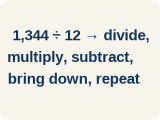
Dividing means splitting a total into equal groups. Long division finds the quotient one digit at a time by repeating the same four steps: divide, multiply, subtract, bring down.Dividir significa repartir un total en grupos iguales. La división larga halla el cociente un dígito a la vez repitiendo los mismos cuatro pasos: divide, multiplica, resta, baja.
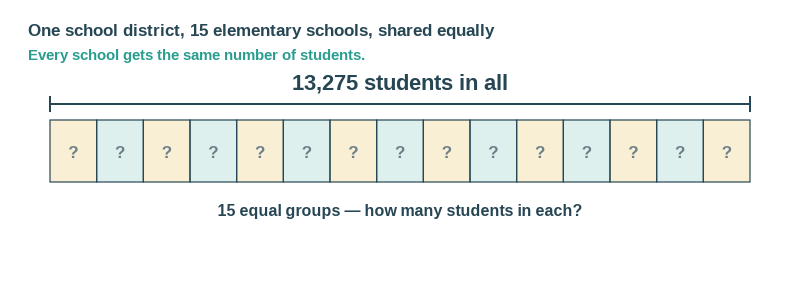
A school district has 13,275 elementary-age students. The district plans to redistrict and divide the students equally among its 15 elementary schools.Un distrito escolar tiene 13,275 estudiantes de primaria. El distrito planea redistribuirlos y repartirlos por igual entre sus 15 escuelas primarias.
4Step 4 of 9:Paso 4 de 9:Watch meMírame
Watch me
I want 1,344 ÷ 12. The dividend is 1,344 and the divisor is 12, so 12 goes outside the bracket and 1,344 goes inside.Quiero 1,344 ÷ 12. El dividendo es 1,344 y el divisor es 12, así que el 12 va fuera de la galera y 1,344 va adentro.
DIVIDE: 12 does not fit into 1, so I look at 13. How many 12s fit into 13? One. I write 1 above the 3.Divide: el 12 no cabe en 1, así que miro 13. ¿Cuántos 12 caben en 13? Uno. Escribo 1 arriba del 3.
MULTIPLY: 1 × 12 = 12. I write 12 underneath the 13.Multiplica: 1 × 12 = 12. Escribo 12 debajo del 13.
SUBTRACT: 13 − 12 = 1. That is what is left so far.Resta: 13 − 12 = 1. Eso es lo que queda por ahora.
BRING DOWN: I bring the next digit, 4, down next to the 1 to make 14. Now I repeat the cycle.Baja: bajo el siguiente dígito, el 4, junto al 1 para formar 14. Ahora repito el ciclo.
REPEAT: 14 ÷ 12 → 1 (written above the 4), 1 × 12 = 12, 14 − 12 = 2, and I bring down the last 4 to make 24.Repite: 14 ÷ 12 → 1 (escrito arriba del 4), 1 × 12 = 12, 14 − 12 = 2, y bajo el último 4 para formar 24.
REPEAT: 24 ÷ 12 → 2 (written above the last 4), 2 × 12 = 24, 24 − 24 = 0. Nothing is left to bring down, so the remainder is 0.Repite: 24 ÷ 12 → 2 (escrito arriba del último 4), 2 × 12 = 24, 24 − 24 = 0. No queda nada por bajar, así que el residuo es 0.
The digits I wrote are 1, 1, 2, so 1,344 ÷ 12 = 112. I check by multiplying: 12 × 112 = 1,344.Los dígitos que escribí son 1, 1, 2, así que 1,344 ÷ 12 = 112. Lo compruebo multiplicando: 12 × 112 = 1,344.
5Step 5 of 9:Paso 5 de 9:Let’s do one togetherHagamos uno juntos
Before each step, say what you think comes next. Then show it.Antes de cada paso, di qué crees que sigue. Luego muéstralo.
Let's try together
Let's do 384 ÷ 8. DIVIDE: 8 does not fit into 3, so we look at 38. How many 8s fit into 38? (4 — write it above the 8.)Hagamos 384 ÷ 8. Divide: el 8 no cabe en 3, así que miramos 38. ¿Cuántos 8 caben en 38? (4 — escríbelo arriba del 8.)
MULTIPLY: what is 4 × 8? (32 — write it under the 38.)Multiplica: ¿cuánto es 4 × 8? (32 — escríbelo debajo del 38.)
SUBTRACT: what is 38 − 32? (6.)Resta: ¿cuánto es 38 − 32? (6.)
BRING DOWN: bring the 4 down next to the 6. What number do you have now? (64.)Baja: baja el 4 junto al 6. ¿Qué número tienes ahora? (64.)
DIVIDE: how many 8s fit into 64? (8 — write it above the 4.)Divide: ¿cuántos 8 caben en 64? (8 — escríbelo arriba del 4.)
MULTIPLY: what is 8 × 8? (64 — write it under the 64.)Multiplica: ¿cuánto es 8 × 8? (64 — escríbelo debajo del 64.)
SUBTRACT: what is 64 − 64? (0.)Resta: ¿cuánto es 64 − 64? (0.)
BRING DOWN: is there another digit left to bring down? (No — the remainder is 0, so 384 ÷ 8 = 48. Check: 8 × 48 = 384.)Baja: ¿queda otro dígito para bajar? (No, el residuo es 0, así que 384 ÷ 8 = 48. Comprueba: 8 × 48 = 384.)
6Step 6 of 9:Paso 6 de 9:Your turnTu turno
Now it's your turn
Next, you will run the cycle yourself on a new problem and fill in what happens in each round.Luego vas a hacer el ciclo por tu cuenta con un problema nuevo y anotar lo que pasa en cada ronda.
Remember the cycle: divide, multiply, subtract, bring down — and repeat it until no digits are left.Recuerda el ciclo: divide, multiplica, resta, baja — y repítelo hasta que no queden dígitos.
7Step 7 of 9:Paso 7 de 9:Check yourself: a first questionCompruébalo: una primera pregunta
8Step 8 of 9:Paso 8 de 9:Check yourself: a harder questionCompruébalo: una pregunta más difícil
9Step 9 of 9:Paso 9 de 9:Put it togetherJúntalo todo
Watch out for a common mistakeCuidado con un error común
A common mistake in Divide Multi-Digit Numbers is skipping a placeholder zero in the quotient when a digit doesn't divide evenly, which shifts every digit after it out of place. For example, dividing 3,216 ÷ 3: 3 ÷ 3 = 1, but the next digit 2 doesn't divide by 3, so a 0 must be written before continuing — bring down the 1 to make 21 ÷ 3 = 7, then bring down 6 ÷ 3 = 2, giving the correct quotient 1,072. A student who skips writing that 0 and jumps straight to 21 ÷ 3 = 7 ends up with 172 instead of 1,072 — an answer off by a factor of ten. Always check: does a digit in your quotient go missing every time you 'can't divide'? If so, you dropped a placeholder zero.
Sentence frameMarco de oración
2,184 ÷ 14 = ___ because I repeated divide, multiply, subtract, and bring down until there were no digits left to bring down, and what was left at the end was ___.2,184 ÷ 14 = ___ porque repetí divide, multiplica, resta y baja hasta que no quedaron dígitos por bajar, y lo que sobró al final fue ___.
Stage 3 of 5Etapa 3 de 5
PracticePractica
Choose Regular or Challenge. Hints come one step at a time; you get a new question after a worked example.Elige Regular o Reto. Las pistas llegan paso a paso; después de un ejemplo resuelto recibes una pregunta nueva.
Loading practice…
Stage 4 of 5Etapa 4 de 5
ApplyAplica
Use the idea in a real situation. Write your reasoning, then compare it with a sample.Usa la idea en una situación real. Escribe tu razonamiento y compáralo con un ejemplo.
Apply in context: Field trip busesAplica en contexto: Autobuses para la excursión
A school is taking 275 students on a field trip. Each bus seats 42 students. Every student needs a seat. How many buses does the school need?Una escuela lleva a 275 estudiantes de excursión. Cada autobús tiene 42 asientos. Cada estudiante necesita un asiento. ¿Cuántos autobuses necesita la escuela?
Step 1 · Guide mePaso 1 · Guíame
How many full buses can the students fill?¿Cuántos autobuses se llenan por completo?
busesautobuses
Step 2 · Final answerPaso 2 · Respuesta final
busesautobuses
Real-world connectionConexión con el mundo real
A school is ordering 1,680 pencils to distribute equally to 24 classrooms for the school year.Una escuela está pidiendo 1,680 lápices para repartirlos por igual en 24 salones durante el año escolar.
1680 ÷ 24
Question:Pregunta:How does multi-digit division help the school figure out how many pencils each classroom gets?¿Cómo ayuda la división de varios dígitos a la escuela a averiguar cuántos lápices recibe cada salón?
Each classroom gets pencils because 1,680 ÷ 24 = .Cada salón recibe lápices porque 1,680 ÷ 24 = .
Reasoning challengeReto de razonamiento
The station must load 3,360 ration packs equally into 14 storage pods. Solve it with long division. Name each step — divide, multiply, subtract, bring down — and check your answer by multiplying.La estación debe cargar 3,360 paquetes de raciones por partes iguales en 14 cápsulas de almacenamiento. Resuélvelo con división larga. Nombra cada paso — divide, multiplica, resta, baja — y comprueba tu respuesta multiplicando.
3,360 ÷ 14 = ___. I divided ___ by 14 and wrote ___ , then multiplied, subtracted and brought down the next digit each time. I checked by multiplying: 14 × ___ = 3,360.
Create & verify: Divide Multi-Digit Numbers Using an AlgorithmCrea y verifica
Write a real-world division problem with a 4-digit dividend and a 2-digit divisor that has a remainder. Solve it with the standard algorithm and interpret what the remainder means.Escribe un problema real de división con un dividendo de 4 dígitos y un divisor de 2 dígitos que tenga residuo. Resuélvelo y explica qué significa el residuo.
Quick test bench (try numbers or expressions)Banco de prueba rápido (prueba números o expresiones)
Stage 5 of 5Etapa 5 de 5
ReflectReflexiona
Answer on your own. Your first try counts as independent evidence; you can still revise.Responde por tu cuenta. Tu primer intento cuenta como evidencia independiente; todavía puedes revisar.